| What America Needs: A Catholic Center Party |
|||||||||||||||||||||||||||||||
![]() |
|||||||||||||||||||||||||||||||
| Honestly, the United States desperately needs more than a few third party alternatives. The Democrats and Republicans, with their monopoly on power, and the fact that their real differences are few and far between, leave many Americans lukewarm on the subject of national politics. Of course, I think there should also be a Royalist Party in every country, but as royals must be impartial and non-political, there still must be other party alternatives that will truly reflect the values of average citizens. | |||||||||||||||||||||||||||||||
| For devout Roman Catholics even more than our seperated brethren, neither political party stands on a complete platform which can be fully supported. The Democrats refuse to defend almost any traditional values, support abortion, government blessing of homosexual "marriages" as well as having a strong record of hostility against the free practice of religion, or at least Christianity with attacks against private education, the 10 Commandments and prayer in schools. Likewise, the Republicans have shown a total disregard for the rights of American workers, hostility toward the lower classes, support for the death penalty and have a record of selling out to big business and a refusal to cooperate with even the most basic forms of environmental protection. All of this is not entirely the fault of the two parties. They would have a hard time reflecting true Christian principles as they look at right and left while the Church looks at right and wrong. So, the only possible solution is an American style Catholic Center Party. Here is my idea of what it should be like, though none of this is original thinking, other, far more intelligent minds came up with this stuff long ago: |

|||||||||||||||||||||||||||||||
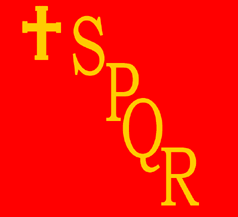
| The core principles of the party should be the old Roman ideals of, | |||||||||||||||||||||||||||||||
![]() |
|||||||||||||||||||||||||||||||
| AUTHORITAS PIETAS DIGNITAS |
|||||||||||||||||||||||||||||||
| What do these mean? I) Authoritas (authority): legitimate authority is traditional, sacramental and must be single, final and unifying. There must be a respect for traditional authority, in recognition of Christ's example that we be one flock with one shepherd with no divisions among us. This is a universal concept and provided Rome, as well as the later Church with a unity of purpose all the way from the pater patria to the pater familias. II) Pietas (piety): in the original Roman context, this was meant more as devotion to the Emperor rather than piety as we know it today, but for our reasons, we should use the modern definition of pious as holiness. There should be support for the Church, respect for religion and a defiance of the current trend to "compartmentalize" faith. For the devout Catholic, support for Christ must come before all other considerations. III) Dignitas (dignity): this is the principle that balances the other two and keeps us from descending into tyranny. It means a recognition of and respect for the basic dignity of man true to the Christian belief that everyone is made in the image and likeness of Almighty God. This gives great honor to every individual as a citizen with definite rights and as a unique child of God. |

|||||||||||||||||||||||||||||||
| The Catholic Party should also work for the readjustment of the current form of government from a two-party federal system to a 'corporatist state' as envisioned by such great Catholic leaders and thinkers as Gabriel Garcia Moreno of Ecuador, Raphael Carrera of Guatemala, Charles Marquis de la Tour du Pin of France, Ramon Nocedal of Spain, Karl Baron von Vogelsang of Austria and Giuseppe Toniolo of Italy. This brilliantly simple and uniquely Catholic form of government was introduced to me by Charles Coulombe, a noted author and hero of mine who described it in this way: | |||||||||||||||||||||||||||||||
![]() |
|||||||||||||||||||||||||||||||
| "A political body should represent, not individuals, but social bodies, organic elements, such as bishoprics, fiefs, cities, communes, corporations. When laws are to be elaborated, it is only from such organized bodies that one can expect competence, independence, and prudence. When classes and interests are represented there is a constant current, and no violent movements occur, but when the parliament is based on an unorganized universal suffrage, only opinion is represented, and all is ephemeral---it is a mere demagogy." As I see it, under the corporatist system, every group would be given fair representation as opposed to the current method of 'every man for himself' voting wherein those with the most money, the loudest voice and the best connections can claw their way to power in 'winner take all' direct elections. Since pure democracy can be so easily manipulated and circumvented there should be a system in place which could guarantee every social group an equal voice in the halls of power. It would also help having a Head of State that is not a political creature who could look at the "big picture" and focus on long-term goals rather than partisan politics. If this could be done, |
|||||||||||||||||||||||||||||||
| just imagine what a stable and benevolent country we could have. Just a thought. Catholics of the world UNITE! If only political leaders would follow the example of Christ the King, who came to serve others rather than to be served Himself. |

|||||||||||||||||||||||||||||||
![]() |
|||||||||||||||||||||||||||||||