 |
|
|
|
|
|
|
|
|
|
|
|
|
|
|
|
|
|
|
|
|
|
|
 |
|
|
|
[1] |
|
|
|
|
| Suffering: A Uniquely Christian Experience |
|
|
| ����������� Looking back, suffering has played a big part in my life at every stage; when I was first studying and acquiring some sense of Christianity, when I was trying to turn my back on Christianity and when I began to come back and eventually become a Christian. When, as a young teenager, and not yet a real Christian, at the Church of God 7th Day in Artesia Wells, Texas I gave my first (and so far only) church "sermon". I decided to tackle the question of why bad things happen to good people. Apparently unable to practice what I preached, I later became discouraged by so much suffering that I tried to convince myself that, while God may be a comforting idea to some, He could not possibly exist. Later on, suffering convinced me that, not only was there a God, but only the Christian God could be the true God, and Jesus Christ must be the Son of God. |
|
|
| ����������� The infamous French revolutionary author the Marquis de Sade once said that, "No kind of sensation is keener and more active than that of pain; its impressions are unmistakable." For someone as cruel as the Marquis, the original sadist, he could be trusted as an expert in the area of pain and suffering. For many people, happiness is a feeling that can be sly and covert, but suffering is instantly recognized and universally understood. It often seems that suffering is one thing humanity understands only too well. Perfect happiness, even as an ideal, often eludes us, but our imagination has no limits when it comes to suffering. |
|
|
| ����������� Our best intentions seem to be able to only alleviate some aspects of suffering, never really understanding or agreeing upon perfect happiness. Yet, devising methods of pain and suffering are only too easy, as evidenced through time by the likes of Attila the Hun, Genghis Kahn, the Nazi concentration camps or the Khmer Rouge. I think the point can be best illustrated by looking at great art and literature. Of particular value in illustrating this point is Dante's "Divine Comedy". When describing the horrors and suffering of Hell, Dante was never at a loss for words, with the torture of all the sinners growing more horrid and creatively painful with each successive level. Yet, when the time came to tour Heaven, Dante can come up with very little, saying only that it was too perfect to describe. It seems that, while we can imagine quite a bit of pain, any real concept of heavenly bliss escapes us. |
|
|
| ����������� Yet, humanity never seems to have a problem with suffering when it befalls an enemy, unknown masses or someone undeniably deserving of such pain. However, when we suffer, when our loved ones suffer, or when people we know to be honest suffer, it becomes a terrible and incomprehensible injustice that makes us doubt the eternal truths handed down by the ages. Our first instinct it seems, is to blame God. We reason, with all of our human logic, if God is all-powerful and cares so deeply for all of us, in particular His most loyal and pious servants, how could He allow such a thing to happen? However, simply by asking such a question, we are making certain assumptions. |
|
|
| ����������� Assumption one is that God is just and fair, rewarding those who are good and punishing those who are bad. This is true, but a bit more complex than it seems. I tend to believe that much of the experiences written about in the Old Testament involved an effort by God to teach justice to His people through example. When the Israelites were faithful they were richly rewarded, and contrarily, when they gave in to wickedness they were chastised by enemy nations, even carried away into bondage in Babylon. However, in the New Testament, God is gloriously unfair. Having taught mankind justice (whether or not they choose to follow it) God, through Jesus Christ, now goes a step further, beyond justice, to teach charity and forgiveness. |
|
|
| ����������� Is God always fair? No, most definitely not, and we should all be eternally thankful for His unfairness. Considering all of our sins, if God were truly fair, who in all the world would not be worthy of death for having spurned their creator? The greatest proof of the divinity of Christ is that we are defiant and He helps us anyway, that we are wicked and He saves us anyway, that we are totally unlovable and He loves us anyway. I can remember looking at a particular crucifix, I could see the pain in Christ's eyes, and I could see the crown of thorns on His head, the wound in His side and the nails through His body. Yet, what struck me the most was that, on one hand that was nailed to the cross, His fingers were raised in blessing, illustrating how Christ had asked for the forgiveness of the very ones who tortured and killed Him, and more than that, how He was suffering death, Hell and the grave, for the very people who had put Him there. To me, that proved beyond all question the divinity of Jesus Christ. I could say like the awed Roman soldier, "Truly this was the Son of God". |
|
|
| ����������� In I Peter, chapter 2, the apostle talks about the obedience people owe to their masters and rulers, even when this is hard and painful for them. He recalls the suffering of Christ, and how He bore it saying, "because Christ also suffered for us, leaving us an example, that ye should follow in his steps: who did no sin, neither was guile found in his mouth: who, when he was reviled, reviled not again; when he suffered, he threatened not; but committed himself to him that judgeth righteously: who his own self bare our sins in his own body on the tree, that we, being dead to sins, should live unto righteousness: by whose stripes ye are healed". |
|
|
| ����������� This should not be taken as a hopelessly impossible task when St Peter tells us to bear our suffering following the example of Christ. Jesus was, after all, a man, as fully human as He was fully divine, and His suffering was not something he relished, but which he left to the judgment of God. During the agony in the garden, Christ pleaded that He might be spared, but submitted to God's will rather than His own human desire to avoid pain. When He was on the cross, Jesus truly suffered, and even He was overcome with pain and sadness to cry out, "My God, my God, why have you abandoned me?" (Mark 15:34) |
|
|
| ����������� Yet, if the Son of God still seems too divinely removed from our own circumstances to learn from His suffering, another perfect example can be seen in the case of the Holy Mother, who was entirely human and who also suffered greatly. She also suffered unjustly we would say. Certainly, no other creation of God can be said to have suffered more unjustly than the Holy Mother. It was Mary, after all, who the archangel hailed as "full of grace" and blessed above all women, Mary who was chosen to be the mother of the Word of God made flesh, Mary whose "soul magnifies the Lord" and who all generations would call blessed. Certainly if any one human being ever deserved to be free from all suffering it would be the Holy Mother. |
|
|
| ����������� However, the suffering of Mary began immediately after the birth of Jesus and continued throughout the rest of His life. The Holy Family was driven to Egypt by the cruelty of Herod, and when Jesus was presented in the Temple Simeon warned Mary that, "a sword shall pierce through thy own soul also". |
|
|
|
 |
|
|
|
[2] |
|
|
|
|
| ����������� Although no one could fully understand, anyone with children or close family can sympathize with what pain the Holy Mother went through during the arrest, persecution and death of her son. When all but one of His apostles deserted Him, Mary remained close to Jesus throughout his ordeal, she followed at a distance to Calvary and she suffered along with Him, as any loving mother would suffer at the plight of her child. His suffering was her suffering; she felt every blow and heard every taunt. Yet, who could be less deserving of such pain than the immaculate mother of Christ? |
|
|
| ����������� Through all of this, we can see how absurd it is to regard suffering always as some sort of judgment on the character or faith of the suffering. God should not and cannot be viewed as some angry being who is trying to gain submission by breaking the will of mankind through grief. As free beings with a free will we can choose to do good or to do evil, and all choices, whether good or bad, wise or foolish, have consequences which we and others must learn to live with. God has said that He does not want any to perish but for everyone to achieve salvation with Him in paradise. God does not inflict suffering to change our lives, but offers us the chance to suffer for something instead of nothing. He does not want to hurt us, but to save us. |
|
|
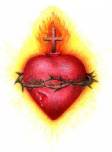
| ����������� Christ Himself can be seen as the greatest living representation of God's Divine Mercy. God had laid out His commandments for mankind centuries before, however He sent Christ to earth as a living invitation to accept His mercy and attain salvation despite the fallen nature of man. So, God Himself suffered, even God the Father, for the sake of His creation. God certainly suffered when His only Son, who was perfect, flawless and innocent, took on the horrid and ugly sins of all mankind. The Bible says elsewhere that God suffers through our rejection of Him, which is a completely natural and understandable thing. All too many of us know what horrible heartache results when someone we love dearly spurns and rejects us. This is the same effect which sin has on the Sacred Heart of Jesus and as much on God the Father in Heaven. Yet, despite this, God saved us anyway. Christ suffered for a reason, which was our salvation. |
|
|
| ����������� Saint Paul, writing to the Colossians, talks about both the suffering of Christ, and his own suffering as a servant of Christ. He recounts how the blood of the cross reconciled a fallen and degenerate people to God in Heaven. St. Paul says that he rejoices in his own suffering because it is for the sake of the Church, which is the body of Christ, because through this suffering he was able to imitate Christ and be light to the Gentiles, bringing the salvation of Christ to multitudes of pagan peoples. St. Paul was not discouraged by his suffering, nor did he believe that God was angry with him or punishing him. Instead, he was grateful that he was able to share in the holiness of Christ by suffering for the sake of the Church. His was pain with a holy purpose. |
|
|
| ����������� This could be compared to the oft-repeated story of Job, whose every increase of suffering was a defeat for Satan when he refused to turn away from God no matter how bad his physical condition became. No one welcomes suffering and no one can escape it, yet, because of Christ, we can ensure that our suffering is not meaningless. In the earliest days of the Church, the Roman Christians were hunted and persecuted for their faith, which they would not renounce. They tried as hard as possible to avoid death, hiding in the catacombs deep under the city. However, when they were captured, and often massacred in the most horrific manner, they did not die as simply fugitives, but because of their faith, they died as martyrs and the legacy they left was strong enough to eventually convert the entire Roman Empire to Christianity. |
|
|
| ����������� However, this preoccupation with suffering also belies a very common problem with humanity, and a constant roadblock on the path to Heaven, which is our inherent concentration on the physical rather than spiritual condition. At times, this may not have been quite as big a problem as today. In the old days, much of what we would call suffering would be called everyday life back then. Before the modern era, infant mortality rates were much higher, diseases were more common and more devastating, luxuries were few and personal comfort was almost unknown. Today however, in our spoiled and pampered condition, we become even more acutely aware of every little inconvenience and disappointment. |
|
|
| ����������� According to God, our physical condition, whether it is pain or pleasure, is not supposed to be our primary area of focus. We are to be more concerned with our spiritual rather than physical condition. Whether we suffer or not, or whether we live in comfortable luxury should not concern us as much as whether our soul is prepared to meet God face to face. What would be the benefit of a lifetime of comfort and pleasure if we would then have to endure an eternity separated from God? In St Matthew's Gospel, Christ says, "And if thy right eye offend thee, pluck it out, and cast it from thee:� for it is profitable for thee that one of thy members should perish, and not that thy whole body should be cast into hell. And if thy right hand offend thee, cut it off, and cast it from thee: for it is profitable for thee that one of thy members should perish, and not that thy whole body should be cast into hell." |
|
|
| ����������� Obviously, even the greatest physical discomfort would be preferable to the agony of being alienated from God forever. Most often, when thinking of the "things of this world" we tend to think about being too focused on fame and fortune, not on suffering, but being too focused on physical suffering can be just as damaging for our soul as the other. People can deal with both happiness and suffering in one of two ways. Someone who has great prosperity can either be humbled and thank God for his good fortune, or come to believe that they have somehow merited this on his or her own and full of self-assuredness turn their back on God. Likewise the person who suffers greatly can either blame God for his misery and become disheartened, or unite it to the suffering of Christ and cling ever closer to God in their time of need. In each of these extreme physical conditions, either of which could be brought on by a number of factors, there is a way we can give it meaning or let it destroy our spiritual lives. |
|
|
| ����������� This is a trial of life, just like any temptation or assorted worldly problem. We can see that everyone suffers, even God and all the saints suffered, all of the good along with all of the bad. The only question is, do we suffer without meaning or do we allow the example of Christ to make our suffering a sacrifice for Him? |
|
|
| Prayer in Time of Suffering (from "The Catholic Devotional")����������� |
|
|
| Behold me, my beloved Jesus, weighed down under the burden of my trials and sufferings, I cast myself at Your feet, that You may renew my strength and my courage, while I rest here in Your Presence. Permit me to lay down my cross in Your Sacred Heart, for only Your infinite goodness can sustain me; only Your love can help me bear my cross; only Your powerful hand can lighten its weight. O Divine King, Jesus, whose heart is so compassionate to the afflicted, I wish to live in You; suffer and die in You. During my life be to me my model and my support; at the hour of my death, be my hope and my refuge. Amen. |
|
|
|
 |
|
|
 |
|
|
|
|
|
 |
|
|
|
|
|
|
|
|
 |
|
|
| [1] Insignia of the Congregation of the Passion |
|
|
| [2] Our Lady of Sorrows |
|