
LEYTE
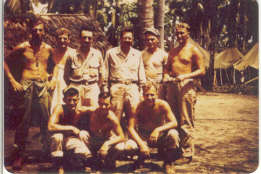
Polish, Greek, Italian, Swedish, German, English and Irish are pictured in this photo at the Staging Area in Leyte. Which brings to mind, one of the reasons why we're here. Quite a few men had lost or misplaced their dog tags, so I was given a list of names including the information to make new tags. I can't remember if someone drove me or if I went alone to the XXIV Corps Headquarters where the time and equipment would be made available to me. After spending a couple of hours there, I finished the job and returned to my base. I made it just in time for supper, but just barely. On that particular day, Headquarters Battery had received a generous supply of ice cream from some outside source, a first for our group on Leyte. After finishing what little supper I had been given, one of the Mess crew brought me my dessert, one level spoonful of melted ice-cream! Thanks alot!.
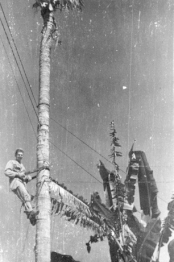
Communications--On my very first day of Basic Trainingat Camp Hulen, Texas in January 1943,I was operating a 12 line BD-72 Switchboard with the Battery Commander sitting at his desk behind me. For the next few weeks I would be working four-hour shifts on a 24 hour basis with the help of new switchboard trainees. Then came the big surprise, a training program in Telephone Communications using the EE8A U.S. Army telephones, miles of W110B wire, splicing the wires, climbing telephone poles with the use of spurs, etc. The photo on the right taken in Dulag in December 1944, is of a buddy, a late entry in the Communications Group. I took my job very seriously on the ensuing Field Problems in Blessing and Francitas, small towns in Texas. I soon lost my job but would be available should the need arise for a rush-rush situation. My interim job would involve digging holes for shower room sumps as no sewer lines were available in the California desert in July 1943. During a night problem in the desert in mid 1943,I was called upon to operate the switchboard inside a tent without the luxury of a candle because we had to observe blackout rules.. On each end of the BD-72 is a small light, which I wasn't permitted to use either..total darkness was the order! I memorized the position of all 12 lines, the drop plate indicator (my words) that flops downward when a call is received. Fortunately for me I can't remember being overworked with calls on that night. The next morning, still a Private and without a permanent job assignment, I returned to my normal routine. "Any holes to be dug today, Sarg?" In mid 1943 there would be an opening for a Battery Clerk in Battalion Headquarters as men were being discharged for various reasons, thus creating an opening for me, by virtue of the present clerk being promoted to Sergeant for another assignment.
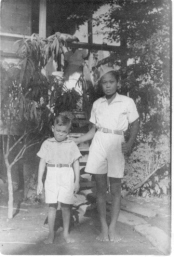
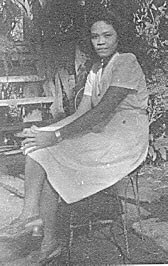 There was never a problem finding willing subjects to photograph. Before taking these two photographs, I was invited to wait inside their house. One very large room and a shiny wooden floor with a small kitchen area. An elderly women, probably the grandmother, brought me a huge brown tobacco leaf and looked at me as if to say, "smoke"? I just shook my head for my answer as she quietly walked away.
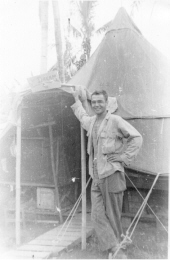
It was necessary to construct the boardwalks because of the rainy season in this jungle area. Pictured here is another one of my good friends S/Sgt Kalawa from Wisconsin. These apartment dwellings come complete with the following exceptions: no gas or electricity, no running water, no lavatory facilities but never required any painting, re-roofing , scrubbing of floors. Never had to worry about stocking the pantry. I forgot, we didn't have a pantry either but the beds minus mattresses were furnished. Pillows? what are they? I used to wrap my boots with my trousers for my pillow. I've had these pictures for 56 years and while typing this and looking at the photo I just noticed the sign at the top of the entrance. The word "Dream" can be seen but am not sure it's preceded by the word "Bad". As you may have noticed there is no mail box near the entrance but the fellows were more than happy to receive their mail the Army way, crowding around the mailman and having your mail delivered hand-to-hand by your buddies. You've probably seen this in many of the war movies throughout the years.
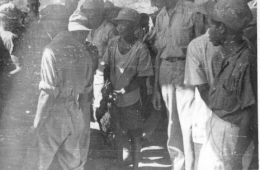
A main sporting event is Cock-Fighting, roosters equipped with a spur attached to one leg. I attended one of these "shows" not to bet, but to photograph the action of two roosters fighting each other. I waited for about a half hour or so while the bets were being placed then the moment everyone was waiting for, the fight was about to start. The roosters were placed in the center of an imaginary arena and before I could push the button on my camera, it was all over in seconds. Here in the photo you can see the owner holding that day's supper or will it recover to fight another day. One incident, not associated with this sporting event, was the sound of a gun or rifle shot somewhere outside. It suddenly became quiet in that straw shack and one of the men quickly yanked out a revolver from his shoulder holster, but pointed it upward, ready for action. No other shots were fired and all was back to normal. During the Okinawa campaign I will be personally involved in a similar situation. I was to report to the Battery Office and to get there I had to use an inclined and narrow pathway. Behind me and at a lower level was an officer and behind him and also at a lower level than the officer was an enlisted man. Suddenly I heard a zzzziiinnnggg, the sound of a gunshot right over my head and the three of us hit the ground immediately. The shot was fired from a Field Hospital location to the east of our area. The three of us, unarmed, just got up and went about our business, dismissing the whole thing. Was it an accident? A sniper?
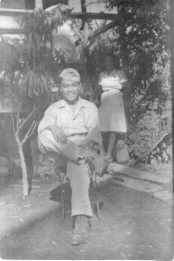
This young Filipino appears to be right at home in this situation, posing for the photographer.


