 |
 |
|
WE ARE BACK AT SWIMMING FROM 10TH SEPTEMBER 2007 ONWARDS AFTER THE SUMMER BREAK.
New Members are Welcome & We are looking for active Voluteers. Contact Mary for more information.
 Click Here For Medical Form to Download and Then Print
Click Here For X-Mas Party Picture 1
Click Here For X-Mas Party Picture 2







![Image link to our FINANCE section]](images/buttons/BUTTONfinance.jpg)



The Octopus Swimming Club was created in October 1981, for people with physical disabilities. We have a membership of fifty people, ranging in age from 5 years to 70 years. As the method of swimming we use requires one helper to one swimmer in the early stages, almost half of our members are instructor/helpers.
Our founder Mary Arrigan learnt the Halliwick Method of swimming in England, while training to become a nurse. On returning to Ireland she set about forming a club in her hometown of Galway.
She found that most people with learning problems had access to some form of organised swimming but those with physical disabilities had none, so these became the target group.
From the start the Brothers of Charity have supplied the accessible swimming pool and the Irish Wheelchair Association has helped out with transport.
The
club meets on Monday nights at 8pm in the Kilcornan Swimming Pool, c/o
Brothers of Charity, Kilcornan, Clarenbridge, Co. Galway. The pool is
located about 10 miles from Galway city, on the Galway/Limerick road.
Click to go back to Top

We use the Halliwick Method of Swimming.
Through water activities we teach water happiness, water safety and independent movement in the water. If swimming is learnt this is a bonus but it is not our ultimate goal.
We use NO buoyancy aids as these hinder movement and balance in the water. Instead each swimmer has a helper. Gradually the amount of help is withdrawn as the swimmer gains confidence, breath control and balance.
We emphasise the Ability of the swimmer not the disability.
Each swimmer is required to complete a medical report with their doctor to give them clearance to take part in water activities.
We have a committee who run the club. Swimmers with disabilities hold many of the committee positions.
On the social side, after our swim session we utilise the on-site coffee shop. At the end of each term we have a social get-together and plans are already afoot to celebrate our 21st birthday in October 2002.
Our members have competed at local,
national and international level.
Click to go back to Top

James Macmillan developed the method, in London in 1949. It is suitable for everyone but is especially suited to people with disabilities, because the person may have poor balance or an asymmetric body shape.
James Macmillan was an engineer who went on to work in the Halliwick School for girls, in London, where he taught swimming. The pupils mostly suffered from polio. He found that the girls fell over when he put them in the water. They found it difficult to keep their balance and they rolled over when they tried to float.
Water is critical of only two things shape and density. If a body is less dense than water it will float. If the shape of the body is altered due to a disability it will float in a different position than a body that is equal on both sides.
The method uses the principles of hydrodynamics and hydrostatics to show how a “body” floats in water. Ways of regaining balance are taught.
The Halliwick Association of Swimming Therapy, Halliwick AST is the governing body and its headquarters is in England. There is now an International Halliwick Association, with clubs all over the world. The newest clubs have been formed in Japan, Malta and Brazil.
Many professionals working in the medium of water use the method. For example some Physiotherapists use elements of it in their work.
The aims of the Halliwick Association are to:
- Teach water happiness, confidence and safety using the specialist method
- Form clubs and promote the method whenever there is a need.

- Most of our swimmers live at home. Many of them are confined to wheelchairs or other mobility aids. The benefits are enormous.
- Freedom of movement in the water environment.
- For some it may be the only independent activity they are capable of doing.
- Health benefits from being active and partaking in a sporting activity.
- Cardiovascular system
- Balance
- Breath control and Lung capacity
- Musculoskeletal structure.
- Social interaction with others – some able bodied, some not so able.
- Boost to self-confidence and self-esteem, which permeates into everyday life.
- Respite for some families and carers for the evening.
- Once a person masters swimming there is no limit to new activities, which can be undertaken, from sailing and canoeing, water-skiing, scuba diving and snorkelling.
- Volunteers get a great sense of satisfaction from helping another person to their full potential.

Our club has been honoured many times since its small beginnings.
- 1984 Galway person of the year.
- 1985, October, Galwegian of the month.
- 1986 T.S.B. Community awards.
- 1993 Member selected to swim for Ireland, in junior international competition, in Scotland.
We have two sponsored perpetual trophies, which are awarded each year to the most improved junior and the most improved adult members.

Every helper in the club is a volunteer. These people are the backbone of the club.
Helpers
in the water are called instructors. Without our instructors there
would be no club.
Other volunteers help in the changing rooms, on transport and around the poolside.
We are always on the look out for
more volunteers to help in the Octopus Swimming Club. If you feel that
you would like to be part of our crew, or would like more information
you can contact us at [email protected]
Mary
A. Langan
206 Lurgan Park
Renmore
Galway

Each member pays a small membership each year. This helps to pay for our insurance.
There are videos and a book available for sale through the Halliwick Association in England.
We received funding from the Irish National Lottery, to help finance a trip to London, to celebrate fifty years of Halliwick in October 2000.
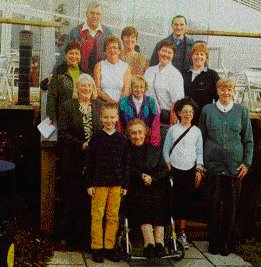
MEMBERS WHO TRAVELED TO LONDON in October 2000

Courses are held from time to time in Ireland and on a more regular basis in Britain. The basic course consists of two Modules, which include theory and water sessions. The Halliwick Method is structured on a ten point programme which integrates balance, breath control and relaxation.
Education of instructors is ongoing at club level. The most important learning takes place in the water. A good helper will be able to detect how much support the swimmer needs. Some swimmers need more help when upright and others when horizontal.
There are progressive badge tests
for the swimmers. Only when the swimmer achieves the third level/green
badge is he/she allowed to swim unaccompanied in deep water.
Click to go back to Top

Here are some contributions from our swimmers:
|
"Swimming" By Mary Kinsella |
|

“My name is Eileen. I am a left leg amputee.
I love swimming as I have great freedom in the water. I swim three to four times a week. I do lengths in Claremorris pool, County Mayo, on Wednesday mornings. On Monday nights I go to Clarenbridge, where we use the Halliwick Method.
Swimming is great for disabled people as it is a great form of exercise.”
“My name is Martha and I have Cerebral Palsy. I started swimming with the club in late 1996. I heard that they did not use any swimming rings or anything like that. I thought that I could not get into the water without a swimming ring because I went to school in Dublin and we always had to wear swimming rings when we were in the pool.
I was shown what they do in the water. At the start I thought that I would not be able to do what they were doing because I jump around too much, but after a few weeks I found it easier. I learned how to find my balance, which has given me a lot of independence. The method used by the club has shown me that my limbs are more powerful than I had thought.
I look forward to swimming every Monday night - it helps me to relax.”
“My name is Bernie and I joined the Octopus Swimming Club in 1988. At that time I was really frightened of the water.
However, I ventured to enter the pool and after six years I was able to swim on my own.
I find it great exercise for every part of my body and it is very enjoyable as it is a social evening for the club. I now can swim the full length of the pool and I feel so independent to think that I can do it all without any helper.”

To contact the Octopus Swimming Club you can e-mail [email protected]et
Other useful sites linked with the Halliwick Method and disability groups are:
HALLIWICK ASSOCIATION:
Provides information about the Halliwick Method of aquatic physical therapy.
INTERNATIONAL HALLIWICK ASSOCIATION:
Aims to provide swimming opportunities for people with disabilities using the Halliwick Method. Provide training in the Halliwick Method of teaching swimming to people with disabilities. Ability not disability is our maxim.
STARFISH SWIMMING CLUB:
Swimming club using the Halliwick Method of teaching swimming.
IRISH WHEELCHAIR ASSOCIATION/sports:
Irish wheelchair association is the governing body in Ireland for sport involving people with physical disabilities.
ENABLE IRELAND:
Useful site for many disability groups in Ireland.
AMPUTEE ASSOCIATION OF IRELAND:
MULTIPLE SCLEROSIS SOCIETY:
IRISH GUIDE DOGS FOR THE BLIND ASSOCIATION:
IRISH COUNCIL FOR THE BLIND:
GALWAY ADVERTISER:
Local newspaper with links to various sites of local interest.
Useful links for disability and mobility in UK:
| We
are affiliated with: The Halliwick Association in England Web Address: www.halliwick.org.uk |
 |
 |
