The Joints
Fibrous Joints
These are non-moveable joints. The bones
are attached by fibrous connective tissue providing little or no movement.
An example are the sutures between the flat bones of the skull, which are
inmmovable.
Cartilaginous Joints
These are partially moveable joints. The
bones are connected by cartilage connective tissue reinforced by fibrous
tissue permitting little or no movement. An example is the fibrocartilage
discs between vertebral bodies, which are partially moveable, and cartilage
between the epiphysis and diaphysis of developing bone, which are immovable.
Synovial Joints
These are the most common joints. They
allow for a wide variety of movements. The bones, capped with cartilage,
articulate within a cavity lined by a membrane secreting a viscous fluid
that absorbs the heat of friction during movement. The synovial joint
is surrounded by a fibrous capsule interlaced with ligaments and tendons.
There are six types of Synovial Joints
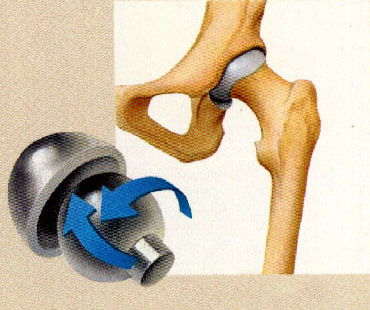
Ball & Socket--The ball-like head of one
bone fits into the socket-like head of another, permitting all movements.
Examples are the shoulder and hip joints.
|
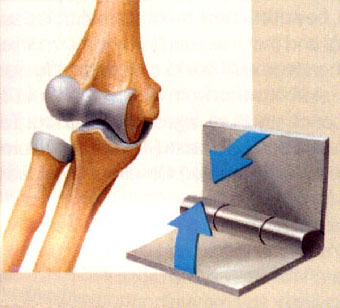
Hinge--The C-shaped surface of one bone swings
about the rounded surface of another. Movement is limited to flexion/extension.
Examples are the elbow, ankle, and the interphalangeal joints.
|
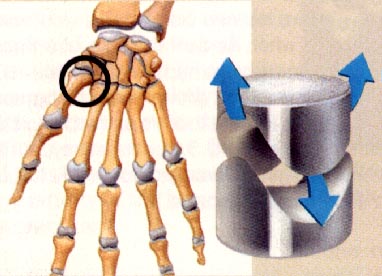
Saddle--The concave surfaces of two bones articulate
with one another. All movements are possible, but rotation is limited.
An example is the carpometacarpal joint of the thumb.
|
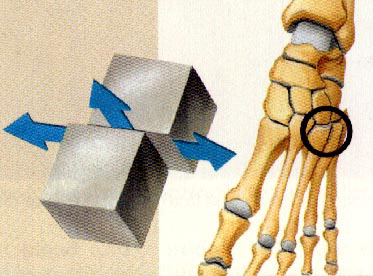
Gliding--Two opposed flat surfaces of bone glide
across one another. Movement is limited to gliding. Examples
are the intercarpal joints.
|
|
Ellipsoid--This is a reduced ball and socket
configuration in which rotation is not permitted. An example is the
wrist joint.
|
Pivot--A ring of bone rotates about a process
of bone. Movement is limited to rotation. An example is the
skull on its atlas.
|
Back
to the Main Page