
©2001 Jon Youngblood
Unity Through Understanding
A Guidebook for the Recently Alive



|
|
|
|
|
©2001 Jon Youngblood Unity Through UnderstandingA Guidebook for the Recently Alive |
||
|
|
|
|
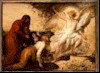
Part One: FaithChapter One: Elementary My Dear1.5 Adam and EveSo just who were these ancestors, our Adam and Eve, who, almost overnight, made the Quantum leap from animal to Homo Sapiens? (sa-pi-ent (sape nt) adj. [[ME < L sapiens , prp. of sapere , to taste, know: see SAP1]] 1. full of knowledge; wise; sagacious; discerning 2. of or relating to the existing human species (Homo sapiens ) --n. a sapient human )1 Holding the Creationists at bay, we have ascertained from the archeologists that this earliest known account of religious behavior is attributed to those big burly brutes (ladies and gentlemen, give them a hand!) the Neanderthals (Homo Sapiens Neanderthalensis, if you must know). What must be remembered, and what most people of the Christian faith will concede, is that the theory of evolution, as proposed by Darwin, does not exclude creation! It does, however, change the method and the timing somewhat. So instead of one week, it's just a tad bit longer. He apparently went through various stages of development instead of proceeding directly to the final product. This does not preclude a First Cause. If we go all the way back in time to the moment scientists refer to as the moment of creation, the big bang, what caused that to occur? That all this should then, from that point, come into being? What or where was all that energy/matter before then? We will discuss these ideas in more detail in Part Two. The important point here is that just because we emerged from apes, does NOT imply that "God Is Dead"; as was the prevailing attitude at the beginning of the 20th century. (The Creation/Evolution Debate will also be revisited in Part Two) Neanderthals lived in Europe 120,000 years ago until 35,000 years ago, during the late Pleistocene epoch. Based on early and fragmented findings in the early part of the 20th century, paleontologists portrayed them as dumb and brutish creatures; as much ape as human. Picture a hairy creature, hunched over , with a long sloping forehead and heavy brow. Hairy muscular hands gripping a wooden club. "Ugh!" he says. Not much more than an animal. Today we know this was not the case at all. In fact, the brain size of the now extinct hominoid, is figured to be larger than ours today! He was advanced in the use of stone tools and wooden spears. Other evidence suggests that they actually performed surgical procedures that prolonged life. Far from brutish and stupid, Neanderthals were a relatively sophisticated bunch who stood and walked fully erect. The archaeological evidence suggests that Neanderthals engaged in complex ritual behavior and were capable of abstract thought. Fewer decomposing relatives in the immediate vicinity attracting wild animals, and depressing the survivors, would certainly be an improvement in living conditions, but the reasons for burial was more than a sanitary, or sanity, measure. Burial was an expression of an emerging spiritual nature. It expressed a Faith in something beyond life. It is believed that not only were our Neanderthal ancestors the first to bury their dead, but to place flowers on the grave! They were found to bury useful items such as tools, or finely crafted bead jewelry in the grave. As if to be useful in a life that would continue even though the body clearly contained no life. As if life would continue in some other world. One which we could not see with these eyes. So then, in measuring the progress of man as a spiritual being, the Neanderthals would be a good place to for us to start. Although there remains some debate about just how much Neanderthal "blood", if any, we have in us today, these changes, whether they occurred concurrently in our more direct ancestors (Cro-Magnon), was learned from the Neanderthals, or was passed down directly through our Neanderthal genes, were to define the boundary between man and animal. An interesting lesson to note here about Adam and Eve was how they came to feel guilt and shame after eating from the Tree of Life. (The Urantia Book has an exceptional and novel explanation for what happened and what the Tree of Life actually was - see also The Urantia Foundation) The catholic church, famous (or infamous) for its use of guilt as a means of inspiring good social behaviors, seems to have tapped into an inherent aspect of human nature. At least for the vast majority. Excepting the psychically defective types - remorseless serial killers like or Jeffrey Dahlmer for example - for whom the emotional capacity for sensing guilt seems to have been congenitally deformed or removed. For the rest of us, guilt seems to come with sentience like cream cheese with bagels, in its many forms, from self-flagellation to sacrificing children to the Gods, and betrays a near universal tendency to feel bad about ourselves and a concurrent need to have our goodness recognized and validated by something greater than ourselves. (see also 11.5 Suffrage)
**** Let's take a moment now and get our bearings. It is not important that the following information be memorized (no, there will not be a quiz later). Nor should you be intimidated if you are unfamiliar with the names or dates. It is important that it be seen and added into your consciousness as background only. However, if you resent having your eyes go through the strain of witnessing it, please continue to the next section. Now, Neanderthals are considered to be the 3rd stage of an evolutionary development with Modern Humans as the fifth and current stage. Things didn't really start to happen for us before the Neanderthals (#3) but in order to gain a better perspective, here is the basic rundown on our recent ancestors:
**** OK. So here we are around 35,000 BC and we are burying our dead. We were communicating ideas. We have harnessed the natural energy of fire. Now the stage was set for our quest of the Unseen World. It was our concern for the well being of our deceased fathers, mothers, and children in the newly conceived of afterlife, which clearly marks the birth of spirituality, and the beginning of the long road to becoming who we are today.
#1 From Compton's Interactive Encyclopedia © 1998 The Learning Company, Inc. [Back to Text]
|