PART 2
It is not too hard to figure out, that except for a little extra attenuation
of any excess woofer HF, or tweeter level due to the notch filter on the
front end, that the power handling will still be limited by what can be
achieved with any first order crossover network. This requires robust
tweeters, low DCR tweeter shunt coils (L1), and all the other issues that
1st order crossovers bring up. I recommend that you review my comments
on series crossover networks at Andy Gradd's page, see:
http://home.iprimus.com.au/gradds/series_cross-oversJR.htm
Given a suitably low resonance tweeter of adequate power handling, and good low frequency performance (it must handle more diaphragm excursion than most tweeters), one can explore a wider variety of woofers and tweeters with the LBI optimized series network.
Most home hi-fi tweeters are limited to 10-20 W RMS long term, and have limitations as to how much excursion they can handle.
I wondered what it would be like to try using a pro sound compression driver that can handle 100W RMS long term, and has significant excursion capability, as well as a diaphragm diameter of 4", in a series circuit.
Of course, these types of units use horns to load and direct the output from the compression driver, and traditionally, have required a minimum of a second order crossover roll-off in order to be able to handle the power, and to limit excursion.
Despite these potential problems, I decided to try this anyway, and use a pro sound woofer to try and keep up with the horn and compression driver.
Initial results using the classic series crossover ala Fig. A are shown
in Fig. 3 below (note, these are actual measurements, and the phase is
180 extra due to reversed polarity at the power amp):
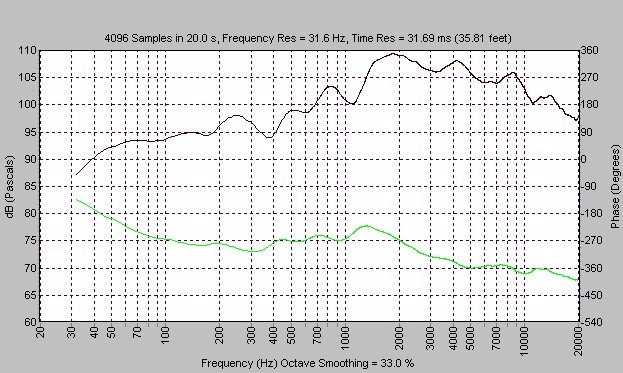
Fig. 3
The results using an EQ LBI Series topology as in Fig. G, are as shown
in Fig. 4 below:
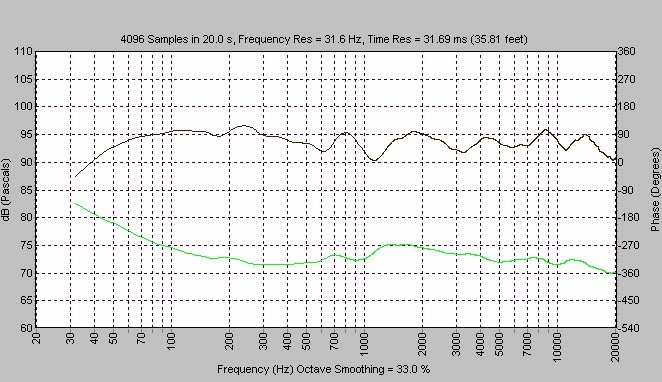
Note the fairly smooth response across the band, and the smooth phase response as well.
Preliminary listening tests with early prototypes are very promising, and will form the basis for a complete DIY project that offers a high sensitivity speaker system that has decent power handling (while the project system will handle approximately 150-200W continuous wide band input, which is plenty for most tube amps, the normal pro sound version with LBI style 2nd order parallel crossover networks would be rated at approx. 600W continuous. Yes, these are real continuous power handling ratings, and would both be capable of a minimum of peak power of 4X these continuous numbers).
All the details of this project will be made available within a few more months, including wood sheet layouts, complete construction plans, a highly refined crossover based on high performance parts, an easy to build yet unique cabinet design with superb vibration damping and acoustic resonance control.
I suggest the following shorthand nomenclature when discussing these types of topologies:
As shown in Fig. C, is an OLBI-1S, for Optimized Look Back Impedance
- 1st order Series
A second order parallel as described in the first section above, would
be an OLBI-2PT, for Optimized Look Back Impedance - 2nd order Parallel
Tweeter
Or you could just call it the Risch topology. ;-)
All applicable copyright laws apply, all rights reserved, except transmission by USENET and like facilities granted. Any use or inclusion in print or other media are specifically prohibited. The informational content is not warrantied in any way or form, and any use of said content are at the reader's own risk, the author shall not be held responsible in any way for any damages or injuries arising from the content of this web site. Common safety practices are encouraged at all times. Do not fold, spindle or mutilate.