| Page 2 |
| Once again, this website pertains to musical instruments. Some instruments I've made and will display are traditional in design. Others are experimental. You can use a variety of materials to make musical instruments. Some are common and easy to find in and around the house. For example, you can use cardboard to make guitars, fiddles, drums, flutes, and horns. Paper straws make excellent, if simple, oboes. Aluminum plates can be turned into cymbals, as can pots and pans.Twigs and branches can be turned into clapping sticks and whistles. Then there are clay, wood (as in lumber and bamboo), metal pipe, PVC and glass. Of course, each material has its risks, as well as benefits. When working with clay, wood and PVC, proper ventilation is necessary, due to noxious fumes and hazardous dust. Glass, is, of course fragile; fragments are invariably sharp. Metal, particularly copper, can develop points and sharp edges when worked. Clay, in and out of a kiln, also has it's share of risks. |
| There are five families of musical instruments: winds, percussion, reeds, strings and brass. You can make representatives of each family. One rule of thumb: keep it simple. You do not need fancy, elaborate designs in order to produce sounds of any kind, particularly music. Let's start with the winds. The simplest example is the digeridoo (also spelled didgeridoo, dijeridu, etc.). The word is actually an English term used to describe the low droning sound of an Australian aboriginal wind instrument made from a branch of eucalyptus, bamboo or some other type of wood.. The aborigines select a tree which has been hollowed out by termites. Then the branch is painted, carved and sealed with beeswax, which is also used to form a mouthpiece . The didgeridoo is a primitive instrument. It also has a long history. Although I've read accounts which suggest the digeridoo has been around for anywhere between two thousand and eighty thousand years, I'm not sure what evidence there is to support these disparate assertions. Perhaps radiocarbon dating or some other sophisticated techniques will answer the question as to just how old didgeridoos are. However, the variety of sounds one can produce from the didge impresses me more than any assertons about its history. The didgeridoo's length can vary from three and a half feet to over ten feet. The diameter can range from one and a quarter inches to about two inches. Although traditionally didges are made from wood, they can also be made from clay, cardboard, metal and plastic (specifically PVC). |
| One produces sounds in the didgeridoo by emitting a bronx cheer or raspberry (sometimes referred to as a "rude noise" or considerably more graphically) into the mouthpiece of the instrument. A method called "circular breathing" accounts for the continuous drone. Saxophone players and some ethnic flute players also use this method as well. |
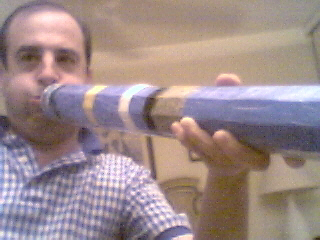
| You can make a simple didge out of ABS tubing, as well as PVC. In fact, you don't need a mouthpiece for an ABS didge since one end is already curved into a sort of flange. The kind of tubing I have in mind is commonly used to store golf clubs. Each tube is about three feet long and an inch to an inch-and-a-quarter in diameter. PVC comes in ten-foot lengths. Although you can probably make didges from either plumbing (white) or electric conduit (grey) PVC, the plumbing (or irrigation) PVC is probably a safer bet, particularly Schedule 40. You might want to start with a tube of about 1 1/4 inch diameter. With this, you can more easily learn how to produce the basic drone. With wider diameters (probably two inches maximum), more vocal effects are possible, though the basic drone may be more difficult to produce. You can either cut a piece of PVC or have someone cut it for you. The piece can be three or more feet long. Actually,you can get a pretty good, deep sound from a four foot long didge. |
 |
| Click here to go back to the index page. |
| Click here for a related site. |
| Click here to see the index page of that site. |