| Crandish History and Culture |
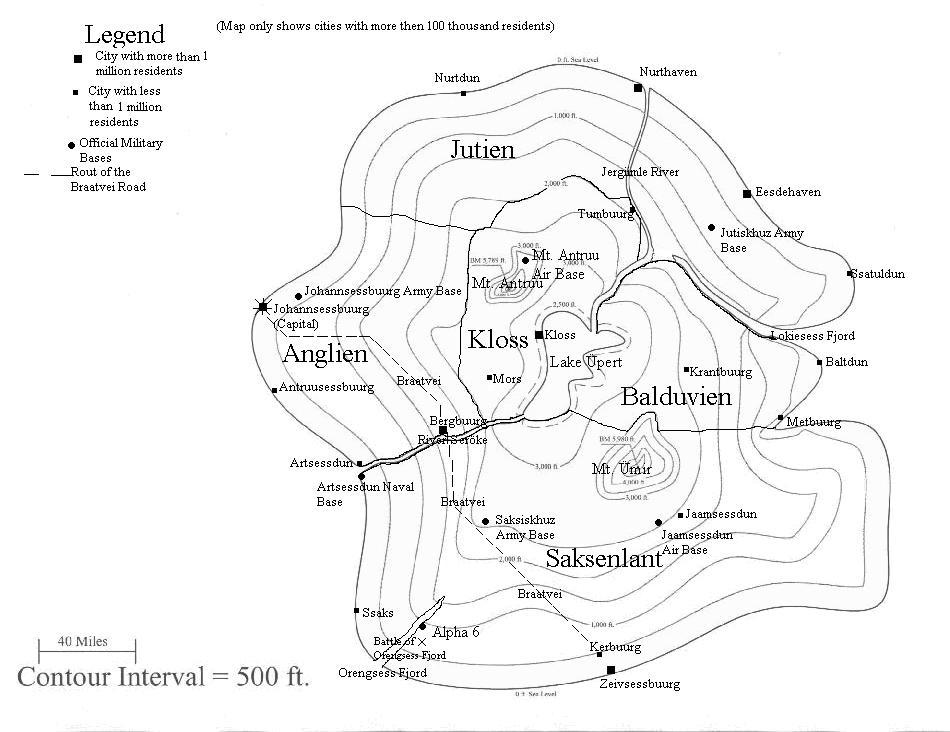
| Cranda is located on a large island in the Baltic Sea. You can see a map by downloading this file. To learn more about the geography, click here. The island was made the home of a small sect of Celtic druids who built their small citadel near the future site of Zeivsbuurg. The druids did not venture far from this area, and kept quiet about their being their, so few others bothered to take a look at the place, and none settled their. The druid citadel is currently an archaeological site and tourist attraction run by the Krantisk Nationisk Korporaheitu. The current Germanic population arrived around 100BC-100AD arriving during the early migration south. The island was divided up among as many as twenty warring chieftains, each one vying for supremacy. Around 120AD this was ended by a large invasion by the Saxons Angles and Jutes, the same tribes that invaded Britannia. This split the nation only three rival kingdoms, Saksenlant in the South, Anglien in the northwest, and Jutien in the northeast. Christian missionaries arrived in 600 AD, and soon converted the inhabitants of Saksenlant, then Anglien and Jutien. The Crandish language was formed at this time, by the mixing of the different Germanic tribes. The Saxon invasion was very important, as it contributed a lot to the language. In the end, the three new tribes that ruled the kingdoms were assimilated into the local population, but they left a lasting mark on the Crandish tongue. Crandish does not quite fit into the usual three Germanic language groups. It is referred to as a member of the Baltic Germanic languages by most scholars. Viking raids begin in the 900s, and escalated, until in 1123 a large-scale invasion was coordinated between the Danes and Swedes. The Danes landed in the west, and the Swedes in the north, and upon marching southward were able to defeat the kings of both Jutien and Anglien. They then moved south to make war with Saksenlant. The king at the time, Johanns I, had been preparing for war with his northern neighbors before the Viking invasion took place, and so was able to stop the Viking advance. He drove the Swedes far enough north that they fled rather then fight, then turned west and attacked the Danes. In a series of battles he drove them to the site of Johannsessbuurg, and drove them off the island. No further attempts were made to conquer the country, but quick raids went on until about 1230. King Johanns I then declared himself the sole King of Cranda, and built his new capital on the site of the final battle. He set up a strong line of rulers, who built up the armed forces and brought peace and prosperity to the tiny nation. A highway known as the Braatvei was build that connected the new capital with the old, now called Zeivsbuurg. The Braatvei starts at the site of King Johanns I's palace (which was knocked down and replaced by a much larger structure later on) and ends at the Royalty's secondary residence in Zeivsbuurg. It was paved in smooth stone, and the King ordered the very first bridge over the River Ser�ke. The two palaces are now museums, and served as the Prussian then German governor's residence after Cranda lost its independence. After the house of Kerbuurg had ended a two War of Secession was fought by the nobility. Eventually the House of Kloss was able to claim the throne under Antruu the Noble. This house held power for the next two hundred years or so. A process of the nobles electing the new king if there was no heir was installed to prevent another civil war. After the House of Kloss the House of Eesdehaven was elected, and ruled until the loss of Crandish independence. In 1552, during the reign of King Fretrick IV Cranda engaged in acquiring a small island off the coast of present day Namibia, and mounted two expeditions onto the African continent. It was by then a center of trade along the Baltic, and serviced numerous ships as a port of exchange among other things. It is mentioned in a report of trade to the King of England in 1482: "Yf the honnoure of a shyppes captaine ys yn questionne, ond (and) the captaine ys of a ferre (far) off porte yn the Easte, a goode place of bargynyng ys the Ysle of Cranda. The Crandishe Kinge ys moste strycte yn keepyng the marchantes honneste, ond hisse soldyers ond police enforce a penaltie of deathe on thei who breake hisse lawe. Thrie captaines were hanged yn hisse citties ond portes yn the two monthes sence I wasse there forre their crimes" Through harsh penalties the Kings made Cranda a center of honesty in the maritime world. Sadly this status was lost with the Prussian invasion. Under Erick II Cranda went and conquer a good chunk of present Namibia, a campaign he personally lead. It lead to great popularity at home, and was the first war Cranda had fought in over one hundred years. Cranda's fortunes went sour when the son of Erick the Great King Erick III angered the King of Prussia in 1723. The Prussians attacked and occupied the island, making it part of the Prussian's domains. The island remained under a small occupying force for nearly two hundred years after that. During the First World War it was used as a navel station to help assist boxing in the Russian fleet. After the First World War Cranda was declared a free state by the Treaty of Versailles, and was run more or less by the Poles, much to the distress of the Native Crandish. Shortly after Hitler invaded Poland he ordered his fleets to invade Cranda, where the Poles had established a small military base, and some were regrouping. The Nazis occupied the island in three days, with minimum civilian causalities. Shortly after that the Germans built a subpen in Cranda, and used it as a base for catching Jews fleeing to Sweden. The Crandish formed an underground resistance movement, and performed several acts of sabotage, which brought about large Gestapo roundups. A small concentration camp was also built for the island's six hundred Jews. The island was liberated by the Western Allies in a small, little known operation called operation Ant Hill just four weeks before the Nazi surrender. The Allies did this to prevent it from entering the Eastern Block. However, they did not grant Cranda independence, and gave it to Sweden. The Swedes didn't care much for the island, and gave it a good deal of independence. However the nation was devastated by the Second World War, and was unable to recover for the next forty years. In the year 1990 a Crandishman by the name of Robert Belci joined the Crandish Independence party. Belci soon rose to the top ranks of the party, and in the year 2002 with a huge showing of public support, declared Cranda the world's first Corporate State. |
| List of Kings: Johanns I (the Great) 1223-1245 Vilhelm I 1245-1262 Johann II 1262-1272 (End house of Kerbuurg) Antru I (the Noble) 1274-1292 Erick I 1292-1312 Fretrick I 1312-1325 Jaams I 1325-1337 Herolt I (the Ill) 1337-1339 Jaams II 1339-1357 Fretrick II 1357-1371 Jaams III (the Bloody) 1371-1382 Aliverr I (the Pious) 1382-1401 Fretrick III (the Wise) 1402-1465 Jaams IV 1465-1489 Jaams V 1489-1515 Jaams VI 1515-1540 Fretrick IV (the Explorer) 1540-1561 (End House of Kloss) |
| Aliverr II 1562-1589 Fretrick V 1589-1612 Johanns III (the Moderator) 1612-1645 Jaamss VII 1645-1672 Johanns IV 1645-1682 Erick II (the Great) 1682-1712 Erick III (the Inciter) 1712-1723 |