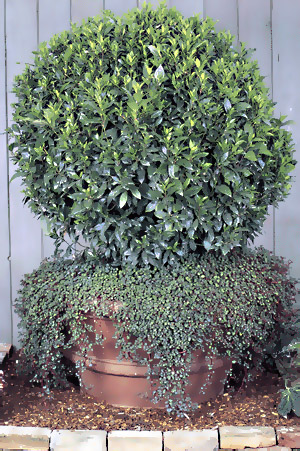
Laurus nobilis
The Bay Laurel tree is the tree that produces the familiar sweet bay spice as opposed to the California Bay or Cherry Laurel which contain toxins. Whether for spice, symbolism of commitment, ornament, or pagan religion, they are great plants to have and they are easy to care for.
Marriage Symbol
I think of our bay tree as a remembrance of our marriage because it happens to be about the same age as our marriage. I got the idea from some former housemates who got married a year after us. They incorporated a bonsai tree into their ceremony as a living symbol that would hopefully outlive them both. Before the end of the summer they had acquired and killed about three living symbols of their marriage and they decided to give up on bonsai and buy goldfish which are much cheaper to replace. (Don't worry, bonsai are not voodoo dolls; their marriage did not die). That summer I bought a bay tree to use as for cooking and it occurred to me that it would make a nice bonsai. Later I realized that it was about the same age as our marriage, so I gradually adopted the idea that it commemorates our commitment ceremony. A few years later, my tree was stolen from the community garden where I keep it in the summer (although my wife did not run away). However, my mother had also coincidentally bought a bay tree that was about the same age as mine. The first winter she left it planted outside in her garden and it died down to the ground due to cold. I discovered it in her garden when I was visiting at Christmas and I dug up the roots and brought it back inside and it sprang back up from the roots. A couple of years later her tree again died almost down to its base; this time due to dryness in the Kansas summer, but it again re-grew from its lifeless base. Later mom decided that she was getting too old to take care of all her plants, so she gave the tree to me and I figure that it is a tree of excellent spiritual character since it has already lived to tell about two near-death experiences.
I have given rooted cuttings from this (auspicious?) lineage to several friends. As with marriage, the first year is often the most difficult time to care for newly rooted cuttings because they are not yet accustomed to their new situation.
Mythical Traditions
Bay was considered sacred by the ancient people of the Mediterranean. Wreaths of bay were given to celebrate special occasions such as winning the Olympics and the gold medals that are given today still picture them. The distinction "poet laureate" or "Nobel laureate" comes from the reference to Apollo, patron of science and art who had a special affinity for the laurel tree.
As the story goes, Apollo loved the nymph Daphne and pursued her fervently. Cupid shot Apollo with an arrow that made him want Daphne but he shot Daphne with an arrow that caused her to avoid male suitors. Prince Leucippus did pretty well when disguised as a woman, but that is another story. Daphne much preferred hunting animals with women to dating men. Daphne asked the gods to save her from the relentless unwanted attentions of Apollo and, tragically, they answered her prayers by turning her into the original bay laurel tree. Apollo declared the tree sacred and thereafter wore a wreath of bay leaves on his head to demonstrate his eternal love for Daphne. In Greece, bay trees are called Daphne trees in honor of the nymph. The Greeks bestowed wreaths from this sacred tree on heroes, scholars, and Olympic athletes. They believed that the tree would protect them from natural disasters and lightning and bay was hung over the door of the sick to protect them. This practice in turn led to the garlanding of newly qualified doctors with bay as a symbol of protection and success known as bacca laureus ~"laurel berry"~ which gave the term baccalaureate, a University degree. Unmarried men came to be called a derivative of this word, "bachelors", because at one time they were considered to be so absorbed in scholarly pursuits that they avoided marriage for fear of being distracted from their studies.
Bay reportedly has narcotic properties and was eaten by the Pythian priestess before taking her seat in the sacred shrine of the Oracle of Delphi. She would be asked a question and her utterances would be reduced to verse and edited by the prophets.
Medical Uses
In ancient times, bay laurel was considered therapeutic for a great many ailments, particularly arthritis and to help with menstruation. The 17th century herbalist Nicholas Culpeper recommended bay to treat "all griefs of the joints and womb and cause a speedy delivery in sore travail of childbirth." He also claimed the herb would treat worms, cough, itching, shortness of breath, infectious diseases and "all griefs of the nerves, arteries, and belly." In the Middle East, a tincture of bay in brandy was rubbed on sore joints and taken internally to induce labour and abortion. American Indians and early colonists used bay to promote labor and menstruation and to treat arthritis, headaches, urinary problems, insect bites and stings. Bay contains compounds known as parthenolides that are useful in preventing migraine. The antiseptic and astringent action of bay makes it a good addition to bath water. A strong tea made from fresh Bay leaves can also be used as a hair rinse after shampooing. Add the tea to bath water or simply put a branch of bay leaves under the hot running water tap to ease muscular aches and pains and rheumatism. Why not rest on your laurels?
Culinary Use
Fresh bay leaves are very strongly aromatic, but also quite bitter. Only use one or two leaves unless a recipe calls for more. Remove the leaves before serving. A rule of thumb holds: The greener the color, the better the quality. Bay leaves cannot be stored as long as their tough texture might suggest, but should not be kept more than one year after plucking. Over aged leaves have lost their fragrance, show a brownish hue and taste mostly bitter. The leaves can be harvested at any time, but have maximum flavor in mid-summer.
Bay is traditionally used in bouquet garni, a classic French dish, and bay can be added to nearly any meat or vegetable dish. A few leaves placed in wheat flour help to ward off flour moths and bay is also used in potpourri, flower arrangements (traditional at Lent and at Yule), and wreaths. Bay berries are also used in cooking, and their flavor is even stronger than the leaves.
Horticultural Background
Bay trees are evergreens that grow very slowly and commonly live to be hundreds of years old even when grown in a small container. In their native habitat, they are usually large shrubs or small trees, but they can grow up to 40-50 feet tall in the ideal conditions: deep, well-drained soil and sunny Mediterranean climate with temperatures never much below freezing. The Bay is part of the Lauraceae family. Other members of this mainly tropical family include Sassafras (Sassafras albidum), Spicebush (Lindera benzoin), Camphor (Cinnamomum camphora) Cinnamon (Cinnamomum verum) and Avocados (Persea). The plant probably originates from Asia Minor and Turkey is still one of the main exporters. The plant can endure temperatures down to 20°F. The laurel has already been used for at least three thousand years for creating wreaths and it is one of the oldest plants used by humans. It is a dioecious plant; some are males and others are females although mainly male plants are used in cultivation. Bay trees produce small, star-shaped, fragrant white or yellow flowers in late spring to early summer. If your plant is female, it will produce small, round, green berries that ripen to dark purplish black in fall. Plants that are not pruned are more likely to produce flowers and berries. USDA Zone: 7-10
Care & Feeding
Spring
Put the bay tree outside when temperatures never go more than a few degrees below freezing at night. If the bay tree's buds have opened and there are tender new light-green leaves, the new leaves can be easily sunburnt by the shock of full sun if the plant is accustomed to the indoors. Put the tree in full shade for several weeks of hardening to avoid the problem. If there are new leaves, they may also be more tender to frost than the tougher old leaves.
Summer
Keep the tree outside in any exposure from full sun to full shade. Full sun will result in faster growth, but the tree will need more watering to prevent it from drying out. Bay trees like regular fertilizing in the summer, but it is not necessary if the soil has a lot of compost.
Fall
I wait until after some frost to bring the tree inside because this kills some of the insects that might otherwise hitch a ride inside.
Winter
The easiest way to care for the tree is to keep it in an unheated room where temperatures never go below about 20 degrees Fahrenheit. As long as the temperatures are cold enough to keep the plant dormant (below about 60 degrees), the bay should get very little water. Only give it enough to always keep the roots moist and perhaps only a couple of waterings all winter is sufficient if the temperatures stay low and humidity very high. As long as the bay is dormant, it does not need any light and you can even keep it in a cool cellar. You will know that the bay is leaving dormancy when the buds start to swell and open and then it needs regular care; If you keep the bay in a warmer room where it is not dormant, it then needs regular watering (and fertilizer) like any houseplant and full sun.
Vacation Care
Bay trees are well adapted to hot, dry weather. I have left them at midsummer for weeks at a time outside in full shade where they are protected from wind and they can survive without any water (other than rain) for extended periods if planted in a relatively large pot that holds much water. Larger pots with heavier soils hold water longer than small pots with light well-drained soil. In winter, as long as the temperature is very low, the trees go dormant and need no water (nor light) for several weeks. You can also keep most houseplants alive without watering for several weeks by putting a clear plastic bag over them (supported by sticks) and putting them in a place with ONLY INDIRECT light.
General Care
Bonsai Tips
Pruning is needed for the health of the tree and is also a way to shape the growth of the tree. The traditional European way is to prune bay trees into a "standard." Usually this takes the form of a single trunk that ends in a geometric green canopy like a ball or a cone (like a Christmas tree). The bay tree is not a traditional bonsai plant, however, if you chose to prune it into a more naturalistic shape, that is what it will look like and its shrubby habit lends itself to bonsai. Because of the large size of bay leaves, bay trees probably look best when pruned into a medium to large sized bonsai. If you use a shallow traditional bonsai pot for your tree it will require more care to keep the roots watered and pruned than you would need with a larger garden-variety pot. For more information about bonsai, and excellent site is: http://www.bonsaisite.com/
Propagation
Bay trees are difficult to propagate from seed and slow to root from cuttings. My favorite way to propagate them is to air layer them in mid summer. Select a vigorous twig and scrape off about a centimeter-high ring of bark about six inches from the tip of the branch. Moisten the wound and apply rooting hormone. Saturate a ball of peat moss and wrap it around the wound and secure it with a strip of plastic fastened around the twig with twisty-ties. Hopefully, by the end of the summer you will begin to see little roots through the plastic and then you know that it is ready to sever the new plant from its branch and plant it in a pot.
Trivia
The names Lawrence, Larry, Laura and Lori are derived from the Latin name of the bay: Laurus nobilis. The Latin genus "Laurus" is too old to be certain, but it may be related to the Latin word "laus" which means praise, triumph or victory. "Nobilis" means famous or noble.
At his death in 1910, at the request of
his family, a Bay Wreath was the only adornment for Mark Twain's
coffin.
"I have seen the wicked in great power, and spreading himself like a green bay tree." Psalms 37: 35