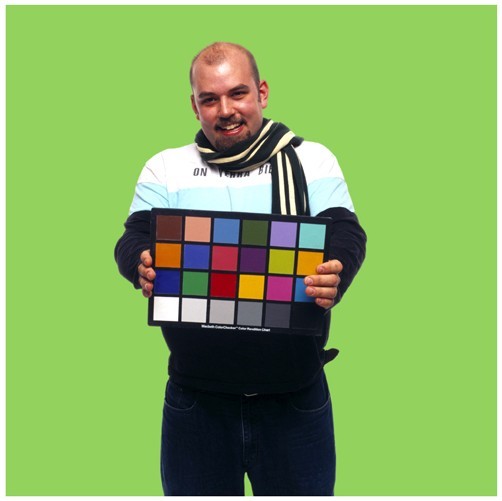

Name: Nathan Robert Albert, but he very obviously goes by the name of Nate. Nate's nicknames are Natedog or Baby - apparently! How sweet?
Born: November 26th 1971 in the lovely city of Cambridge, just over the Charles River from Boston, Massachusetts. The mighty mighty Nate (hey, anyone can be just mighty, right?) is a sagittarius which means that he is very patient and extremely kind, ambitious and good at focusing on personal goals. Now I don't really know if this is true (it probably is though) but I do know thats he's one incredible guy, intelligent and kind, considerate etc, etc, he's also a damn fine guitarist and a rare talent - he basically rules! I think Johnny Rioux said it best when we recently discussed the wonder of Nate and his playing skills; "Nate is a total genius!" he said "(Nate) plays guitar as if he was speaking through it!"...just how true is that?
Nate's background has prepared him for the loose improvisations of rock - apparently (hey, I didn't write ALL this stuff) but it has also left him hungry for the discipline and rigor of intellectual inquiry. The same split is evident in his family background: Nate grew up with his mother, Joan, a photographer, in Cambridge's Harvard Square; his father, Stephen - who Albert says comes from "real strict, kind of grim, German stock" - is a school principal in Pennsylvania. Nate started his education at the Fayerweather Street School, where for one semester he was allowed to choose what he wanted to learn. (He opted for skateboarding and songwriting.) Classes were only slightly more traditional at The Pilot School - the same Cambridge high school attended by Matt Damon and Ben Affleck - and at Hampshire, Albert says, "School was totally about freedom. But for me it ended up being a little too loose."
Nate is obviously more reknowned for his sterling work with The Mighty Mighty Bosstones, a band in which he played guitar since he was a teenager. Very highly respected by his ex-bandmates and indeed his peers, Nate has made a huge impact on the music scene he is a big part of...once a Bosstone always a Bosstone...Dicky Barrett had this to say when Nate left the band;
"('Pay Attention') is guitar-heavy for one simple reason" explained Bosstones frontman Dicky Barrett. "Nate is an exceptional, excellent, great guitar player and with an eight-piece band, sometimes the members get overshadowed.
"Nate wrote the book for ska-core, metal-meets-ska, punk rock-meets-ska music. Nate is the definition of that. (He's) one of my closest friends, and I love him so much. I truly do."
The following is an article from Guitar.com circa the Bosstones release of "Pay Attention";
But don�t look for Albert onstage during this year�s Warped tour. After "Pay Attention" was recorded the guitarist left the band. Barrett's succinct comment: "I'm not stoked. Nobody else plays like Nate, and he's one of my best friends."
Albert, 29, has returned to college, which he quit when the Bosstones signed with PolyGram in 1992. But he explains that "the main reason is because my mother has been really ill and I wanted to be around my family. She's been sick for a while, so that had been a struggle for me. It had also gotten to the point with the band where I felt I had done so much that it would be okay to not be out there."
Albert recently discussed his contributions to the Bosstones - and in particular his inventive playing on Pay Attention - over a plate of grape leaves at the Middle East.
Guitar.com: What was your creative role in the Bosstones?
Nate Albert: As Joe Gittleman and I grew up together, we had this fantasy of doing the rock thing. If Joe was the canvas, I'd be like Jackson Pollack's painting. Not so much on the records, but live - just making stuff up, playing over songs. I was watching some of our old TV appearances and realized I would free-style on TV, too. I saw a couple glances, like "What are you doing!"
Guitar.com: Your free styling is unusual, because ska demands such precision.
Albert: Yeah, and when we played live I would just leave the building, which some nights would be great and other nights would be incredibly annoying for everyone. We were playing over 300 shows a year, and the only way for me to get over musical monotony with these songs was to screw with them. But it really developed my guitar playing. The Bosstones started when I was 13. I couldn't solo. Plus, at that point when you're writing a song you're wondering "Is this gonna even work?" rather than thinking about laying some nice colors over it.
Guitar.com: You�re playing on "Pay Attention" is adventurous.
Guitar.com: Do you agree that Dicky's lyrics take the band into new territory, too?
Albert: Yeah. It was a result of maybe a crisis of conscience the band had after Let's Face It came out. "What are we doing this for? Can we make a difference?" That's when we started getting involved with the Safe & Sound Project, the Anti-Racism Action Group and Rock for Choice. Having those people tour with us for two years had a real impact on Dicky. I do think that rock 'n' roll can subvert culture and change politics. This kid who was in a Soviet Union ska-core band came up to me at a festival in Belgium. He said, "Your music saved my life and changed my whole reality." Me and Dick and Joe were super fans and music was our salvation from how we grew up. I don't think we ever thought our music would have an impact on other people, but we discovered it did.
Guitar.com: Now, jazz is something your past recordings never hinted at, but there's a perfect cocktail jazz intro to "Let Me Be."
Albert: I've always been super into jazz - Wes Montgomery and all those cats. That intro is the kind of thing me and Joe the Kid (drummer Joe Sirois) would do when the bass rig would die or Dicky's mic cut out during a show. Usually (we�d do it) as a backdrop for somebody telling jokes to keep the audience's interest. I also took jazz lessons when I was in high school, and took an improv seminar with Yusef Lateef. That's where I learned a lot about jazz and guitar playing in general. I would shake with anxiety after class, because we'd all have to solo - and then Lateef would solo. I mean, John Coltrane referenced him as an influence. That's really hard-core. He told me, "No one can sound like you and you can't sound like anyone else. You are on an island of your own, so don't worry what other people are playing or get competitive." That was the best advice, because up to that point I was always trying to sound like somebody else - Angus Young or Stevie Ray Vaughan - as opposed to just having them as influences.
Guitar.com: Have you seen the band with Lawrence Katz, the new guitarist?
Albert: I saw them on Letterman, but haven't seen them live yet. I'm waiting for the Warped tour. What I saw was really good. It wasn't as strange as I thought it would be. It felt like a different band. The songs demand proficiency in a lot of aspects of guitar playing. I'm glad they found somebody. I was nervous.
Guitar.com: One of your signatures is the way you use two or three sounds (crunchy, clean, weird) or approaches (ska, punk) on every song.
Guitar.com: Often on "Pay Attention" you're playing with a very warm, punchy tone. "So Sad To Say" is a good example.
Albert: I used a Melody Maker on that, and brought down the tone pot. I had a conversation with Rivers Cuomo from Weezer, about how he would fight with (producer and ex-Cars leader) Ric Ocasek because Ric wouldn't cut any guitar with the tone up. So I gave that a whirl. And it totally works for rock songs. I started to listen again to Zeppelin and other classic bands and realized, "Oh my God, everyone's doing this."
Guitar.com: On a number of tunes - "Over the Eggshells" and "Finally," for example - there's radical string bending going on, both single notes and whole chords. But I've never seen you use a whammy bar.
 Albert: That really came from the live record we did here at the Middle East. When we listened back, it was like "Whoah! There's a guitar player in the band." So I had more leeway for Pay Attention. It was also linked to Kevin, our sax player, leaving the band. It shook up the dynamic. The horns didn't seem as much a center. We were also playing with a lot of punk bands, Green Day and Pennywise, so we got into the rock element a little bit more.
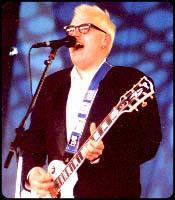 Albert: That had a lot to do with dynamics. Also, there was a point where we started having conversations like "How can we have the horns stand out more? How can we have the guitar play a role where it's present but doesn't intrude." My clean sound became the way to do that and to carve more room for Dicky, because his voice is like a distortion box - it's a lot of tones resonating. In the choruses we have harmonies or backing vocals to pull him out. But distorted guitar often fights with his voice.
 Albert: The only place I used a whammy bar is the opening of "Skeletons." Otherwise I never use one. So if you hear vibrato it's my fingers. Anything that sounds like a whammy is me hitting a note that's already pulled up and letting it drop. On "Eggshells" I'm combining finger vibrato with popping harmonics, and the tone's kind of down. The main thing a guitar player needs to work on is vibrato. If that sucks, you sound like shit, basically. Listen to Albert King, B.B. King, Albert Collins - their vibrato is so good. They could play two notes and it's ripping. If you hear Angus Young's vibrato, you know it's Angus Young. The worst is tacky vibrato that's not in time with the song or has no character. BY TED DROZDOWSKI