Cool Lego Site of the Week Empty, nothing contained Jonathan Stephenson's
Lego Technic Mustang

April 6-12, 1997
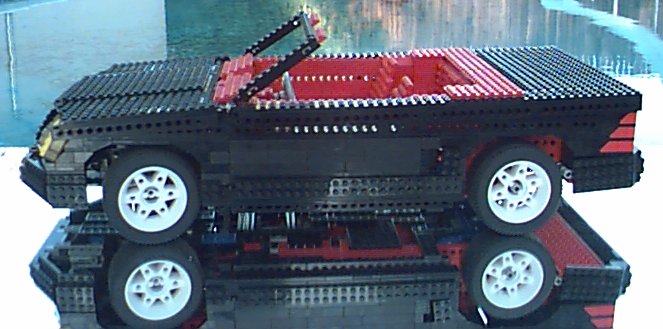
left side view on water

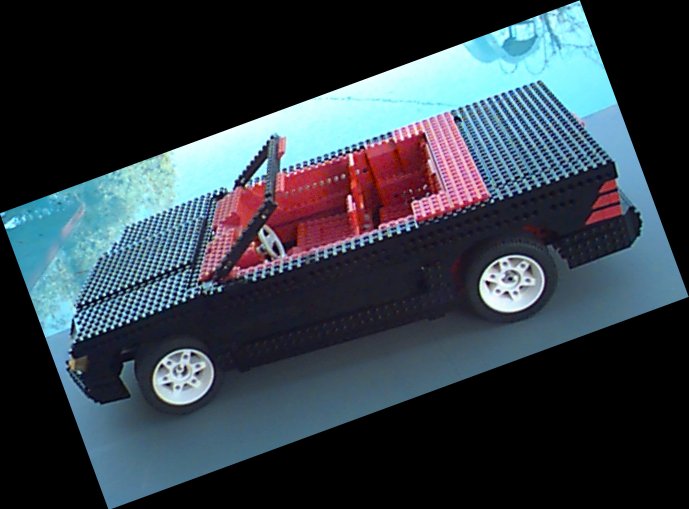
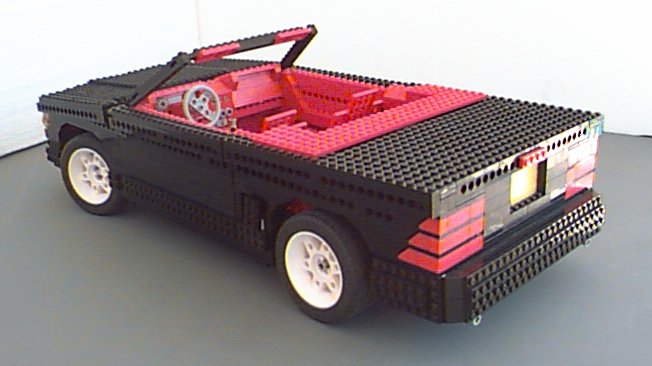
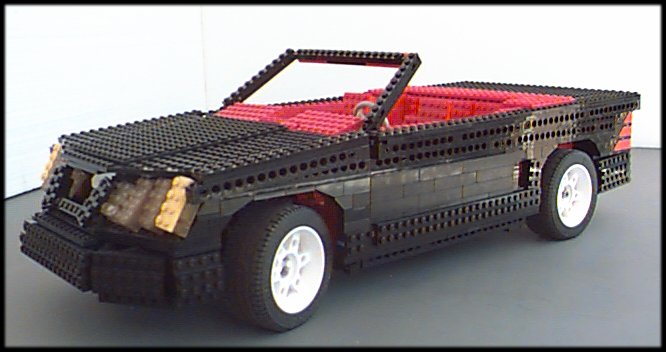
The Lego Technic Mustang is my own design of a sporty convertible that's a rough replica (is there any such thing as an exact Lego replica?) of the 94-95 Ford Mustang. The purpose of building this car was to have a fully-featured Technic car that also has a full body and interior. Its features include V8 engine, 4-speed transmission, full suspension, steering (of course), parking brake, two-way adjustable seats, and front and rear impact-absorbing bumpers. I've written a fair amount of detail on this page because I know if I ran across something like this, I'd want to know all about it. If you prefer, feel free to skip the text and just click on the pictures for a larger view. By the way, if you have any Lego cars of this type on the net, please email me your address.
BODY | INTERIOR | CHASSIS | TRANSMISSION | ENGINE | SUSPENSION

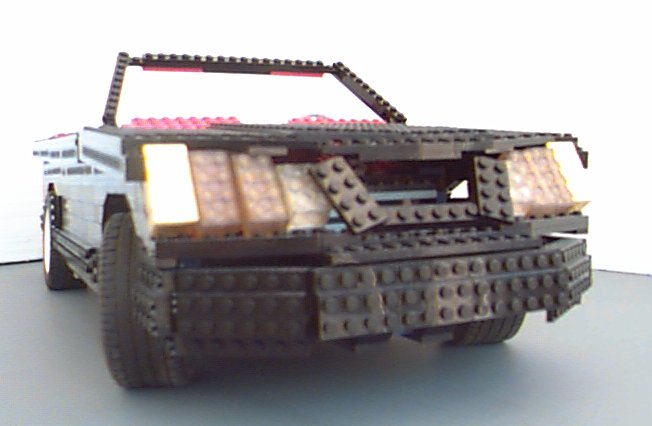
Back Left view side left viewfront view

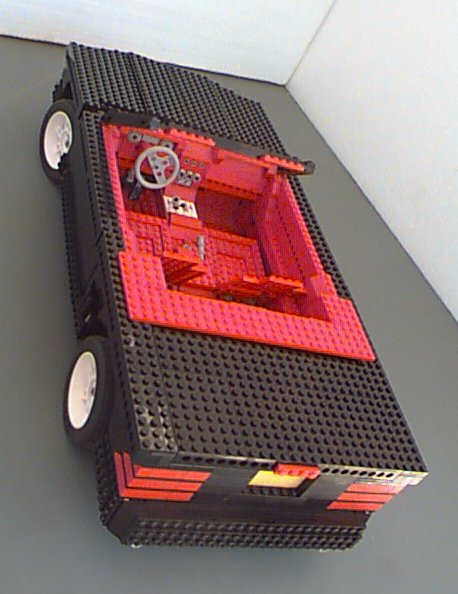
view from aboveside left

Body

I chose to model the car after the Mustang for two reasons. One, I think it's a great design and two, the Mustang is a bit more conducive to Lego interpretation than many other cars (like the Camaro). Its overall shape is not terribly curvey. The upper surface is essentially a flat plane sloping forward. The sides are also pretty much a flat plane (with some styling lines). The front and rear don't have a lot of horizontal curve. Given that the squarer something is, the easier it is to copy in Legos (e.g. I can make a beautiful Lego cube) and given that for its relative boxiness, the Mustang still looks great, it seemed like an excellent subject to attempt in Lego. My approach was to duplicate the proportions as closely as possible, incorporate the major styling cues as best I could and hope that the end result, even if it doesn't look exactly like a Mustang, still looks good in its own right.

The hood, trunk and doors all open. The hood and trunk lid hinges prop open. The body flex puts just enough pressure on the doors to keep them closed. The front bumper uses two of the small shock absorbers in the main section and the small edge sections are hinged to the body. There are hinges between each section. It works very well. The rear bumper uses two large shock absorbers, one on each end. The whole bumper is solid and attached only to the shocks. The big shocks are a lot stiffer, so it doesn't work quite as well as the front. The windshield is simply on hinges attached to solid chassis uprights. I was really happy with the look of the headlights. Unfortunately they're attached only by gravity, so they tend to go flying in a frontal impact or in turning the car over! The black grill piece is on hinges. The vertical pieces along the lower body between the wheels are attached using those cool half -pegs from the newer Technic kits. I'm also really grateful for those black pegs! They make the body look a lot cleaner than if I had to use gray ones (the black pegs are also a lot tighter, which comes in handy for many purposes). I wanted to make a folding fabric convertible top, but even Technic Legos have their limits.

HOME
interiorinterior from passenger side

Interior

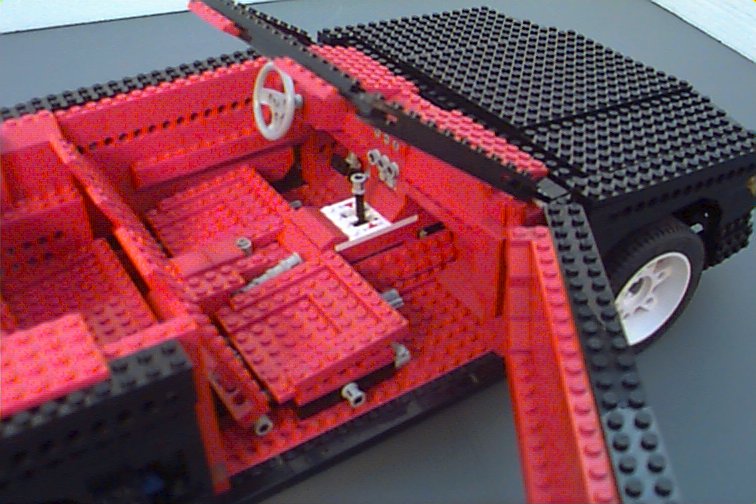
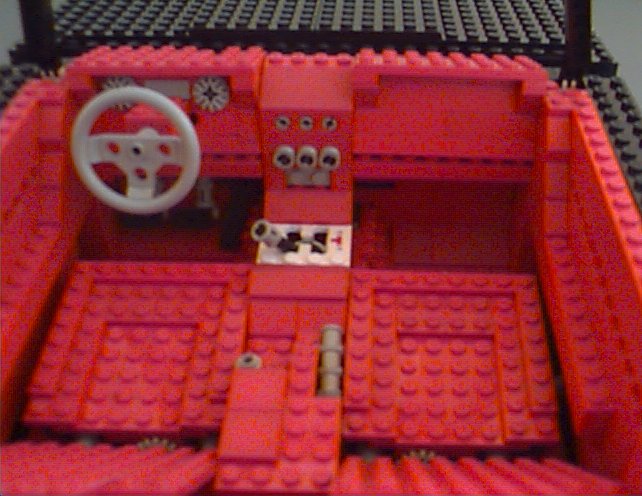
The seats move forward and back and the seat backs recline. You may notice in the pictures that the seat backs are a bit thin and ugly. This is because I simply ran out of pieces. The seat bottoms were one of the first things I did, then I built the rest of the car. By the time I was done, I only had enough flat red pieces to make very minimal inaccurate ones. As soon as I can get ahold of some more pieces, I'll revise them. The back seat is even more cramped than the real one (in a scale way, that is). Real convertibles nowadays have very narrow back seats, to make room for the top mechanism. My car has a similarly narrow back seat, but to be able to fit between the frame rails. The holed pieces that can be seen just above the seat bottom are the frame pieces that go over the axle and into the trunk. Real cars also generally have their seat backs pushed back very close to the rear axle. This is hard to do with Legos, since a structurally strong chassis requires more space than a real car's, especially when having to accommodate the rear suspension. My back seat is pushed back as far as possible before hitting the cross member needed for the coil springs. I think it's a pretty tight design for Legos, but those scale back seat passengers are still going to be a bit cramped. The drive shaft/transmission tunnel is a bit larger than the real one. This was necessary both to accommodate the transmission and because it is a weight-bearing chassis support structure. The gray lever on the right side of the console is for the parking brake. The round gray piece to the left of it is attached to a 1x3 flat piece which slides under the lever to lock it in place. The lever is attached to a fixed gear, which lowers onto a gear on the drive shaft. It's pretty solid and will keep the car from moving on a slight incline, but much of a push will make clicking gears and a moving car. The goals of this were mainly to enable me to say it has a working parking brake with a realistically placed control that doesn't take up much space. The gas, brake and clutch pedals are strictly for show.
HOME
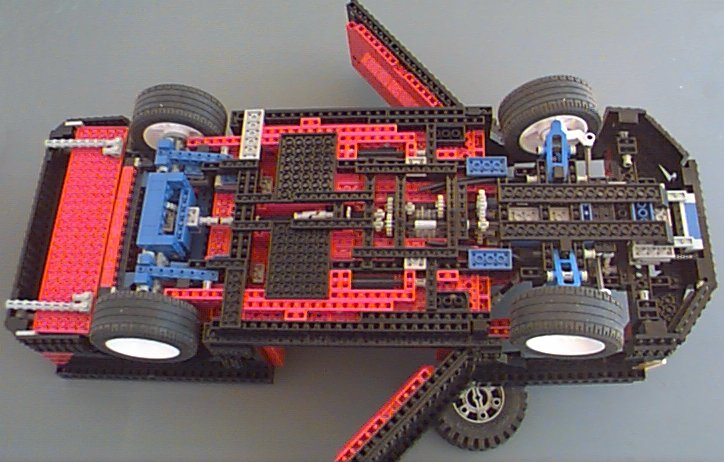
chassis view from undersideanother chassis view from underside

Chassis

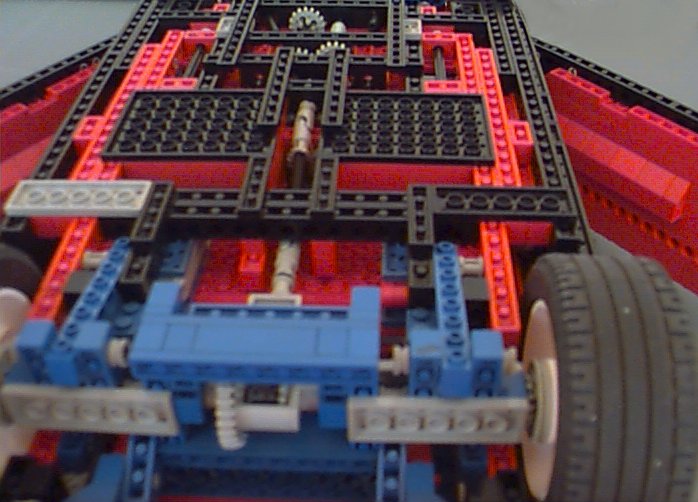
In building a Lego car this big and heavy, a major challenge is make it so that it both has opening doors and supports its own weight without undue flex, creaking, loosening, etc. My goal was to build a chassis that would be strong enough to prevent much body flex, even with the full weight of the completed car on it, and wouldn't be very reliant on the body itself for support. My approach was to use multiple frame rails and to use the elevated drive shaft tunnel as a support structure. It's designed to be sitting on its wheels, so the middle of the car supports downward forces better than upward forces. The test of success is if you can open and close the doors easily and without the body noticeably flexing (it passed). It can be picked up in the middle without excessive flexing or fear, but I always pick it up by the axle areas. Of course, real convertibles have these same challenges. I wanted to make a convertible because it's lighter, allows full access to the interior, steering wheel and gearshift, and building a realistic looking windshield and roof structure that contributes to structural strength is even more of a challenge. Maybe on a future project.

HOME
view of transmission from underside

Transmission

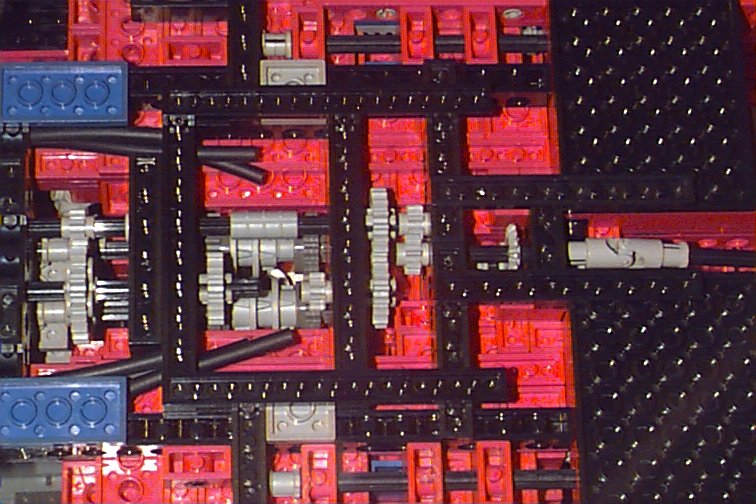
The transmission is a 4-speed without reverse. The transmission in the Supercar is such a great design that I couldn't see how to improve on it, so I pretty much copied it. The only changes are in packaging. I wanted it to be as compact as possible, fitting in the area behind the engine as in a real car and not intruding in the interior laterally. It took a fair amount of trial and error to get it to fit in the space required, stay out of the interior, allow the tunnel to bear weight, and still work well. The obvious upgrade would be to have a reverse. The Supercar transmission is so compact for a 4-speed, it was perfect for this application. To use the same components, you'd have to lose a forward gear and even then it would be difficult and space-consuming to have an opposite turning gear integrated into it. It didn't seem worth it for a car who's wheels run its engine.

HOME
underhood viewanother underhood view

Engine

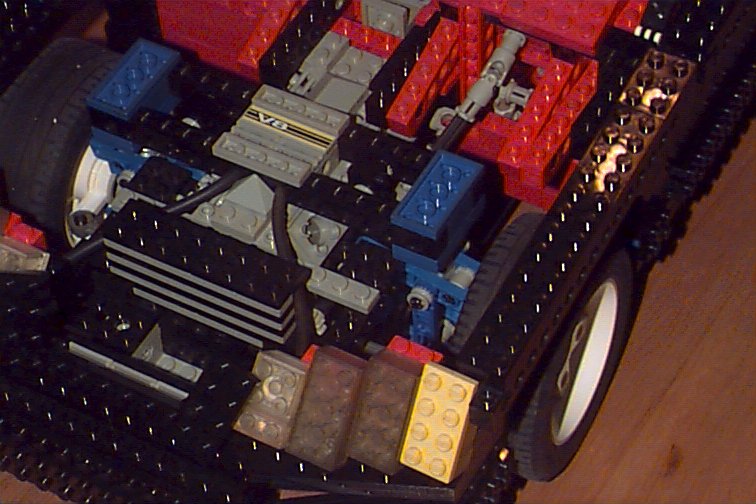
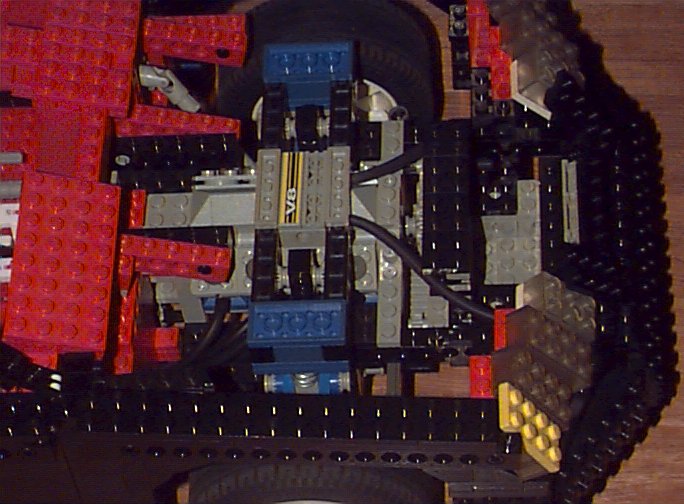
The engine is a basic V8. The angle between the cylinder banks is smaller than in the supercar. This was necessary because the challenge with the engine was to get it to fit between the support structures for the front suspension. The space available couldn't be increased horizontally or vertically beyond what was barely enough to fit. It does have a black exhaust manifold that can be seen in the right-side picture. Beyond that it has fuel injection, high compression, and a heavy-duty cooling system (haha!).

HOME

Suspension

The front suspension is an upper and lower control arm set-up with coil springs mounted on the upper control arm (not unlike the real Mustang prior to 1979). The components are from the Supercar, of course. The rear suspension is a live axle with upper and lower trailing arms (like the real Mustang since 1979). The coil springs are mounted on the lower trailing arms. The coils for the front and rear are the same small but stiff springs bought at a hardware store. I've used sections cut from notebooks in the past, but a car this heavy is just too much for those. The reason I didn't use the Lego spring/shock assemblies is because Lego suspensions tend to have the opposite characteristics of real suspensions in the area of damping. Real cars tend to not have enough damping (hence the need for shock absorbers), while Legos tend to have too much damping (requiring ways to be found to reduce friction). The Lego shocks just have too much inherent friction. There can easily be so much damping that the car doesn't keep a constant ride height. They work well for the Supercar because its suspension makes no effort to be compliant. Its suspension is always fully extended and is the scale equivalent of a ride harder than a race cars's. I wanted to build a car with more realistic ride characteristics. Coil springs mounted in the middle to outer-middle of a control arm provide a good balance of support, bounce, damping, and compliance over bumps. The steering is located ahead of the axle and is the usual rack and pinion. I discovered a long time ago a way to reduce steering wheel effort (a major consideration in a car this heavy). Not being an engineer, I don't entirely understand why, but somehow the laws of leverage work so that using as large of a pinion gear as possible connected to the steering wheel with as small a gear as possible will reduce effort. It probably just increases the turns lock-to-lock in exchange for less resistance. Anyway, I use one of the old extra large gears.

HOME
, last updated January 27, 1998

Back to http://www.geocities.com/motorcity/factory/3599
If you have any questions, comments, ideas, etc., please email me, Jonathan Stephenson, at [email protected]

Hosted by www.Geocities.ws

1