The Impact of the Esso Verdicts on Engineering
Practice
First published in Engineers Australia,
August, 2001
When a jury in the Supreme Court of
Victoria found Esso guilty of 11 criminal charges under the Occupational Health
and Safety Act, it was essentially passing judgement on the company's
management performance. It found that the company had failed, in several ways,
to provide and maintain a safe workplace. Some of the charges have direct and
strong bearing on engineering practice at not only the Longford gas plant, but
also at all other complex, hazardous process plants in Australia.
Behind the guilty findings for these
charges lie judgements with respect to the community's expectations of
performance by engineering practice in delivering workplace safety at complex
process plants.
The
Rupture of GP905
The vessel that exploded at Longford was a
shell and tube heat exchanger, GP905, located in Gas Plant 1. In normal
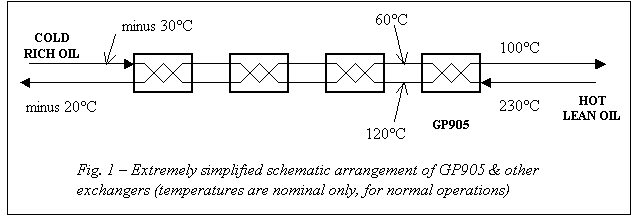
operation, cold rich oil entered the vessel at 60°C and exited at 100°C, being heated by a counter
flow of hot lean oil entering at 230°C and exiting at 120°C. It was a "hot
service" vessel, and not expected to ever experience temperatures lower
than ambient.
Heat transfer between the two process
streams was achieved in other heat exchangers as well as GP905, as depicted in
Fig. 1. The cold rich oil entered the first of these exchangers at or below
minus 30°C.
The prosecution argued that GP905 exploded
as a result of:-
·
flow of hot lean oil ceased due to a pump
shutdown, and remained so for at least three hours
·
flow of the cold stream (at first cold rich
oil and then cold hydrocarbon condensate) continued
·
without the heating medium, GP905 dropped
in temperature to below minus 30°C which was way below its minimum design safe
operating temperature
·
the weld metal of GP905 became brittle at
the low temperature and susceptible to fracture if unduly stressed
·
approximately 4 hours after the pumps shut
down they were restarted and flow of hot lean oil was re-established into GP905
·
hot lean oil entered the cold exchanger,
producing sudden thermal stresses and causing a weld to crack
·
the vessel had been kept at its normal
operating pressure and, upon the weld cracking, violently ruptured
Charge 1
- Failure to Conduct Any Adequate Hazard Annalysis
The OH&S Act requires employers to
identify, as far as is practicable, workplace hazards. Absolute safety is seen
as an unachievable ideal, and much hangs on that phrase "as far as is
practicable". For any alleged breach, a court will consider the accepted
methods, standards, codes of practice, safety management systems and so on
utilised within the industry in question. For the jury to find the company
guilty on this charge, it had to be satisfied on two "elements" of
the charge, namely:-
(i)
the hazard of cold embrittlement existed
(ii)
the company had a practicable means of
identifying the hazard, that it did not employ
The prosecution case for element (i) was
fairly simple:-
If the flow of heating medium ceased and
the flow of cold medium continued, then GP905 would reach temperatures lower
than its minimum design temperature and become dangerously cold. This was the
hazard.
Their case for element (ii) was that a
HAZOP study was the tool available to the company by which it could have
identified the hazard. Moreover, a HAZOP study performed by a competent team
could be expected, beyond reasonable doubt, to have identified the hazard. A
HAZOP on Gas Plant 1 had never been done.
Since a guilty verdict was found for this
charge, it follows that the jury considered both these elements proven.
HAZOP -
HAZard and OPerability Study
HAZOP is a methodology widely practised in
process industries to identify likely hazards in complex, extensive process
plants. A team systematically examines the plant design, considering the
consequences of deviations from normal conditions at each item of equipment.
The team always includes process engineers familiar with the plant.
In pretrial hearings, the judge ruled that
the prosecution could not merely assert that the hazard was identifiable, but
it also had to specify the particular method the company should have used to
identify the hazard. Hence, HAZOP became an integral component of charge 1.
HAZOP
in Australian Case Law
The term "HAZOP" has been
referenced three times in Australian case law, prior to the Esso trial - once
in the Environment Court of NSW, and twice in the Industrial Relations
Commission. Although in each instance HAZOP was a minor component of the overall
case, the record shows that the law recognizes the HAZOP methodology as an
established and defined engineering and management tool, although it is not a
statutory requirement.
With the Esso case, HAZOP has been examined
in detail by a jury, and their verdict of guilty for charge 1 elevates the
position of the methodology in Australian law. A jury has now made a judgement
on the expected performance level of a HAZOP study, which in turn implies an
expected performance level of the HAZOP team members.
Impact
on Engineering Practice
The Law loves a precedent. Having now
established that HAZOP can be expected to achieve a particular outcome, it
becomes easier in future cases to pursue the allegation that an employer failed
to identify a hazard in a complex plant.
In its defence, Esso called an expert
witness who maintained that the outcomes of a HAZOP are neither predictable nor
guaranteed. He argued that much depends on the quality of the individual team
members. This is plausible, but somewhat academic – the jury has effectively
taken the question out of the experts’ hands. The jury has said that the hazard
of cold embrittlement was identifiable and should have been identified. That is
essentially a statement of the community's expectations of the experts' performance.
Ongoing
Offence
Charge 1 was alleged to have been an
ongoing offence from 1 Jan 1993 to 25 Sept 1998, the day of the explosion.
There was no need for the vessel to have actually ruptured for this charge to
be proven. It was not even necessary for the hazard to have been realised, that
is, for the vessel to become brittle. The hazard - the potential of cold
embrittlement - existed continuously during normal plant operation. So the
offence was that the company failed to perform adequate hazard analysis on a
continuous basis for the entire period of more than five years. The charge
could have stood up in court at any time in that period and did not depend on
the tragic incident of 25 Sept 1998.
Potential
Impact on Engineers
Charge 1 essentially targeted the
performance of company management. Engineers might like to consider the
following scenario - that the HAZOP was done, but did not identify the hazard.
In that situation, would individual team members be joined with the company in
alleged breaches of the Act?
HAZOP team members must now keep in mind
that their performance may be subject to inspection and judgement by a court.
This applies not just to future HAZOPs, but also to past HAZOPs whose results
have current effect.
Charge 9 - Failure to Monitor Plant
Charge
9 was that the company failed to adequately monitor the health of the plant.
The prosecution claimed that the tools to do so were the control room
instruments and charts in the hands of experienced process engineers. The
essentials of this charge were :-
(i) crucial chart recorders were not
functioning
(ii) there were no on-site engineers
The
non-functioning recorders were associated with the very parameters that were
needed to diagnose the process upsets. These would have been invaluable to
investigators after the event. For diagnosing the dangers from abnormally cold
vessels, the most important parameter was the temperature of GP905, the chart
recorder for which was not functioning. However this instrument did not
register sub-zero temperatures, so its usefulness, even if working, was
limited.
Heavy
icing was seen on GP905's pipework - conclusive evidence that its internals
were at less than 0°C. This was enough data for "any competent
engineer", in the prosecution's words, to recognise the danger and advise
the operators to not shock the vessel. However, no such person was available on
site to make this assessment. Engineers were based at head office in Melbourne,
200 km from Longford. They were accessible by phone, but the prosecution claimed
that the data necessary to diagnose the process upsets was not available, as
the relevant recorders were not functioning.
The
likely impact on engineering practice of the guilty verdict for this charge is
not as clear as for charge 1. If the jury's view was that process engineers
should always be available on-site, then that is an expectation that cannot be
met. There are simply far more process plants in Australia than process
engineers.
What
is clear is that the jury considered that the danger should have been correctly
assessed, and that the relevant discipline to ensure this happened is process
engineering. The profession now has the responsibility to determine how to
ensure the necessary expertise is available to plant operators as and when it is
required.
The Esso case has generated powerful
judicial verdicts with respect to the community's expectations on companies in
providing and maintaining safe workplaces. The engineering profession and
individual engineers have crucial, unavoidable roles to play in delivering
industrial safety. The Longford tragedy underscores the responsibilities and
challenges that continually face the profession.
ÓJohn O’Meara, B.Engg.(Chem.), M.Biomed.
Engg.
21 Aug 2001
HAZOZ – Hazard Management in Engineered Systems