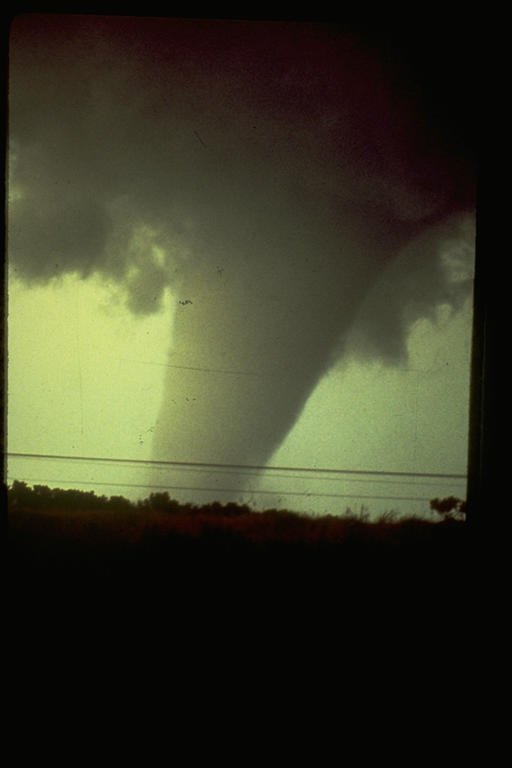
Tornadoes
How a Tornado Forms: Warm, moist air is forced upward and pushes cold, dry air from the upper atmosphere downward. (This is called cyclonic) This updraft of warm, moist air forms thunderstorms. Sometimes thunderstorms can have such a rapid circulation of air that they begin rotating. These are called mesocyclones. If air within a mesocyclone rotates fast enough, it can spawn a funnel. When this funnel touches the ground, it becomes a tornado.
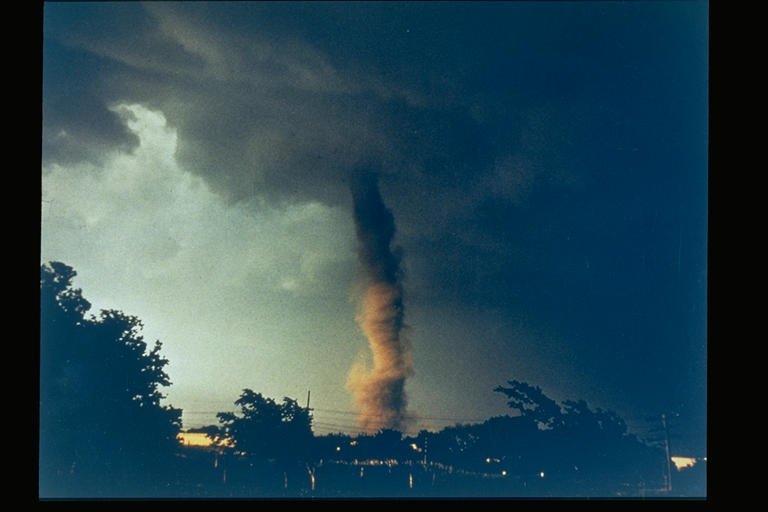
Tornado intensity is commonly measured using the Fujita Scale. This scale is based off of the damage that a tornado inflicts. The meteorologists at the University of Oklahoma at Norman (through Project Vortex) were able to correlate actual tornado wind speeds with the Fujita Scale. The Fujita Scale is as follows:
F0 (40-72 mph winds) - Damage to chimneys, loose objects such as patio furniture, TV antennae and home satellite receivers, trees, windows, and roof shingles. This is the weakest tornado and occurs around 29% of the time.
F1 (73-112 mph winds) - Damage to carports, garages, and sheds. Unsecured trailer homes and automobiles are overturned. Trees and fences can be uprooted. These are the most common tornadoes and occur about 40% of the time.
F2 (113-157 mph winds)- Damage to house roofs; sheds and outbuildings may be destroyed; secured trailer homes are overturned. These tornadoes cause major damage but only occur 24% of the time.
F3 (158-206 mph winds) - Severe damage to houses including walls and roofs being torn apart. Metal framed buildings damaged or may collapse. Forests and farmland are flattened. The tornado that devastated Germantown, TN in November of 1994 was an F3 tornado. It destroyed several homes and ripped out a part of Houston High School. The path of destruction started around Poplar Pike and Germantown Road and ended around Houston Levee Road. This destructive tornado caused millions of dollars in damage and killed 3 people. This tornado only occurs about 6% of the time.
F4 (207-260 mph winds) - Houses are flattened. Buildings are destroyed, leaving few walls standing. Large projectiles of steel or concrete may be shot at long distances. Basically, an entire neighborhood may be leveled. These devastating tornadoes occur about 2% of the time.
F5 (261-318+ mph winds)- Houses not only destroyed but the debris is gone too. The last tornado could destroy your neighborhood, this tornado could make you ask, "Where did my TOWN go?" Large structures are destroyed- you can just forget about anything above the 1st floor, if even that is still there. Thankfully these tornadoes, the most powerful, occur less than 1% of the time.
Tornado myths
MYTH #1- Tornadoes cannot strike inner cities and major cities. This may be because of bluffs, skyscrapers, rivers, etc.
FALSE! Tell that to the residents of Kansas City, Wichita Falls, Nashville, Oklahoma City, and even Miami. The fact is that a bluff, skyscrapers, rivers, etc. may cause a disruptance in the flow of lower atmospheric air but that disruption is not enough to stop a massive mesocyclone from turning. It would be like a toddler trying to stop a semi from rolling backwards. The reason tornadoes don't usually hit downtown areas is that downtown areas are small and tornadoes usually hit a relatively small area. Besides that, tornadoes are a rare weather phenomenon. Now, granted, research has found that wide open spaces make for the ideal places for tornadoes and mesocyclones to form, but the weather will go wherever it wants to go.
MYTH #2- A tornado warning just means there may be a tornado.
FALSE! A tornado WATCH means that conditions are favorable for the production of tornadoes. A tornado WARNING means to get your butt into a safe place because a tornado is headed your way! There are 3 main ways that meteorologists at the National Weather Service use to determine wether to issue a warning.
** A tornado sighted by stormchasers. Stormchasers are members of Skywarn and are trained to know what is a tornado/funnel cloud and what is just a funky looking cloud in the sky. They work closely with the National Weather Service in order to give the meteorologists (who are inside the weather service office) an idea of what's happening where the weather is.
** A tornado sighted by officials. Police, firemen, and other public officers are also trained to know what is a tornado and what is not. Since police regularily patrol all across the city, the information they can give about city conditions during a severe weather situation is invaluable and extremely helpful to meterologists.
** A tornado sighted by doppler radar. Doppler radars are the kewlest things in the world. The NEXTRad radars (which we in Memphis are very lucky to have) can tell you almost everything you wanted to know about a storm. This includes where the wind is going within a storm and how fast it is going. (The doppler does this by bouncing sound waves off the water particles in a cloud. The faster the wind is moving, the faster the water particles will be moving. Fast moving water particles also can develop a charge by rubbing into one another. The discharge from cloud to cloud or cloud to ground is what we know as lightning. The superheating of air caused by the strong electrical charge is called thunder. A little weather basics for you.) If the meterologist sees through the radar that the potentially volatile cloud has a strong, concentrated rotation then chances are a tornado is about to or already has touched down.
So when you see, "The National Weather Service has issued a TORNADO WARNING for [your county here]..." PLEASE take shelter!
MYTH #3- Waterspouts aren't dangerous.
Tell THAT to residents of Miami, FL who saw a "harmless waterspout" demolish parts of their downtown area. Waterspouts, while generally weaker than most ground based tornadoes, are STILL tornadoes! It's just a tornado that is in the water. If an F5 tornado decides to frolic in a lake for a while, it's STILL an F5 tornado and if you're on a boat when it hits you, it will kill you or at least toss you a couple of thousand feet through the air.
MYTH #4- "I can go outside and look when severe weather approaches and not be killed."
The lightning, the tornado, the downbursts, the falling trees do not care how many times you've been outside during severe storms. it just takes ONE strike of lightning to ruin your day, one chunk of flying debris to kill you, one piece of hail to knock you unconcious, and one tree to flatten your outlook on life. Be smart, be safe, and stay inside. The people who love you will thank you for it later.