|
|
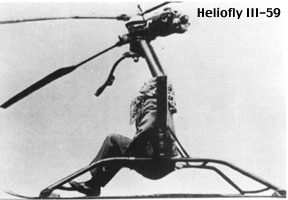
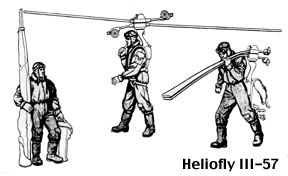
The Austrian engineer, Paul Baumgartl, concerned Resulting from previous work was a design in 1942 for a strap-on helicopter. This was the Heliofly III-57, which had a rotor consisting of two co-axial contea-rotating single blades, each of which was to be driven by its own 8 hp Argus As 8 engine, which also acted as a counter-balance. When it became apparent that the Argus engines could not be readily obtained, the helicopter was redesigned in 1943 as the Heliofly III-59 to be powered by a single 16 hp engine. In this design, the engine drove and counterbalanced the lower blade and, through gearing, also drove the upper blade, so that torque was still counterbalanced by contra-rotation. A weight, instead of an engine, counterbalanced the upper blade, and the flapping rotor system had cyclic pitch control. Heliofly III-59 Rotor Diameter: 20 ft Length: 20 ft Empty Weight: 77 lbs. Loaded Weight: 265 lbs. (approx.) |
  |
|
|
| Sources: Airpower, March 1990 - Vertical Lift - German Helicopter Development in WWII, Mal Halcomb, German Helicopters 1928-1945, Heinz Norwarra, Schiffer Military History - 1990 & German Aircraft of the Second World War, JR Smith & Antony L Kay - Nautical & Aviation Publishing 1972 |
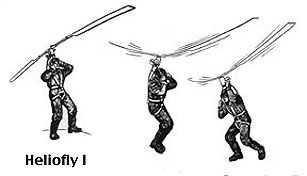
 himself during the Second World
War with the design of small single-seat helicopters, in the
suburbs of Vienna. It is not certain whether his work was sponsored
by the German Government, but his machines were in the same category
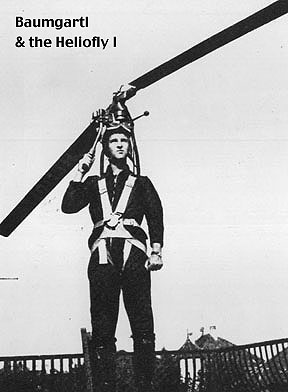
as those of Nagler-Rolz. Baumgartl's first product was the Heliofly
I of 1941, which was little more than a strap-on autogyro glider
for sporting use.
himself during the Second World
War with the design of small single-seat helicopters, in the
suburbs of Vienna. It is not certain whether his work was sponsored
by the German Government, but his machines were in the same category
as those of Nagler-Rolz. Baumgartl's first product was the Heliofly
I of 1941, which was little more than a strap-on autogyro glider
for sporting use.