
Not all bites involve actual injection of venom

Signs and Symptoms MAY include:

  • Severe pain and swelling around the bite.

  • Weakness and dizziness.

  • Irregular heart beat.

  • Excessive sweating.

  • Low blood pressure and shock.

  • Nausea and vomiting.

  • Numbness and tingling around the mouth and in the hands and feet.

  • Breathing difficulty.

  • Blurred vision.

  • Seizures.

  • Coma.

  • Multiple fang marks and small cuts, if the bite is from a coral snake. Symptoms may not appear for 3 to 4 hours.

  • Deep single or double fang marks, if the bite is from another snake. Symptoms begin quickly.

  • Skin discoloration that resembles bruising around the bite. Bleeding spots under the skin all over the body.

POSSIBLE COMPLICATIONS

  • Gangrene, requiring amputation of the affected part.

  • Aspiration pneumonia.

  • Shock.

  • Convulsions.

PROBABLE OUTCOME

  • Usually curable with early and proper medical care.

  • Often with bites from poisonous snakes, little or no venom is injected.


VENOMOUS SNAKEBITE

EMERGENCY

FIRST-AID INFORMATION

WHAT TO DO IF BITTEN


Immobilize the patient horizontally and transport to medical care immediately, if possible, try and keep bitten extremity at heart level or in a gravity-neutral position.
Raising it above heart level can cause anti-venom to travel into the body. Holding it down, below heart level can increase swelling.

Allow bite to bleed freely for 15-30 sec.

Remove rings or constrictive items close to the bite.

Use only acetaminophen for pain. (Tylend or equivalent)

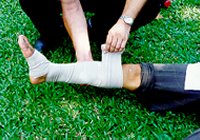
Apply a broad pressure bandage over the bite site as soon as possible.


DO NOT take off jeans, as the movement in doing so will assist venom to enter the blood stream.

DO NOT give alcohol.

DO NOT apply ice.

DO NOT apply an arterial tourniquet. (This can cause crippling injuries).

DO NOT eat or drink anything unless okayed by medical sources.
DO NOT engage in strenuous physical activity.
DO NOT apply oral (mouth) suction to bite.
DO NOT Wash the bitten area. The snake involved may be identified by the detection of Venom on the skin.

DO NOT permit removal of pressure dressings, Sawyer or ACE bandage until you are at a facility ready and able to administer anti-venom. As soon as the dressings are released the venom will spread causing the usual expected problems of venomous snakebite. The hospital at this time must be prepared to administer the antidote. (anti-venom)

Skin incisions are not recommended unless the person has medical training.
Hospitalization for mechanical breathing support if needed, dialysis treatment if kidneys stop working, cardiac and neurological monitoring.
Surgical debridement (removal of dead or contaminated tissue) after 3 or 4 days.


If bite on hand, finger, foot or toe, wrap leg/arm rapidly with Ace or crepe bandage past the knee or elbow joint immobilizing it, wrap no tighter than one would for a sprain. Make sure pulses are present. Check for pulses above and below elastic wrap; if absent it is too tight. Unpin and loosen.
Leave area of fang marks open.
Apply Sawyer Extractor immediately until there is no more drainage from fang marks.
Extractor can be left in place 30 min or more if necessary.
It also aids in keeping the venom from spreading by applying a negative pressure against the tissue where the venom was initially deposited and creates a gradient which favors the movement of venom toward the Sawyer's external collection cup.

If extractor not available apply hard direct pressure over bite using a 4 x 4 gauze pad folded in half twice. Tape in place with adhesive tape.
Soak gauze pad in Betadine solution if available and not allergic to iodine.
Strap gauze pad tightly in place with adhesive tape.


Bites to face, torso or buttocks are more of a problem. Disinfect.
Use extractor device until there is no further drainage possible and then apply pressure dressing with gauze pad and tape.  ACE/crepe bandaging can not be applied to such bites.
A pressure dressing made of a gauze pad may help if a Sawyer Extractor is not available.
Anti-venom is the only and best treatment for snakebite and you must get as much as is necessary as soon as possible. Anti-venom administration should not be delayed.


REMEMBER :

  • Not all bites involve actual injection of venom. Panic Kill, anti-venom too!

  • The Ignition Key to a car that works is the best Snakebite Kit.


Banded Krait

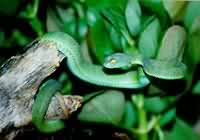
Green Pit Vipers

Indochinese Spitting Cobra

King Cobra

Malayan Pit Vipers

Malayan Krait

Sea Snakes

Siamese Cobra

Siamese Russel's Vipers

Venomous Snakes of Thailand


Banded Krait

Bungarus Falviceps

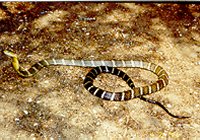
     This snake is found throughout Thailand, has very distinctive black and yellow bands and produces a very potent neuro-toxin.  However, the Banded Krait is nocturnal and during the day remains inoffensive and placid.  At the Snake Farm, in fact, you may watch attendants pick up a whole armful of these snakes.
     Like the King Cobras and Malayan Kraits, this snake prefers to eat cold-blooded animals, including other reptiles and other snakes.  It prefers dry places, and has been known to venture into human dwellings.  It bites readily and without warning at night.
     Clinical manifestations are similar to those of the Cobras, but pain and local reactions at bite sites are less and may be absent.  Mortality in Thailand may be high, possibly due to delay in seeking treatment with an almost painless bite similar to the Malayan Krait.
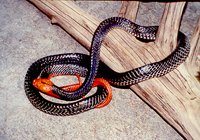
     You will be able to see another Krait at the Snake Farm: the beautiful, rare, and shy Red-headed Krait.  A human bite from this snake has never been reported, but it does contain a portent neurotoxin and is capable of inflicting fatal bites.

Green Pit Vipers


     Each member of the family Viperidae has a pair of large, hollow fangs located anteriorly on the upper jaw which are connected by ducts to venom-producing glands.  The fangs fold back against the roof of the mouth when it is closed.  They swing forward when the mouth is opened to deliver a strike.  Viper venom produces hemorrhagic blistering and extensive necrotic reactions at bite sites followed  blood clotting disorders.

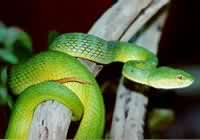
     There are at least 9 species of these snakes.  Also known as the “one step and you’re dead” snake, Green Pit Vipers were the most common cause of snakebite among American soldiers in Vietnam, although no mortalities were reported.  Today, Green Pit Vipers account for 93% of all venomous snakebites in Thailand.  Death from Green Pit Viper bites are rare, and is usually caused by bleeding disorders and shock.

     A pooled polyvalent anti-venom for this group of snakes is being made by our Institute.  However, the polyvalent Green Pit Viper anti-venom may not be effective against less common species of Pit Vipers.  Current research should clarify these issues in the near future.

     Not all Pit Vipers are green.  They have yellow or red eyes and most have reddish prehensile tails.  Their heads are triangular and distinct from their bodies.  Most Green Pit Vipers bite readily and are often encountered in trees or bushes, and in gardens.

Indochinese Spitting Cobra


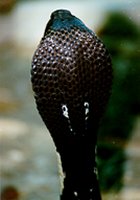
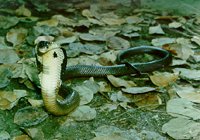
N.siamensis Hood Markings and Golden Spitting Cobra

     This snake, which grows to 1.5 meters in length, has hood markings which may be either spectable-shaped or U-, V-, or H-shaped.  The distinctive characteristic of this snake is its ability to spit its venom at a predator.  The fangs have an anterior opening, enabling the “spitting” of venom for a distance of up to 2 meters.  Venom spit into the eyes will cause an immediate burning sensation.  Left untreated, it may cause corneal inflammation and ulceration.

     The Indochinese Spitting Cobra is often confused with other cobras, and so the total geographic range of the snake is unknown.  It is believed that Spitting Cobra bites are more common than reported, since bites are usually reported only as “cobra bites”.  Recent studies have shown that anti-venom from the Monocled Cobra (Naja kaouthia) cross-protects against the venom of the Spitting Cobra.  This may or may not be the case with the other species of Spitting Cobra found in the South of Thailand, such as the Golden Spitting Cobra (Naja sumatrana). This issue is currently being studied further.

King Cobra


Ophiophagus Hannah Family Elapidae

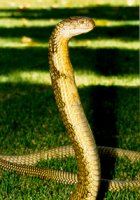
     This well-known snake, which is the largest venomous snake in the world with an average length of four meters, has recently achieved endangered species status due to the commercial value of the skin, meat, and bile used in Chinese traditional medicines.
     King Cobras bites are rare, and encounters occur mostly among snake handlers or persons attempting to capture this valuable animal.  Although Siamese Cobra venom is about 10 times as toxic as King Cobra venom on a dry-weight basis, clinical manifestations of a King Cobra bite are more severe due to the large quantity of venom injected.  The distance between fang marks in almost all snake bites is related to the snake’s size and severity of intoxication.  All snakes in the family Elapidae have two short permanently erect fangs on the anterior end of the upper jaw.  The King Cobra is easily identified by a long, narrow hood which is spread when disturbed.  Characteristics which distinguish the King cobra from other cobras include the lack of pattern on the hood and a pair of large occipital scales behind the parietals.
     King Cobras feed only on other snakes and lizards.  They prepare a nest and lay 20-40 eggs which the female guards.  This terrestrial snake is encountered both day and night, most often in forests and plantations.  King Cobras usually hiss loudly before striking, and are the only Cobra capable of moving its entire body forward while in the striking position. The bite of all Cobras (including Siamese Cobras, King Cobras, and Spitting Cobras) injects a paralytic neurotoxin into the victim.  This results in localized pain at the bite site, followed by difficulty with speech, swallowing, and breathing.  Death is due to respiratory paralysis and can be prevented by artificial breathing.

Malayan Pit Viper

Calloselasma Rhodostoma

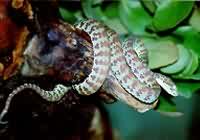
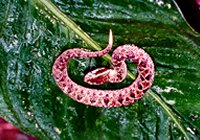
     This snake, like the Green Pit Viper, has a thermo-sensitive pit located between the nostrils and eyes which is used for finding warm-blooded animals.  The Malayan Pit Viper has a thick body and grows to only about 1 meter long.  Like the Green Pit Viper, its head is triangular and distinct from the neck, with an upturned snout.  Its reddish-brown surface has dark, triangular markings.

     Due to its camouflage, the Malayan Pit Viper is hard to see and is an occupational hazard to rubber plantation workers and farmers.  It strikes quickly and without hissing.  The poison of the Malayan Pit Viper has a potent tissue-destructive and hemo-toxic action that can cause severe necrosis of muscles, resulting in crippling amputations.  Mortality among hospital treated patients is rare in Thailand.

Malayan Krait

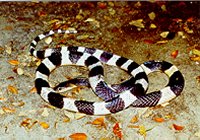
     This black and white banded snake is nocturnal and one of the most dangerous snakes in Thailand.  Malayan Kraits bite readily at times and without hissing.  In addition to this, the bite is virtually painless, and victims may neglect to seek proper treatment.  Farmers are the usual victims and are bitten when walking outdoors at night.

     Deaths from this snake are probably underreported, since most occur in rural areas, at night and unattended. Like the Cobra’s venom, the Krait’s venom is neuro-toxic and signs of paralysis may appear within minutes or be delayed for hours.  Up until recently, no anti-venom was available for the bite of the Malayan Krait and little clinical experience has been reported for this snake.  However, a study performed recently at our Institute showed that Banded Krait anti-venom protects mice against death from both Malayan Krait bites and Red-headed Krait bites.

Sea Snakes


     This large group (at least 22 species) of very poisonous snakes remains relatively unstudied.  Like the Cobras and Kraits, they are members of the family Elapidae.
     They are characterized by vertically flattened, oar-shaped tails and very small ventral scales.  They have small, fixed, needle-like anterior fangs.  These snakes are entirely marine, but are occasionally seen several kilometers within river estuaries.
     Venom from the Beaked Sea Snake is among the most potent known to man, and one drop (0.03ml) can kill three men.  A sea snake’s venom is neuro-toxic and diffuses rapidly.  One polyvalent sea snake venom has been successfully manufactured in Australia, but we are not certain whether it protects against the venom of all species.  Sea snakes are difficult to keep alive in captivity- another reason why sea snake anti-venom is presently unavailable in Thailand.
     When bitten by a sea snake, fang marks may not be visible, and this may give false assurance that no envenoming has taken place.  Deaths are almost always due to respiratory arrest and/or delayed hyper-kalemia due to widespread muscle destruction.  Human bites resulting in envenoming are rare and usually occur among fishermen who pick up snakes from nets or step on them wading in coastal waters.

Siamese Cobra


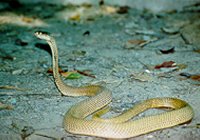
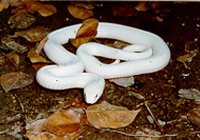
     Possibly the most dangerous snake in Thailand, the Siamese Cobra (known also as the Monocled Cobra) inflicts a bite which, if left untreated, may result in death after 1-6 hours.  This black or brown snake grows up to two meters long, and has hood markings usually shaped like ocelots or masks.  Albinos with red eyes are not uncommon.
     The Siamese Cobra is often encountered near human habitation, and is responsible for approximately 18% of all venomous snakebites in Thailand.  Its first defense,  is to flee.  But if cornered or threatened, the Siamese Cobra will raise the anterior third of its body, expand its hood, usually hiss, and strike if the predator comes too near.  They may strike with a closed mouth, but may also bite and hold on with a chewing motion.  It has been known to bite rice farmers wading in knee-deep water. The neuro-toxic venom of the Siamese Cobra is of low molecular weight and diffuses rapidly.  The toxin produces disorientation and paralysis due to anoxia caused by respiratory arrest. Although the action of the poison is similar to that of the King Cobra, the toxin itself is distinctly different and a different antiserum must be used for treatment.
     Virtually all neuro-toxic symptoms are reversible with or without anti-venom when good respiratory care is rendered.  The effect of the intravenously infused anti-venom is not immediate, and may require hours before respiratory assistance can be discontinued.

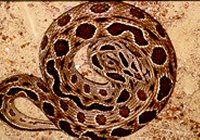
Siamese Russell's Viper

Daboia Russellii Siamensis

     This typical viper is related to the American rattlesnake and has the triangular-shaped head of most vipers.  It has a series of oval “blobs” along its back and is brown in coloration.  The Siamese Russell’s Viper may enter human dwellings, and is a major cause of deaths in rural Burma, where medical care is often not readily available.
    It relies heavily on camouflage to avoid detection, and if threatened will hiss loudly and may strike quickly. This snake produces a potent hemo-toxin which damages the red blood cells and often results in renal failure, requiring prolonged hospitalization and peritoneal or hemo-dialysis.  However, many human bites do not cause envenoming, even though fang marks are seen.  Pain is moderate at the bite site, and evidence of serious poisoning may appear within minutes or be delayed for hours.

Venomous Snakes of Thailand


     At least 175 snake species have been identified in Thailand, of which 85 are venomous.  All venomous snakes are so from birth and even newborns can inflict dangerous bites.  It used to be that about 10,000 snakebite injuries were reported in Thailand annually.  However, the incidence has been decreasing gradually over the past decade due to the exploitation of the snakes’ natural habitat.  Some snakes, such as the King Cobra, have even reached endangered species status.
    Despite a still significant incidence of snakebite, there are less than 20 snakebite deaths in Thailand every year, compared to 20,000 annual snakebite deaths in India, and 10 annual snakebite deaths in the United States.  However, all patients who receive proper medical care should survive.  The danger of snakebite is generally exaggerated, and Bangkok’s traffic poses a far greater danger than snakes and tropical disease combined.
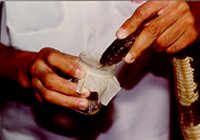
    Here at the Institute we keep more than 10 varieties of snakes for educational and breeding purposes.  Venom is extracted or “milked” from a snake every two weeks.
    Anti-venom is prepared in horses by injecting controlled doses of snake venom.  After about 6-8 months, the horses will be immune to the effects of a large amount of venom.  Serum from the blood of these immunized horses is effective in neutralizing most of the actions of venom.  Each kind of venom is used for the production of each specific anti-venom.  Therefore, serum from the blood of a horse immunized against the Siamese Cobra venom is effective for a case of Siamese Cobra bite and useless for a case of Viper bite or even King Cobra bite.
    Most snakes are not aggressive by nature and will attack humans only under provocation.  They see better at night and therefore will not naturally be seen  in broad daylight.  Snakes have no external ears and are deaf to sounds.  A snake can quickly perceive the approach of a footstep by the vibration conveyed through the ground with which its body is in contact.
    A couple flicks of its two-forked tongue is the means by which a snake tracks its prey.  The tongue, which lightly tastes the ground and air in front of the snake, is highly sensitive to scent particles left by the prey.
    Snakes are carnivorous.  King Cobras prefer live snakes, while water snakes eat fish.  Other species feed on rats, frogs, insects, etc.  A snake prefers food killed by itself.  However, close monitoring of the snakes’ diets here at the Snake Farm necessitates occasional force feeding, which does not hurt the snakes.  Once having fed, a snake will not require food for days.  Some will even adjust their dietary habits and feed on prey that they would not otherwise touch in the wild.


Note : This Web Site is a Private and  NON Commercial Web Site.  Some content and pictures of this Informative Page come from some other Sites.  So I am using it as it is, as I am thinking that it can save the Life of People if the message is sent Again and Again.  If there is some trouble, please let me know and I will remove this page immediately.

Hosted by www.Geocities.ws

1