|
|
Oppression |
|
|
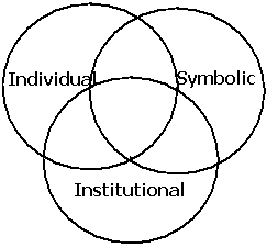
Dictionary dot com defines Oppression as, “A feeling of being heavily weighed down in mind or body.” From birth we are all born into different worlds of freedom and punishment which vary depending on many social factors such as our race, ethnicity, sexual preference, and gender. In order to understand these differing forms of privilege and punishment we must learn from where they come. Hill Collins describes the underlying factors of Oppression in three forms: The institutional, the symbolic, and the individual—each one overlapping on the other striving for space to control our lives. I believe this to be an overly simplified view; however, it does serve the generalized purpose and helps guide the discussion on the topic.
In another way, however, discrimination may not be totally an institutional problem, it can also be individual—a culmination of all the forms. Let’s make an example, a man and women are coming in to interview for a job. You are the interviewer. The position you want filled requires really strong work ethics, people skills, and self motivation. Now the male who comes in is a focused, well educated, energetic guy. Right off the bat, the guy is an amazing negotiator. You get the impression that he is a “go-getter with upper management material written all over him.” Now, the female, she is also a really strong candidate. She has proved herself well qualified in experience. She has lead many projects. She doesn’t quite go for the negotiation stance though, instead, she more or less just “lays it all out” and leaves her resume to “speak for itself.” Now, on one hand, while the male was up there negotiating or basically “tooting his own horn”, to the interviewer, he may have seemed as if he wanted the job more than the female, which couldn’t be further from the truth. She may not believe in bragging and making herself appear better than she really is, or, she could have been just displaying a sense of modesty. Now, these are not really gender differences, but psychological. The outcome also depends on many other factors as well—not just the interviewee’s but also the interviewer’s. In fact, the deciding factor lies with the interviewer; who do they relate to? If the interviewer is a conservative, middle class, white woman, unless they consciously avoid placing bias in the subject, they are more likely to higher the female than the male. To higher or firer somebody based off of your own individual biases towards or against a specific group based on their race, ethnicity, sexual preference, or gender is where discrimination comes in to play. This is also where we find the foundations for affirmative action. Now, before I continue with the individual form of oppression, to lessen any future confusion before it pops up, I want to go into the symbolic form. The symbolic form refers to all the different norms and labels society has been developing overtime to tell us what the average person from each particular facet is. Blacks are all good basketball players. All women are over emotional. Jews are cheap. Asians have slanted eyes and can’t see over the steering wheel when they drive. We grew up learning to place people into these different categories and also point them out when they detour from them. For example, how would someone respond to a man crying? They’d probably tell him to stop being a wuss and suck it up. This is because males are viewed as being dominant. These types of stereotypes are upheld by all aspects of difference. A black man may complain about how another black man has sold out his people by becoming white; this statement is a fallacy. No matter what a black person does in their life, unless they have some sort of medical procedure performed on them—like Micheal Jackson did—they will never become white. “I think I’d like to be rich now; so, I’m going to go down town, and sell myself out to become white by default—that way I can be successful.” The characteristics of a black man to be educated and successful have nothing to do with their somehow “selling themselves out”—as if such were possible. Personally, I’m Hispanic; however, my own socio-psychological aspect of self, or just my self identification for short, does not need to reside solely upon my race, ethnic, and gender background. To do so would only self perpetuate the different stereotypes by discouraging the characteristics not associated with the label—in essence upholding those same things that we as individuals find so frustrating to begin with. In another way, men enforce the rule of “no wussy men” in a sense of self based privilege preservation. In order to maintain that a specific race, ethnicity, sexual preference, or gender is dominant, an over-all atmosphere must be controlled. The presence of a weak, effeminate, heterosexual man in a masculine society creates an exemption to the sense of superiority of the whole and may work to undermine the foundations that that same sense of superiority is held up on. So, in this way certain precautionary measures would always be in force to ensure conformity. These measures can take on different forms to the individual male, like him not wanting to get the crap beat out him, to just wanting to have a girlfriend—because usually girls don’t like wussy guys. It’s just too confusing. Girls base their own sense of attraction on their own sociologically constructed stereotypical view of men. All men who don’t fit that category are ruled out as undesirable. Of course, this is usually not performed on a conscience level. Thus, goes to prove how stereotypes and biases are chronically ingrained—jammed into our heads over the course of our life; yet, at the same time, our biases can also be consciously over-ridden by recognizing and understanding our own socially constructed views.
After reading all this, it should be very easy to see how Dictionary dot com could describe oppression as a “weight” against the mind and body. We are all being weighed down and immobilized—stuck in a type of quicksand of conformity, too afraid to struggle out of the fear of being pushed down more—and that’s where we’ll stay, in a type of quicksand, until we can learn to work together and gain common grounds upon which to pull ourselves out. |