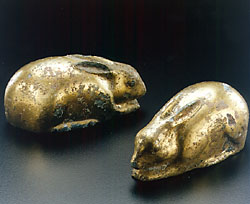
Pair of weights in gilt bronze |
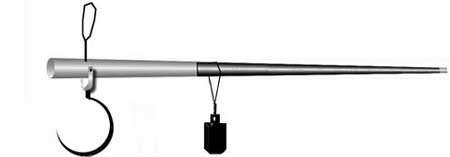
The steelyard is a Chinese invention. As early as 200 B. C., China began to make
a scale of this type big enough to weigh several hundred pounds. The steelyard consisted
of the following parts: an arm, a hook, lifting cords and a weight. The arm or beam
measured about 1.5 meters long, graduated with the weight units-jin and liang*. The hook,
hanging from one end of the arm, was used to lift up the object to be weighed. Hanging
from the other part of the arm was the freemoving weight, attached on a looped string. On
the arm was fixed one, two or three lifting cords, placed much closer to the hook than to
the other end. Anything to be weighed should be picked up by the hook, while the weigher
lifted up the whole steelyard, holding one of the cords. He then slid the weight left or
right until he found a perfect balance of the beam. He then read the weight from the
graduation mark on which the weight-string rested.