The
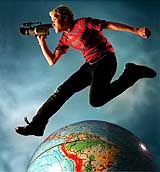
brat is back � By MELISSA FYFE � JOHN SAFRAN, 25, hasn't even got on the plane yet but he's grinning with mischief. He's found a DIY business card machine and printed some cards for his 100-day journey around the world, saying he's a terrorist and drug trafficker. In the Ansett buffet lounge, Safran's parents, Alex and Gitl, are wondering if their son will make it home alive. They're sure the ABC has made a big mistake and will soon discover their son is actually a bit of a dill. "The whole thing has burst on to us. We were quite unprepared and are still in a state of shock," Alex says. Yes, agrees Gitl, with a proud smile. "When we looked at his application, we didn't actually have faith in him." On the surface, Safran is an unusual choice. He doesn't particularly like travel or documentaries; dropped out of school because he considered it unethical and insincere; then he got into advertising. But Safran has proved to be a popular, if controversial, part of Race Around the World, a show that has captured the imagination of a nation of travellers. He first caused trouble for the ABC when he went to the Ivory Coast and put a voodoo curse on his former girlfriend. Like many of Safran's stories, it was premeditated. He had brought with him a photo of her and one of her letters. Even though he knew the woman would take the curse seriously, he went ahead with his film, titled The Right to Bear a Grudge. A chicken was sacrificed in the process (but later eaten by the villagers). Because of a live link Safran did with Triple J, his former girlfriend found out about the curse and threatened the ABC with legal action if it ran his film. Even though the woman was never identified, the ABC was thrown into a tizz and the film was slightly changed to be less offensive. In Rio de Janeiro, Safran went to a series of confession booths, telling the priests he had kissed a boy. He then compared the number of Hail Marys he was given by each priest. The film was never run because Safran did not get the priests' consent. ABC management thought the use of a hidden camera was indefensible. At Athens airport, on his way to Israel, Safran was detained for routine questioning. Officials were suspicious of his strange, frenetic itinerary and high-tech camera gear. But their suspicion was heightened when they found his business card. They eventually got the joke and Safran was escorted on to the plane and given a complimentary drink voucher. In Jerusalem, Safran explored the relationship between footy and religion, praying for his beloved Saints to win the grand final and running through the streets naked to prove his devotion. (He had to do that twice because he wasn't happy with the first take.) "I much prefer to go for the moral lowground, because then you can't fall any lower," says Safran, back in Melbourne. He played up against what he perceived as "ABC sensibilities". There would be no doe-eyed tales of woe from Safran. Besides, he says, he's no good at being serious. His reasoning for the voodoo story is blurred: he's not sure what's real any more. Safran, who thought the ABC over-reacted, says he's over his former girlfriend, now, but, at the time, there was some residual tension. "I don't feel bad about the voodoo thing," he says. "She's done stuff to me twice as bad but in more socially acceptable ways." And besides, he says, it was a funny idea. Safran divided the judges. Tony Squires, regular judge and Sydney Morning Herald television critic, loved him. When the Jewish Safran filmed himself being baptised and dunked in a murky river on the Ivory Coast, Squires said: "He's manipulative, he's dangerous, but he's good." Series producer Paige Livingston describes him affectionately as a big, loving marshmellow. But, after Safran's Lebanon story about a man with three wives, judge David Caesar (the bold-and-bald director of the film Idiot Box) described it as "s...house camera work by a smart-arsed Westerner going in taking the piss out of a soft subject". Caesar also accused Safran of going for a soft target when he did a story on an anarchist in London. He said if Safran was to make fun of someone, it should be someone like John Howard. Safran's retort: "Making fun of a conservative politician on the ABC, gosh, that's ground-breaking. He (Caesar) is obviously one of these jerks who's really laid down by dogma. What sort of schmuck thinks there's a list of characters you can make fun of?" Safran wasn't the only one who had a problem with the judging. The racers have described the judges' comments as ridiculous, silly, juvenile, irrelevant, stupid and insensitive. Racer Olivia Rousset, 25, says she was insulted when she saw tapes of the show, sent to her overseas. "I thought they were really belittling our efforts." So what were they going through? On the flight to Botswana, Kim Traill, 28, lost her backpack. She bedded down in a tent, which she discovered was full of mice. They munched through most of her remaining possessions, including a tube of toothpaste. She filmed her story but accidently taped over her best footage. Devastated, she rang Australia only to be told that the judges didn't like her first stories. "At that point, I just wanted there to be a lump on the back of my head, so I could say I had a brain tumor and bow out of the race gracefully," she says. She thought the comments were damning and that she didn't deserve or want to be there. "I just sat on the bed and stared into space." In Kazakhstan, the woman Traill was filming had a nervous breakdown. On the way to Bangkok, she sprained her ankle and the doctor told her to keep off it. Confined to a hotel room and bored to distraction, she lied about her improvement to the Race office so she could go to her last country, Laos. "That was a mistake," says Traill, who still couldn't run on her foot, two months later. In Laos, Traill wanted to film a story about Buddhist monks. She woke at 3.30am and painfully hopped two kilometres through the village to find that only a handful of monks had bothered to get up and chant. Scott Herford, 23, broke down in Morocco, and even Rousset, one of the most competent and impressive racers, says she broke down in Scotland, losing all perspective on what she was doing. In between moments of adversity, there was plenty of inspiration. In Mongolia, Bentley Dean, 28, was in the South Gobi desert when he had that feeling of travel zen. "I was looking over the desert at dusk, and there was this complete feeling of utter peace and sense of belonging there, and loving the country. Several times on the trip I'd be in an aeroplane or on a bus and for no reason whatsoever, you just get incredibly emotional to the point that you feel water welling up in your eyes, just because of the sheer beauty of where you are on the planet." Some racers came back with a reaffirmed belief in humanity. ("I thought the world was a bloody good place," says Claudia Rowe, 25.) Dean discovered in his travels that the poorer the person, the more generous he or she was. But Safran came back with his middle-class sensibilities confused. He was sick of being taken for a ride. In India, he gave away so much money that he almost had to beg at the airport for his departure tax. He understood people's motivation for trying to rip him off, but it wore him down. "I just don't want to say the world's great. People can be truly awful." says Safran, who is fast becoming a celebrity in his own right, appearing on Midday with Kerri-Anne and the ABC's Recovery program. The quality of the documentaries fluctuated but every racer managed to come up with some filmic gems that surprised everyone, including Race organisers. Ross Warneke, The Age's TV critic, says he thought three out of every four films were enthralling. "Some have been incredibly insightful, which I didn't expect." He adds that it was an ambitious program and the ABC deserves praise for taking the risk. The racers had mixed feelings when they got back. In the interviews he gave to the press, Herford seemed bitter and ungrateful. Rousset wasn't sure what to make of it all, and Ben Davies, 25, wasn't sure why everyone was being so sentimental. "I have found other racers I've seen so far - they look at each other to find solace and to confide," says Davies. "But I can't give it. I don't feel as though we've fought a hard game of footy together and we've come out at the end for a pat on the back. I don't feel that camaraderie." The racers are now taking up freelance opportunities and hoping the Race will launch their film-making careers. But television will probably never again let them be the star, camera person, director, writer and producer all rolled into one. For those who are keen to get in next year, the overwhelming advice from the racers is: be yourself. "Ultimately," says Traill, "you can't be anything else. But you must be completely nuts." Behind the Race The first series of the ABC's risky television experiment, Race Around the World, ends
on Monday. The idea, based on a Canadian show, was to pluck eight talented young things
from obscurity, give them $8500 for airfares, a $100 daily allowance, and send them around
the world for 100 days. When the ABC announced they wanted eight candidates for the first series in October last year, it was a dream opportunity for Australia's film-savvy and travel-bugged youth. The ABC received 25,034 inquiries from all over the country. Many were put off by the demanding application process but, eventually, 1345 hopefuls applied. This was culled to 16, who were sent to a month-long film course at the Australian Film, Television and Radio School in Sydney. The competition was cut-throat. Eight returned to obscurity, devastated, while the other eight embarked on their tax-payer-funded, global search for pathos and drama. The ABC has already sent out 20,000 application forms for next year's series. For an ABC program, Race rated well, attracting its target audience, the Triple J youth market. In Melbourne, it averaged between 185,000 and 190,000 viewers. Its main competition was Channel 9's In Melbourne Tonight, which rated in the 300,000s. Faces and places Kim Traill, 28, Wonga Park A tip for any future racers: "Don't go to 10 Third World countries. I wore myself into a hole in the ground." With her trademark heavy eyeliner, Traill is the oldest and most travelled racer. She trained as a classical clarinettist until distracted by travel. In Kyrgyzstan, someone offered nine sheep, nine horses and a goat for her hand in marriage. Traill, who estimates that she lost 30 out of 100 nights sleep while away, showed remarkable improvement over the series but, at first, the judges thought her voice-overs were preachy and twee. Daniel Marsden, 23, Ipswich, Queensland Marsden admits he would often procrastinate by folding up his camera and microphone wires and putting rubber bands around them. Despite his tardiness, he proved he had a beautiful and sensitive eye for film. But his flirt-piece with Miss Peru, filmed, last minute, on the way to the airport, was a low point. The judges crucified him. Said David Caesar: "It was like a bad home movie about him trying to get a root. She was as interesting as a cane toad." Olivia Rousset, 25, South Perth Rousset's family is Mauritian and this is where she went during the race to take a quick breather with the relatives. They call her a Mozzie there - a Mauritian Aussie. Rousset hit the ground running with her first story. In Los Angeles, she met Chris, a pharmacist from Connecticut. He was trying his luck in his first porno movie but his luck ran out when he failed to get "wood" (industry speak for an erection). Scott Herford, 23, Sydney The youngest racer, with no overseas travelling experience, Herford had the odds stacked against him when he was called from the Rainbow Temple ashram in Byron Bay to replace Deborah Mandie, who pulled out 10 days before the racers were due to leave, throwing organisers into a panic. (The opening sequence had been shot.). Herford came back exhausted and bewildered. "It was the loneliest time of my life. It was a war and a marathon." Claudia Rowe, 25, St Kilda Rowe studied media at Deakin University but earns a buck waitressing. She is a hopeless romantic and the Race was a great excuse to go on a world-wide search for love. She found it on a beach in Miami. There she was, sitting with her new-found beau, when a man walked past, heading towards the water. Fully clothed, he entered the surf and the couple realised he was trying to kill himself. Rowe's date saved the day, proving himself not only a beau but a hero. John Safran, 25, North Balwyn Safran hated his first documentary. Attempting to film the homeless in Japan's underground train system, he got stuck in a stairwell overnight. "Seriously - and I'm not just saying this to do that cute '90s self-deprecation thing - but my first documentary is the worst thing made by man or woman or child since the beginning of time." It took him 20 minutes to watch it when he returned to Australia. "I'd watch three seconds, pause, cringe and run around the house to get it out of my system." Ben Davies, 25, Bondi, NSW During the Race, Davies certainly showed he was versatile. One minute he was with Guatemalan cowboys, wrestling anacondas and catching piranhas, and the next he was interviewing Jacques Verges, a powerful French lawyer, who has defended some of the most notorious criminals of our time, including Carlos the Jackal. "I wanted to meet Jacques for two years. There was so much anticipation. Coming out of that interview was a high point," he says. Bentley Dean, 28, East Brunswick Nicknamed "Bad Boy" Bentley, Dean admits he cared more about his films than his deadlines. Dean filmed the long-necked women of Thailand, who, with their ringed necks, are exploited as a tourist attraction. At the start of the film, he turned the camera on himself and asked a long-necked woman what he looked like. Like a monkey, she replied. Back in Melbourne, Dean, a film student, went straight into assisting with the short film Tangerine Dream. � |