Instrument-Building, page 1
table of contentsInauspicious Beginnings
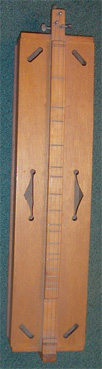
When I was in Cub Scouts more than forty years ago, we made maracas by covering lightbulbs with papier mache, painting them, and whacking them to break the glass inside the papier mache. Those were pre-safety days, and the results were quite satisfactory.In my last year of college I made a dulcimer stick, that is, an Appalachian dulcimer with no body, just a neck. Set it on a desk and it has all the soundbox it needs. After college I raided it for parts to build a dulcimer with a rectangular box made of 1/4" "mahogany"-face (what was dismissively referred to as Philippine mahogany, which is maybe the same as luan?) plywood. I made the box extra-deep to compensate soundwise, so I was thinking anyway, for the box being plywood. I still have that lovely. My dad was getting into woodworking in a serious way, so I had access to some tools and help. The neck for that dulcimer is a piece of nearly straight pine that I found laying around the garage. It turns out he had been using it for a straightedge. When he told me that, I just rolled my eyes, and he bought a real straightedge, a nice aluminum meter-stick.
 My dad's dad was a cabinet-maker
by trade. That meant, among other things, that he had work while others didn't
during the Depression. My dad took up woodworking about five years after his dad
died and stayed with it seriously till he died about nine years later. He was
interested in furniture and bowls. I was interested in musical instruments and
indeed have always been fascinated by any kind of musical instruments � the
places where those most concrete arts of woodworking and metalworking meet up
with that most abstract and fleeting of arts, music. In museums I want to see
musical instruments. In people's homes I visually scan for musical instruments.
I have read books about the history, construction, and working of nearly every
kind of musical instrument. The Worldwide Web has been for me mainly a means of
learning about and looking at musical instruments. I own musical instruments I
play passably, barely, or not at all. I have made instruments as a way of taking
part in that activity where handiwork enables music, to have something that may
not look like much but that I can play. I have very seldom played for others. My
attitude (and it does have an attitude sometimes) has been that what I do for
fun should not become work done to meet the expectations of others. I am far
from being or even becoming a skilled woodworker or a talented musician. I know
only as much as need to do what I want to do, and often not even
that.
My dad's dad was a cabinet-maker
by trade. That meant, among other things, that he had work while others didn't
during the Depression. My dad took up woodworking about five years after his dad
died and stayed with it seriously till he died about nine years later. He was
interested in furniture and bowls. I was interested in musical instruments and
indeed have always been fascinated by any kind of musical instruments � the
places where those most concrete arts of woodworking and metalworking meet up
with that most abstract and fleeting of arts, music. In museums I want to see
musical instruments. In people's homes I visually scan for musical instruments.
I have read books about the history, construction, and working of nearly every
kind of musical instrument. The Worldwide Web has been for me mainly a means of
learning about and looking at musical instruments. I own musical instruments I
play passably, barely, or not at all. I have made instruments as a way of taking
part in that activity where handiwork enables music, to have something that may
not look like much but that I can play. I have very seldom played for others. My
attitude (and it does have an attitude sometimes) has been that what I do for
fun should not become work done to meet the expectations of others. I am far
from being or even becoming a skilled woodworker or a talented musician. I know
only as much as need to do what I want to do, and often not even
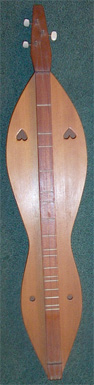
that.I built two more dulcimers. One had a body made of the same plywood, only triangular, and with a fancier headstock. I gave that to my sister, and I haven't had the nerve to ask if it still exists. It's been more than thirty years, and she has lived in four states on two coasts. The other was from a kit I bought from Constantine's. But my angel of non-conventionality watched over that project as well (I haven't decided whether that angel is fallen or not), so I turned the dulcimer around backwards. I didn't mean to, but I noticed more slowly than glue and then more quickly figured out I could make it work.
About three years after that flurry I came across a drummer's practice pad, the kind from Remo with a real head on it, and decided it should become a banjo. I had been looking at the banjo diagrams and instructions in Foxfire 3 and listening to a lot of clawhammer played on fretless banjos by the likes of Frank Profitt, and that sounded like something I'd like to do. My storebought banjo just wasn't right for that. I got started on a neck made of a 1 x 2 of nice-looking maple and gathered up some stray tuners, but then life intervened and the beginnings of a banjo went into a box for about twenty-six years. continued