This page is just started, but anyway here are some of the present and former inhabitants of the orphanage:
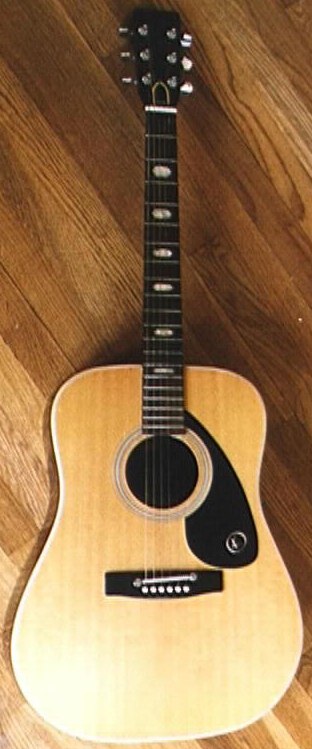 A few months after I got out of college and, more importantly, had got a few paychecks, I was mall-walking and saw this guitar in the window of a branch of Kay Kalie Music. It had its back to the window, a case under it, and a price tag: $139.95. I went in, the guy showed me a similar-looking Martin D-35 with a (ahem) higher price, and I walked out with the guitar.
Kay was one of the old Chicago-based mass-market manufacturers, but this is from after the Kay company was gone and the name had been taken over by an importer. It was made in Japan by Teisco and is sort of Martinish in appearance. The top is laminated spruce, the body laminated Brazilian rosewood except in the middle of the of the back there's a triangle of maple or somesuch. I've replaced the awful adjustable saddle with a real saddle. I installed a JLD Bridge Doctor because plywood, while it won't crack, will bend. During a moment of raving insanity I considered replacing the top with a real spruce soundboard. But then there are some real nice-sounding acoustics from China for less than $400.
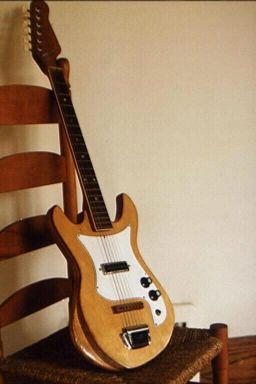 $7.95 at Goodwill
It's a typical very cheap Japanese guitar of the 1960s. The body shape is inspired by Mosrite, the headstock by Fender. There was a �Decca� plate on the headstock when I got it:
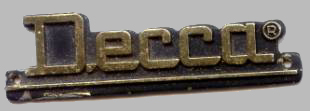
That's as in the Decca record company, which imported such wonders. Michael Wright�s Guitar Stories Volume One has photos of a catalog from which this can be identified as a model DMI-227. Wright doesn�t say what factory produced these guitars, but that headstock shape and string retainer can be seen on lots of Japanese electrics of the time.
It's a short-scale (23�") minimal noise-maker. The bridge bass is chromed hunk-o-metal. The bridge tops on these were one-piece plastic or metal similar to what you might see on a Gretsch guitar with a Bigsby, but mine didn't come with that, or with tuners. The catalog says that the body is mahogany. Well maybe the inside layers of that plywood are "mahogany," i.e., luan, but that's some sort of blonder stuff on the outside layers.
I stripped blue paint off the body. With that came the original black to clear honey-ish sunburst. I refinished it clear, whittled a lousy bridge out of some scrap koa, and installed some tuners. More recently the bridge has incorporated a bit of aluminum tubing. And lately my son and a friend of his have grafittied and stickered all over the guitar. I'm thinking of turning this into an octave mandolin, if I can figure out how to do that.
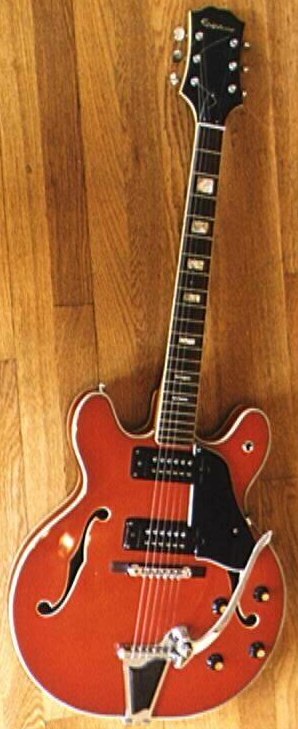 $100 at Goodwill
This is from 1970, the first year of imported Epiphones and was made in the Matsumoku plant in Japan. The story is in Walter Carter, Epiphone: The Complete History. The body is hollow except for a � x �" block from top to the bottom under the bridge. It's a model 5102T, which became the EA-250 after some minor alterations. Mine has a tune-o-matic-style bridge, but I think the original was a roller bridge. There is lots of bling on this guitar.
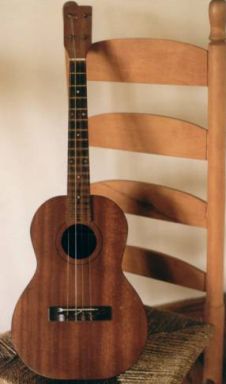 A baritone ukulele, probably from one of the Chicago manufacturers (Harmony, Kay, or Regal), $7.95 at Goodwill. Really nice to play.
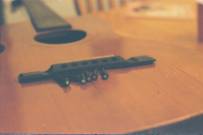
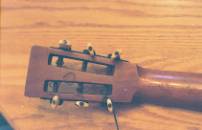 A Washburn guitar from 1896 according to a guy who would know. I bought it for $18 at an antique mall and sold it quickly for more than that. It was quite cracked up.
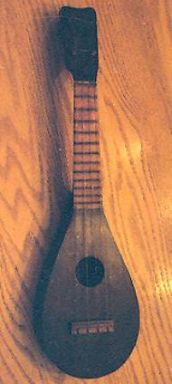 I don't remember where this ukulele came from or what it cost, but I got $50 for it, which was probably about 900% profit.