Planning the Bass
This will be a neck-through fretless bass with two J-style 8-pole
pickups and two piezo-ceramic disks and the tuners at the wrong end.
The neck will be four layers of 13/16" maple with
mahogany veneer between the maple layers. I'm using the Bill
Moll bass plan from MIMF
as a guide for the profiling of the neck ('cept for the headstock). The
full 3¼" width will be kept in between the body halves. The
(no-)fretboard will be rosewood with a 9" radius at the nut opening to
a 12" radius at the bridge. String spread 1½" at the nut, 2¼" at the
bridge. There will be some simple inlay markers offset to the bass side
of the board. Maybe mahogany binding or a mahogany veneer layer under
the board. The ball end of the (flatwound) strings will be at the
headstock end, sort of Steinberger or Kubicki-style.
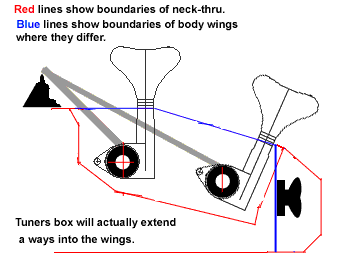 The tuners are black
imitation Gotohs. They will be mounted in a cage south of the bridge
attached to the neck wood and made of neck wood and/or blackened
aluminum. The tuners will be turned so that the buttons (possibly
replaced by knurled knobs) are pointed at the audience. Cutaway side
view to the left.
The tuners are black
imitation Gotohs. They will be mounted in a cage south of the bridge
attached to the neck wood and made of neck wood and/or blackened
aluminum. The tuners will be turned so that the buttons (possibly
replaced by knurled knobs) are pointed at the audience. Cutaway side
view to the left.
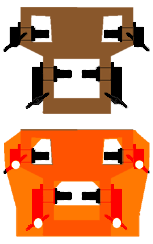 This top view shows the tuners in their cage
with and without its lid, which ought to be of the neck-thru wood, for
pretty. The animation isn't terribly effective because it doesn't show
the tuner buttons over the lid, but think of this as a design picture,
not a picture picture.
This top view shows the tuners in their cage
with and without its lid, which ought to be of the neck-thru wood, for
pretty. The animation isn't terribly effective because it doesn't show
the tuner buttons over the lid, but think of this as a design picture,
not a picture picture.
Why put the tuners at the wrong end? I complain a lot about instruments
being neck-heavy (not the Ibanez bass, though, because its body is made
of basell bat ash and weighs as much as your sister). It must have
something to do with the shape of my body (I weigh more than
your sister). So I'm grabbing a bunch of weight off the end of the
lever--the headstock and tuners--and putting it where it can help.
 The body
will be pine on top and mystery whitewood underneath. Some kind of
carving on the top, a belly contour on the back. The piezo disks will
be on the underside of the pine, one on the treble side and one on the
bass side. There will be a bit of air between the top and the bottom to
free up the pine for a bit of vibration, though I'll have to check
whether the piezos work better mashed or wiggled (see Trout Cove
Lutherie for the distinction). I might use some of the
mahogany for body binding.
The body
will be pine on top and mystery whitewood underneath. Some kind of
carving on the top, a belly contour on the back. The piezo disks will
be on the underside of the pine, one on the treble side and one on the
bass side. There will be a bit of air between the top and the bottom to
free up the pine for a bit of vibration, though I'll have to check
whether the piezos work better mashed or wiggled (see Trout Cove
Lutherie for the distinction). I might use some of the
mahogany for body binding.
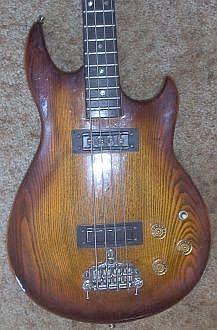
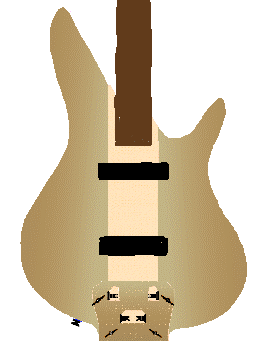
I've been tossing around too many ideas for the shape of the body,
including one that follows the outline of my 1977 Ibanez (that's it on
the left) and some far more involved. But I've settled on a
simple design (on the right) that is a modification of the
body in the Moll plan. In the picture you can see the extension of the
neck-thru to accomodate the tuners and how the (no-)fretboard, the
neck-thru, and the body wings are related.
The electronics will be in the lower treble bout as
per normal, but will show through a recessed mahogany panel in the side
rather than through the top. Pickup selector for the J-pickups, blend
or selector for piezo vs. J, final volume and tone. I'm not planning to
incorporate a preamp right away, but the piezos might need one (though
I've found some of those to be surprisingly hot). Since the premade
bobbins for the Js assume a wider string spread, there will be a
stainless steel blade set across the top of the poles. Pickup covers
(with the blades sticking through) will be of wood.
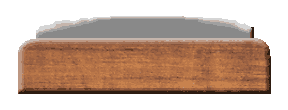 The bridge will be a simple
hunk of stainless steel set into a hunk of wood. It'll look sort of
like the J pickups when viewed from the top. That's a lame picture
there, but it gives the idea.
The bridge will be a simple
hunk of stainless steel set into a hunk of wood. It'll look sort of
like the J pickups when viewed from the top. That's a lame picture
there, but it gives the idea.
The finish:
- yellow stain on all the wood, then
- red or brown or red-brown stain to produce a hand-done
(violin-style) burst, then
- oil and wax
-
I'll post something on the sources of parts next.