Doc's Galapagos Trip 2002 ...
Or... How to see peculiar reptiles in the mud,
and have fun doing it.
NOTE: You can view larger versions of the pics by clicking on the pic.
|
|
Doc's Galapagos Trip 2002 ... Or... How to see peculiar reptiles in the mud,
NOTE: You can view larger versions of the pics by clicking on the pic. |
Our 12 day trip to the Ecuadorian Islands of the Galapagos (Archipelago de Colon) in early December 2002 gave us days that were increasingly more remarkable as time went on.
QUITO:
|
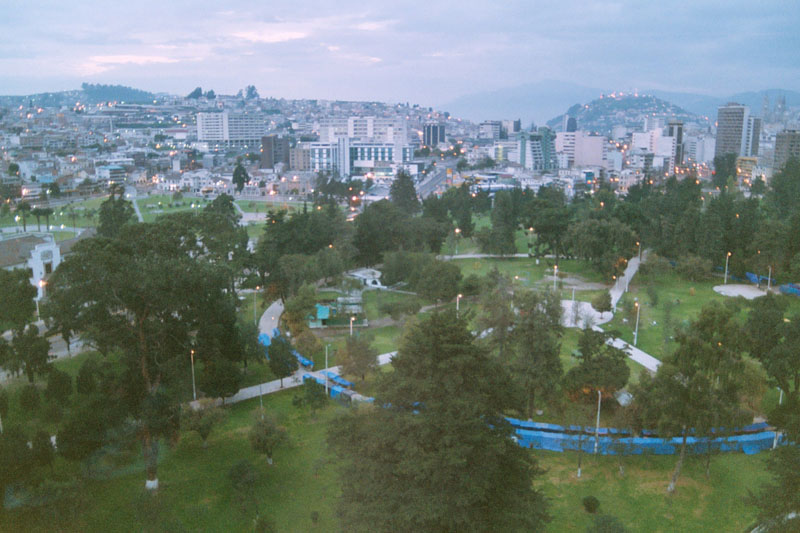
Quito at Dusk |
American Airlines took us from Miami to Quito where it is Eastern time and the national currency has been switched to US Dollars. At 9000 feet the air is thin and the sun is quite effective. It's also cool at night... in the 50's or less. Pam's relationship with the Hilton Colon made the late night arrival an easy transfer. The incoming customs was fairly brisk and baggage could be self handled or a porter would assist your exit through the throngs of those waiting for relatives or to offer transport. The Hilton had a rep there with a bus, but it was obvious that you could easily get to any hotel of your choosing. The Hilton's Executive Floor handled everything we needed including free internet service. Food was a bargain anywhere, even room service at the Hilton. Obviously, even better prices were available at local restaurants. Due to connections to the Galapagos, you are pretty well stuck with an overnight in Quito. We elected to arrive in Quito after our 4 hour Southbound flight on Saturday evening so that we could spend a full day on Sunday sampling the local crafts markets that lie next to the Hilton. |
|
In the Parque del Ejido directly to the South of the Hotel (Also referred to as Rio Amazonas Park as this Avenue dead ends into it) there were 200 or so stalls that were arrayed with everything from Galapagos "I Love Boobies" shirts to intricate arts and crafts, elegant clothing and weaving. By our US standards, the prices were 1/2 to 1/3 of what one might find in the US for similar goods. Just to the NE corner of the Hilton is a permanent artists market with solid structure covered flea market stalls. Fabulous artwork-quality clothing and carvings are available at startling prices. A lovely leather & cloth weaving patchwork sweater was $28, the matching (huge) shawl $33. Tagu, a nut that when carved looks like ivory, was everywhere. Quito is a huge city best done in the daylight. Stay in the market parks. We are both extremely observant and this helped prevent one directly attempted assault when we strayed a mere 30' outside of the park area. It was a little tense for a few seconds but we both dealt very effectively with the two goofs who squirted barbecue sauce on us from behind, then tried to be kind and point this out to us. Maybe it was the 4" lockback knife (now in airline checked baggage) I always carry that gave them second thoughts or maybe it was how Pam and I instinctually split up and began to encircle them instead, however they gave it up as we exited the area. On other streets, we were being sized up quite often. (In a one hour walk we had 6 solid contacts). Best advice: Don't fall for the ketchup trick, stay out of the "old city", be absolutely aware of your entire surroundings (front/rear/side), do not let approaching throngs of women or kids near you (cross the street immediately). Stay inside the market areas of the Parks. |
 |
GALAPAGOS:
| The Monday transfer from the hotel to the TAME (Transport Aero Military Ecuador) facility which is located just before (S) of the International Terminal is very early in the morning. TAME insists that we arrive at 05:30am, two hours before the 07:30am flight from Quito via Guayaquil (don't even THINK of going out of the airport there) to Baltra (Galapagos). Go to the far end of the hall first to what passes as a special area for ensuring that you are not importing any alien critters to the Galapagos, a protected area. They may ask to open your suitcases. You will exit this space directly at the TAME desk for the flight to Baltra Galapagos. Then you will wait in this line until 06:40 when they will finish handling all other flights and passengers and turn their attention to the next immediate task of the day, sending you and all the other annoying tourists on your $400 round trip flight to paradise. TAME (Typically Angry Malevolent Employees). It as at this point that you may or may not be advised that you have exceeded the 20 kilo (44#) limit per person and that you will now have to pay in cash $1.72 per kilo additional. They may also charge you the same extra upon your return from Baltra. If you are nice they may ignore it or charge you less. We had both occur. |
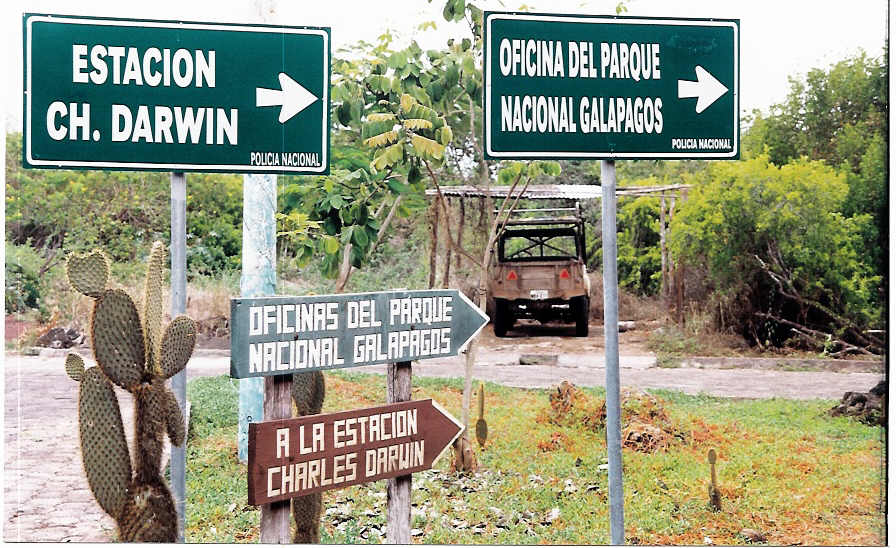 |
Do not drink the coffee in the TAME waiting area without test sipping it first. There. I warned you. Ladies: Wherever you may go, carry tissue with you. (Obvious good advice for any international travel). The flight is 2 hours to fly the 600 miles west into the Pacific where the Equator meets 90 degrees West Longitude. Try to sit on the Port (left) window side of the plane as this is the prevailing wind approach giving a glimpse of the Islands. (Sit on the Starboard when flying back {to Quito} for the spectacular view of Gordon Rocks. When you get to Quito, you can make a same day flight Northbound but will need a $25 departure tax). The Baltra Island airport (Central Time Zone) is where you have the $100 in cash ready and will willingly hand it to the National Park representatives for the glimpse of heaven you are about to have.
If you are on a live aboard vessel, you will take a pre-arranged short ride
to the bay just to the SW that your ship is moored in. We had been on live aboards
and have also done land based in the Galapagos previously. For many reasons,
we prefer the land based, but it depends upon you. Let me tell you why we chose
land based dive ops... Live aboards are the only way to get to Darwin and Wolf
islands. These are a very very long trip to the NW of Baltra. You will also
dive often
the islands nearby Baltra. You will be with predominately US citizens. You will
eat the same cook's food each day. Your bed will rock. You will be wet for a
week. You are locked into a "week" schedule on most boats that Rodales
refers to (Jan/Feb 2003, "Top 100") when they say, "The only
way to dive here is by live-aboard and RSD readers wouldn't have it any other
way". So much for the magazine that "now incorporates Skin Diver".
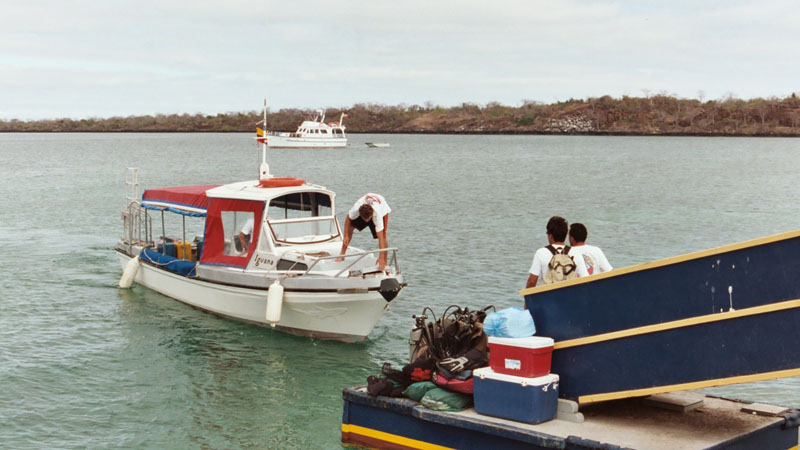 Scuba Iguana's boat |
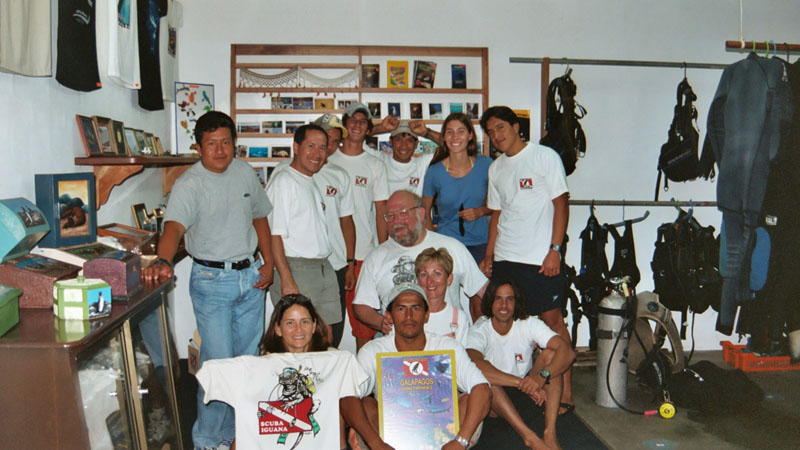 The Dive Staff |
We once again selected Scuba Iguana (www.scubaiguana.com) in Puerto Ayora to do our diving. From island of Baltra, there is a bus that can and does go nowhere else but to a ferry dock. $.70 will get you across to Isla Santa Cruz with your gear. The bus line continues South for an arrow straight 25 mile trip over two volcanoes to the Southernmost town of Puerto Ayora. You can do this for $3 or you can request a driver who will load all of the dive gear that TAME charged you to haul and he will take you and it through all of this for $40 in a 4 seat pickup truck. We thought it was worth it, although by Galapagos standards, sheer extravagance.
 |
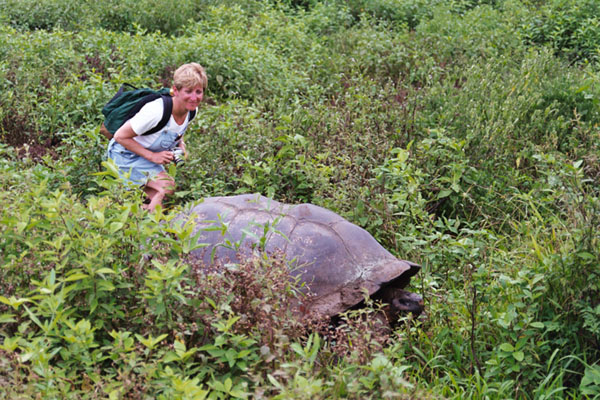 |
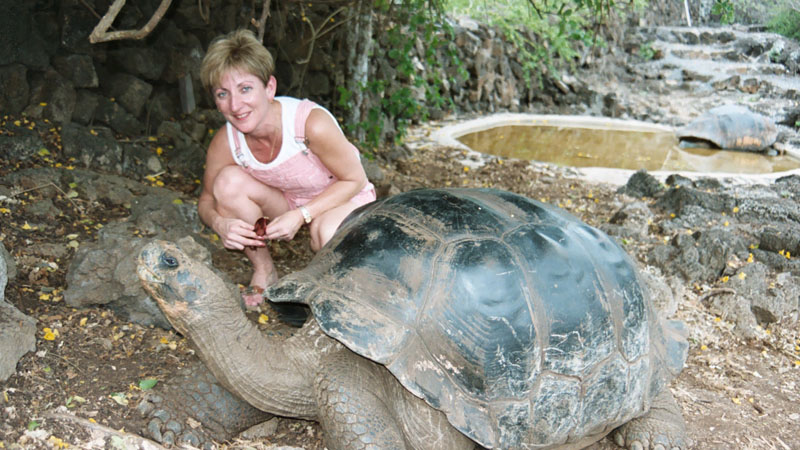
You go from sea level at Isla Baltra to 850 meters and then back down to Puerto Ayora. Along the way you may see the huge Galapagos Land Tortoise in their natural environs of the highlands, you may see sunshine at the sea and clouds and rain in the micro climates above. Ask your driver to stop for a moment at the crest of the Volcano top where the road bisects two long dead volcanos with a mere 100' wide strip of rock in between (Gemelos). You will pass signs that advise "Cuidado, Cruces de Tortuga" (Turtle Crossing) which is as much a warning to save the creature as it is your life as well.
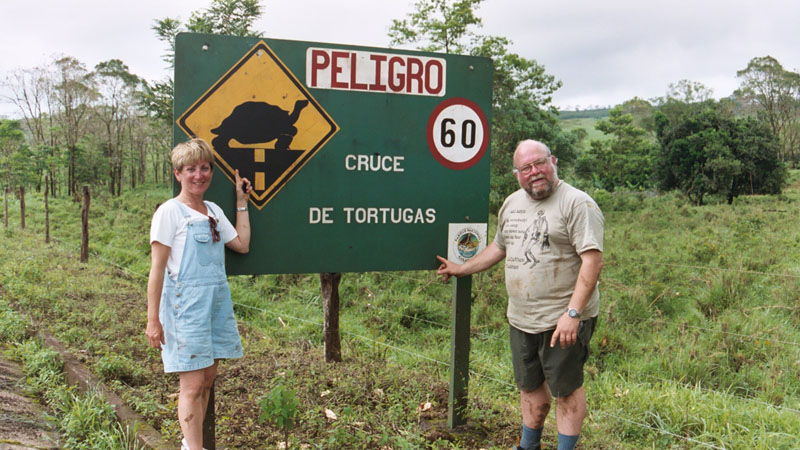 That would be mud all over us, honest! |
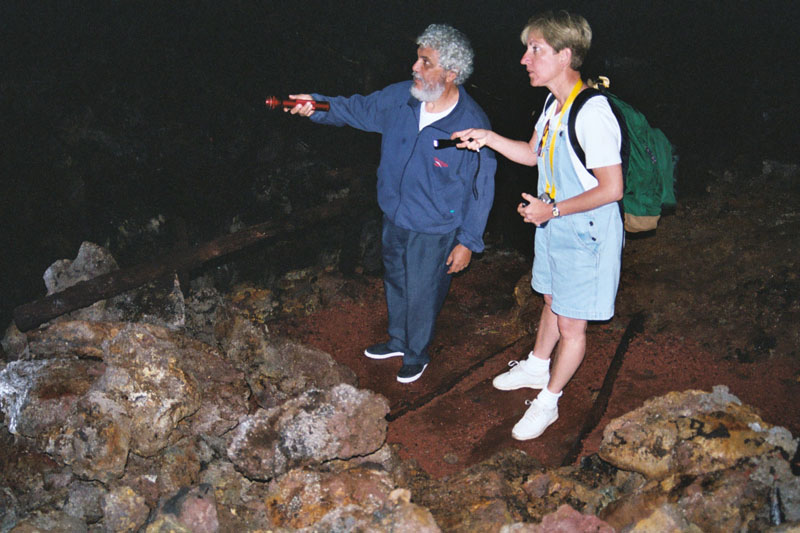 Touring Los Tunelos with Oswaldo |
Along this road there is also the Millennium Resort where is located the Lava Tube (tunelos) tour led by Oswaldo. He spent the 60's in Chicago as a photographer (it turns out that we worked for the same masters) and you have no doubt that he was indeed there when he says he went to Woodstock and hung with Janice Joplin in California. He has lighted the caves that were just discovered in the last 7 years in a manner that, although currently limited, is esthetically pleasing. We paid $10 for two for this tour on our last off-gassing day. During that last day, we hired a driver at $10/hr who, besides taking us to the two aforementioned features, also took us to a private reserve and interpretive center for Land Tortoises. These guys are really big, some shells 48" long. They include rubber overboots in the small fee, maybe it was $3. Included also, your driver will take you for a walk through their lava tunnel. Both tunnels are indeed lighted, but we always travel with a Mag Lite AA mini (1 each) and that proved very useful for a detailed look at these geologically very young tunnels that were beginning the cave encrustation process. This second cave did involve crawling on your stomach through a narrow 2' high constriction. We got a light smearing of Galapamud, but it was well worth it. Neither of these are for the infirm, uncoordinated or claustrophobic. We always carry a day pack with water bottles, etc. Our driver loved the Fig Newtons.
|
In Puerto Ayora, this is the place where you will find the largest of the Galapagos population center and commerce as well. Any Sam's Club handles cash in a day that would represent the total transactions that occur here in a year, but it is a town that has balanced the thriving 60,000 tourists per year (A Galapagos Islands total figure) with a quaint Ecuadorian/European ocean village. With El Nino approaching once again (as in 1988) we were expecting cool and dry, but instead it was quite moist for the first few days. Never once did we need rain gear, but the Gore-Tex coats always went along for apres-dive comfort. You can walk the ten minutes from one end of the town, along it's one main road, from the main landing for all visiting boats (including the live aboards) all the way to the far end which terminates at the Darwin Research Station and pass delightful little shops with all levels of artwork, food, internet access... whatever young traveling people might enjoy. We visited a different restaurant every night, drank liters of beer for $1.70, and even found "Coke Light" which curiously comes in silver plastic bottles- to be used later for water. The grocery store right near the landing was the largest and had a small variety of cookies, crackers, bread and even peanut butter or tuna fish that would provide some of our romantic dinners! |
|
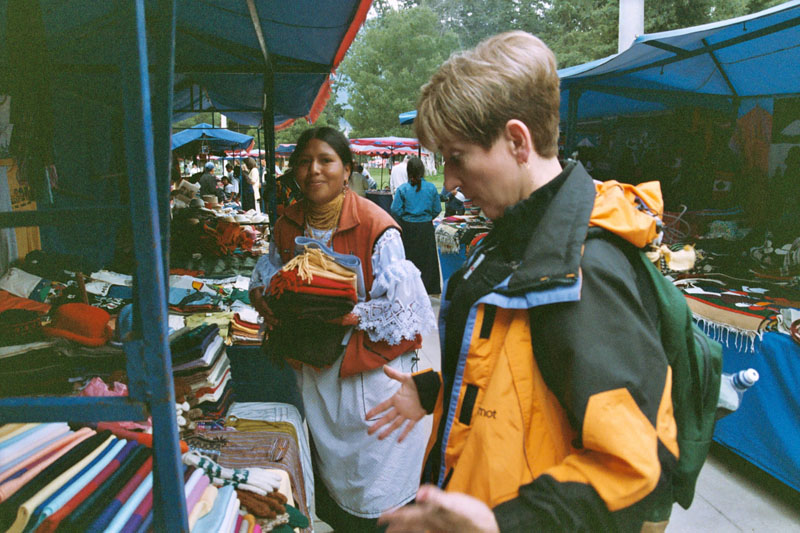 Doc foolishly said "Buy them all." ... so she did! |
The rum was very cheap at $3 for a bottle and the pepper was indeed remarkable. Vanilla and Cinnamon came home for the holidays. Pam bought many items of Ecuadorian craft as well as eclectic Euro style modernism. At the edge of the Darwin Research station is a nice gift shop that has surprisingly low prices on "official" clothing. The station is not handicapped accessible, but isn't anywhere near as arduous as our underground adventure. It is open during the daylight hours and you may walk unguided (or not) and observe the increasingly well interpreted displays and exhibits. This is not the natural environs for the famous Galapagos Land Tortoise, but the Research Center has many varieties on display, including "Lonesome George", the last of his species known to exist. His presence is a sobering reminder of the effect of non indigenous species introduction. Earlier seamen introduced the goats and pigs that have decimated their food source. Eradication programs are prosecuted vigorously and are effective. Other displays allow you to walk amongst these living behemoths that may be 150 years old. Bring your camera! |
| Just before the gate for the Research station is where we stayed and dived. The property is called the Hotel Galapagos (which indeed is partially inside the Darwin Station) and can be found at http://www.hotelgalapagos.com This is a property that is at home in this natural surrounding. Your bungalow's front view will be of a cracked lava flow rock that is home to the land and marine iguanas. The place is owned by them. Seals come to your feet. Pelicans fish in the shallows. It is situated in such a way as to become part of the Galapagos experience. The owner Jack and his staff have not changed perfection. The water is reverse osmosis purified, the showers are hot and the towels are crisp and dry. We paid $100 cash/night for a room that included a breakfast enough to start the dive day. Evening meals were priced at $20 each. |
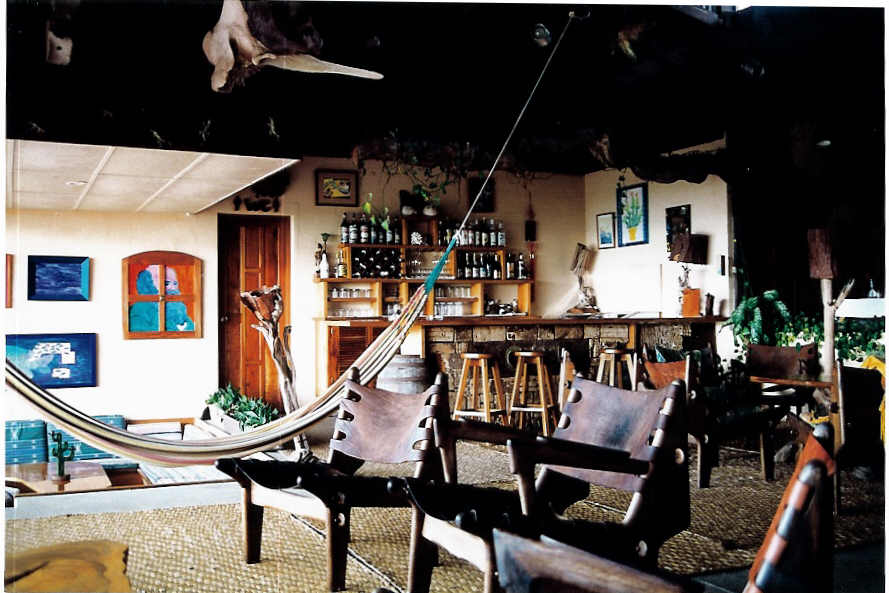 Hotel Galapagos |
|
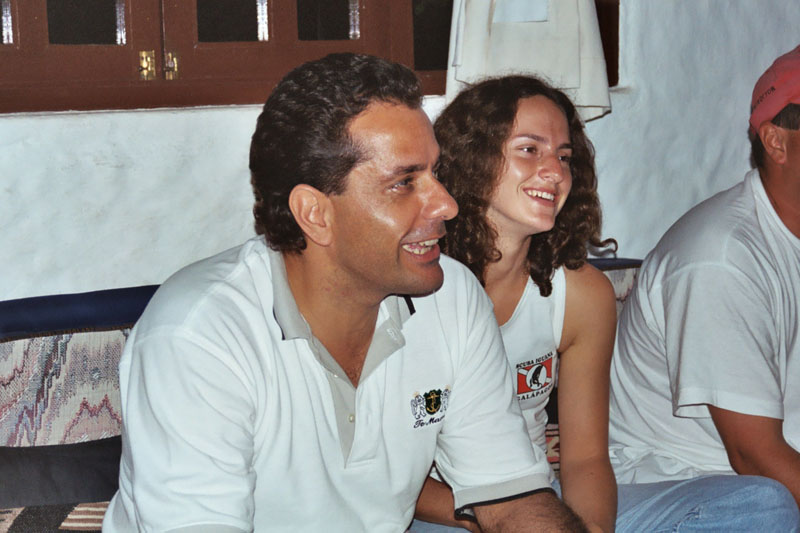
Mathias Espinosa & Maria |
Part of the property is Scuba Iguana http://scubaiguana.com and is owned and operated by Mathias Espinosa. (Try searching GOOGLE using his name and IMAX) Mathias appeared in the recent IMAX 3D film, "Galapagos". He is a "Guia" (naturalist guide) for the Galapagos Parks, a representative of the Parks to the Government and an incredible source of diving knowledge and experience. His staff is well trained and attentive. His dive op features gear that I should have used instead of dragging my wings and regs along. The boat is a covered 35' vessel that comfortably held 12 total divers. It was powered with twin 85 hp motors and had a head for the ladies and roll up plastic drapes for the side windows. For $110 a day, you got two dives and lunch- discounts for multiple days. (If after the first day, you'd rather eat the rice and meat dishes that the crew enjoyed, they may shake their heads, but you'll probably like it better than the extravagance that they go through for your meal) The diving starts in the local "Academy Bay" where they do their orientation dives. On this dive, we checked or weights and saw schools of "Mobula Rays", white tips, a 24" octopus and lots of sting rays. The second dive brought us to "Dance with the Seals". Pam literally started crying tears of joy as they playfully poked and nipped at us. They took great sport in zooming about us, but also allowed close interaction for all. There was a cracked wall and swim through where a 4' (not kidding) sting ray holds court. A white tip crowds you over to swim through. |
| Galapagos diving is a different experience for most of us
US divers. It is often described as "advanced" but nobody tells
you what that really means. If you have 400 dives in the Caribbean you are
not advanced. The Galapagos combines lateral current (that can be extreme)
that necessitates not thermal protection gloves, but common cotton/rubber
work gloves. You hand over hand yourself over the barnacles. The 72 degree
water was do-able even by Pam who is always cold... she wore a 5/7, I wore
a 3/5. We wore no head gear. Obviously, on a live aboard, there are other
considerations such as more than 2 dives/day and the decreased recovery
factors caused by the stress of the marine shipboard living environment,
so 7 mil with hood would be advised. Buy a pair of $4 gloves at Home Depot.
SI was unfamiliar with Halcyon and integrated weights but adapted quickly
and dealt with lifting them over the gunnels well. They deal in feet/psi
as standard. Live aboards use inflatables and similar rigid hulls, so you'll
have to be comfortable with back roll entries and drift diving recoveries.
Bring your surface signal gear, be aware of how to use it, but don't plan on it. |
Academy Bay |
Now here's the "advanced" part: In certain dive sites there may not
only be lateral currents, but vertical as well. Listen carefully to the Dive
Master briefing. What they mean when they talk about upwelling and down welling
should be pre-visualized before the situation. You will be flying along in the
current and pass over pinnacles (looking like sea mounts) where you must "fly
the plane on instruments". Buoyancy skills have to be on the money. SI
at first limits these exposures to the final portion of your dive where you
may already be at 40' after a prolonged exposure at 80'. (You may be holding
on to the volcanic rock for 10 minutes in 80 feet watching the hammerheads circle-
divemasters will share air with a 7' octopus with those who suck air) At this
later and final ascending stage, you will learn about upwelling. Then, if the
water is full of air bubbles from the churn (you may see bubbles going DOWN
past you), you will find that air in your BC won't float you in
water that has so much air in it. You will begin to descend. Take this initial
venture as a lesson to learn.
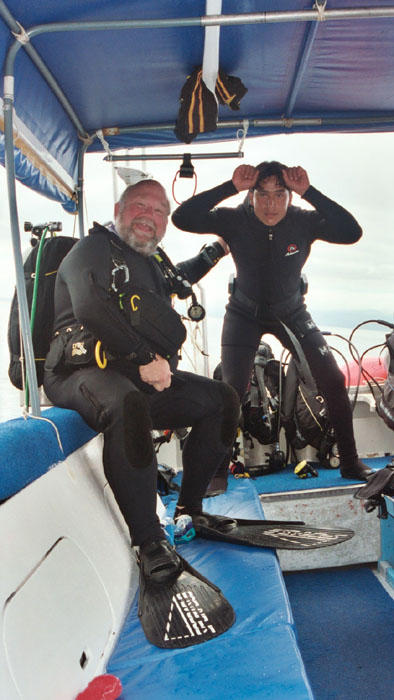 Doc & Pepo |
We were joined on one day by two older (our age) US divers who werethere early to dive before the Aggressor trip they had booked. They refused the orientation dive in calm inshore waters and then took 22 minutes of fussing around in open sea (as we sat on the gunnels) jerking around with her Force Fins and his Bio Fins and deciding whether to wear a hood. He had a video camera with lights (don't plan on any close ups) and both of them ran OUT of air without advising the DM of half full status - as was asked in the briefing. All in all, we preferred diving with the younger crowd that included 20 to 30 year old British, Aussies, Spaniards, French and others. Pam was brought to the surface by a DM when she reached 750 psi, but the lead DM "Pepo" and I would suck it down to my 300 after 1 hour and then surface. We saw squadrons of creatures. Hammerheads, White Tips, Galapagos Sharks, little critters, too. The two most common Nudibranchs were a small (1") blue black which was hunted always by the larger (3") version of a different species. There are two common sponges that adhere to the flat contours, one grey and one yellow. Orange Cup Coral was out and sparkling even in the daylight. The locals wrote this off to the commonly occluded viz (50' max), but I had never seen it out and feeding in anywhere near this light condition. In short, we saw everything that the people see on a live aboard. I compared notes with some that we met in the town and airport. I have chatted with them in previous years. I've been on Galapagos live aboards. So that's how we made the choice to go with a land based operation. Another operation that I would rate a distant second would be Nauti Diving which is also located on that same main street. Scuba Iguana, though, is far and away the best choice, superior to most Caribbean operators. Scuba Iguana will leave it's boat at Baltra, 30 miles North, and will take you by cab to the boat to explore islands such as San Salvador Elizabeth, Pinzon. From it's home base of Puerto Ayora, we went to Santa Fe and Gordon Rocks. |
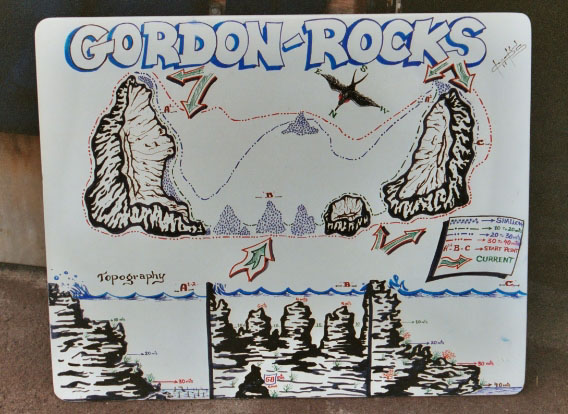
| Gordon Rocks is best described as an underwater volcano. You
will glide around the remnants of a crater, over the pinnacles of an eroding
wall, all the time looking at hammerheads, rays, seals and more. The next
day, you will stand atop a 2600' collapsed lava dome, then crawl in a lava
tube 150' below the earth. NB: Quite often working there is the French author of any number of Galapagos Diving books, Pierre Constant. Check your bookstore under Galapagos/Ecuador. He is well known in this area of expertise and he stays with his groups at the Hotel Galapagos and dives with Scuba Iguana. |
 |
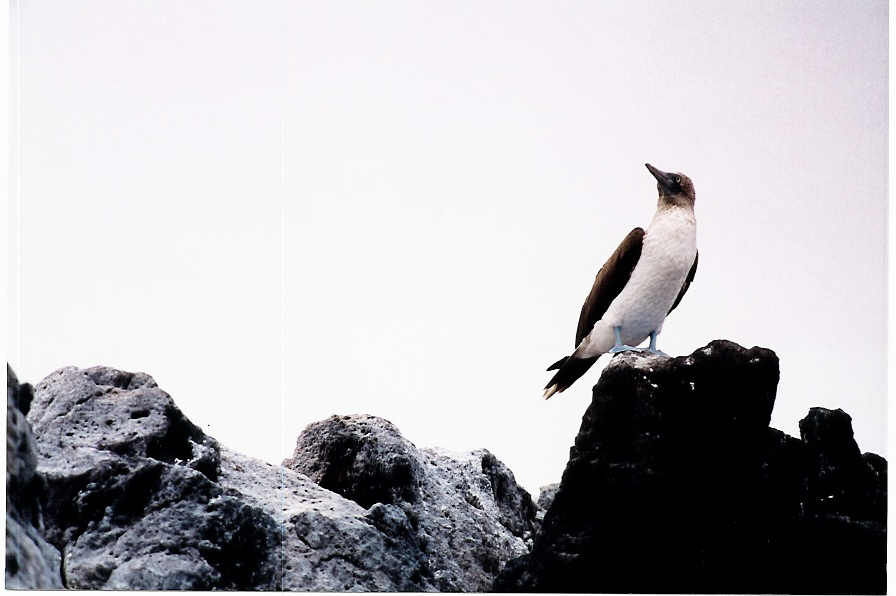 Blue Footed Booby |
 Darwin in Action |
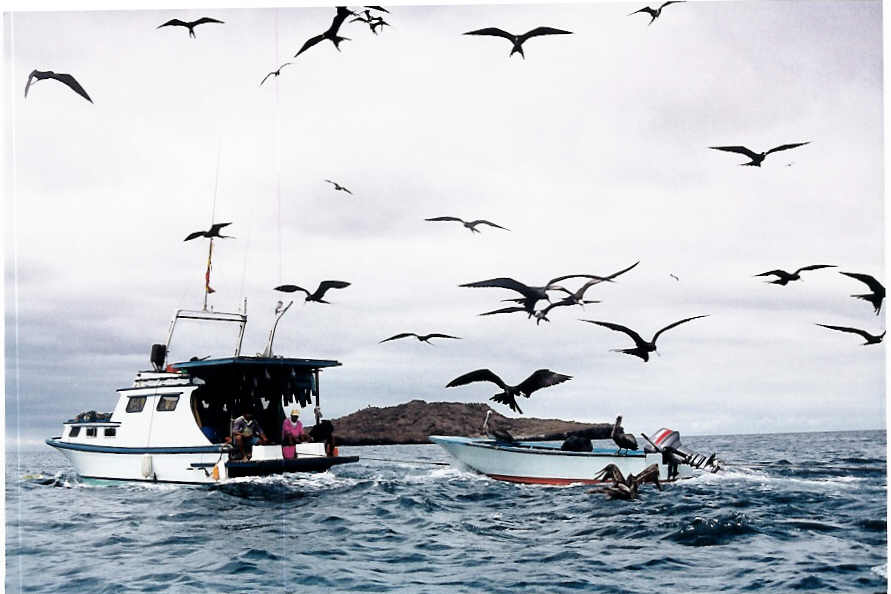 Dinner on the Fly |
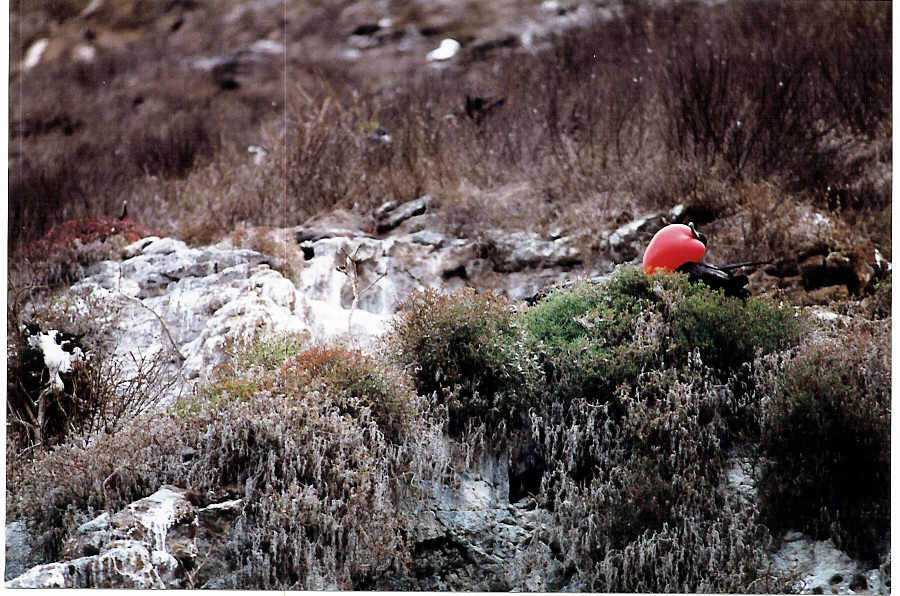 Frigate Bird Display |
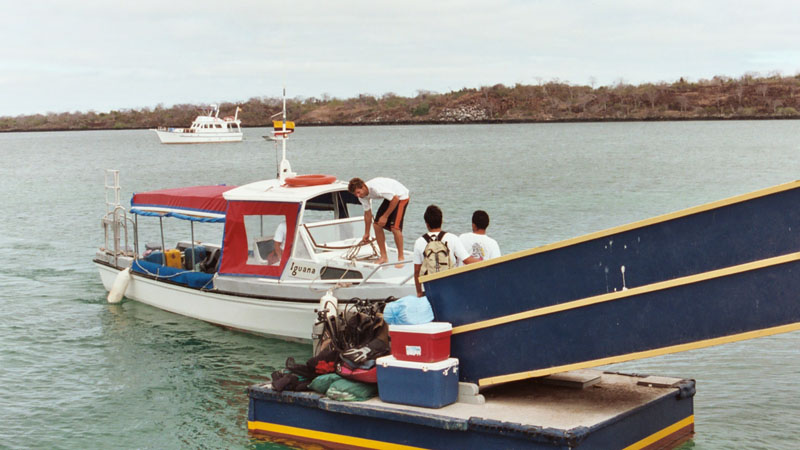 Gearing up for the dive. |
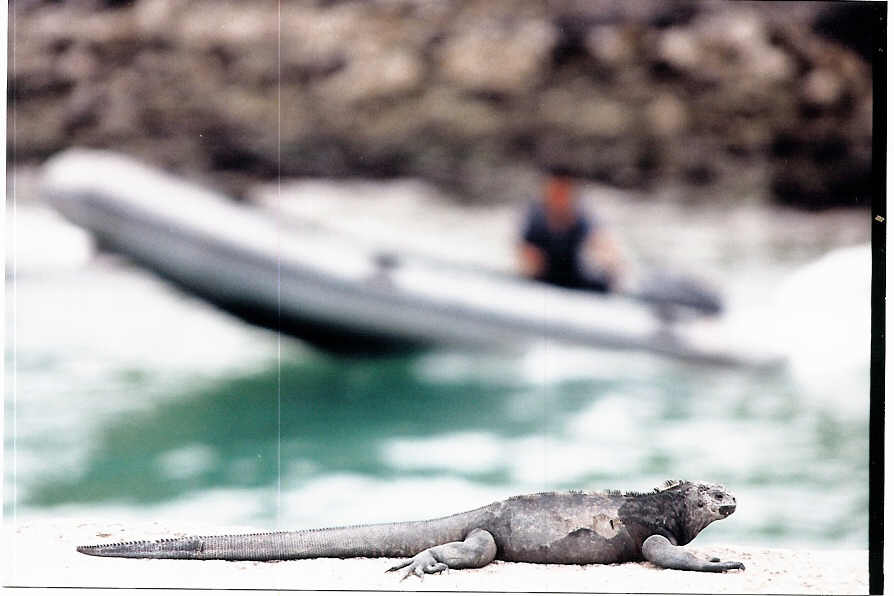 Marine Iguana |
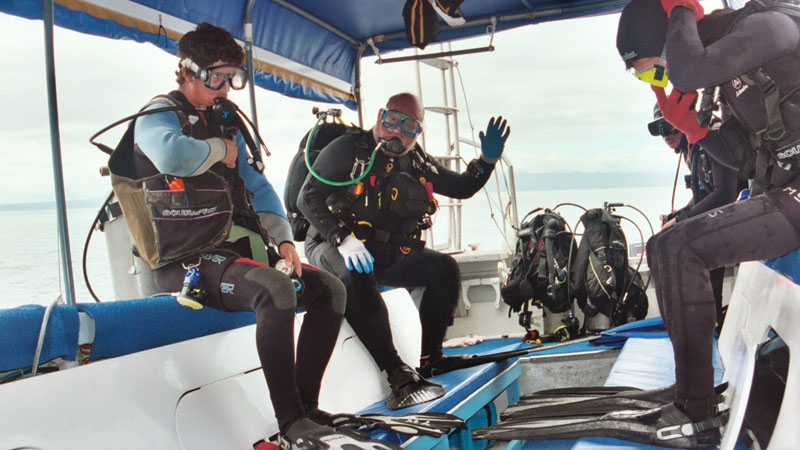 Men in Black |
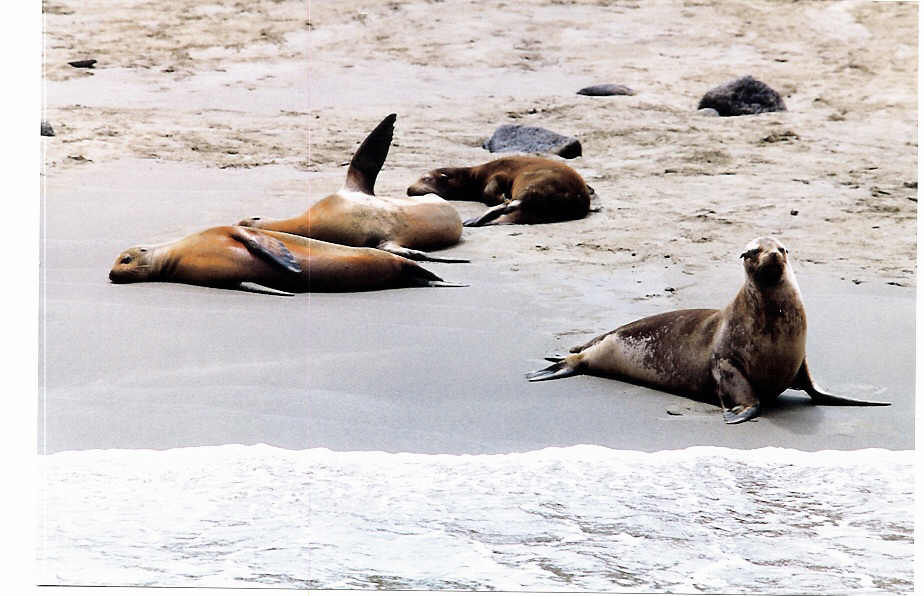 Pam's best friends |
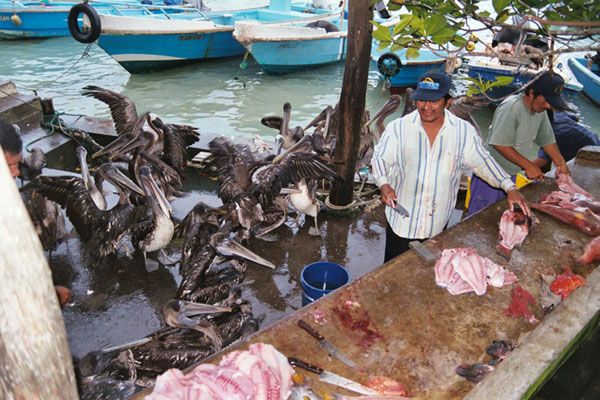 Pelican Buffet |
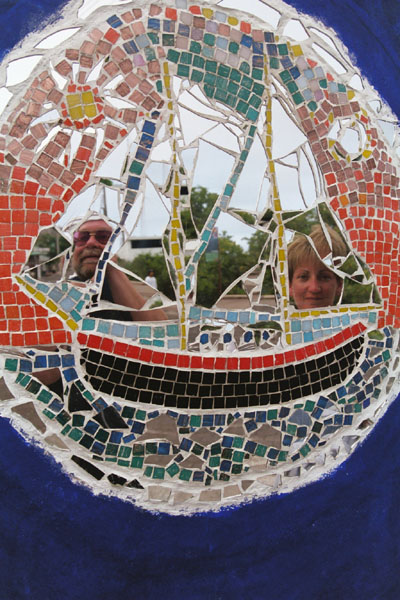 Seven Days Good Luck |
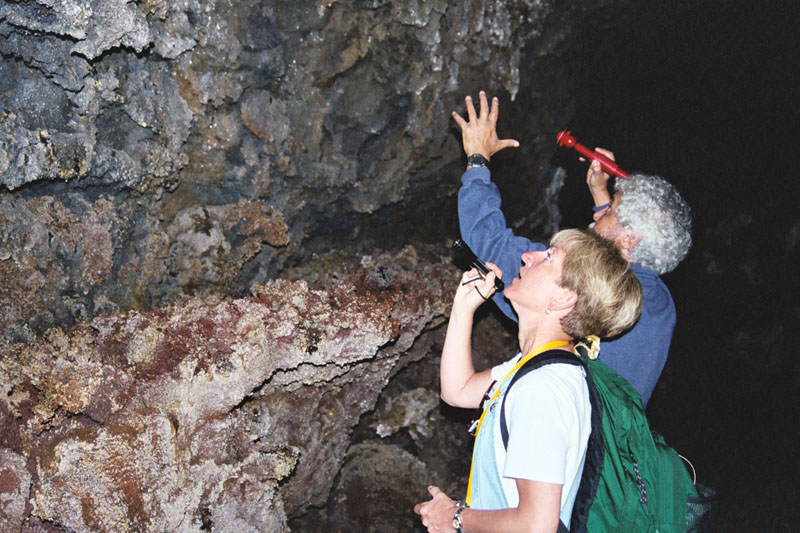 With Oswaldo in the Tubes |
NB: Mathias also has a few CD's available throughout the Galapagos. One is Sons of Galapagos II, the other is Iguanamen. Both are excellent.
If you have any questions in regards to Galapagos diving or specific travel destinations, always consult http://groups.google.com/ If you have any unanswered questions about what we consider to be a quite viable option, the land based dive op, please feel free to write.
You can contact Doc at [email protected]