Oliver C. Fletcher and His Descendants
This chapter takes up the lives of the Oliver C.
Fletcher family where it left off in Kentucky Oliver C. was the son of John and
Elizabeth (Harvey) Fletcher of Adair County, KY.
Oliver, his wife, Jane (Harvey), their daughter Martha Ann, and John Wesley, son
of Oliver Fletcher by his first wife, Elizabeth. Roberts (see chapter 2, page
82), moved from Adair County, Ky. to Cole County, Missouri in 1843. Nancy M. was
born to them in 1844. She was deaf and dumb. (1850 U.S. census of Morgan County,
Mo.) James D. was born to Oliver and Jane 28 Dec. 1849.
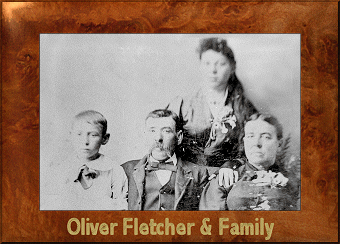
The following expert from "The History of Henry and St. Clair Counties, Missouri" by Goodspeed, published in 1883, page 1181 and 1182 gives valuable information on the Oliver C. Fletcher family. The expert features James, son of Oliver and Jane Fletcher.
JAMES D. FLETCHER, farmer, section 8, is the son of Oliver Fletcher, a native of, Kentucky, who was there married to Miss Jane Harvey, of the same state. They came to Cole County. Missouri, in 1843 where James D. was born December 28, 1849.
In 1854 the family came to St. Clair County, Missouri, and here our subject was reared and attended school. He has since followed farming in this county except from 1869 to t874. which time he spent in Texas, the Indian Nation and Arkansas. He own a farm of 160 acres. August 3 1879 Mr. Fletcher married Miss S. Lyons, a native of Indiana They have one children. Walter S., (at that time)
Later
they had Carrie J., Sarah Martha 'Mattie', Dora H., and Frank.
Sept. 1850 - Birth of William P., son of Oliver and Jane.
By 1850, when the U.S. census was made, the family had moved to Richland
Township, Morgan County, Mo.
1850 U.S. census -The Morgan County, Richland township,
Missouri census list Oliver and Jane with children; John W. age 17, Martha Ann
age 9, Nancy M. age 6, James age 1, and William age 1 month. Both Oliver and
Jane is shown as 33 years old. The two oldest children, John W. and Martha Ann,
attended school within the census year. The birth place of Oliver and Jane is
listed as
Kentucky. John W. is listed as being born in Illinois, Martha Ann in Kentucky
and the other children in Missouri. Oliver's occupation was farmer. Nancy M.
died sometime between the census years 1850 and 1860. She does not appear on the
1860 census.
1853 - Martin Harvey was born to Oliver and Jane at Morgan
County, Mo. He evidently was named for Oliver's uncle, Martin Harvey.
1854 - The Fletcher family moved from Morgan County to
Osceola, St. Clair County, Mo.
22 Dec. 185? - The following is a promissory note to
Thomas N. Henley of Osceola, MO. It is signed by Oliver giving us a sample of
his signature. This and other promissory notes, dated 1 Jan. 1856, 19 April
1859, and 24 Nov. 1860, plus other debts show that Oliver was having a hard time
making ends meet. Records of all these debts are available but are somewhat
repetitious and all will not be entered here. These records were found in the
St. Clair County courthouse by Marilyn Hatridge. We are fortunate to have any
records at all from St. Clair County. Not only was the courthouse burned in 1861
by Jim Lane, but it also burned in the early 1900s. These records
are some of few that escaped that fire.
Twelve months after date we or either of us promise to pay Thomas N. Henley,
administrator of the estate of Henry E. Moran, deceased, sixteen dollars and
fifteen cents for value received,
negotiable, and payable without deflation or discount and ten per cent interest
per annum from due date until paid. Witness, our hands this 22 day of Dec. 185?"
Signed by Oliver C. Fletcher
and Pinas R. Dunn.
29 March 1856 through 8 Sept. 1860 - Oliver had an account
with. Halm who probably owned the general store at Osceola. The total bill was
for $24.67. The debt was paid 10 March 1866. (Original record available)
1 May 1856 - Eighty acres of land was granted to Oliver C.
Fletcher. The description reads; east half of Northeast quart,
Section twenty-eight, township thirty-nine, range twenty-five. Entry #47,038.
(Original record available)
7 Oct. 1856 - Oliver was granted forty more acres of land.
It was the northwest quarter of northeast quarter, section twenty-eight,
township thirty-nine, range twenty-five, and lay next to the eighty acres
granted to him on 1 May 1856. Entry #49,793. (Original record available)
2 April 1860 - Another forty acres was granted to Oliver
C. Fletcher. Certificate #58067. Book 152 - page 119. This made a total of 160
acres granted to him. The land lay five miles north of Osceola in Osceola
Township. 'The History of Henry and St. Clair County states; "This is one of the
central townships of the county. The Osage River passes through it from
northwest to southwest. With the bold outlines of it's rugged cliffs, the
density of it's woodlands, and the winding of it's beautiful river, Osceola is
one of the grandest townships in St. Clair County. The Osage River, whose high
bluffs, magnificent caves, and it's valleys and ravines, gives it a most weird
and fanciful appearance. The richness of it's soil and the mineral wealth of the
hills and bluffs makes the township a most desirable place for man's
habitation".
1860 - The U.S. census for St. Clair County, Osceola
Township, shows Oliver C. and Jane with these children; John W. age 25, Martha
Ann age 19, James D. age 12, William P. age 10, and Martin
H. age 7. Oliver and Jane's age was 44. Oliver has real estate value of $700.00
and his personal property value was $600.00. All children except John W. had
attended school during the year.
20 Dec. 1860 - The beginning of the Civil War. - Between
800 and 900 men, from St. Clair County, volunteered for the Confederate cause. A
small minority joined the Federal cause and many more probably would have if the
Kansas Jayhawkers had not destroyed Osceola on 22 Sept. 1861, but Jim Lane and
his murderous followers of thieves and assassins came near driving out all Union
sentiment from the hearts of the people. (Goodspeed history, page 964)
The following account of the devastation brought to Osceola by the Kansas
Jayhawkers was published by Goodspeed in 1883.
THE BURNING OF OSCEOLA BY JIM LANE
The "Border War" was known all over the United States long before the first
cannon boomed at Sumter, and grew out of the questions that had long been
agitated, whether Kansas should be a free or slave state and it culminated in
the election, the freeholders carrying the day by small majority. Jim Lane and
others of less notoriety began a warfare all along the frontier counties in
Missouri, bordering on Kansas. This grew more bitter when Missouri began
retaliation. crossing the border
into Kansas and committing many depravations in revenge for deeds that had been
committed in their state.
It was these bands that afterwards became noted as the Missouri and Kansas
guerillas. Jim Lane long before 1861, had threatened to make a raid on Osceola
for the purpose of robbing the bank at this point. Osceola, at that time was the
great metropolis of southwest Missouri, and in fact, it was the greatest
commercial city west of Jefferson City or southwest of Boonville. The people of
St. Clair County had nothing to do with casting illegal votes in the Kansas
election, nor had they taken any part in the border war. About the first of
December, 1860, Jim Lane collected together about one hundred and fifty of his
followers and started for Osceola. After moving his band as far east as
Papinviie, he retraced his steps back across the border line, and his band
disbanded subject to the call of their leader. The cause of his sudden change of
mind was that the citizens of St. Clair County had been informed of the object
of his visit, and had collected in force for the defense of their beautiful
county seat. Fully five hundred well armed men were ready to met him and they
remained on guard till all danger was over. Lane kept up his agitation of a raid
on Osceola, and pictured to his followers in glowing colors the vast amount of
wealth that would be secured from the town and bank, but they well knew that the
old pioneers would never give their consent, and that the streams
would be dyed with blood as long as the old Virginians and Kentuckians, by whom
the county was populated, had strength enough to level the ever ready and never
failing rifle. Soon after this futile attempt of Lane's the thunder of battle
sounded along Columbia's southern shore. Fort Sumter fell, star after star shot
from the cluster of states, and southern blood and valor were at fever heat and
rallying to arms. 1861 was here, and war was inaugurated. The blaze of battle
began to scorch the fair fields of the sunny south, and the great commonwealth
of Missouri was suffering terribly from invading armies on three sides of her,
she being almost a desolate daughter of the Southern Confederacy.
Illinois joined with Kansas and sent untold numbers of plunderers into the
richest districts of Missouri. Banks were robbed, the wealthiest citizens
plundered, stock driven off, and wagons and teams stolen and loaded with the
goods taken from the people, and wearing , apparel and
jewelry of every description was taken from the ladies.
There never was a richer field for plunder than Missouri in 1861. The people
flew to arms. Old men and boys alike, regardless of age, formed themselves into
home guards for protection against the numerous bands of outlaws that overran
the state. Guerilla bands were organized all along the bloody border, and a
jayhawker and guerilla war began in earnest. Old men and boys were murdered by
the jayhawker bands for opinions' sake, and "blood for blood" became the
rallying cry; and
to give a more bitter aspect to the feeling, black flags were unfurled by both
parties, and the glare of the burning houses served to show where the human
monsters had left their prey.
As men were now hurrying off to join the regular army the Missouri border was
left pretty much unprotected, and the Jayhawkers widened their field of
operations. In September, 1861 while General Price's army was at Lexington, and
no Confederate soldiers in St. Clair County, except a few stragglers and
recruiting officers, Lane considered his chance for carrying out his long
neglected threat of burning and sacking Osceola. It stands on the right or south
bank of the Osage River,
and is one of the healthiest towns in the West, being situated upon a beautiful
elevation 200 feet above the river bed and surrounded by beautiful, rolling
ridges at the foot of which gush forth springs of sparkling water of the finest
quality and taste. St. Clair County was settled up by a thrifty and enterprising
people who turned their attention largely to stock raising, and a majority of
them had grown wealthy before hostilities begin. Men of wealth and enterprise
bought property in Osceola and went into business. The town is considered at the
head of navigation although the boats have ascended as far up the beautiful
stream as Taberville, or near the western boundary of the county.
Boots ascended the river as far as Osceola regularly before the breaking out of
the war, and the town became the great shipping point for eleven counties in the
Southwest, and goods were also hauled from this point to Benton County,
Arkansas.
The town had grown to large proportions, and was a mine of wealth to the
citizens of the county.
The place had long been the " apple in the eye" of Jim Lane as the richest
strike in the southwest, and on the 22d day of September, 1861 he collected
together about two hundred of his band and from a point near Fort Scott made a
Bee line for the town.
The bank deposits, amounting to about $150,000, had been removed to other cities
for better security, as the directors knew the exposed condition of the place,
and Lane's desire to raid the town. The line of march of the Jayhawkers led down
the south side of the Osage River from Fort Scott to Osceola, a distance of
about sixty miles. They crossed Sac River at the Waldo Ford. Sac River is a
small stream that empties into the Osage two miles above Osceola. On the 23d day
of September, 1861, about eight o'clock P. M., Lane and his band entered the
town with torches in hand and two pieces of artillery. No Confederate soldiers
were occupying the town at the time of their entrance, but Captain John M.
Weidemeyer and forty men chanced to be in the vicinity, and as Lane
entered the town they fired upon him from the brush, and then slowly retreated
in the direction of Warsaw. Weidemeyer has since often been heard to say that if
he could have pictured the scene which a short twenty-four hours was to bring
forth, he and his men would have died in their tracks before deserting the
doomed city. The pillage soon began. Instead of pursuing Weidemeyer the
Jayhawkers burst open the doors of the bank and removed the safe that had
contained the money,
and blew it open, but only a few private papers of no value to anyone except the
owners rewarded them for their trouble. Finding himself balked, Lane flew into a
towering rage, and swore the whole town should suffer the consequences, and be
burned all pillaged. The clan were ordered to search the town for anything of
value. No citizens from the country were allowed to pass the pickets under any
circumstances while the pillage was going on.
The morning of the 24th, Dr. John Trollinger and three others wished to cross
the river into town, not knowing that it was infested by Lane and his band. They
arrived on the opposite side of the river and
hallooed for a skiff to bring them over. This was done, but no sooner were they
safely landed than they were fired upon by fifty or sixty outlaws. The doctor
received eleven buckshot wounds, though not of a serious character, and one of
his friends, named Summers, was shot in the mouth with a minnie ball, which
carried away part of his jawbone and injured him for life. The other two managed
to escape, leaving their horses in the hands of the enemy.
As Zachariah Lilley, one of the old "pioneers of the county, and a man greatly
he loved by all who know him, was fording the river on horseback, aiming to come
to town, he was fired on by the guard, and the gentleman had to wheel his horse
and dash into the timber to save his life, the bullets whistling around him in a
very unpleasant manner, but fortunately he escaped unscathed.
In this manner they fired on everyone who dared to approach the town. By night
the pillage was over, and a large wagon train had been loaded with the spoils.
Negroes swarmed to Lane like flies around
carcass, and were permitted to load themselves down with goods of every
description. What was considered of little value or too bulky for easy removal
was thrown into the streets. Hundreds of barrels of whisky had their heads
knocked out, and the contents formed little rivulets and ran into the river. The
court house was broken open and the county records destroyed. And now Lane
ordered his men to scatter and apply the torch to every house in town. The band
went to work and
soon the business portion of the town was a seething mass of flames. The fire
leaped from house to house. The flames and smoke seemed to have reached their
element, but still the storm raged on. The county buildings were soon enveloped
by the devouring fiend, but still the flames went up. It was not long before the
entire city of magnificence and wealth - the pride of the entire people of
Southwest Missouri, was a smoking mass of ruins. Even the women and children
were not
allowed to move anything from their burning houses, and much suffering was the
result. Soon the work of destruction was finished. Lane and his men started with
their plunder for Kansas, leaving old age and helpless innocence to keep vigil
over the dead and wounded, and water with tears the spot which only a few short
hours before had been peaceful, contented, happy homes. In Lane's official
report to the government he said he had taken $1,ooo,ooo worth of goods away
with him, and it could not have fallen short of that amount, and it is safe to
say he destroyed a great deal more than he carried away.
But the city of Osceola was fearfully avenged when Lawrence, Kansas was razed to
the ground, and the inhabitants scattered to the four winds of heaven.
7 Oct. 1861 - Oliver C. Fletcher went to his doctor, Moses
Hubbard. The doctor visit plus medicine cost 75 cents. Perhaps Oliver was
injured during Jim Lane's attack on Osceola. Other Visits to
the doctor were on the 12th and 15th of May 1862. The total bill was for $6.25,
paid 25 Feb. 1864.
1862 - John Wesley, son of Oliver Fletcher, joined Company
B, Regiment 16 of the Missouri Infantry. He served until the end of the war in
1865. This information is gathered from John
Wesley's widow's application for pension. (see entry dated 22 July 1909)
Confederate muster rolls were kept but little care was taken, by the Union, to
preserve them. The only other record of John
Wesley's service is a picture of him in uniform.

1865 - End of Civil War - The destruction, by the
Jayhawkers, of the old town of Osceola had been complete, but now the new
Osceola was being raised upon the banks of the beautiful Osage River.
22 Nov. 1865 - Marriage of John Wesley, son of Oliver C. and Elizabeth L.
(Roberts) Fletcher, to Rebecca Caroline, (Carrie), daughter of Neil and Mary (Buie)
McCorvey of Union County,
Arkansas. No record, except that of the family Bible, has been found of this
marriage. It is assumed that John Wesley met Carrie during the war while he was
in Union County, Arkansas. They made their home at Wesson, Union County,
Arkansas. John Wesley and Carrie had children; Fannie Lee, William Harvey, Amma
Aurelia, Charles M., Mary Lear, John Oliver (Tom), Gracie May, Jessie, and Hope.
The exact date of Oliver C. Fletcher's death is not known, but he must have died
just a short time before the following record, dated 10 Aug. 1866. No record of
how he died has been found, but one
story told by his great granddaughter, Majorie "Jennie" Thompson, was that he
was killed by a carpetbagger. This is entirely possible, considering the
violence between the carpetbagger
and the white Southerner.
At the end of the Civil War the Congress enacted it's punitive legislation
against the South. Practically ever able-bodied white man in the South was
robbed of his citizenship, because
he had borne arms against the Union. The Freemen's Bureau was established as
part of the United States War Department's attempt to "reconstruct" the South.
Carl W. Breihan, noted historian
and author of 'Ride the Razor's Edge', states; " A pestilence was upon the land.
The blue-belly militia, which had ever been ready to turn tail and run, (when
fighting the guerrilla militia
of Missouri) was now the conqueror, determined to grind the "dirty rebel" under
heel. They did their best. They made it illegal for former Confederates to own
guns, thus making it impossible for them to hunt wild game, a staple in the
land. They requisitioned horses and mules and unhitched them from
the plows of former Confederates. If they could not farm, they could not pay
their mortgages, or the ridiculously high taxes levied against them, and Yankee
carpetbaggers were waiting to buy up land for little or nothing. It was called
"Reconstruction", and it was an outrage, a legal excuse for
pillage and murder." The carpetbaggers, (a term of contempt applied by the
people of the Southern States) generally cooperated with their Southern
counterparts, called scalawags, and both groups were bitterly resented by the
white Southern.
It was during this reconstruction period that the Ku Klux Klan was organized by
six former Confederate army officers. It's activities were directed against the
Republican Reconstruction
government and their leaders, both black and white.
Along with the Yankee militia, carpetbaggers, and scalawags, the people had to
contend with many outlaw bands who roamed in and around St. Clair County. Among
them, the Younger and James brothers. These were the most famous, but by no
means the only ones. 'The History of Henry and St. Clair Counties' states; "They
may have had, and probably did have, full cause during the war for carrying out
a spirit of revenge for the murder and abuse of their families, but in the
robbing of banks and railroad trains, they well knew they were outside of the
law. and in becoming outlaws as they did, choosing that mode of life, it is safe
to say they knew it's penalties, and were prepared to submit to them if caught".
10 Aug. 1866 - Part of the Fletcher land was sold to pay delinquent taxes for
1864. (Abstract of O.J. and Sylvia Davis, on file at Lowery City, Missouri
bank.) This was the land granted Oliver on 7 Oct. 1856. Evidently, Oliver's
wife, Jane, had the opportunity to pay the taxes later and get the land back.
There is a receipt showing that she paid taxes on it in 1867. (Original record
available)]
10 Aug. 1866 - Oliver had died and the land was being sold off to pay taxes.
Jane had to make bond as the legal administratrix of his estate. The following
is a copy of her bond. (Original record available) "We, Jane Fletcher as finical
and T. J. Chiles, George Heall as securities are held and firmly bowned to the
State of Missouri in the sum of Two hundred Dollars for the payment of which we
bond ourselves, our heirs, Executors, and administrators. The conduction of the
above is that if Jane Fletcher, administrator of the estate of Oliver C.
Fletcher, deceased, shall faithfully
administer said estate account for pay and deliver all money and property of
said estate and form all other things touching said administration required by
law or the order or decree of any Court hearing jurisdiction then the above bond
to be void otherwise to remain in full force. In witness whereof we have each
set our hands and affixed our seals this 10th day of August 1866.
Jane Fletcher, T. J. Chiles, George Hall."
25 Aug. 1866 - When a man died an appraisal was made of his personal property.
Every last item was counted and it's value listed. It is my understanding that
the widow was left with just enough to get by on until all debts against the
estate were settled. The next record is what was allowed Jane and her children,
followed by the appraisal of Oliver's estate, dated 5 Sept. 1866. The appraised
value of his personal property was $422.25. This appraisal did not include the
real estate.
(Copy of original appraisal of Oliver C. Fletcher available)
6 April 1867 - Jane paid $10.00 to the firm of Burdeh and Clarke to collect an
unspecified amount of money through H.K. Turk of Kentucky. Hiram K. Turk,
executor of the will of Elizabeth Fletcher, mother of Oliver, was supposed to
give Oliver two hundred dollars out of the proceeds of land sold at her
death. Elizabeth died about 1864 and evidently Oliver had not received his
share of his mother's estate. Jane had been left with unpaid bills and
young children to support. She was trying to collect the much needed money.
(Original record available)
Jane was a strong and determined woman. She managed to pay the debts against the
estate but she claimed that the taxes for the years before and after the Civil
War had been paid, specifically
those for 1857 and 1861. She, probably, had also claimed the 1864 taxes had been
paid, but the land was sold anyway. Several attempts was made in Probate Court
to collect the taxes. The court house had been burned by Jim Lane in 1861 along
with all the records, plus, few and incomplete records were kept during the
remaining years of the war. The result was many law suits over taxes.
17 July 1867 - Jane paid $7.65 on one hundred and sixty acres of land for the
year 1865. The original record of all these tax records are available. it is not
known if Jane ever did have to pay 1857 and 1861 taxes. If so she managed to pay
them without having to sell the family land. By 1883 her son, James, was farming
the full 160 acres. (History of St. Clair Co., MO
This is the last record, that has been found, of the problem Jane had w1th the
county over taxes. It is not known 1f she ever did have to pay the 1857 and 1861
taxes. If so she managed to do it without selling the land. By 1883 her son,
James, was farming the full one hundred and sixty acres. (History of St. Clair
County)
1870 - U.S. census -A search of the Missouri, Arkansas, Texas, and Oklahoma 1870
census has failed to turn up any of the Fletcher family from Missouri, except
John Wesley who was in
Union County, Arkansas. Maybe Jane got things settled in Missouri and the
family, loaded up in the wagon and set out to other parts of the country and was
missed by the census taker. James stated
in 'The History of St. Clair County, Missouri' that he had spent from 1869 to
1874 in Texas, the Indian Nation, and Arkansas. Judging from the above history,
they returned to St. Clair in 1874. At any rate, by the time the 1880 census was
made, Jane and family were right back on the farm
in St. Clair County.
1875 - Grasshoppers, by the untold number, ate the crops in St. Clair County.
Jane and her family had come back home, and probably had a crop planted this,
"the year of the grasshopper",
as it was called by Goodspeed. A committee was formed to provide relief for
those who were suffering the most. The History of St. Clair County stated; "The
labor and living of a year was
gone within ten days, and it was not to be wondered at that blank despair seized
upon the minds of many, which even the relief offered seemed but a mocking, when
viewed by a mind dazed
and a sorrowing heart".
27 March 1877 - William and Harvey Fletcher started home after a visit with
their half brother, John Wesley, at Wesson in Union County, Arkansas. They took
with them a horse and a mule
belonging to W.H. Hill of Three Creeks, Arkansas. It is said that every
genealogist will, sooner or later, find horse thieves in every family line. The
Fletchers have found theirs. The following account of the capture of William and
Harvey is from 'The El Dorado Eagle', a weekly newspaper from El
Dorado, Arkansas, dated 9 June 1877. The article had been copied from 'The
Sentinel Democrat', a paper in Osceola, MO.
"The Sentinel Democrat, of Osceola, St. Clair County, Mo., gives the following
account of the capture of the two prisoners who were lodged in jail at this
place to Tuesday evening On last Tuesday, W.H. Hill, of Union County, Arkansas,
arrived in town (Osceola Missouri) with a requisition from the Governor for the
arrest of Harvey and William Fletcher, charged with the
stealing of a mule and horse on the 27th day of March, from W.H. Hill, Sr., of
Three Creeks, Arkansas. The sheriff, in whose hands the requisition was placed,
immediately started out to hunt up
the men and found them working in the field on their farm five miles north of
town. The two boys were surrounded and ordered at the point of the muzzle to
give themselves up. Harvey gave himself up to Sheriff Cox, while William started
to run to the brush and was fired upon four times, but stumbling, he was made a
prisoner and both were brought to town. Mr. Hill claims that it is a clear case
and that the half brother of the Fletchers, who lives at Three Creeks,
acknowledged to
him that when it was announced in March that the animals were missing, he
suspected the two boys; while both Harvey and William most emphatically deny the
whole, and say they are willing to
pass the remainder of their days in the penitentiary if they cannot prove a
clear title to all stock which they have ever had. The truth of both assertions
remains to be proven, but it is to be hoped that the boys will prove themselves
innocent of the charge. Sheriff Cox deserves praise for his promptness in
attending to the disagreeable duty. On yesterday Mr. Hill started for Arkansas
with the two boys, where they will stand trial, and if they get clear, they
propose to make it pretty hot for some of the men who assisted in their capture
and fired upon William."
9 June 1877 - The El Dorado Eagle printed the following article on William and
Harvey. The editor took the opportunity to lash back at the 'Little Rock star'
for statements it make about
Union County, AR being sympathetic to outlaws.
Still they come - The sheriff of St. Clair County, MO brought into our town on
Tuesday evening, two prisoners, William and Harvey Fletcher, who left this county
on the 27th day of March, last,
carrying with them a mule and horse belonging to Mr. W.H. Hill, Sr., of Three
Creeks. Our young, friend, Mr. W.H. Hill Jr., pursued the thieves into Missouri,
armed with a requisition from the Governor, and found them comfortably domiciled
at their at home, making a crop with said animals. Right here it may be well to
remark that most of the outrages lately committed in Union County, such as
murders, horse-stealing, etc., have been perpetrated by citizens of other
states. Perhaps they have been reading the slanderous reports put in
circulation about our County by that lying Radical sheet, the Little Rock Star,
to the effect that the people of Union were in sympathy with
murderers and too timid to hang horse-thieves. It is true that our citizens are
not very fond of such sport, but if the thing continues, it seems very probable
that a vigilance committee will have to be organ1zed and a day appo1nted for a
general hanging and cleaning up. Our jail is a very large one, but
not sufficient to accommodate all the horse thieves from Missouri nor
the murderers from Texas. If these raids on our people are not stopped, somebody
will get hurt; and in the event that a general hanging should be decided upon,
we would extent a cordial invitation to the editors of the Little Rock Star to
come down and lead off in the "aerial dance." Rope shan't cost him anything, and
we also furnish the music to the tune of "let justice be done, though the
heavens fall" and 'stars' go
out. (Original artical available) Since the trial of William and Harvey was
held in Union County, AR it is included in the Union County text.
John W. and half brother, William, borrowed $224.20 from George W. Bunch of St. Clair County, Mo. The date of the loan is not known but it would have been sometime before 14 March 1882 when George Bunch obtained a foreign judgment from the St. Clair County court. They had paid $27.90 on the note, but with interest, they still owed $207.30. Mr. Bunch's attorney came to Union County to collect. (book K, page 210-11) This borrowed money may have been to finish out the $500.00 owed the state of AR. (original Court record available)
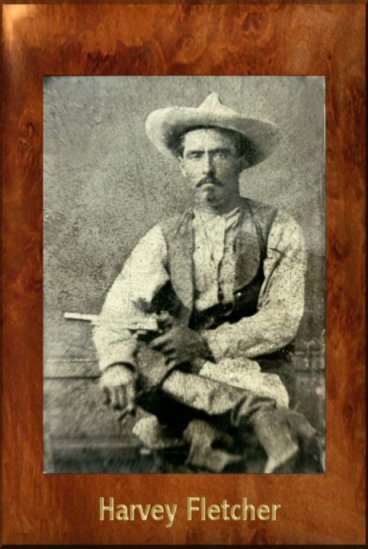
However, it didn't take Harvey long to make up his mind that he did not want to stay around for the outcome of the trial. With all the excitement the case had generated in Union County, and the resentment the County was feeling over the Little Rock Star's accusation, he probably thought he just might be used as an example. By 30 Oct. 1877 Harve had jumped bail and left his brother, John Wesley, and friend, James T. Sheppard, holding the bag for $650.00. Knowing the sentiment of the county, and the almost certainty that the two boys would be hung, John Wesley might even have encouraged Harvey and William to run. (Judging from the name John Wesley gave his oldest son, William Harvey, he held a lot of affection for the two.) An old letter, dated 13 March 1879, and addressed to John Wesley, at the EI Dorado, AR. post office, shows that Harvey went to Cook County, Texas and was murdered there. (See entry dated 13 March 1879.)
13 March 1879 - C.S. Hughes wrote
the following letter to John Wesley in union County, informing him of the murder
of his youngest brother, Harvey. This old letter shows that Harvey went to Cook
County, Texas when he left Union County in 1877. Some of the Fletcher's distant
cousins, the descendants of Job Fletcher, lived there.
I reported it at once to D.P. Uphorn, United States Marshal, at Fort Smith, Ark. The evidence will hang Miller, if caught. You ought to write to the marshal and try and assist in having him caught. I run Miller out of this country, but he has some bad friends left here and I have to keep on my watch all the time. He was killed in presence of myself and wife without any warning. He said he had never saw Miller before that evening and had nothing between them. Miller was drunk and did it for nothing. I have spent lots trying to have him caught. Write to me at once to Hewetts Store, Cook Co. Texas. Respectfully,
Harvey seemed to be the family clown. (Or wild Child) One story passed down over the years, to Murrel (Mayer) Carpenter, the grand-daughter of Harvey's sister, Martha Ann, is that he came upon a burial site of Indians who buried their dead above ground and in a sitting position. He tied a rope around the dead Indian and pulled him behind his horse through town.
It is not clear what part of the country this incident took place, but if it was in Cook County, Texas, this just might have been the reason for his death.
12 Augist 1884 - The public
administrator of St. Clair County, James Canthon, had charge of handling the
estate of Havey Fletcher, who had died in Cook County, Texas in 1879. the
following articles, the administrator's notice, was ordered to be published in
the weekly newspaper for four weeks.
In pursuance of an order of the Probate court of St. Clair County, I have taken
charge of the estate of Harvey Fletcher, deceased, on the 12th August 1884. All
persons having claims against said estate are required to exhibit them for
allowance to the administrator within one year from the date of said letter or
they may be precluded from any benefit of such estate; and if such claims be not
exhibited within two years from the date of said letters they will be forever
barred. Signed James Cautaorn (different spelling), charge estate of Harvey
Fletcher, dec'd. (Copy of article available)
On the same day as the above, a petition was published to sell Harvey's one
fifth interest in the Fletcher land, to pay his debts. Order of publication
-state of Missouri, county of St. Clair,,
In the Probate court for the county of St. Clair, August term, 1884.
James Canthon, administrator of Harvey Fletcher, deceased, presents to the court
his petition, praying for an order for the sale of so much of the real estate of
said deceased as will pay and satisfy the remaining debts due by said estate,
and yet unpaid for want of sufficient assets, accompanied by the accounts, list,
and inventories required by law in such case, examination whereof it is ordered
all persons interested 1n the estate of said deceased be notified that the
appl1cation, as aforesaid has been made, and that unless the contrary be shown
on or before the first day of the next term of th1s court to be held on the
second Monday of November next, an order W1ll be made for the sale of the whole,
or as much of the real estate of said deceased as will be sufficient for the
payment of sa1d debts; and it is further ordered that this not1ce be published
in The Sun, a weekly newspaper
printed and published in St. ~Clair County, Missouri, for four weeks before the
next regular term of this court.
State of Missouri, County of St. Clair, ss. I, Oscar McNeil, clerk of the
Probate court, held in and for St. Cla1r county: hereby certify that the
foregoing is a true copy of the original order of publication therein referred
to, as the same appears of record in my off1ce. Witness my hand and seal of said
court. Done at office in Osceola th1s 12th day of August 1884. Signed, Oscar Q.
McNe1l, Clerk.
12 August 1884 -This copy, of the petition for the sale of Harvey's part of
the land, was filed in Probate Court at book 2, page 461. Evidently the only
debt Harvey owed was to Doctor Cally Hamblin in the sum of $26.65. It would be
intrest1ng to know the date of the doctor's vis1ts. The adm1n1strator goes on to
say that there is no other way to pay the debt except to sell the land and
that he believes that it w1ll sell for as much now as in the future.
John W. and half brother, William, borrowed $224.20 from George W. Bunch of St.
Clair County, Mo. The date of the loan is not known but it would have been
sometime before 14 March 1882 when George Bunch obtained a foreign judgment from
the St. Clair County court. They had paid $27.90 on the note, but with interest,
they still owed $207.30. Mr. Bunch's attorney came to Union County to collect.
(book K, page 210-11) This borrowed money may have been to finish out the
$500.00 owed the state of AR. (original Court record available)
12 August 1884 - The public administrator of St. Clair County, James Canthon,
had charge of handling the estate of Harvey Fletcher, who had died in Cook
County, Texas in 1879. the following articles, the administrator's notice, was
ordered to be published in the weekly newspaper for four weeks.
In pursuance of an order of the Probate court of St. Clair County, I have taken
charge of the estate of Harvey Fletcher, deceased, on the 12th August 1884. All
persons having claims against said estate are required to exhibit them for
allowance to the administrator within one year from the date of said letter or
they may be precluded from any benefit of such estate; and if such claims be not
exhibited within two years from the date of said letters they will be forever
barred. Signed James Cautaorn (different spelling), charge estate of Harvey
Fletcher, dec'd. (Copy of article available)
On the same day as the above, a petition was published to sell Harvey's one
fifth interest in the Fletcher land, to pay his debts. Order of publication
-state of Missouri, county of St. Clair,, In the Probate court for the county of
St. Clair, August term, 1884.
James Canthon, administrator of Harvey Fletcher, deceased, presents to the court
his petition, praying for an order for the sale of so much of the real estate of
said deceased as will pay and satisfy the remaining debts due by said estate,
and yet unpaid for want of sufficient assets, accompanied by the accounts, list,
and inventories required by law in such case, examination whereof it is ordered
all persons interested in the estate of said deceased be notified that the
application, as aforesaid has been made, and that unless the contrary be shown
on or before the first day of the next term of this court to be held on the
second Monday of November next, an order Will be made for the sale of the whole,
or as much of the real estate of said deceased as will be sufficient for the
payment of sa1d debts; and it is further ordered that this notice be published
in The Sun, a weekly newspaper
printed and published in St. Clair County, Missouri, for four weeks before the
next regular term of this court.
State of Missouri, County of St. Clair, SS.
I, Oscar McNeil, clerk of the
Probate court, held in and for St. Cla1r county: hereby certify that the
foregoing is a true copy of the original order of publication therein referred
to, as the same appears of record in my off1ce. Witness my hand and seal of said
court. Done at office in Osceola th1s 12th day of August 1884. Signed, Oscar Q.
McNe1l, Clerk.
12 August 1884 - Date of the petition for the sale of Harvey Fletcher's part of
the land, was filed in Probate Court at book 2, page 461, St. Clair Co., MO.
Evidently the only debt Harvey owed was to
Doctor Cally Hamblin in the sum of $26.65. It would be
interesting to know the date of the doctor's vists. The administrator goes on to
say that there is no other way to pay the debt except to sell the land and that
he believes that 1t w1ll sell for as much now as in the future.
1900 u.s. census - By June 1900, Jane was living in Cherokee Nation, Indian
Territory, which later became Rogers County, Oklahoma. She lived in the
household of her daughter, Martha Ann and Martha's husband, Oliver Marquess,
sometimes spelled Marcus.
1900 U.S. census - James and his family were also in Indian Territory and was
still living there when the 1910 census was made.
1900 U.S. census - William P. and his family were living in Kansas City, Jackson
County, Missouri and was still there in 1910.
Jane died sometime between the census years of 1900 and 1910. She is buried in
Rogers County, Oklahoma.
By 10 May 1930, at least part of the land in St. Clair County belonged to P.W.
Fletcher. (William P.) At least part of this land is what was granted Oliver C.
Fletcher back on 1 May 1856 in St. Clair County, Missouri.
Book 176 - No 2 - page 592
Agreement For Quarrying and Purchasing Materials
P. W. FLETCHER
This Contract entered into this 10th day of May 191O, by and between P. W.
FLETCHER, party of the first part, and THE STATE HIGHWAY COMMISSION OF MISSOURI,
party of the second part, Witnesseth:
That, Whereas, said party of the first part, is the owner of certain realty
described as follows: Northeast (NE 1/4) of section
28, Township 39N Range 25 W County of St. Clair, State of Missouri and whereas
said party of the second part desires to enter thereunto road building material,
such as bank gravel. The said part of the first part covenants for himself, his
heirs, assigns, devises and grantees, that said party of the second part, its
agents, contractors, or assigns, may enter upon the land of the aforesaid party
of the first part for the purpose of excavating, removing and purchasing said
road building materials and said party of the first part agrees to sell to said party of the second part said road building materials, in
such quantities as it the said party of the second part, may require, and that
said party of the second part shall have ingress and egress upon and over the
lands of the aforesaid party of the first part to haul said road building
materials over said lands to the public highways.
In consideration whereof, the party of the second part
agrees to pay one dollar (100) for the whole term of the lease and Ten Cents
(.10) per cubic yard for all material which meets the state specifications or
which is accepted by the Commission. Material not accepted by the Commission
shall become the property of the land owner. The said party of the first
part further agrees to allow the party of the second part, its representatives
or contractors, to locate and erect such equipment machinery, etc., as may be
needed to produce the required road building materials, and to store such
acceptable road building materials, for further use, upon suitable location of
land of the party of the first part. Should storage of acceptable road
building materials remain upon the property of the party of the first part
longer than one year after the operation of the quarry and pit has ceased,
the party of the second part agrees to pay Ten ($10.00) dollars for each acre or
fraction thereof, for the actual land used for storage purposes, and for the
right of ingress and egress to said storage piles at all times, It is further
agreed that the party of the first part shall accept the One ($1.00) dollar in
hand paid (together with the Ten Cents per cubic yard royalty as full
compensation and settlement for all damages and rents incurred in the faithful
and prudent performance by the party of the second part or its duly authorized
agents of the terms and provisions of this contract. This agreement is for a
period of Two years and shall extend from the 10th day of May, 1930, to the 10th
day of May, 1932, with the privilege of renewal to the State Highway Commission
of Missouri for a like period
of time and upon the same terms astl1is agreement. Payments will be made monthly
as the acceptable material is removed from the premises or as it is placed in
storage piles.
In Witness Whereof, we have subscribed our name this lOth day of May, 1930.
P. W. FLETCHER - Party of the first part
(SEAL) STATE HIGHWAY COMI1ISSION OF MISSOURI
By Y. BROWNEN - Party of Second Part
State of Missouri - County of Boone
On this 10 day of May, 1930, before me personally appeared P. W. Fletcher
to me known to be the person described in and who executed .the foregoing
instrument and acknowledged that they executed the same as their free act
and deed.
K. H. GUNDELFINGER (SEAL) Notary Public.
My Commission expires on the 5 day
of January, 1933.
Filed for record 26 June 1930 at 3P.M.
SIDNEY PARKER, Recorder
By MARY G. SMITH - Deputy
Could this P.W. Fletcher be our William P. with the initials reversed? The
answer to this and other questions about the family are yet to be found.
Research will continue on Oliver C. and his descendants and as facts are
uncovered will be passed onto interested descendants.