 |
| . |
| . |
| . |
| . |
| . |
| . |
| . |
| . |
| . |
| . |
| . |
| . |
| . |
| Guestbook powered by Bravenet |
| . |
| . |
| . |
| . |
| I have fished all my life and have learned many things, some have taken some time, but I am willing to share my experince with you... I invite you to read "Johnnie's Tips" below and hopefully they will be of value and rewarding to you and make this sport more pleasureable, for you as anglers. |
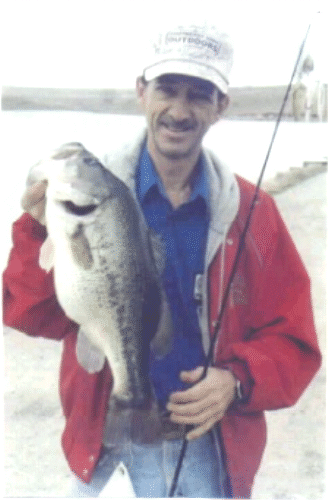
| 8lb. Bass |
| "Johnnie's Tips" |
|
| 5lb. Bass |
| 4lb. Bass |
| Nice Fish |
| E-mail Me |
 |
 |
| Click on my picture to view ' My Site' "Please Huh Please" |
| "Please come back as often as you wish, Thank You, for visiting" |

|
| Watch For My New Book Johnnie Crain's Fishin' Tips and Stuff "Coming Soon" |
 |
|
|
|
 |
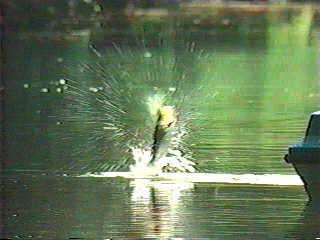
| Fairfield Lake Fairfield, Iowa Caught on spinner bait |
| Mississippi River |
| Using A "Poormans' Carolina Rig" Can be effective... |
| Lake McBride, Iowa |
 |
 |
| Click on Icon above Check Out Another Great Site |
 |
 |
 |
 |
| Click Flag For Prayer For AMERICA |
| God Bless America Long May She Stand |
|
|
| My friends, I have for several months now been field-testing a new product from Humminbird. Zercom/Humminbird has now given testers permission to release the name of the newest depth finder, in their catalog of great locators. The unit is the Piranha 1. It is a low end (cost wise) that preforms like a high dollar unit, with just enough bells and whistles to get the job done, yet is simple enough, even the week-end angler can master its menus in minutes. In fact, I simply turn the Piranha on automatic and use it. This fine little unit has shown me things I've never been able to pick up before, such as a Zebra mussel bed in the Mississippi River, and clam beds as well. The Piranha shows stake beds clearly in twenty feet of water as they appear out on the bank, broken slats and all. Fish show up as fish, with some larger than others; baitfish is easily identified, as are grassbeds and submerged trees. Roadbeds, flooded hedgerows and old bridges are a snap to find with the new unit. The Piranha reads well at high speed, but does its most efficient work, while strapped to a trolling motor, this unit is not effected by trolling motor noise and believe me, the transducer can take a beating. When fishing in the Mississippi River backwaters, the trolling motor and transducer really took a beating from the fallen trees and submerged tree stumps, we often encounter in shallow water. The P-1 as I call it, can read well in three feet of water, most units won't do that. For most applications, the P-1 is as effecient as the Zercom Z160, a much higher priced unit. Of course, when I need a more detailed resolution in deeper water, I use the Z160, especially when jigging spoons are in over forty feet of water, the Z160, shows the spoon and line movement. Generally, for all around fishing, you can't beat the Piranha, from Humminbird, a name you can always trust. Try it soon; it's a great bargin I want to share with you.... Good Luck and Good Fishin' Johnnie |
| ***October Tip*** |
| T I P S |
| From Johnnie |
 |
| . |
| . |
| . |
| . |
| . |
 |
| . |
| Good Luck and Good Fishin' |
 |
|
| Last Updated 01/07/2002 |
|
|
|
|
| You Are Here |
| One thing ice angles sometimes do not know, that I have learned from extensive use of the Aqua-Vu underwater camera is just how much fish move around under the ice. Most anglers believe that fish tend to remain fairly motionless beneath the frozen water. While fish do not move much laterally looking for food, they are in constant movement vertically. I have watched bluegill, bass and crappie especially move through submerged cover from the bottom to the top. Algae breaks free from the cover on sunny days and floats around with the ice crystals, bluegill eats much of these algae. Baitfish is attracted to the algae also and the crappie and bass feed on the baitfish. Most often, to my suprise, the fish do not hide in the cover, but tend to hang loosley around the outside edges of sunken trees, brush and other cover. I feel the cold water slows their reaction time just enough that the fish need to be in open water in order to quickly grab a nearby meal. Most anglers would be suprised at how often the fish are up near the bottom of the ice instead of on or near the bottom. The fish simply deflate their swim bladders to fall slowly to the bottom and inflate the bladders to rise to the top. Fish do not move far, even for an easy meal. Your jig or bait should be kept close to the strike zone, which on some days may be hard to locate. Keep your baits moving up and down until the desired depth is located, moving your hole left or right of sunken cover may also be a benefit. Some fish move with the sun, either staying in its rays or in shady areas. Think vertical, very your bait depth and move if no fish are encountered within thirty minutes, they either aren't there or won't bite. Good Luck Johnnie |
| *** December Tip *** |
| . |
| . |
| . |
 |
| . |
 |
 |
 |
 |
|
|
|
|
|
|
 |
| Friends, Remember: Feb. 14th |
|