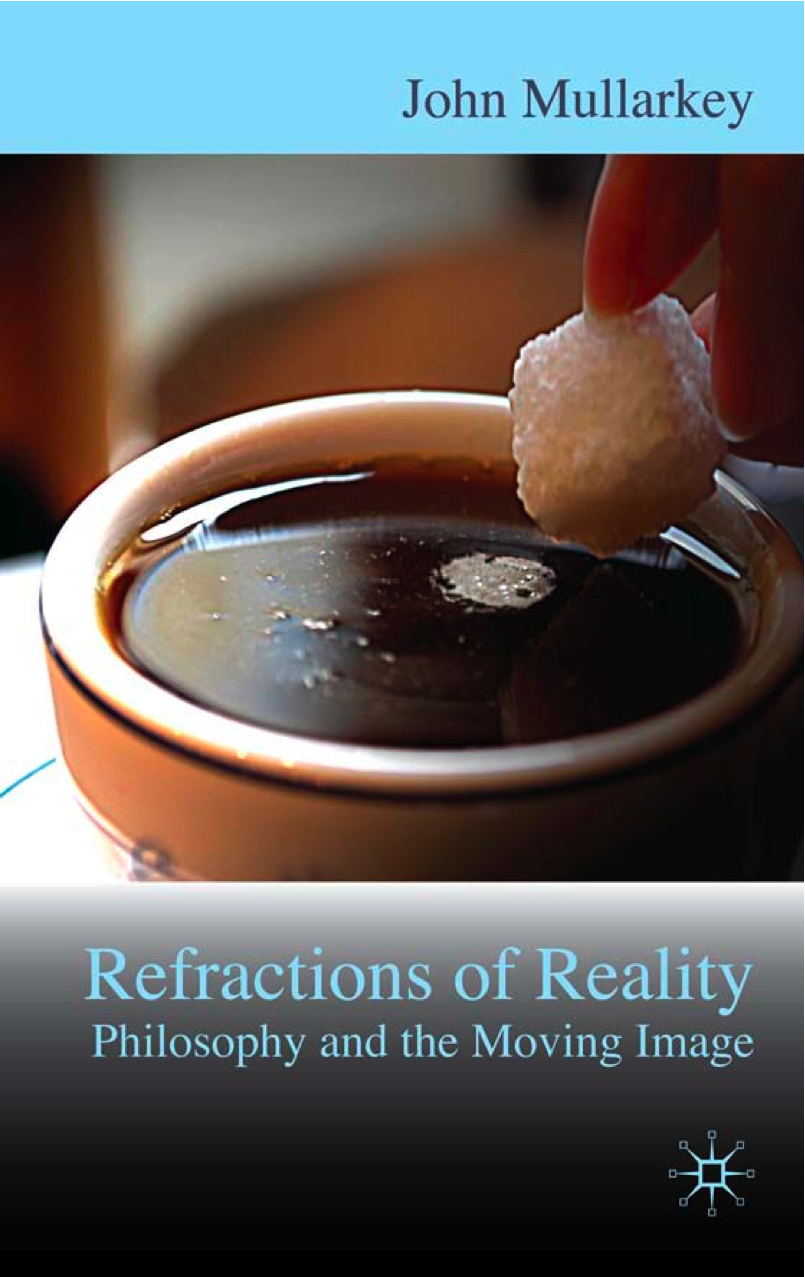
Refractions of Reality: Philosophy and the Moving Image
Why is film becoming increasingly important to philosophers? Is it because it can be a helpful tool in teaching philosophy, in illustrating it? Or is it because film can also think for itself, because it can create its own philosophy? In fact, a popular claim amongst film-philosophers is that film is no mere handmaiden to philosophy, that it does more than simply illustrate philosophical texts: rather, film itself can philosophise as film. Approaches that purport to be less textual and illustrative can be found in the subtractive ontology of Alain Badiou, the Wittgensteinian analyses of Stanley Cavell, and the materialist semiotics of Gilles Deleuze. In each case there is a claim that film can think in its own way. Too often, however, when philosophers claim to find indigenous philosophical value in film, it is only on account of refracting it through their own thought: film philosophises because it accords with a favoured kind of extant philosophy. Consequently, the aim of seeing film as philosophy is more often than not reduced to 'film as text as philosophy', in as much as the film's audio-visual matter - no less than its cultural, technological, or commercial dimensions - are nonetheless interpreted from a ready-made philosophical vantage-point.
Refractions of Reality: Philosophy and the Moving Image is the first book to look at all the central issues surrounding the vexed relationship between the film-image and philosophy. In it, John Mullarkey tackles the work of particular philosophers and theorists (Zizek, Deleuze, Cavell, Bordwell, Badiou, Branigan, Ranciere, Frampton, and many others) as well as general philosophical positions (Analytical and Continental, Cognitivist and Culturalist, Psychoanalytic and Phenomenological). Moreover, it also offers an incisive analysis and explanation of several forms of film theorising, providing a meta-logical account of their mutual advantages and deficiencies that will prove immensely useful to anyone interested in the details of particular theories presently circulating, as well as correcting, revising, or re-visioning film theory as a whole.
Throughout, Mullarkey asks whether the reduction of film to text is unavoidable. In particular: must philosophy (and theory) always transform film into pre-texts for illustration? What would it take to imagine how film might itself theorise without reducing it to standard forms of thought and philosophy? Finally, and fundamentally, must we change our definition of philosophy and even of thought itself in order to accommodate the specificities that come with the claim that film can produce philosophical theory? If a 'non-philosophy' like film can think philosophically, what does that imply for orthodox theory and philosophy?
Table of Contents
Acknowledgements
Preface: The Film-Envy of Philosophy
Who Wants to be a Philosopher Anyway?
Philosophical Cinema or Cinematic Philosophy?
Convergence on the Film Process: The elan cinematique
Philosophy's Perpetual Identity Crisis
Introduction: Nobody Knows Anything!
Oh, They Both Make Such Good Arguments!
The Circular Logic of Paradigms and Examples
Between Theory and Post-Theory
Continental or Analytic? Once More Unto the Breach
Rapprochement or Impasse? Film as Relational Process
Towards a Non-Philosophical Cinema
Nobody Knows Everything: Knowing, Being, and Process
Chapter One: Illustrating Manuscripts
The Meta-en-scene
The Advent of High-Concept Cinema: Once Upon a Premise...
Extreme Pretexts
Philosophies Through Films
Gone to the Movies
Conclusion
Chapter Two: Bordwell and Other Cogitators
Introduction: Going Back to the Future
Classical and Arthouse: Hurray for Hollywood
Messages are for Western Union
Science, Empiricism, Culture
Closely Observed Frames
From Reflection to Refraction
Play Time
Moving the Continuum
The Representationalist Axiom of Analytic Film-Philosophy
Chapter Three: Zizek and the Cinema of Perversion
Good Theorist, Bad Theorist: Bordwell Contra Zizek
Freudianism for Beginners
The Return of the Real
The Film Gaze
Representationalism Again: Zizek and the Pre-Cogs
Traversing The Fantasy or Transcending the Real?
The Return of the Real to Reality
Films, Time and Time Again
Conclusion
Chapter Four: Deleuze's Kinematic Philosophy
Deleuze's Ambivalence: Philosophia sive Cinema?
Cinema's Concepts
A Non-Reductive Materialism
From Movement to Time: Images and Signs
Time Regained
Is Cinema Bergsonian?
Movement-Image and Time-Image: When is a Cut Irrational?
Films and their Makers: From the Automatic Art to the Autonomy of Art
Amongst the Deleuzians: A Thousand Tiny Examples
Conclusion
Chapter Five: Cavell, Badiou, and Other Ontologists
Cavell and the Ontology of Ordinary Film
The Philosophical Ordinary
Reflections on the Ontology of Film
Automatism of the Medium
Contra Deleuze?
Modernism
Reflexivity: Film's Other Minds
Other Cavellians
More Ontologies: Frampton's Affective Thinking
Badiouís Inessential Cinema
Chapter Six: Extended Cognitions and the Speeds of Cinema
Anderson's Elusive Reality
Branigan's Radial Camera
When is a Film? The Cinematic Event
Nothing Happening: Events in the Blink of An Eye
Bringing Us Up and Down to Speed
Chapter Seven: Fabulation, Process and Event
Jacques Ranciere's Film Fables
Thoughts Taken Out of Context
Making Movies and Art with Time
Fabulating the Film Event
Paradoxical Feelings: Moved by Movements
Chapter Eight: Refractions of Reality Or, What is Thinking Anyway?
Outline of an Outline
Affective Embodiment
New Mediations
Differential Spectatorship
Sound and False Fidelity
Acting Realism
Animal Cinema
A Non-Philosophy of Cinema
What is Thinking (Again)?
Conclusion: Code Unknown: A Bastard Theory for a Bastard Art
In Praise of Being Unphilosophical
Filmology: From Unknowing to Pluriknowing
Beyond Coprology
Bibliography of Works Cited