Risk-averse publishers shunned his work, forcing
him to finance and self-publish Anema - The Age Of Robots.
Then, when he tried to sell his printed work, he
was met with hostility at primary school bookstores which felt his story
about robots that can think for themselves was inappropriate. Even his
own university bookstore rejected his work.
In his search for a better way to reach his
audience, Mr Tay turned to the Internet and joined the growing movement
that now sees thousands of people making their mark with Web comics.
Like blogging, the movement took off about three
or four years ago. In fact, there is a website promoting Web Comics
Awareness, and the group has designated May 5 as Online Comics Day.
The basic form of Web comics or 'dot.comics' is
a comic strip that is accessible via the Internet.
Some, like Anema, are illustrated stories whose
narrative continues over many strips; others are self-contained daily
strips covering a few panels.
Many act as substitute blogs for writers,
illustrating in words and pictures their feelings and observations.
Some are hilarious, others are quirky. Some are
brilliantly executed and others have rudimentary drawings or use
characters from computer games.
In fact, some comic artists even provide their
readers with character packs that allow budding writers and bloggers
without artistic flair to try their hand at comics.
Attracting an amazing 500 hits a day, The New
Adventures Of Bobbin strip by Ms Jocelyn Yik has developed quite a
following.
The spunky 20-year-old Yale economics undergrad
from Bishan writes and draws her witty Web comic between college
classes.
Her strip about Bobbin and her friends is an
insightful look at the trials and tribulations of a 20-something girl
making her way through life.
'The best thing about Bobbin is having the
opportunity to share what I think is funny with a considerable
audience,' the self-deprecating publisher says. 'The second best thing
is getting to meet all the weird and wonderful people who read my
comic.'
In fact, that's one of the reasons why Web
comics are appealing to both artists and readers. Each strip attracts
its own community and many actually boast a community forum, where fans
discuss the strip and whatever catches their fancy.
Not only do they get to know one another but
also they get to interact with the comic authors who are usually active
in their forums.
Another Singaporean studying overseas and
publishing his own Web comic is Mr John Chua, a 23-year-old medical
student in Melbourne.
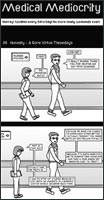
Designed more for his medical friends, his strip
Medical Mediocrity acts as a blog about his life and is a way to fend
off boredom.
With a modest 200 hits a month, his site is
low-key. He says: 'I guess being a comic about medical students, it's
probably a bit hard for other people to understand.'
Regardless of its success, Mr Chua finds being
able to express himself creatively the most satisfying aspect of his
work. He says: 'The site is mainly for my own enjoyment, something to
call my own.'
Indeed, Web comics for the most part do not
bring in any money or revenue for their creators. Almost all of them do
it as a hobby.
Popular strips may earn some revenue from banner
advertisements but that's barely enough to defray costs for the Web
service.
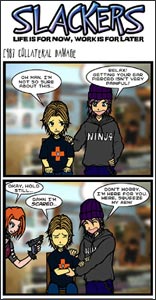
Mr Xie Menggeng, the creator of the popular
Slackers comic, has seen some interesting results from his Ham And Slug
comic experiment.
For a year now, he has been publishing strips
created by his readership using characters he has generously provided on
a template.
In a spin on the same theme, he has set up a
'comic round robin' where readers are asked to submit their own strips
based on the characters from the Slackers strip.
The results have been interesting, with crazy
plot twists and a variety of styles.
He says: 'The fun is in seeing what has happened
before, and imagining how you would continue the story.'
Fully embracing the medium of the Internet, he
adds: 'A key difference between print comics and Web comics is the
community of readers that take part in this created world, a strong
friendship between the audience and the work itself.'