|
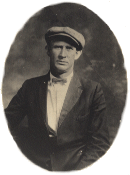
My Grandfather John Hicks was a lap counter at The Brick Yard,
long before the age of electronic counters. As he would stand along track
side manually counting his cars laps, He seen such cars as:
.
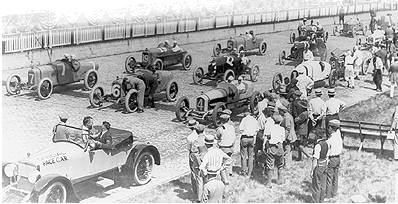
Indianapolis 1921
.
Track dimensions and banking are basically the same as when
constructed in 1909.
Original track surface was crushed stone and tar, resurfaced
with 3.2 million paving bricks in late 1909, Hence the nick name "The Brick
Yard"; all but the main straight was paved by asphalt by the late 1940’s;
main straight was completely paved following the race in 1961; track was
completely repaved in 1976,1988 and again in the fall of 1995; most bricks
remain in place under the current surface. The 36-inch "Yard of Bricks"
at start/finish line are the only remaining visible bricks.
.
The first Indianapolis 500—at that time called the
International 500 Mile Sweepstakes—was run on May 30, 1911.
Ray Harroun won the first Indianapolis 500 in 1911 at an average
speed of 74.602 mph.
Finishing in 6 hours 42 minutes 8 seconds and claiming the champion's
$10,000
share of the $25,000 purse.
.
Now with more than 250,000 permanent seats,
the Indianapolis Motor Speedway is the world's largest seating
facility. And thousands of spectators can also be accommodated in the Speedway's
224-acre infield
(the area enclosed by the racetrack).
.
Throughout its history, the Speedway has served as a testing
ground for many major automotive breakthroughs. Harroun's car in the inaugural
race was fitted with the first rear-view mirror. In more recent years,
pioneer developments at the Speedway include
computer engine and fuel management systems, fuel-injection
systems, turbocharged engines, disk brakes, better tires, and improved
suspension systems.
A far cry from lap counters from the early days.
|