THE BUILDING YEARS
The development of the outpost gained momentum when Major General Leonard Wood became commanding general of the Philippine Division. He not only facilitated funding releases but took an active development in its physical development. By 1907, quarters for the Division Commander and four cottages for officers, and mess hall were constructed. Contouring the land as well as building tent sites and stables began.
This did not by any means meet the needs of the military, especially
when the Camp was “filled to overflowing”, during the summer
of 1907. Conditions for the sick however, eased in 1908 when the military
hospital became fully operational and began to show remarkable success
in the treatment of tuberculosis as well as acute and chronic dysentery.
The next burst of enthusiastic interest and sustained support in the
development of the Camp came when Major General J. Franklin Bell became
commanding general (1911 – 1914). During his incumbency Camp John
Hay’s mission expanded beyond simply a convalescent center and
became a haven for rest and recreation. In fact, it was becoming a showplace
and a place for civilian and military dignitaries to visit. It offered
a variety of facilities including tennis courts, a basketball court,
bowling alleys, movie theater, and a dance hall. It was also during
this time that an 18-hole golf course shared with Baguio Country Club
opened. Major General Bell also designed and supervised the construction
of the most enduring landmarks of the Camp: Italian Garden (later Igorot
Garden), the commanding general’s house and the amphitheater beside
it. The house and the amphitheater were later named in Bell’s
honor.
Notwithstanding the massive building efforts, the Camp facilities still failed to meet the needs of the military. Thus, the building boom continued. To expedite matters, construction facilities such as a brick factory were built. This resulted in the first concrete buildings. In 1915, the dormitory for officers and their families (later known as the Main Club) and the Post Exchange and gym (later known as Snyder Hall) were built. By 1916, the hydroelectric plant was operational, bringing electricity to the Camp. The following year, a new 24-bed hospital was erected on the site of Captain Rudd’s original headquarters (later known as the Bachelor Airmen’s’ Quarters). Its initial capacity was later increased to 50. In 1918, a permanent headquarters building was completed with the commissary, warehouses and other facilities such as a concrete officer’s mess, a mess hall, library, bakery, and Post Exchange near by. Barracks for the Philippine Scouts were also built in the area later known as Scout Hill.
By the 1920’s, the
timeless look that Camp John Hay would wear for the next 75 years had
been set. Little would change physically over the next half century.
This would give Camp John Hay an aura of time having stood still, a
characteristic that gained it international renown. It was also in the
‘20s that the Philippine Scouts – who had a permanent garrison
inside the Camp since 1914 – were authorized to build houses for
their families on the road to Loakan. Scout Barrio was then born on
the western flank of the Camp.
| A Look Back in Time |
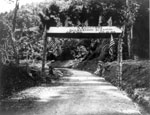 Kennon Road was opened on January 29, 1905. 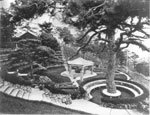 |