

Grumman Aircraft Co. F4F Wildcat
Wildcats were the standard carrier fighters when Japan attacked Pearl Harbor. In 1938, a competition was held by the navy between the F4F Wildcat and the F2A Buffalo. Although the Buffalo won, the F4F proved itself a much better plane in combat. This caused the Navy to cancel the order for Buffalos, and switch it to Wildcats. Since the Wildcat was the one of the first Naval monoplanes, it could easily be out turned, climbed, and ran by the Japanese Zero. However, the Wildcat was much more rugged, and could outdive the Zero. As long as the Wildcat pilots did not get into a dogfight with the Zero, they had a good chance of beating it.
The F4F was the premier carrier-based fighter for the US and Britain in the start of the war. Since Britan didn't have any carrier-based fighter, they ordered Wildcats from Grumman. The demand for Wildcats was so great, that General Motors. 8,000 Wildcats were built. Even when Grumman's successor for the Wildcat (the Hellcat) was introduced, Wildcat production continued.
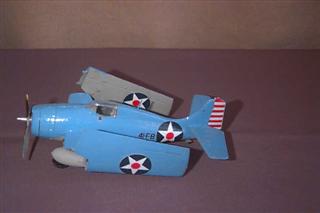
Folding wings enabled this plane to be stowed aboard an aircraft carrier.
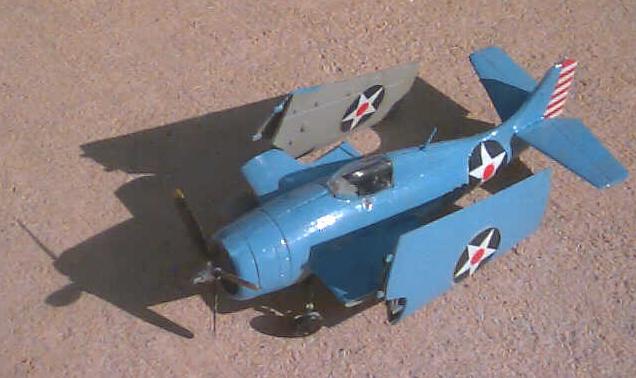
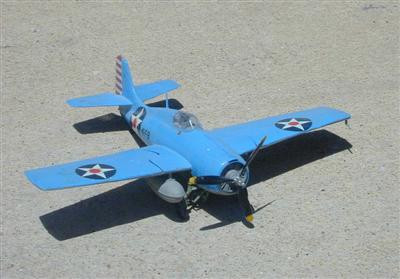
This insignia shows the plane to be flown around the start of the war, in 1941 and 1942.
| Crew | One pilot |
| Armament | Four .50 in machine guns |
| Maximum Speed | 331 mph |
| Engine | Pratt and Whitney R-1830-17 Twin Wasp |
| Other Weapons | 200 pounds of bombs, or two 58-gal. droptanks |
| Uses | Mainly used in the Pacific as a carrier-based fighter, or as a ground-based fighter |

