
"Old
Crow" 357th Fighter Group, 363rd Fighter Squadron, flown by Major Clarence
Anderson during the winter of 1944-1945
Catagories:
American, Fighter
Questions?
Comments? E-mail
the web/model master
�2003 John Eckhardt
Specifications
and Photos are of P-51 D version
North American Aviation
P-51 Mustang
This
fighter is the most famous American plane from World War II. Sporting six .50
caliber machine guns, this plane could easily tackle with any of the German
planes it was against. It was designed in response to British specifications
*
in under 120 days! The Allison engine that it was originally equipped with
hampered the Mustang�s performance at medium to high altitudes. The British put
their famous Rolls-Royce Merlin engine into the P-51, and improved the fighter
greatly. This plane was equipped with drop tanks, which increased its range to
over 2200 miles. This capability enabled it to be the first Allied plane to fly
over Germany. Escorting bombers was its primary mission from the time it was
introduced (1943) until the Luftwaffe had been destroyed in late 1944. Then it
was assigned missions to attack any target that moved on the ground.
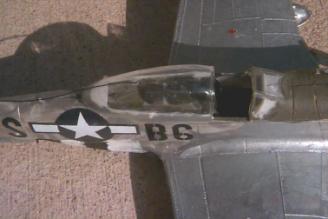
Note the �bubble' canopy, which allowed the pilot
to view backwards. This was first implemented in the �D version.
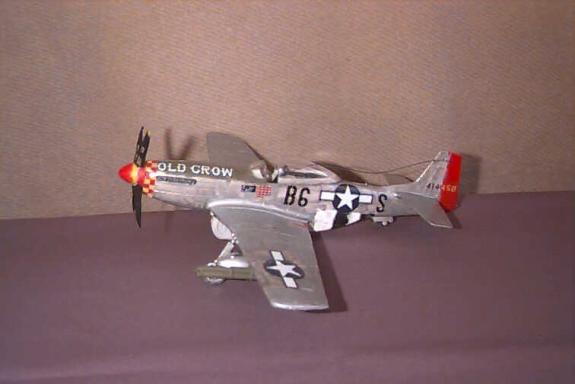
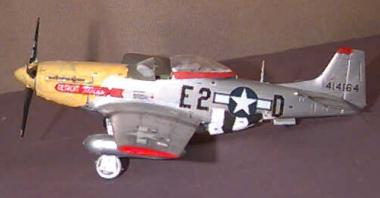
This model �D is equipped with 2 rocket
pods. (other pod not visible) These held three rockets each, and
were primarily used for ground attack. Later in the war, it was a common
occurrence for the P-51 to destroy a tank or two.
Note
on these planes, the D-Day stripes for operation Overlord. All Allied
planes were painted with white and black stripes so they would be recognized by
friendly troops.
| Crew |
One Pilot |
| Armament |
Six .50 inch Browning machine guns |
| Maximum Speed |
437 mph |
| Engine |
Packard-built Rolls-Royce Merlin V-1650-7 (1490 hp) |
| Other Weapons |
1 ton of bombs or rockets |
| Uses |
Mainly used as European bomber-escort/fighter, some ground attack Some
P-51s were operated in the Pacific theater, also. |
* The British
had actually asked North American to produce more P-40s. That company said that
they could do better than that, and they came up with the P-51. The first model
could fly over 25 mph faster than the P-40, even with its Allison engine.


