
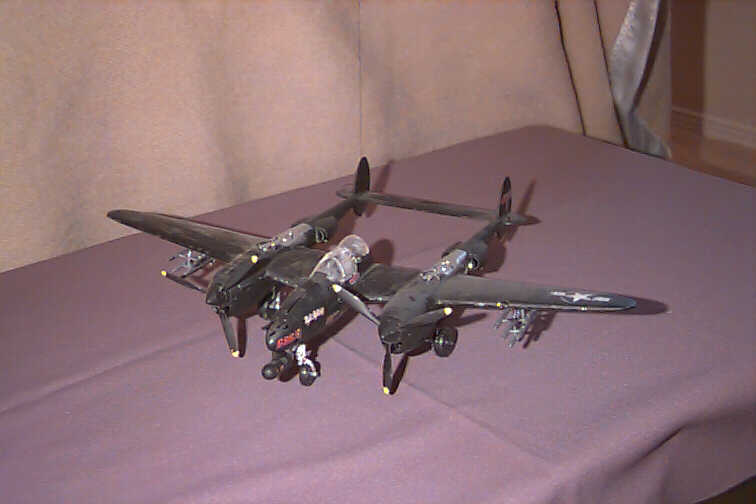
Two superchargers made this airplane effective at high altitudes.
Lockheed P-38 Lightning
The P-38 Lightning was America's only twin-engine interceptor in World War II. The P-38 concept started when, in 1936, the Army issued specefications for a high-altitude, high-speed fighter. Since Lockheed thought a single-engine fighter could not possibly fit the specifications, they decided to use two engines. It had a radical design, using twin engines and tails. The Allison engines drove counter-rotating propellers, which eliminated the tendency of a single-engine plane to turn to one side.
Lightnings were used in every theater of the war. In the Pacific, it wreaked havoc on Japanese planes, as it could outgun any Japanese plane, and it had much more armor. The top-scoring American ace, Richard Bong flew this plane, and with it, downed 40 Japanese planes. Once the Americans had landed their forces in Africa and were 'closing the vise' on Rommel, the Lightnings found their role in destroying Rommel's supply lines. Later in the war, the last version, the -M, was created to fend off other aircraft during the night. It was equipped with radar, and thus had another crewmember. The P-38 was one of the toughest planes around.
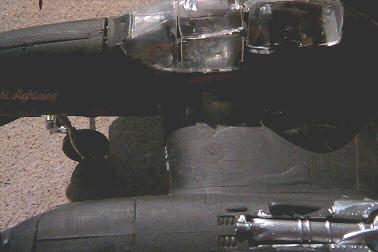
There was an extended cockpit for the radar operator in this -M version.
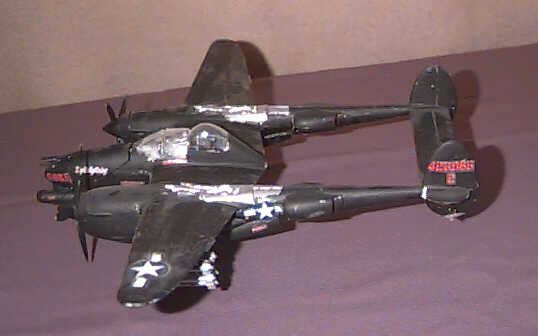
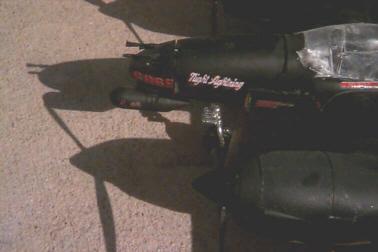
The twin tails and fearsomeness of the P-38 led to the Germans calling it the "Fork-tailed Devil"
| Crew | One Pilot and one Radar Operator |
| Armament | Four .50 inch machine guns and 1 20-mm cannon |
| Maximum Speed | 414 mph |
| Engine | 2 counter-rotating Allison V-1710-91 inline engines |
| Other Weapons | 3,200 pounds of bombs, rockets, or droptanks |
| Uses | Used in all theaters, with great success as a bomber escort, night fighter, interceptor, and sometimes even a bomber. |

