Welcome
to the experience that is Political Theory.
Here we go.
Your
grade is split up into two categories:
1--Class
participation (25%)
2--Course
work [Performance on policy development exercises {aka, “DRV’s}, written
essays, policy agenda papers, formal debates, written tests, written quizzes,
and any other course driven work of an in-class or out-of-class nature.] (75%)
Class Participation (25%)
Think of this part of your grade as an ongoing 100 point assignment that can fluctuate over time. Here’s how it’s determined:
|
Points
(out of 100) |
Description |
|
100
or above |
Student is consistently and meaningfully involved in all areas of class interaction |
|
90-99 |
Student is consistently and meaningfully involved in all areas of class interaction; however, the consistency and meaningfulness occasionally lapse (but all areas are given attention by the student) |
|
85-89 |
Student is involved in a meaningful way in most areas of class interaction |
|
75-84 |
Student is involved in a meaningful way in most areas of class interaction; however, the meaningfulness occasionally lapses (but most areas are given attention by the student) |
|
50-74 |
Student is inconsistently involved in areas of class interaction but is still involved in a meaningful way |
|
11-49 |
Student is inconsistently involved in areas of class interaction with occasions of interaction that lack meaning or direction with respect to the subject matter being discussed |
|
0-10 |
Student
rarely, if ever, is involved in areas of class interaction |
|
REGARDING
THE PREVIOUSLY MENTIONED SCALE: Where a
student falls in a given range is completely my discretion. Please note that this category of your
participation grade is not mutually exclusive in so far as your attendance
and timely arrival to class is concerned.
Late arrivals and absence do significantly and prejudicially affect the consistency and meaningfulness of class
interaction. In
Political Theory, there is no regard given to unexcused or excused
absences. They are treated the
same. You need to be present in this
class and you need to be on time to this class. I do not make distinctions between excused
and unexcused reasons for absence and/or lateness. |
|
It’s best that you think of
the 25% participation grade as a scenario where constant pressure is being put
upon you. You do not “bank” (or “build
up”) good will in the participation portion of your grade. Put another way (as an example of what I’m
describing here), a student might operate in the 98-100 range (as described above)
for, let’s say, 16 of the course’s 18 weeks.
If, during the 17th and 18th weeks of the course,
this student suddenly begins operating
in the, let’s say, 35-40 range (as
described above) then the student’s final participation grade will be something
between 35-40, regardless of the previous 16 weeks. The opposite is not true. If a student operates in the 35-40 range for
12 weeks and the 95-100 range for 6 weeks then his/her participation grade will
be some variation of a hybrid between 35-40 and 95-100. The final number would be my decision. This would also be true when the down time
comes in the middle of the semester (i.e.
6 weeks right off the bat at 95-100, 6 weeks in the middle at 35-40, and
then 6 weeks down the home stretch at 95-100= The student WOULD NOT end up with
a participation grade of 95-100. It
would be considerably lower than that.)
All of this is in the way of
conveying the following to you:
Political Theory holds no provision for “letting your guard down,” as it
were. Now, this would certainly be an
unfair expectation in a classical high school course. Fortunately (for me) you did NOT choose to
enroll in such a course.
Let me explain.
The following statement is
candid because candor, at your current level of academia and quasi-adulthood,
is what you deserve. I do not apologize
for it because it is, quite simply, the price of doing business in Political
Theory. If you “buy in” then you’ll be
rewarded with a phenomenal 18 weeks.
Here I go (with the aforementioned candor). Ready?
It is your
privilege to be in this class.
It is not, however, your right. Great and abundant
resources have been marshaled in the way of providing you with one of the most
unique educational opportunities made available at any high school in the
United States--if not the world. This is
no small claim, but I stand by it. You
will be given chances to engage in particular pursuits that, for most of you,
will never be made available to you again for the rest of your lives. Some of you may choose to pursue fields of
study and/or careers where said pursuits will be a regular part of your day,
but those fields of study and particularly those careers, are rare. This is it.
This is your chance to learn about the human-on-human dynamic of
behavior in politically charged environments.
This is your chance to deal firsthand with the profound complexities of
political systems, complete with all of their contradictory outcomes,
unintended consequences, and uplifting
victories (as well as crushing defeats).
And here’s the kicker, it doesn’t matter if you’re at all interested in
politics. This course offers you
something that will be profoundly useful to you no matter where you go, no
matter what you do. Whether you’re
headed for a career in international relations, business (yes, business!), journalism, law, medicine . . . . . it
doesn’t matter. This is the theory of
politics as it should be experienced, and the theory of politics is applicable
to all walks of life as all walks of life hold, to varying degrees, routinely political experiences. You cannot escape politics. It’s everywhere. But again, there can be no room for you here
(in Political Theory) if your intent is to just get by (or to take swaths of
time out of the semester where you just get by).
You’re either in or you’re
out.
If senioritis lurks in the
shadows or a sense of lukewarm commitment (to this course) haunts your best
intentions then my advice is for you to go to guidance and drop . . . . now.
Again, candor. It’s what you deserve. Having written all of the above, I’ll finish
on a high note. This will be an amazing
journey, quite unlike anything you’ve experienced in a classroom setting, if
you choose to be “in.”
Course work (75%)
The other 75% of your grade is based on all the
formal work we do in this class. Much of
this work will be the product of what you achieve as a class or in smaller
groups formed within the class. In the
case of written assignments, you will always be directed clearly as to what is
expected of you. You will be given a due
date that is expected to be recognized.
Written Work: Unless you are
notified of a different approach, you should not expect to submit written work
in hard copy form in this class. Work is
to be submitted via email. Identical virtual copies of written work are to be sent (preferably
prior to the due date). The first copy must be an email without
attachment. The entire piece of written
work must be pasted into the face of the actual email. The second copy must be a separate email with
the written work attached as a file. I
prefer Microsoft Word, but the word processing program of your choice is
acceptable. You may opt to send only one
email (with the written work copied into the face of the email AND an attached
file of the written work), but the duel copy backup plan is advised.
Again,
unless otherwise noted, written work will not be accepted in hard copy form. It
must be emailed to me at . . . . .
. . . . [email protected] . .
. . . such that it is RECEIVED no later than the designated due
date (and due ‘time’ if such designation exists). Please be advised that emails can become
entangled in electronic media traffic such that they will not be received for
some time after they are sent. This
reason alone is cause to get written work done early. If you are presently in the habit of doing
written work the evening before it is due, you are strongly advised to get out
of that habit.
Written
work is not measured by the physical space occupied on a sheet of paper. Instead, Political Theory uses a word count
as its principal tool of measurement (there may be exceptions, at times, during
the semester, but you will always be notified ahead of time if you are to use
something OTHER THAN word count). The typical typewritten page holds about
250-300 words using standard size and style font. In Microsoft Word, you can get an accurate
word count by going to “Tools” and then “Word Count.” I don’t necessarily know how to do word
counts in other word processing programs, but I do know that you can email your
paper to a school computer (which will have Microsoft Word), copy and paste the
entire paper into a Word file, go to “Tools” and then “Word Count.” All of
these considerations should underscore the importance of preparing written work
well in advance of the due date (and time).
A SPECIAL
REGARDING
WRITTEN WORK:
Work must be submitted only to the
following email:
John D. Jacobson
A SPECIAL
Below
you will find a list of potential course work performance areas. This list is not necessarily
comprehensive. In other words, there may
be evaluated performance areas that come up during the semester that are not
listed here.
Here
are some of those potential performance areas:
A--Policy
Agenda Papers and Policy Development Exercises (aka, “DRV’s”): We may go through long stretches of time in
this course where we will be simulating forms of government on either the
national, state, or local level. This
will be largely similar to the DRV concept used in American Government. (If you
haven’t taken American Government, please see Appendix A of this document for a
copy of the DRV description given to American Government students). The DRV environment in Political Theory
differs from the DRV environment in American Government in several ways:
1--In Political Theory every student in the course must be able to convincingly prove his or her contribution to the policy development process. Only taking notes during the policy development will not be recognized as contributing. You must show clearly that your ideas played a role in the policy that was developed if you do not intend to be heard. Political Theory DRV’s are largely biased in favor of those students who are actively verbal and/or actively contributing with written work that is discussed and perhaps even adopted as actual policy for the given area of policy development.
2--In American Government, the teacher ALWAYS sets
up the DRV for the class by outlining the area of concern and giving a rough
understanding of what type of policy needs to be developed. In Political Theory, we will ultimately get
to a point where the teacher never does this.
It is the students’ responsibility to both develop policy AND determine
what areas need policy development attention (and in what order they get said
attention along with how much time and energy should be put into each area,
etc.). In other words, you all operate
as a functioning (simulation of) policy developing governmental
organization. You are not handed a task to
complete. Quite the opposite, it is your
responsibility to survey the political/international/national/state/local
landscape and determine what the tasks for completion ought to be AND then
proceed with completing them. Thus, it
is imperative that you get in the habit of developing . . . .
B--
. . . . Policy agenda papers. These will
be due every time we begin a “Policy Development Cycle.” Think of it like this. You are instructed to survey the
political/international/national/state/local landscape (depending on what form
of government we’re simulating) and present your boss with a priority list of
what areas need attention. The priority
list is known as a policy agenda paper.
It should ALWAYS be typed (governmental bodies don’t deal in handwritten
documents for this type of work) and it should adhere to the following guidelines:
a--It should have a clearly worded list of the areas
you believe need policy development
b--The areas of policy development should be
numbered in order of priority starting with #1 as your top proposed priority
c--Each area should include a synopsis of the issue
of concern
d--Each area should include an argumentative
justification from you explaining why it should be considered for policy
development
[Note: In my
estimation, parts “c” and “d” together should account for approximately 125
words for each area discussed. Therefore, if your policy agenda paper
discusses five separate areas, then that would be approximately 625 words of
material just for guidelines “c” and “d”]
Depending on the policy development cycle’s length
and level of government, different policy agenda papers will require different
minimum numbers of priorities. Some may
be as low as 2 or 3 items. Some are
likely to be much larger. 10? 15? I see lists this long as strong
possibilities.
Note: It
goes without saying, but I’ll say it anyway---all Political Theory students are
expected to keep themselves abreast of international, national, state, and
local news. This course does not
have a textbook. Current events readings
will be provided for you from time to time, but your biggest single reading
responsibility is to keep up with all that’s going on around you. Political Theory DRV’s are graded in the same
“the real world is your answer key” way they were in American Government;
however, the expectation is higher here in two areas---(1) Your solutions need
to show an elevated level of sophistication.
This is Political Theory. For
lack of a better way of putting it, when you’re in this class, you’re in an
atmosphere that has the type of expectation level you’d expect to have as a
college sophomore----and (2) You are also evaluated on how sensible your
choices are with respect to WHAT you choose to prioritize. Overlooking/ignoring what I would consider to
be an important policy development area will affect your grade. In DRV’s, I represent the free press and the
general public all wrapped up in one.
Don’t disrespect me! I bite! For
the life of me, I cannot fathom how someone could write up a successful policy
agenda paper without knowing what’s happening in the world.
Here are some
other potential performance areas . . .
A--Written
essays. These will come up from time to time. They will deal with any number of topics
related to our policy development exercises, various areas of political
thought, etc. They must always be
typed. Beyond that, you’ll get specific
instructions as to what exactly is expected.
B--Written
Tests and Quizzes. I don’t imagine that we’ll
have too many of these, but they’re a possibility. Expect them to be primarily written exercises
with the occasional objective set of questions thrown in for good measure.
C--Formal
Debates. These will be largely similar to what we did
in American Government; however, the topics will be a little more theoretical
in nature. Assume that all the same
rules and expectations apply. Please
see Appendix B if you haven’t taken American Government. There you will find the description of formal
debates given to American Government students which should help you understand
what this is all about. NOTE TO ALL
STUDENTS: The same debate rules used
in American Government will be used in Political Theory so do be sure to know
what’s expected of you if you miss a debate or judgeship. Also, be aware that this means the same rules
will apply for me having “strong and significant” differences with the outcome
of a debate. Please review appendix B if
you need to refresh your understanding of these rules. Perhaps the biggest difference between debates
in Political Theory and debates in American Government is that the Political
Theory debates will seek to be as free as possible of time limit constraints so
that the debate may come to a somewhat natural end of its own volition.
A website that you should
regularly contact is . . .
http://www.geocities.com/johndavidjacobson/misterjacobson.html
Plagiarism is forbidden. Any student who plagiarizes will receive a 0% grade for all grades in this course that are given in the grading quarter during which the offense occurs. It may be of use to you to know that this policy has been implemented twice in the history of Political Theory. It is not an empty threat and should be taken very seriously. Plagiarism is indeed a serious offense (in fact, it is a violation of law) and therefore will be punished severely. The official Political Theory definition of plagiarism is as follows: Plagiarism is the copying of another author’s partial or complete work without properly crediting that author. In other words, plagiarism is when an individual copies words from another source (either in segments or as a whole) and attempts to present the written work as his or her own writing. In this class, when a student knowingly allows for his or her work to be copied by another student, I consider this to be a form of aiding and assisting plagiarism. Both students (the student who copied and the student who allowed his or her work to be copied) will be punished identically, as previously described. I understand that, at times, students may wish to quote another source in their work. This is fine. To make absolutely certain that there is no confusion regarding whether or not a source is being quoted, I require that all directly quoted material adhere to the following rules:
a--In the text of the
written work, the author’s name should either be mentioned shortly prior to the
quote or be mentioned shortly after the quote.
b--The quote should be put
in "quotation marks."
Please also note that quoted work does not, by itself, suffice as a complete assignment or even a portion of a complete assignment. Quoted work will be regarded by me only as supplementary to a student’s own answer.
Course Grades:
Final
examination: See “Final exam
conditions” below.
Here
is the grading scale for all evaluated work in this course:
|
Grade |
Percent
mini-mum |
|
|
A |
91% |
|
|
A- |
90% |
|
|
B+ |
89% |
|
|
B |
81% |
|
|
B- |
80% |
|
|
C+ |
79% |
|
|
C |
71% |
|
|
C- |
70% |
|
|
D+ |
69% |
|
|
D |
61% |
|
|
D- |
60% |
|
|
A failing grade is
anything below the D- values. |
||
Final
exam conditions: The final exam will be given under the following
conditions for all students:
Condition #1—All students in Political Theory take the
final exam. There are no final exam
exemptions in Political Theory. The
final exam is worth approximately 20% of a student’s overall grade unless the
student is taking the final exam under the conditions noted in the next item
(Condition #2)
Condition #2—Some students will take the final exam
only to validate their standing in Political Theory. The language I’ll invent for this purpose
will go something like this: “The final
exam in Political Theory is to validate.” A student taking a Political Theory final
exam ‘to validate,’ need only worry about getting at least a ‘C-’ on the final
exam. With the ‘C-’ (or better), the
student may keep his/her original 18 week grade as the overall grade for the
course.
EXAMPLE (Good):
EXAMPLE (Bad):
If a student is taking the
final exam to validate and it should happen that the final exam grade is
actually higher than the 18 week grade, then the final exam grade will be counted
as 20% of the overall grade (which would be a good thing). The simplest way to think of a final exam to
validate is this: If you get at least a
C-, then your existing 18 week grade cannot be lowered. From C- on up, a final
exam to validate can only raise your overall grade or (more likely) keep it the
same.
How does a student
get to take the final exam ‘to validate?’
ANSWER: It has to be offered by me. I will not base my decision primarily on a student’s standing grade, although a higher grade is more likely to result in an offer. I look at the full semester. I’m particularly concerned with participation, attendance, and related matters. Again, the opportunity to take a final exam ‘to validate,’ is solely the result of my discretion.
Appendix A: A description of the American Government
course DRV: A "Decision Rating Value" is a grade given to the class
for how it chooses to handle a real life matter, usually something happening in the news at the time of the game.
These assignments have a wide range of value, usually somewhere between 5 and
100 points [This range may not hold as
true in Political Theory]. What we do is take the class roster and randomly
choose a President (or an appropriate person of power who would make the given
decision---i.e. we may choose an Attorney General, a Secretary of State, a
Mayor, or a Governor, etc.). Once we’ve chosen this person, we know who will be
making the decision. I take the decision this person makes and "rate"
it. In this game, your rating is held up to the scale of the "real
world." Now, I don’t have a real world rubric handy because I’d be insane
to try and make one. So, just as in the real world, you fly blind on this type
of grade. As you progress in this course you will hopefully develop an appreciation
for the nuances and complexities of high level decision making. In making your
decision, you must take into account all the possible consequences. A decision
which clearly does this will probably get a good grade. A decision which
overlooks major considerations will not get a good grade. The entire class will
usually get the same grade, even
those who are absent when the decision is made (We are, in fact, mimicking the
real world with this type of activity; thus, as in the real world, you’re stuck
with the work of your colleagues if you take a sick day, etc. If you are gone
on a given day, it’s always a good idea to check and see if this game was
played since it’s dependent on current events and therefore usually not
mentioned on the course guide.). Now, don’t panic. The game isn’t me drawing a
name and then putting a ton of pressure on one person for the entire class
grade. Once we’ve chosen our President (or whatever title is appropriate) then
we have time, as a class, to ADVISE this individual before she or he makes the
big decision. So, when the game is on, make yourself heard in a convincing
manner. That’s how you play a significant role in determining your grade,
whether you’re President or not. One of my favorite quotes in politics is the
following: "The voices of hundreds ventriloquize a leader when he
speaks." If you don’t intend to be heard, then I’ll need to see a clear
record of notes you made during the DRV. These notes should show me that you
were processing and understanding the flow of the discussion. If you don’t
understand the flow of the discussion, then it’s time to be heard. In other
words, raise your hand and ask for help! Successful DRV’s should always have
someone in charge of drafting all official decisions. This person SHOULD NOT be
the individual who is in charge of the room. Make sure this person can write
clearly and thoroughly as I will be grading only his/her written words
for the entire class grade.
Appendix B: A description of formal debates as used in American Government: From time to time, we will have formal debates in class on a variety of topics ranging from current event issues to constitutional issues to everything in between that you can imagine. These debates are graded by me. The room is split into three groups for each debate: (1) Side one of the debate, (2) Side two of the debate, and (3) Judges. Each debate is worth a certain number of points. The winning side of the debate, which is judged by members of the class who aren’t directly involved in the debate, receives a marginal amount of extra credit which can be split up between the competing sides if the debate is close or an outright tie.
Here
is the rubric I use for grading debate participants:
|
Score
(in points, not stars) |
Explanation |
|
90-100 |
Debater was consistently involved in a meaningful way. Good points were made. A workable, timely, and well thought out defense was offered when points were made by the opposition. |
|
80-89 |
Debater was involved in a moderately consistent and meaningful way. Seemingly well prepared points were made. A defense was offered when points were made by the opposition. |
|
70-79 |
Debater showed evidence of minimal involvement but was prepared. |
|
60-69 |
Debater showed evidence of minimal involvement and appeared to be unprepared at times. |
|
0-59 |
It’s not clear what purpose, if any, the debater served. He or she was not involved in the debate (or was involved at such a small level that the word minimal is being kind) and/or offered involvement that displayed a fundamental and near complete lack of preparation. |
|
It is possible to get at least a "C" grade on a debate without being very verbal so long as the debater can provide written proof (primarily in the form of preparatory notes, etc.) of his or her value in helping his or her debate team. Preparatory notes would be notes made prior to the debate taking place. It would be critical that I see a connection between these preparatory notes and what was actually said by teammates during the debate. The stronger the connection, the better the grade. |
|
Judges
will be required to use a scoring sheet similar to the following:
Name:______________________________________________
Date: ____________
Debate
Issue: __________________________________________________________
______________________________________________________________________
Use
the back of this sheet or your own paper to record notes as the debate unfolds.
Do
not mark this ballot until the debate has concluded (The penalty for doing so
is the value of one complete debate grade). Ballots cannot be turned in late
for any reason. A late ballot is treated the same as missing part of a debate.
My
choice for the debate winner is:
___
Side one ___ Side two
Note: Your vote will remain
confidential. Only the teacher sees this ballot.
Written
summary justification of choice (This is necessary only if you feel you have
inadequate notes): Why did you choose the way you chose? (use back of paper or
an attached sheet of paper if needed).:
Reminder: Decisions should
be based on which side made the most convincing argument(s) and NOT your
personal opinion(s).
Here
is the rubric I use in grading judges: (Scoring sheet = ballot)
|
Score
(in points, not stars) |
Explanation |
|
90-100 |
Scoring sheet was filled out
in a complete and well thought out manner. Detailed notes or a thorough
explanation of the decision was present. –AND--
Physical demeanor (posture, note taking, eye contact, etc.) during debate
indicated a high level of engagement and serious involvement in the debate
being judged. |
|
80-89 |
Scoring sheet was filled out
in a moderately complete and well thought out manner. The level of detail in
the notes or thoroughness of the written explanation of the decision was
adequate, but not top level. –AND/OR--
Physical demeanor (posture, note taking, eye contact, etc.) during debate
indicated a moderate level of engagement and involvement in the debate being
judged. |
|
70-79 |
Scoring sheet was filled out
in a minimally complete manner. The level of detail in the notes or
thoroughness of the written explanation of the decision was less than
adequate. –AND/OR-- Physical
demeanor (posture, note taking, eye contact, etc.) during debate indicated a
minimal level of engagement and involvement in the debate being judged. |
|
60-69 |
Scoring sheet was not
adequately complete. –AND/OR-- Physical
demeanor (posture, note taking, eye contact, etc.) during debate indicated a
level of occasional disengagement
and lack of involvement in the debate being judged. |
|
0-59 |
Scoring sheet was
inadequate. At best, it was marked with a chosen winner, but no notes or
decision explanation were present. –AND/OR--
Physical demeanor indicated disengagement and lack of involvement in the
debate being judged. |
|
0 and an additional 20 point
penalty |
The scoring sheet or makeup
paper was not turned in on the day it was due. |
A student is eligible to be a
judge only if he or she witnesses the entire debate. Similarly, a
debater is eligible for a final debate grade only if he or she is present for
the actual debate (opening and closing statements may be missed; however, it
should be understood that this could affect the student’s grade if the student
elects NOT to do a makeup paper and stick with his/her actual debate grade). In
either case, a student will have to write a paper for each debate missed. If you
miss part of or all of a debate that you were to judge, then you must write a
1.5 page typed paper (the first two lines should contain your name followed
immediately by the debate topic. Adjust font size if necessary in order to get
this information contained to the first two lines of the makeup essay). If you
miss part of or all of a debate that you were to have participated in (with the
possible exception of missing only the opening and/or closing statements), then
the paper must be 3 pages. [Note: In Political Theory, it is likely that these
essays will need to be longer and based on word counts as opposed to actual
sheet-of-paper-length. Be sure to find
out what the specific lengths are before writing the makeup essays] All papers should be double spaced. Again,
only the first two lines should be used for clerical items (your name and the
debate topic). All makeup papers follow
the same format: [a] Explain the best argument(s) for side one. [b] Explain the
best argument(s) for side two---and---[c] Which side is most convincing and
why? All makeup papers are due at a date and time to be determined by
Mr. Jacobson. Debates occur in a
continuous manner without respect to the class period. In other words, if a
debate is in progress but the class period is ending, then the debate will be
suspended for that day and resumed the next day of class at the point where it
was originally suspended.
I cast a silent vote on each debate. If I have a
different vote than the majority of the judges and my difference of view is of
a ‘strong and significant’ nature, then all the judges who voted in the
majority (in other words, all the judges who disagreed with me) are assessed
grades of zero along with 20 point penalties. Each judge may individually
retrieve his/her 20 point penalty and judging grade by writing up a thorough
and complete explanation of why he/she voted as he/she voted. The explanation
must make reference to specific aspects of the debate and must NOT make
reference to personal opinion regarding the debate topic. This written
explanation is due, without exception, the day after I announce to the class
that the ‘strong and significant’ difference of view has occurred. Absence on
the day I make this announcement or the day after I make this announcement is
not an acceptable excuse for turning this written explanation in late. The key
in avoiding this situation is to make certain that you are basing your vote
only on what you see in the debate and not on personal opinion about the debate
topic, friendship, lack of friendship, etc.
Appendix C: The following are questions for consideration
in the introductory phase of political theory.
They may be revisited at different points throughout the semester. We may or may not cover all questions during
the semester.
1. What ought to guide the
decision making authority of the state?
2. What (in your opinion)
actually does guide the decision making authority of the state?
3. What are the primary duties
and responsibilities of the state?
4. If government is “the system,” then what is wrong with the system?
5. If government is “the
system,” then what is right about the system?
6. In a republic
(representative democracy), is it possible for morals and ethics to be the
primary decision making guides when developing policy (making decisions)?
7. In a republic,
(representative democracy), what factors and/or considerations may prohibit
policy developers (elected officials and officials appointed by elected
officials) from making decisions based primarily on ethics and morals?
8. What are the strengths of a
republic? the weaknesses?
9. What does it mean to be
“Presidential?”
10. Is being “Presidential”
necessary for the health and security of the state?
11. In terms of a leader’s
appearance to the public, should the leader strive to be herself/himself at all
times?
12. Does leadership come with a
responsibility to promote and “image” of leadership?
13. Is it acceptable to you that
a promoted “image” of a given leader may not always be an accurate reflection
of the given leader’s true personality, feelings, etc.?
14. What is your opinion
regarding the use of decorum in leadership oriented scenarios? (i.e. Always
referring to the President as Mr./Ms.
President or Sir/Mam, always
referring to cabinet members as Ms./Mr.
Secretary or Sir/Mam, always
referring to Senators as Senator or Sir/Mam, always referring to House
members as Congresswoman/man or Sir/Mam)? {{Note:
These are only a few examples of decorum used in leadership oriented
scenarios. There are countless more.}}
15. In a position of national
leadership, what factors would you use to determine what issues you would work
on and in what order you would work on those issues (and how much time you
would allot for each issue)?
16. Should there be more
requirements than we presently have in order to be eligible to vote? fewer
requirements?
17. Consider the movie “Starship
Troopers.” Would you be willing to
consider the citizen/civilian model of society as a valid idea? The basic concept is this: Society is
divided into two categories, civilian and citizen. The only difference between a citizen and a
civilian is that a citizen may vote and hold public office. A civilian may not vote and may not hold
public office. In order for a civilian to
become a citizen, a civilian must first contribute a given period of his/her
life (approximately two years) to some form of public service.
18. What acts of the state would
you be willing to order and/or accept in the name of national security during
peacetime?
19. What acts of the state would
you be willing to order and/or accept in the name of national security during a
time of war?
20. Consider that you live in a
world of over 6 billion people who speak thousands of languages and practice
tens of thousands of ethnic customs, etc.
Is antagonism between organized groups of people (societies) inevitable
or can it be overcome?
21. With respect to the previous
question, is antagonism of a military nature inevitable or can it be overcome?
22. Consider that you live in a
world of over 6 billion people with a range of average annual income that goes
from approximately $100 per year on the low end to over $100,000,000 per year
on the high end. Is antagonism between
organized groups of wealth classes inevitable or can it be overcome?
23. With respect to the previous
question, is antagonism of a military nature inevitable or can it be overcome?
24. Is it possible to
objectively evaluate the necessity (or lack thereof) that may exist for a
society to have a military if the evaluator happens to live in a society that
is a military power?
25. Consider the U.S. Constitution’s
first amendment: Congress shall make no law respecting an establishment of religion, or
prohibiting the free exercise thereof; or abridging the freedom of speech, or
of the press; or the right of the people peaceably to assemble, and to petition
the Government for a redress of grievances.-àFor each component of this amendment ask the
following questions: (a) What are the limits? (b)What is guaranteed? In other words, where can speech be limited?
What types of speech are guaranteed? And so on . . . . .
26. Consider the U.S.
Constitution’s second amendment: A well regulated Militia, being necessary
to the security of a
27. Consider the U.S. Constitution’s fourth amendment: The right of the people to be secure in their persons, houses, papers, and effects, against unreasonable searches and seizures, shall not be violated, and no Warrants shall issue, but upon probable cause, supported by Oath or affirmation, and particularly describing the place to be searched, and the persons or things to be seized. For each component of the amendmentà (a) What are the limits? (b)What is guaranteed?
28. Consider the U.S. Constitution’s fifth amendment: No person shall be held to answer for a capital, or otherwise infamous crime, unless on a presentment or indictment of a Grand Jury, except in cases arising in the land or naval forces, or in the Militia, when in actual service in time of War or public danger; nor shall any person be subject for the same offence to be twice put in jeopardy of life or limb; nor shall be compelled in any criminal case to be a witness against himself, nor be deprived of life, liberty, or property, without due process of law; nor shall private property be taken for public use, without just compensation. For each component of the amendmentà (a) What are the limits? (b)What is guaranteed?
29. Consider the U.S.
Constitution’s sixth amendment: In all criminal prosecutions, the accused
shall enjoy the right to a speedy and public trial, by an impartial jury of the
State and district wherein the crime shall have been committed, which district
shall have been previously ascertained by law, and to be informed of the nature
and cause of the accusation; to be confronted with the witnesses against him;
to have compulsory process for obtaining witnesses in his favor, and to have
the Assistance of Counsel for his defence. For each component of the
amendmentà (a) What are the limits?
(b)What is guaranteed?
30. Consider the U.S. Constitution’s eighth amendment: Excessive bail shall not be required, nor excessive fines imposed, nor cruel and unusual punishments inflicted. For each component of the amendmentà (a) What are the limits? (b)What is guaranteed?
31. Consider the U.S.
Constitution’s tenth amendment: The
powers not delegated to the
32. Consider the U.S. Constitution’s
fourteenth amendment (section 1): All
persons born or naturalized in the
33. What does the U.S.
Constitution not contain that it should contain?
34. What does the U.S.
Constitution contain that it should not contain?
35. At what point, if any, does
one state have the right to impose its will (via the use of force) over another
state? [When we’re not talking about the amendments, state = nation]
36. At what point, if any, does
one state have the right to impose its will (via the use of non-military
measures such as economic sanctions, etc.) over another state?
37. Define how one’s
constitutional fundamental right to privacy is limited?
38. Define how one’s
constitutional fundamental right to privacy is not limited?
39. Is ignorance of the law an
acceptable defense in your view? (i.e. I’m not legally responsible for the law
I’ve broken because I did not realize that what I was doing was a violation of
the law.)
40. How does the United Nations
work and operate in terms of its decision making process?
41. Regarding international
affairs, do the interests of the United Nations outweigh the interests of a
single state? or vice versa?
42. Does a Superpower have
different responsibilities as compared to a non-Superpower state?
43. What is “diplomacy?”
44. What is your philosophy
regarding the necessity of diplomacy (or lack thereof) in a world of sovereign
states?
45. How should consideration of
cultural differences affect diplomacy (if at all)?
46. What importance do you put
on the concept of respect in terms of the dealings within and between the
three branches of the federal government?
47. What importance do you put
on the concept of respect in terms of dealings between sovereign states
in diplomatic ventures?
48. In a republic, what level of
importance should be assigned to the following question when forming policy?à “How will the press report
this?”
49. In a republic, what level of
importance should be assigned to the following question when forming policy?à “How will
this affect my chances to be re-elected?”
50. In a republic, what level of
importance should be assigned to the following question when forming policy?à “How will
this affect the way in which my legacy is viewed by future generations?”
51. What do you
personally find more interesting, foreign policy or domestic policy?
52. With
respect to the answer you gave to the previous question, what measures would
you take (as President of the
53. If you were
in a leadership position, what level of importance, if any, would you place on
having an environment where your advisers disagreed with one another and/or
disagreed with you as a part of the decision making/policy development process?
54. How should
leaders with large advisory staffs make their decisions?
55. What
importance, if any, do you place on leaders “being decisive” in private staff
meetings? in public?
56. Is policy
development with bad public relations (poor reception by mass media, the
general public, etc.) as effective as
policy development with good public relations (good reception by mass media,
the general public, etc.)?
57. Assume that a particular area of policy
development has bad public relations (the mass media is critical and the
general public is not approving). As
leader, you believe that the policy is the morally correct thing to do in spite
of the bad public relations. What do you
do?
58. Should
morality dictate constitutionality?
59. What
options are available to a democracy when the majority of its people favor an
immoral policy?
60. If you were
going to overthrow a government, how would you do it if you resided as a
citizen of the government you intended to overthrow? . . . . . if you were the
head of another government? [Note: These
particular questions are asked in order to help develop an understanding of
security measures that governments frequently take in order to guard against
being overthrown. I am in no way trying
to persuade you to overthrow any governments.
Such behavior has been known to cause severe bodily injury and even
death.]
Appendix D: Here is a
general outline of the course. The key
word here is general since the course is largely based on the natural
flow of class discussion, current events, various decisions made by the
students themselves (particularly in policy development exercises), and decisions
made by the teacher. We will have
deadlines and whatnot, but the emphasis will be on letting the course explore
areas of focus at its own pace; therefore, it would be wrong for me to
establish definite dates at this time.
You will always get plenty of warning when something is due. I urge you to consider this to be a sketch
outline of sorts. You will notice that
no due dates of assignments, quizzes, or tests are listed here. We will make those decisions as the course
unfolds. You will be given a significant
say in this decision making. At various
times throughout the semester we may step away from what we’re doing to use
class time for formal debates along with discussion of political theory
oriented readings, political theory oriented issues, current events, etc.
Part
I: IntroductionàThis will involve three things: (1) Taking some time
to discuss how the course works and what’s expected of the students. (2) Taking some time to familiarize ourselves
with many, if not most, of the thought patterns dealt with in Appendix C. (3)
Taking some time to thoroughly analyze the current state of international and
national affairs. (4) Introduction of ‘Big Thinkers’ endeavor.
Part
II: Historical policy and/or
fictitious policy development cycleà This is essentially a practice session for policy
development where students are given historical scenarios or contrived
scenarios that require decision making.
Here are some of the potential historical scenarios
where students will be in DRV mode:
a. Maintaining neutrality in WWII in the 1930’s
b.
The Korean crisis (
c. The Manuel Noriega “crisis”
d. The Rwandan crisis
e. The Iranian crisis (1950’s version)
f. The Iranian crisis (1970’s version)
g. The Cuban Missile crisis
h. The Iran-Iraq War (mid-1980’s)
i. The Iraqi Crisis---Part I (early 1990’s)
j. The Iraqi Crisis---Part II (2002-2003)
k. The Afghan Crisis (Cold War Version)
l. The Afghan Crisis (Post-September 11th Version)
m. Immediate Post-September 11th crisis management
n. The Economic Crisis of 1929
o.
The
p. The End of the Cold War
q.
The
r. The Stalin-Eisenhower dispute over the initiation of D-Day
s. The Vietnam War (various issues)
t. South Africa Divestment controversy
u. The “Jim Crow Dilemma” of Dwight D. Eisenhower
v. The “Freedom Ride Dilemma” of John F. Kennedy
w.
The
x. The Hungarian “Five Days of Freedom” of 1956
y.
The U2 Spy Plane incident in the
z. The immediate follow up to the Kennedy Assassination
aa. The 1970’s recession
NOTE:
Students are encouraged to think of particular areas of history
(preferably those that would involve the U.S. Government in some way) that
could be translated into a DRV.
Note:
Contrived scenarios will be created by the teacher, but the teacher is
open to suggestions. Think of some good
“What if?” questions!
Part II is likely to involve continued discussion of
the “Big Thinkers” endeavor.
Part III: Policy Development Exercises-àThis has
already been explained, but I’ll give you an overview of what was stated
earlier. We’ll go through policy development cycles
according to the standards of the real world where you will be graded according
to your ability to take into account the complex array of factors that actual
leaders (and their advisers) need to take into account when they do their
jobs. Put simply, we will pretend to be
the White House, the State Department, the Governor’s office, etc. For more information, please refer to the
thorough explanation earlier in this document (under the “Course Work” section,
part A).
Now, a couple of new items. We will also explore what I call “fantasy
world” policy development cycles where you may base your decision making purely
on ethics and morals—or—perhaps we will do a cycle where you may base your
decisions purely on self gratification.
I expect that much discussion will come from this process. That discussion is actually central to what
political theory is all about: What
should the state do? What can the state do?
Of course, there are more questions one could raise, but the spirit of
political theory is captured by the various answers that come to mind when
discussing these two questions in particular.
The truly interesting dynamic would be where we
split the room into different policy development teams where certain teams work
under the real world conditions while other teams work under the fantasy world
conditions. Comparing the results is
fascinating.
It should be kept in mind that Part III is the
biggest part of the course. Again, we
will have periods of time where we step away from this process, but Part III
will be the predominant component of this course.
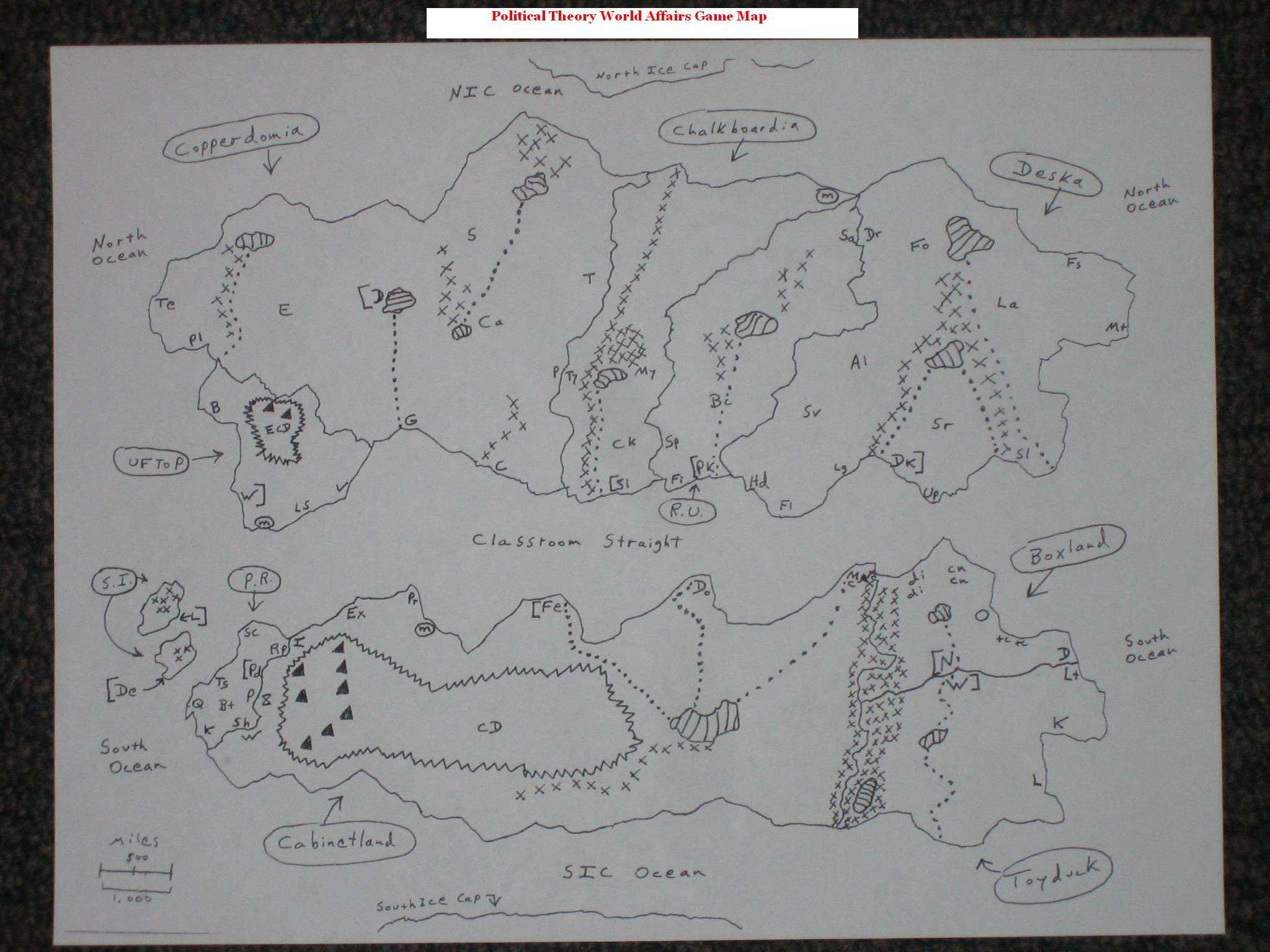
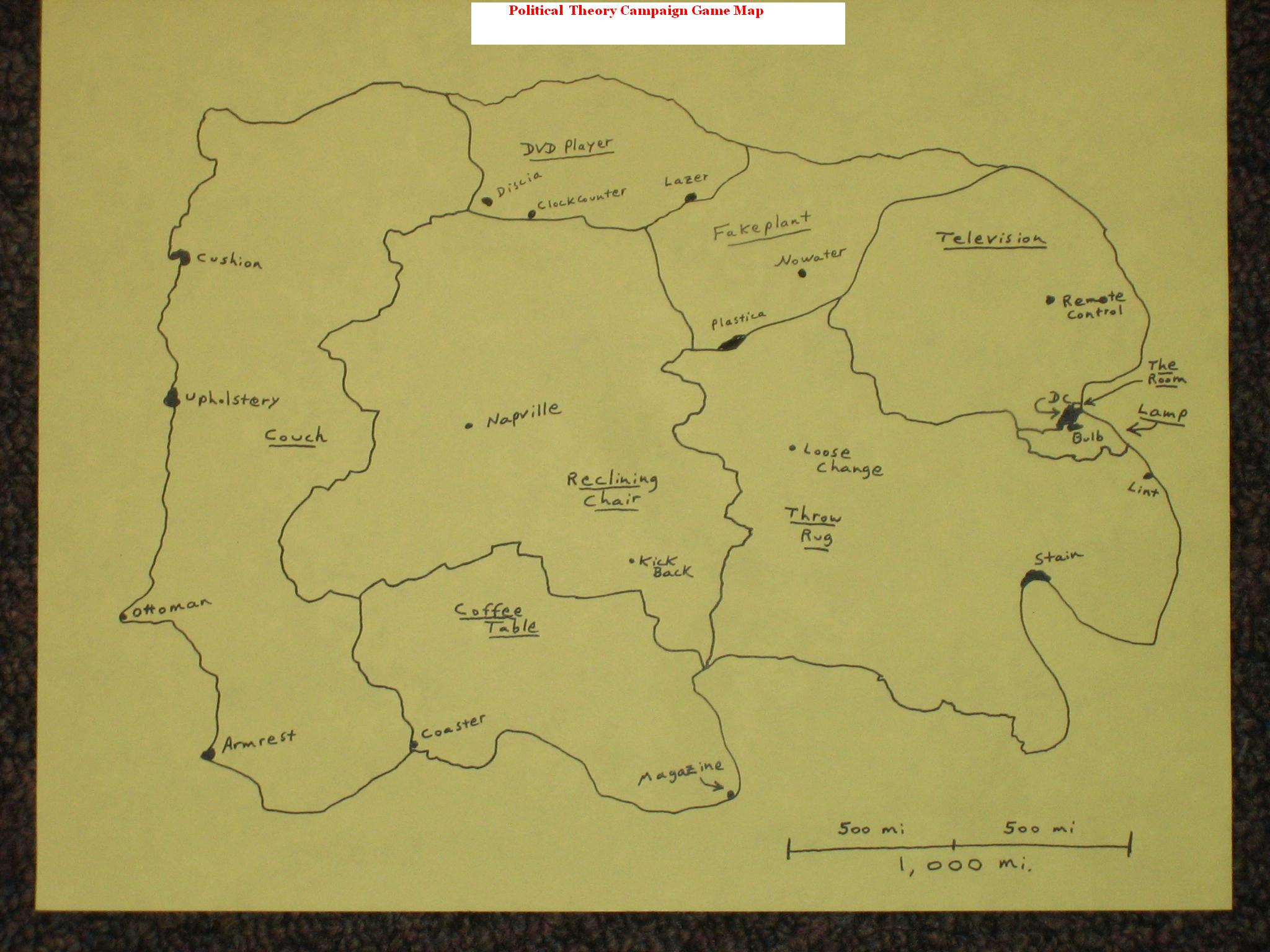
Traditionally, Political Theory classes have elected
to go into a more abstract area of policy development at this stage (such as
Dinnertablia, World Affairs Game, etc.).
Each class creates its own destiny.
Part III will certainly involve more discussion
of the Big Thinkers endeavor.
Part IV: There’s a final exam, but I’ve already
discussed those details.
The bottom line is
this: Prepare
to be constantly thinking in this course.
Many courses say it but don’t mean it. This course is
designed, first and foremost, to keep the mind of the student active and
stimulated at a sophisticated level, absent even a hint of what you might call
“busy work.” The curriculum is only partially planned with basic
political theory oriented objectives in place.
This is the case because it is the student who is an active part of the
course’s design. The teacher guides this
process, but the student has the most influence over what direction the course
takes during the 18 week semester.
I look forward to all of it.
---JDJ
Appendix E: Students in Political Theory will need to have regular access to school computers in order to be online. If you need to be online in order to survey news, check the course website, or perform any other tasks involving your student status in Political Theory, please show this appendix to any and all teachers inquiring about whether or not you have permission to be on the internet. Note to teacher: This student must be given wide latitude to use the internet for his or her responsibilities in Political Theory. Expect to see this student at John Jacobson’s website for this course or any number of links involving the acquisition of news or Political Theory related topics. If you have reason to believe that this student is accessing the internet for claimed Political Theory purposes that are not valid, please make note of the student’s website use and website use history for his/her current login session, inform me of what you found, and I will discuss the matter with the student. The student is expected to be fully cooperative with you regarding this matter.
Appendix F: Here is a possible format for policy
development exercises.
First of all, there are three types of policy development exercises:
1. You role play the actual people in power. You “own” their history, their prior statements, their prior decisions, etc. You are them. You are responsible for fully and adequately explaining sudden changes in policy behavior in a way that the free press and general public would deem acceptable.
2. You are the people in power. You’re not role playing. You are you. Your policy is driven only by ethics and morals. Politics is not a factor. Don’t worry about the real world. (This may be repeated, replacing “ethics and morals” with “self gratification.”). This can be done in the real world (with the cameras on and the people watching) and also in the fantasy world (where we assume cooperative compliance from the free press and the population in general).
3. You are the people in power. You’re not role playing. You are you. Your policy is driven by whatever you want: politics, morals, ethics, self gratification, a combination of these four, etc. But you are in the real world. The cameras are on and the people are watching.
Secondly, this is a likely pattern to be followed going into a policy development exercise (of type 1, 2, or 3):
a. Choose a President, Governor, Secretary of State, etc. (In other words, choose the “boss” of the room). We can do this any number of ways---randomly, by class vote, etc.
b. Determine advisory staffàSecretaries of Defense and State; Attorney General; Chief of Staff, Senior Policy adviser, etc. The question, to the “boss” is this: How do you want to set up the room? Who has rank over whom? Who is responsible for what?
c. Survey everyone’s policy agenda papers and determine a “master policy agenda paper.” This would likely be done in a round table discussion format where lots of people share their proposals (from their respective policy agenda papers) and decisions are made as to which proposals “make the cut” to the “master policy agenda paper” which is essentially cut and pasted together.
d. Start setting policy (This would happen in the spirit of a DRV as described in Appendix A). I’m assuming that this would be the most time consuming component of the policy development exercise, lasting perhaps for several days.
In nearly all of the above scenarios, I reserve the right to call for a press conference. In a press conference, I can ask anything I want. I may also encourage other students to serve with me as members of the press corps and to ask anything they want (We use the word anything liberally, but it stands to reason that we, as members of the press, would exercise some responsibility since we’d want to keep our jobs. So don’t abuse the meaning of the word if you’re invited to be a part of the press corps. For example, a question such as, “Does the President ever feel like running around the Rose Garden in leotards after a fresh chest shaving?” would likely land a member of the press corps in the unemployment line). Press conferences may (and often will) be used as methods of evaluating the class (or part of the class) during and/or at the conclusion of a policy development exercise.
Very Important Note: It is absolutely imperative that you abandon
all conventionally held notions about how workload is distributed within a
class and between classes. Certain
people with certain policy development cycle roles may be expected, at times,
to carry heavier work loads than others.
We will often be responsive to, and even somewhat at the mercy of, real
world events. If your policy development
cycle role happens to be right in line with a major world event that is
unfolding, then you may carry a different workload than someone who has a
responsibility not directly related to the unfolding world event. Additionally, different sections of Political
Theory meeting at different times of day are wholly independent of one
another. As already described, students
are largely responsible for the direction of a given section of this
course. As teacher, I will not
attempt to make workloads between classes equitable. Each class is its own situation.
Appendix G: Here are some web links for sources that may be utilized in this course. This is not a comprehensive list of web links. Others may be added as the course unfolds.
Leviathan by Thomas Hobbes: http://www.infidels.org/library/historical/thomas_hobbes/leviathan.html
Bad
News: The Noam Chomsky Archive: http://monkeyfist.com/ChomskyArchive
Great
Books Index: John Locke: http://books.mirror.org/gb.locke.html
Great
Books Index: John Stuart Mill: http://books.mirror.org/gb.mill.html
On
the Duty of Civil Disobedience (part I):
Henry David Thoreau:
http://nanosft.com/walden/essays/civil1.html
On
the Duty of Civil Disobedience (part II):
Henry David Thoreau:
http://nanosft.com/walden/essays/civil2.html
U.S.
Supreme Court Opinions since 1893: http://caselaw.lp.findlaw.com/scripts/getcase.pl?court=us&navby=year
Wikipedia
Political Theorist Page (VERY IMPORTANT):
http://en.wikipedia.org/wiki/Political_theorist
Appendix H: The student message board may be found at: http://www.geocities.com/johndavidjacobson/misterjacobson.html
Please be in the habit of checking it and your email on a regular (daily) basis.
Appendix I: Each semester is different. Each class is different. Please just keep this in mind. Whatever advice you get from previous
Political Theory students should be taken with a grain of salt.
Appendix
J: The responsibility of absence and
late arrival: This
particular “rule” is more of an announcement of understanding, for both you and
me. I fully understand that students
will miss class. I assume that you will take full responsibility for all of
your absences and late arrivals. We
will, on occasion, announce changes in class.
You are responsible for finding out about these changes. I am not responsible for being the person who
catches you up on what you missed. And
again, the idea of a ‘late arrival’ in Political Theory is somewhat of an
anachronism as I’ll likely just lock the door at the bell. Even so, you
must understand that there is no way to replace a missed
class. Once a class has been missed, in
effect, a certain degree of irreparable damage has been done to your place in
the class “flow.” This is simply a
reality of how this course works. Again,
I understand that, most of the time, class will be missed for perfectly valid
reasons. Valid or not, a missed class is a missed class. You are expected to
aggressively and proactively attend to this damage in a thorough manner. If you do not, then you are responsible for
any and all consequences which may occur as a result.
Appendix
K: Dinnertablia
game. I hope to do this activity
with you at some point in the semester.
Dinnertablia is an island nation (We will determine exact longitude and latitude location as a class). Here’s a brief sketch of its inhabitants:
Forkites
and Knifites: These closely related
ethnic groups are a part of the Silver Religion. They tend to be dominant in the military
(which was under colonial control until recently), although they are ethnic
minorities (composing approximately 12% of the population, 6% each). They have a 70% literacy rate. Average education level hovers around 11th
grade. There is a great warrior-like
tradition among these peoples dating back centuries. When the island was colonized, the colonial
power needed domestic security for possible threats from foreign invaders
seeking to overtake the island’s profitable salt mine and peppercorn
industries; thus, the colonial power recruited these two ethnic groups as a sort
of in-house military that would operate under colonial officer control. The arrangement was very successful, but was
underwritten by a tacit agreement that the military would not see a tremendous
amount of outside ethnic infiltration. A
small number of other ethnicities (see below) do have a presence in the
military, but the presence is token at best and virtually bereft of any officer
level standing. In other words, ALL
ranking officers in this military are either Forkite or Knifite, and the vast majority
of infantry are as well. The military is
primarily a land based army that was established (as already mentioned) to
stave off foreign invasion. There is a
small Navy and Air Force that operates in a supplemental capacity for the
Army. This military has not been
designed for any type of first strike behavior.
It is purely defensive in its makeup.
[80]
Spoonites: This ethnic group is also closely related to
the Forkites and Knifites, although they are much more passive. They do have an affiliation with the
military, but traditionally in a non-combat, support capacity. They are also Silver Religion worshippers and
are approximately 6% of the population.
They’re slightly better educated than their fellow Silver followers with
an 80% literacy rate. High school
education (on average). They are the
ultimate ‘betweener’ ethnicity. Their
slight degree of pacifism derives from a close relationship with the
Absorbspillist Tableclothers (see below).
Although they practice the Silver Religion, they’ve modified it for
their own purposes in a somewhat less aggressive fashion. Forkite and Knifite Silver Worshippers are
often referred to as “stabbing” Silvers while the Spoonites are often called
“nostab” Silvers. Regardless, the
Spoonites maintain a close relationship with their Silver worshipping brethren
(the Knifites and Forkites) by virtue of this semi-common faith. For this reason, although the Spoonites are
not really fighters, they have been given tremendous freedom to break the
ethnic military cartel held by the Knifites and Forkites, albeit in a
non-combat, non-officer capacity.
Virtually 70% of all Spoonites make their living either in the military
or in some capacity that is dependent on the military. Other than Knifites and Forkites, there are
more Spoonites in the military than Salt-N-Peppas, Finechinas, and
Tableclothers combined. [80]
Salt-N-Peppas: They are a mega-minority (approximately 4% of
the population) but are highly educated (college and/or graduate level---95+%
literacy rate) and hold traditional control over the country’s natural
resources (salt mines, peppercorn plantations).
This control came as they tended to be more cooperative with the
colonial power that took over Dinnertablia; thus, this colonial power granted
special favors to the Salt-N-Peppas over the years which ultimately resulted in
the Salt-N-Peppas gaining control over the aforementioned mineral/agricultural
industries. They are one of the two
wealthiest ethnicities in Dinnertablia.
They are members of the Crystal Religion. They are virtually non-existent in the
military. [115]
Finechinas: They compose approximately 22% of the
population. They are devout members of
the Wedding Gift Religion. They are also
quite wealthy (primarily dominant in the banking and trade industries) and well
educated, on virtually the same level as the Salt-N-Peppas. The Salt-N-Peppas are more or less totally
dependent on Finechina controlled markets of trade, although a degree of
interdependence exists, conventional wisdom holds that the Finechinas could
survive without the Salt-N-Peppas, but the opposite situation would not be
true. The Finechinas subdivide into a
closely knit array of sub-ethnic groups:
Plates, Bowls, Glasses, Platters, etc.
Although these sub-ethnic groups have distinctions from one another,
there is little infighting. Like the
Salt-N-Peppas, the Finechinas were highly cooperative with the colonial power,
and were extended tremendous advantages in terms of educational
privileges. The Salt-N-Peppas banded
ethnically to force out any Finechina dabblings in the salt mine/peppercorn
plantation industry, so the Finechinas turned to banking and trade which,
ironically, created a state of dependence for the Salt-N-Peppas. [120]
Tableclothers: They are the majority of the population
(approximately 56%). They are poorly
educated (less than 20% literacy rate with an average educational level of 2nd
grade) and largely exist at or near the poverty level. They are a laboring class, relying on
industries provided by all of the above.
They have virtually no presence in the military, and are not culturally
inclined toward military duty as their religion, Absorbspillism, is
predominantly based on the notion of nonviolent sacrifice for others. The only ethnic relationship they have that
is even remotely positive is with the Spoonites (see above). The colonial power tended to stay away from
them due to their large numbers, fearing that giving too many favors to them
might, in the end, cause a power struggle; thus, the Tableclothers were
essentially locked out of all military, economic, and educational opportunity
bestowed upon natives by the colonial power. [70]
The
numbers in [brackets] refer to the respective percentages of the game’s point
value (to be determined) that each group has at the beginning of the game. The total points allotted for the game are
finite. Split evenly across the room,
there are enough points for everyone to get an 84% (which is a solid B). If I’m of the opinion that the final product
of the game is exceptional in nature, then I will award the entire room 12
extra percentage points per person. You are not required to attempt to achieve a
situation where the percentages would be even across the room.
Note: Dinnertablians speak a dialect of Kitchen, which is almost identical to
English.
Here’s
the game: The class will be divided into the previously
mentioned groups, according to population proportions listed above. You are convening to form a constitution and
establish the framework for a society.
That’s your directive. Make of it
what you will. I offer you nothing else
in terms of advice. You may call upon me
in various capacities. I can be an
ambassador from any country you’d like.
I can also be a supervisor from the United Nations. How you set up your government, the general
structure of your society, etc., is up to you.
For centuries, Dinnertablia has been held as a colony by another
country, Kitchenia (exact longitude and latitude to be determined by the
class). Kitchenia has agreed with a UN
Security Council Resolution calling for Dinnertablian independence and will
remove its colonial control at a date to be determined when we start to play
the game.
Details of your situation
may be revealed to you by me according to how good your questions are (You need
to think about what to ask). Obviously,
my descriptions above can’t cover all possible background. When a question arises, we will randomly assign
it an answer (and then fill in any necessary explanation). I will offer a brief period of time at the
beginning of the game where you may recommend details to add to the history
and/or present set of Dinnertablian circumstances.
If you do not like the
grade(s) handed out at the end of the game, you may argue with me in an effort
to justify a higher grade or set of grades.
That is a part of the process in this game. DO NOT expect that just making an argument
will automatically result in higher grades.
The argument has to stand up against my justification for why the original
grades were given. I can imagine that
there might be a certain amount of frustration as I’m not telling you what you
need to do in order to get a good grade; however, one must look at this as a
purely theoretical exercise in political science (hence, the class title). If I give you a neatly prepared sheet
entitled, “Here’s how you succeed at the Dinnertablia Game,” then the process
becomes you jumping through academic hoops instead of what it should be, an
exercise in theory. In other words, the
learning here is dependent upon you NOT really knowing what you SHOULD do. And, by the way, who gets to say what you
SHOULD do? Me? Well, yes, somewhat---but only to be a bit of a naysaying
Devil’s advocate. That’s the teacher’s
job in a situation like this. There will
be problems with anything you do. I
can’t imagine the perfect solution with respect to the above
circumstances. How you approach this
activity entails the whole range of what you ought to be thinking about in
political theory. You have ethical
issues, ethnic issues, security issues, government structure issues, societal
value issues, etc. There is no definitive roadmap for a
solution; thus, it should be fascinating to see what path (or paths) you
ultimately choose to take. You have no
preset leadership structure in place for your ‘constitutional-society-framework
convention.’ You’ll have to figure out
how to set up a dynamic whereby decisions may even be made (before you even
determine what decisions need to be made, how to make them, and—finally---what
those decisions actually should be).
It’s imperative that you
think creatively. I will be grading in a
DRV-ish sort of way. Put your minds
together. Where is your allegiance? To
your ethnicity? To the building of a successful society? Both? [Is this
possible??] Think.
Here’s a rough outline of
how this game proceeds:
1--Assign ethnicities
2—Determine exact locations
(longitude and latitude) of both Dinnertablia and Kitchenia
3-- Brief period of time for
you to recommend details to add to the history and/or present set of
Dinnertablian circumstances (Details will be described, added or not added
randomlyàVia coin toss or dice roll or card draw, etc.)
4—Determine date by which
Kitchenia removes its full colonial control (This may also double as the date
that the game ends).
5—Play the game [Note: Additional randomly determined details may be
added randomly during the game if I deem them necessary]
6—Game ends
7—We will hold a series of
debriefing discussions on the game (Why did you do what you did in the way that
you did it?)
8—Initial grades distributed
9—Arguing over grades (If
necessary)
10—Final grades distributed
(If necessary)
Appendix
L: Fantasyworldia. Put simply, this is the Dinnertablia game
without any of the ethnic or historical complication. Establish your ideal society and its
attendant government structure. Although
not a definite requirement, I’d be reluctant to approve the playing of Fantasyworldia
without first experiencing Dinnertablia.
If
you were in American Government, then you may have done “The Bill Game.” If you weren’t, then it may also help to speak with someone who
played it. The purpose of “The Bill Game” in American Government was to
demonstrate the highly complex nature of bill passage under the federal
legislative system. This is Political
Theory. Our purpose here is, well, more theoretical in nature. So, we will do an adapted version of the Bill
Game.
In
this adapted version we do not operate at the committee level. Instead, we are the full House of
Representatives. Now, there will be
somewhere between 20-30 of you in class (give or take a few). The full House has 435 members. We will allow each of you to hold control of
“voting blocs.” A voting bloc is a tight
knit group of Congresspeople who are likely to vote together. Some of you will hold sway over larger blocs
than others. This will be determined
randomly. The Speaker of the House will
hold the largest bloc. We will determine
the Speaker the same way we determine the Committee Chair in the American
Government version of The Bill Game. In the spirit of theory, you’re given free
reign to design bills that you honestly believe to be good for society. Cost may be an issue. Whether or not money becomes an actual issue
will be determined by you in the game.
Here’s a sketch for playing the game under real world conditions:
1—Determine
the House Speaker and political party affiliations (I may get involved in order
to balance the party affiliations)
2—Assign
voting bloc values randomly (Some of you will control more votes than others).
3—Determine
a due date for written version of bills (We will also have a discussion of what
ought to be included in the bills).
Every member of the class must write a bill, even if you are working in
groups.
4—OUTSIDE
OF CLASS: Everyone has to write a
bill. Word your language as if you were
hoping to submit an actual proposal for a law.
Make it as long as you want.
Detail is imperative, lest your bill be taken to mean something other
than what you want it to mean.
5—We
all come to class with our written bills and then follow an agenda set by the
Speaker. Do we do revisions? Debate
riders? I will give out 50% of the actual game grade point value in extra
credit to be played around with under the same circumstances as in the American
Government version of The Bill Game (i.e.
If we determine that the grade value of this game is 200 points, then
there will be 100 points of extra credit set out for you to potentially go
after under the same circumstances as in the American Government version of The
Bill Game). [It’s important to note that the Speaker controls the flow of
debate, not me. The Speaker decides when
we discuss revisions, riders, and when we may actually have a vote on the
proposed bill. I will likely be playing
as a bloc of Congresspeople, and I WILL NOT be the Speaker.]
We
may also play the game under fantasy world conditions. I will not be involved in this game as a
voting bloc for political party balancing.
There will be no political parties other than potential alliances you
may form. There are no voting
blocs. You all represent the same
percentage of the 435 total votes in Congress.
We will assume that the Senate is like minded and will approve what you
approve. One of you will represent the
President. In other words, one of you
will either sign or veto any bill that is passed. There will be no Speaker, no extra credit
carrots, no responsibility to external political considerations----only a room
full of people with a great deal of (pretend) power to shape society,
ostensibly for the better. You will
still have to write bills for submission to me.
You are still free to practice tactics that may be practiced under the
real world conditions, but it is not a requirement. Again, you exist in a fantasy world in this
version of the game.
We
may play a third version of the game which really isn’t a game at all. The shot of the situation is this: You don’t have to worry about pleasing ANYONE
but yourself. If you could simply will a
bill into law under fantasy world conditions, what would it be?
Comparing
the product of each version of the game will, no doubt, lead to some
interesting discussion and insight into the theory of politics. Point values will be determined when we play
the game. Again, I think it’s helpful to
understand the basic idea behind the American Government version of The Bill
Game in order to play the Political Theory version.
As
always, if you’re not sure, ask!! This is yet another type of activity where
you intentionally are left somewhat in the dark so as better to get at the
theoretical nature of the decisions you make.
This method of classroom instruction rewards those who think to ask
questions as opposed to those who expect to have everything set out for them
ahead of time.
APPENDIX
N: The
World Affairs Game
We will play the game
for at least ten days of class, not including the setup and follow up
phases. Any time beyond ten class days
that is allotted to the playing of the game is subject to negotiation. My approval, of course, would be required. The passage of game time will be whatever it
will be. If I can get agreement from a majority of the people in the room to
accelerate game time ahead a few years, then I’ll do it. This will allow us to run odds on the success
or failure of plans, policies, etc. that you may have put into place. Only
I can propose the acceleration of a
period of time. A
typical day of class will be the same as 288 days in the game---but again, the
possibility exists for it to be more than that. The
possibility also exists for a day of class to be less than 288 days in the
game, but this would imply that we have chosen to let the game run in ‘real
time,’ for a while (See below).
There will be
occasions where we have to pause the game so that all countries can be updated
on major developments. When we’re in
pause mode, real time will equal game time.
Presumably, real time and game time will be the same when we meet as a
room in some sort of UN-like setting (assuming
you even form such and organization).
As a general rule of thumb, pause mode becomes increasingly necessary as
the policy load gets bigger and bigger.
I write this not to discourage you from developing policy. On the contrary, you need to develop
policy. Policy is the essence of this
activity. I write this only to point out
a reality of the game. The game, by its
very nature, becomes more and more complicated as policy gets developed. We need to make certain that everyone in the
“world” is understanding what’s happening.
A group of three countries could develop policy that has devastating
consequences for a fourth (uninvolved) country.
That fourth country needs to know what’s up. Pause mode may be the only way to ensure
this.
Please make certain
that your written policy is legible
and in black ink (so that it can be copied) or typed. Most
importantly, please make sure that your policy has an appropriate amount of
detail. Don’t leave major loopholes in
your policy (Others in the room may take advantage of it). More importantly, policy that is unclear or
‘loopholey’ can get exploited by reality control. Think ahead. I would expect that a fair
amount of policy would be written outside of class time (and then perhaps
amended or edited in class once you get an opportunity to bounce it around to
others, negotiate its merits, etc). I
recommend double spacing all typewritten policy so that alterations can be made
before submission. Having written this,
we obviously don't have the time or the means to make all policy perfectly air
tight---so I will deny attempts to find loopholes if I think the “spirit” of
the written policy has the appropriate level of detail. This is a judgement call on my part.
Again, I’m reality control. For the most part, I’d expect that policy
would be for public consumption. You
write it. It gets agreed to by the
involved countries (or maybe it doesn’t).
It gets published. Bring it to me
when you have an agreement. If it meets
the legible-no-major-loophole test, I’ll take it. I’ll probably just read it out loud and then
hang it up somewhere. I may even make a
few copies of it from one day to the next (so long as we aren’t killing too
many trees, which usually ends up being the case, so I tend to rely more on
making digital photographs instead).
There’s a second type
of policy called “eyes only policy.”
This is policy that is not for public consumption. It may be domestic in nature. It may be a secret agreement between
countries. I don’t know. I need to have this as well---but CLEARLY
label it at the top of the paper (and any subsequent papers) as “eyes
only.” It will not be read out
loud. It will not be posted for public consumption. IMPORTANT: Eyes
Only Policy has to be something that could be reasonably kept secret from the
larger population of the world.
When the game is
over, I’ll take some time to evaluate the collected policies and adjust the
grades accordingly. I’ll make my first
offer to the class regarding where I think the grades are at. It is possible that with the right type of
policy, the overall grade container may be enriched. In other words, the percent (%) grades you
see below are not reflective of a “closed container.” The overall grade percentage in the room may
get larger than what you see below. Is
it possible for everyone to get an A? Yes. Is it possible that the container could be
“cracked,” as it were? In other words, could the overall grade average of the
room go down? perhaps way down? The answer is also yes. For example, someone lob a nuclear weapon or
two and see what happens. Conventional
war can be bad for all, good for some and bad for others, etc. It’s unpredictable. War can be very good (see Adolf Hitler’s
removal from power, 1945) or horrifically bad (examples are too numerous to
mention). For me to encourage or
discourage war as a solution would be against the spirit of the game. Again, the word unpredictable is the
best “advice” I can offer. At least with
diplomatic negotiations, people don’t die.
Sorry, does that qualify as ‘discouragement?’ Do whatever you want. Sometimes, war is necessary, I guess.
~Sir Winston Churchill
Some time
after my first offer, we’ll reconvene for a round of negotiations where you can
attempt to raise your standing grade.
Perhaps I overlooked a long term effect of your policies. It’s possible. In fact, I might be so bold as to call this
eventuality probable—but it’s up to you to contest those points. I can’t guarantee you anything other than
I’ll be fair. I expect that you will
construct sophisticated, “if-then” arguments that cover a wide range of
possibilities. Just making an argument
for the sake of making an argument does not ensure you a higher grade. Political Theory does not reward effort for
the sake of effort. The percentage
points in the room are in the metaphorical “container.” The container can have its components
rearranged. The container can be opened
for more percentage points to be added to the whole. The container can be ‘cracked,’ and have
percentage points spill out (hopefully not).
This whole process of reconvening to essentially argue about my first
offer grades would be the same as the “step 9” phase of the Dinnertablia
activity (Please see the Dinnertablia description if
you haven’t done the Dinnertablia activity).
Once this “step 9” phase is complete, I’ll consider individual negotiations on a case by
case basis. These negotiations will
operate largely in the same spirit as negotiations for removing absences/late
arrivals. I make no promises at this
phase.
If you operated in a manner that was not seeking to be subversive to the
spirit of the game, I’ll be far more likely to negotiate with you. However, if, in my judgement, you were
operating in a blatantly irresponsible manner with a sense of recklessness---on
the assumption that you could just come to me and negotiate your way out of the
mess in the end (leaving a path of destruction in your wake), then I simply
won’t negotiate with you.
I take for granted
that you will play hard. I need to be
convinced (at times) that you played smart.
Play hard and smart, and you’ll be OK.
Respect the Political Theory “laboratory of government.” Be creative.
And have some fun.
J JDJ
Note II: To determine a country’s GDP, multiply the
population by the economic rating. We’ll
call our units of wealth, “Greyhounds.”
A country with 20 million people and an economic rating of 50 would have
a GDP of 20,000,000 x 50 = 1,000,000,000.
However, setting all of this aside, the easiest way to deal in the
consequences of all things financial is to simply translate matters into how
they will impact your actual grade for this activity (which is what I’ll do
when something of a financial nature happens).
DO NOT confuse this with the idea that your grade is based exclusively
on the financial well being (or lack thereof) of you and/or your country. It’s not.
* = Role may be
added. In the event that a class has fewer than 22 students, certain roles will
be given over to reality control.
Population: 137 million
Economic rating:
280 (You are a wealthy country).
You consume approximately 35% of the world’s energy. You have an incredible trade system and house
the world’s financial capital=
Military standing: You have the strongest military in the world. Your Navy, Army, Marines, and Air Force are second to none with the highest level of technological capability and the best trained, best paid soldiers. You are well equipped with special forces and a highly sophisticated intelligence network. You have a full arsenal of nuclear weapons. Active troops= 1.8 million (750,000 Army; 300,000 Air Force; 500,000 Navy; 250,000 Marines). Reserves= 1.2 million--------Other countries may have more actual human power, but your human power is magnified greatly by your technologically underwritten equipment. You have military bases located around the world. You are the only country in the world to have military bases on foreign soil. All of your military bases date back to 55 years ago when the President of Copperdomia secured a series of treaties to establish the bases. The treaties are set to expire after 60 years.
Religious situation: You are highly secular. Religion is not a primary guiding force in daily life. The vast majority of your people are of the “Lower Quadrangular Window” (LQW) faith, but it’s a largely symbolic, traditional following that is, again, secular in terms of its role in daily life. Your society has a strict separation of church and state.
Natural resource situation: Your agricultural production is #1 in the world. You have modest levels of natural resources, but nothing major. You import most of your vital resources (like oil!). Timber is a big industry for you, though.
Government structure:
You are a democracy with a President (who serves unlimited 5 year terms)
who heads an executive branch. The
government has a single house legislative branch. All treaties negotiated by the executive
branch must be approved by the parliament.
The parliament can remove a President with a unanimous vote. There are four provinces in Copperdomia, the
Roles: 1 president and 2 parliament members (128% for everyone)*
Population: 40 million
Economic rating: 17 (You are a poor country). There’s no real tourist industry in your country.
Military standing: Not very strong. You don’t even have an air force. You’ve never invested much in your military due to your proximity to Copperdomia. Active troops= 25,000. No reserves.
Natural resource situation: You have strong agricultural production (but
the value of your crops is drastically undercut by the glut of agricultural
production in Copperdomia) and a healthy strip of largely untapped copper and
coal mines in the center of your nation (in the
Religious situation: Your country is fairly religious and fairly well committed to the “Upper Portal Window” faith; however, there is a growing movement of “NSI-UPW” where people tend not to see the Window Opener as a pre-eminent figure in UPW. UPW guides much of daily life and culture as well as government decision making, but once again, you have to take this with a grain of salt. More and more influence from Copperdomia is beginning to undercut this old school traditional UPW culture. “Fair weather UPW’ers” are increasingly common (especially among the young who, in large numbers, admire Copperdomian culture). A FWUPW is really secular more than anything, but may outwardly profess to be a follower of UPW. There is an LQW minority in the border region with Copperdomia (about a millioin people) that identifies more with Copperdomia but has no majority interest in becoming a part of Copperdomia.
Government structure: You’re a constitutional monarchy. The royal family is purely symbolic (but a drain on government coffers as they hold a great deal of wealth and don’t have to pay taxes on it). The country is largely run by the parliament (with a prime minister as a chief executive) which is directly elected by the people. The Prime Minister here is not very powerful. He/she isn’t even the Commander in Chief of the paltry military (All military decisions must be approved by the Parliament). The Parliament tends to make the decisions and it’s expected that the Prime Minister will approve of them. The Prime Minister serves a series of 2 year terms. The ruling Eraser Party has held power for over 40 years.
Role: 1 Prime Minister (81%), 1 Parliamentarian (83%)*
Population: 33 million
Economic rating: 34. There’s very little tourism due to the social unrest in your country.
Military standing: The military, on a world scale, is modestly strong. All males are required to serve for 4 years after their 18th birthday. You have a very strong navy that is largely based around your southern coast. Your air force is also rather well equipped. [High spending on military might has lead to underfunding of domestic programs]. You have a nuclear weapons research program that is reportedly less than a year away from achieving development of a nuclear warhead. Regional Party Leaders in Deska are vocal about their opposition to your nuclear program. You have the missile technology (at present) to deliver any payload as far as 1,000 miles and are probably five to seven years away from being able to achieve ICBM (long range) missile technology. Active army troops= 950,000 (fully 600,000 of whom are stationed at various spots on the Deskan border); Active air force= 75,000; Active Navy= 165,000; Reserve troops=250,000
NOTE: The northern city of
Natural resource situation: Modestly successful agriculture. Several stores of accessible uranium and coal in your two mountain systems.. Strong and thriving fishing industry (All countries have fishing industries to a degree, but the south coastal waters of R.U. are particularly suited to fishing---Fully 40% of your GDP comes from fishing).
Government structure:
Essentially, you’re a democracy, but it comes with complications. Virtually all of the wealth is based in the
Advancedplacement people who are only about 10% of the population. AP’ers elect a President and a Congress. The arrangement between the legislative and
executive branches is very similar to the
Religious situation: It’s also divided. The Easyclass majority are largely UPW (although, again, this UPW is complicated in much the same way it is in Chalkboardia. Essentially, everything I said about Chalkboardia holds here with the notable exception of Copperdomian cultural intrusion. There certainly is some Copperdomian cultural intrusion [here, as well as all over the world] but not nearly as severe as what you see in Chalkboardia). The Advancedplacement minority are highly secular, but those who do ‘have religion’ tend to be followers of the ‘Lower Quadrangular Window’ faith. There are traditional conflicts between the UPW and LQW faiths as each believes it has the ultimate “view” of the truth of the world that is “outside” (Both religions call it, “The Roof”). The one religion that has never really been tolerated here, and one of the few things that will unify AP and EC peoples, is the Hanging Light religion (Keep reading). In fact, there is a law in R.U. that makes the open practice of HL a felony punishable by up to 10 years in prison.
HISTORICAL NOTE: The people of this nation, divided as they may be, are unified on HL and one additional (related) topic—a mutual hatred of Deska. 135 years ago, Deskan invaders ravaged this nation, pillaging its resources for a time and even taking some of its people (of both the Easyclass and Advancedplacementer populations) into forced labor camps to work Deskan run farms (in the R.U.). The national elementary, middle, and high school curriculum of R.U. teaches that Deskans are “unrefined, backwards-thinking people who were unable to manage their own affairs and needed R.U. slave labor in order to survive as a nation.” This, of course, is a very convenient interpretation of history, but it’s the version that’s taught in R.U. nonetheless. (In Deska, the essential opposite interpretation is taught). A long border runs between R.U. and Deska. There IS trade across this border, but essentially no tourism. It’s a violation of Deskan law for a Deskan citizen to travel to R.U. unless on official “Party sanctioned” business. An R.U. citizen typically has to wait for over a year to get government approval to travel to Deska. In the previous 2 years, fewer than 1,500 R.U. citizens have traveled to Deska (and they were all AP’ers)
Role: 1 President (a secular LQW Advancedplacementer) (92%), 1 ‘Easy Dude/Easy Dudette’ (80%)
[* = Congressperson ( 89%)------or---------Easyclass civilian (76%)]
United Federation of Television and Overhead
Projector (UFTOP)
Population: 14 million (primarily coastal, city dwelling)
Economic rating: 95 (You are fairly wealthy due to
the fact that you possess approximately 20% of the world’s oil). There is no tourism in your country other
than that which happens for religious purposes.
Many UPW people like to see the residence of the Window Opener (see below).
The Window Opener lives in the Grande Portale, a massive estate located
in the exact center of the capitol city of
Military standing: Virtually non-existent. You have a symbolic union of military personnel who are actually police officers elevated to a rank commeasurate with military standing. You have only an “army” of these “soldiers” which stands at approximately 5,000 “troops”. That’s it. It’s not a real army and would easily be defeated by just about any military in the world.
Natural resource situation: Pretty sweet. [Just about everything written here regarding oil also applies to Cabinetland, only in greater abundance] Again, you have 20% of the world’s oil [80% is in Cabinetland], and the world (as a whole) has made virtually no progress toward alternative energy sources. A best estimate is that the world is well over a decade and a half [15 years] away from achieving the industrial capacity to rely primarily on alternative energy sources and that the cost, depending on the plan to get to that point, would be significant. Is there a way to cut into that 15 year prediction? Hard to say. Is there a need? Well, there’s pollution, for sure . . . and there’s fossil fuel emission . . . for sure (Some of you may argue about what the consequences are) Scientists differ in their prediction of peak oil. Some say it’s already happened. Others say it will happen within the next 10-15 years. Most agree that, at the outer edges of a best case scenario, the world is heading into its “final century” of fossil fuel energy at the current rate of consumption. Still some say that there may very well be treasure troves of undiscovered oil in the ice caps, deep beneath the ocean floors, in various mountain ranges, etc. Who knows? No countries have undertaken serious investment in alternative (non-fossil-fuel based) energy at this time. All of this is in the way of saying, it’s cool to have oil---and you have oil. You don’t have much in the way of agricultural capability, though. And you can’t subsist (biologically) on oil.
Religious situation: You are STRONGLY UPW. Virtually 100% of your people are devout followers.
Government structure: You’re a theocracy. There are no democratic principles in your country. People willingly follow the word of the Window Opener, who is both a religious leader and autocratic government leader. Free speech is not a right in this country if the “freedom” extends to speech that is critical of UPW and/or the Window Opener. Lately, there have been rumors of NSI-UPW creeping into certain facets of back room discussion, but there’s no outward evidence of just how significant this is (if it’s even real in the first place). Largely speaking, UFTOP is the most closed society in all the world. Very little beyond the Window Opener’s residence (from the outside) is known. People tend not to interact with the media.
Role: 1 Window Opener (who gets to carry the big window opening stick in class AND is free to move about the school grounds at will—provided that he/she does not interrupt other classes, etc.---without permission AND who is exempted from the late arrival/absence accrual during the tenure of the game AND who may reduce up to a total of 12 absences/late arrivals of other students {not PER student . . . . 12 total!}, distributed however he or she wants . . . provided that those students are UPW) [190%]
Population: 4 million (primarily coastal, city dwelling)
Economic rating: 11 (You’re mighty poor)
Military standing: You have a small navy of approximately 3,000 sailors along with a standing army of approximately 50,000 poorly trained, ill equipped soldiers. Technically, the NSI and SSI Presidents preside over the respective portions of the military that are stationed on their individual islands; however, this is a mess as the forces tend to change islands at will. On any given day, either the NSI President, the SSI President, or some random General might actually have the most control over this military, but that’s not saying much.
Natural resource situation: There are reportedly many natural resources that exist deep in the mountain ranges of your two islands; however, there is no real road system to get to these natural resources and the government itself is unable to organize properly to develop such a system (The system would cost on the order of 15-30% WAG grade in order to fully develop and give full access to the possible riches inside---And those riches are not entirely understood or accounted for). Rogue elements in the military control all access to the mountains on the southern island and keep interested business at bay so that they (the military) may profit exclusively from what they are able to find and take out themselves. The mountain range on the northern island is dominated by about ten thousand army troops only. These corrupt troops tend to work in conjunction with local organized crime in controlling access to the riches. In both cases, the natural resources that may exist in the mountains are only marginally being tapped into since no real sophisticated search techniques have been employed. No one seems to know the full extent to which the government in the north has control over any of this (and, to a lesser extent, we could say the same about the south). Corruption is inherent to SI daily life. That much is certain.
Religious situation: The northern island is predominantly UPW. However, there is a theological split with most of the rest of the UPW world as the northern islanders do not see the Window Opener as the true voice of UPW. Instead, northern islanders view the religion as being entirely bereft of hierarchy. The UPW practiced on the north island is typically referred to as NSI-UPW. [NOTE: According to NSI-UPW, the upper portal windows give clear vision to all followers. There are no favorites (UFTOP and most other UPW followers tend to believe that the Window Opener has a special ability to see through the upper portal windows. This ability has been handed down over the years from one Window Opener to the next.). The southern island is highly secular with a slight lean toward LQW---but secular is essentially the rule of thumb. What legal and legitimate trade related wealth that does exist is in the southern island (although both islands have high crime, high infant mortality, etc.). The military’s presence is predominantly housed in the southern island as well (with the exception of the small number of corrupt, organized crime partnering soldiers who guard the mountain riches of the northern island).
Government structure: By tradition, the government is run by an appointed leader from each of the two islands. As the islands are so different from one another, this is one of the primary reasons why very little gets done. There is no process for tiebreaking between the two votes. The appointed leader from the northern island has come from a hereditary lineage of NSI-UPW theocrats that stretches back for over 90 years. The southern island leader is chosen by the people, but the military gets veto power over the choice of the people. If the military vetoes an elected leader, then the military has the right to install its own leader (which it has not done for over 30 years, principally because the military itself can’t agree on who is in charge and, therefore, who would have the authority to issue a veto). The military does not enjoy this veto authority on the north island. The result of this is that S.I. has two official capitol cities, one on each island.
Historical Note:
The
Roles: 1
[* = Random military general (74% . . . or whatever)]
Population: 112 million (You are quite dense!!! That’s not a comment on your IQ, rather, just a note to point out that it’s a little crowded on your island.)
Economic rating: 70 (on the books) and 30 (off the books). There is an extensive trade of contraband that originates from your country and helps to illicitly fund major portions of the military. This contraband flows into countries like Copperdomia (where it is all illegal, but where there is the biggest demand for it), Cabinetland (where it is also illegal), and Deska (where it is illegal as well). It is also illegal in UFTOP. It is technically illegal in Chalkboardia and R.U. (although Chalkboardians traffick it in large numbers). The legality or illegality of this contraband in other nations (S.I., Boxland/Toyduck) is not a pre-existing condition of this game (at present). If said legality/illegality is not specified as a pre-existing condition by these other nations, then the assumption will be that contraband is illegal. The ‘on the books’ part of the P.R. economy is respectable and comes primarily from exotic agricultural exportation (fruits, coffee, etc), fishing, and tourism. Tourism exists everywhere in the world (to an extent), but your country is the world’s hotspot, as it were. The “E” Channel shoots a lot of specials there, for instance. MTV does a lot of spring break specials there, once again, just as an example.
Natural Resource Situation: This is discussed in the other areas of your profile.
Military standing: You have a very strong navy of over 750,000 sailors with extensive fleets and a highly advanced technological base. If Copperdomia has a navy that might be considered (loosely) a ‘rival,’ you’re it. Your army stands at over 3,000,000 and is fully integrated into daily life. Soldiers are everywhere, and two years of service is mandatory for all men and women over the age of 16. However, you do not have the same military technology as, say, Copperdomia (even your navy isn’t quite on the same level---Your army isn’t even close to having the same level of training, technology, etc.). Your intelligence network is very strong. You have an elite air force unit of approximately 50,000. It’s very effective, but small—not designed for long range operations.
Religious situation: If anything, it’s LQW, but you’re highly secular. Religion is not a meaningful part of public life. Having a good time is a bigger part of public life than anything else. Of course, there’s a UPW influence from Cabinetland, but it’s largely marginalized by P.R. culture. In spite of these differences, there’s a lot of travel done back and forth between P.R. and Cabinetland.
Government structure: You’re a democracy with a Parliamentary system (You don’t have an executive branch). Your Prime Minister, who is chosen by the Parliament, is NOT your military’s commander in chief. That role is appointed by the military. The Prime Minister and the Commander in Chief must consult on major military decisions. War can only be declared by the Commander in Chief. In reality, the Commander in Chief has the ability to pressure the Prime Minister and the Parliament. There is a single figure in your country who is extraordinarily powerful as a result of having consolidated virtually all of the primarily illegal contraband trade. We’ll call this person the “contraband Lord.” The contraband Lord is also very influential in government decision making, but from behind the curtains, as it were. And, just a reminder, a goodly portion of the Contraband Lord’s profits funnel into off the books accounts which are drawn upon by the powerful P.R. military. To be sure, the majority of the P.R. military’s funding comes from P.R. taxes, but approximately 30% of the funding is in cash, and that cash is produced by the international sale of contraband.
Roles: 1 Prime Minister (90%). 1 Commander in Chief (95%). 1 “contraband Lord” (180%)
[* = Parliamentarian (88%)]
Population: 32 million (Mainly coastal city dwellers with about 2 million nomadic desert dwellers)
Economic rating: 320 (You are wealthy, but the wealth is not evenly distributed)
Military standing: You have an army of 75,000 modestly trained and modestly equipped soldiers. There is no real access to state of the art technological equipment, though. Your weapons labs don’t have any real funding. In order to get state of the art equipment in a reasonable (less than five years) amount of time, you’d have to buy it. You have a highly skilled and extensively well placed intelligence network, though.
Government structure: You are a monarchy. The royal family controls virtually 95% of the country’s wealth (yet makes up less than 1% of its population). The chief monarch has almost absolute power, although there are various princes and princesses who may be willing to challenge a given monarch should he/she get out of control, as it were.
Religious situation: The masses are strongly, strongly, strongly UPW. Maybe not UFTOP strong, but strong. The NSI-UPW brand of UPW is punishable by death administered via local UPW-village-city council (which exists in every city and is one of the only political-governmental organizations available to the commoners). The city of Illin and, to a lesser extent, the city of Exportia are considered to have quietly maintained NSI-UPW movements; however, the Window Opener is widely revered here, but said reverence is based on a public perception that the Window Opener does not consider the Royal Family to be tru UPW’ers. The Royal family is technically UPW, but is actually quite secular (and, some would say, Copperdomianized).
Natural resource situation: You have a strong agricultural sector in the East and 80% of the world’s oil. How’s that?? Answer= Real, real, real GOOD!!!!!!!!!!! But again, the wealth is in the hands of the few.
Roles: 1 Monarch (285%) and 2 common people (71%)
Population: 490 million (You’re the most populated country in the world)
Economic rating: 46
Military standing: You have a standing army of over 5,000,000 (one third of which is stationed up and down the R.U. border); a navy of just under 1,000,000; and an air force of 500,000. You have an extensively well equipped (although not terribly well advanced in terms of technology) conventional military network with a small arsenal of long range nuclear missiles (approximately 45). Copperdomia, by comparison, possesses over 400 long range nuclear missiles. You do not possess nuclear submarines. Copperdomia has, at best guess, over 25.
Government structure: You’re a traditional communist state. Private property is not permitted. The state owns and controls the means of production. The type of communism you practice allows for a central party oligarchy who advise the Party Leader (who is essentially the chief executive). The Party Leader may be removed by a 2/3 vote of the oligarchy. The Central Party is the only legal party in your nation. Basic civil liberties may be suspended by the Central Party during “national emergencies.” There are an average of 2 national emergencies a year in Deska, which is to say, national emergencies are just about anything the Central Party wants them to be. The Party Leader must have the approval of a majority of the Oligarchs in order to form a treaty with another nation. The Party Leader is the Commander in Chief but only the Oligarchs may declare war. A Party Leader serves as long as the Oligarchs desire for him or her to serve. The military is highly compliant to the wishes of the Central Party (although the Central Party has never really got in the way of the military’s consistent desire to remain large). The Central Party is the only legal political party in the country. The Oligarchs are chosen by regional party leaders (who, in their own right, have tremendous power and should not be taken for granted) who are chosen by provincial party leaders who are chosen by people who have been registered with the Central Party for at least ten years. On average, only about 17-18% of the country qualifies for voting rights under this system. And again, the “system” is about choosing among the party membership, not from outside of it. If only 17-18% of the country can vote, then only about another 20-25% are awaiting eligibility. That means, in a given year, less than half the nation even claims Party membership.
Religious situation: You’re not UPW or LQW. You follow the world’s third major religion, the Hanging Light faith (HL). It has a totally different view of spirituality as compared to LQW and UPW. HL followers do not believe in the world outside. They believe that all the answers in life can be seen by the lights that hang above us. Officially, HL is discouraged by the central party. In reality, it has hundreds of millions of devout followers. There are fewer than 100,000 HL followers in the world outside of Deska (and most of them practice the faith illegally in R.U.).
Natural Resource situation: You have an enormous agriculture situation. Fully half of your people are farmers, although production is rarely enough to feed your nation (That’s where the Copperdomian surplus comes into play). Incidentally, only about one in ten farmers belong to the Party. There are reserves of coal, uranium, copper, etc. in your central mountain range. “Labor” isn’t really a natural resource, but it’s best placed here since there’s a movement of people from farms to the cities. This movement is driven by the growing number of factories that are springing up in the cities.
Roles: 1 Party Leader (90%) and 3 Central Party Oligarchs (85%)*
Population: 25 million
Economic rating: 46
Military standing and Government Structure: Toyduck is a military dictatorship. The army, navy, air force, special forces,
and intelligence networks come under the authority of ‘The Grand Duck.’ The Grand Duck is all powerful. No free speech is permitted in Toyduck, and
there is virtually no civilian form of organized resistance to speak of in the
entire nation (Although there is always the feeling that there could be, if
things got really bad). The military
forces here are quite strong, particularly the Navy (over a million sailors
with a fairly high tech fleet of ships, aircraft, etc.). This is principally due to the history
between Toyduck and the
Finally, there’s a figure who has emerged in Boxland who is calling for Boxland independence (and runs IBN=Independent Boxland Now). This figure has a Podium Republican mother and a Toyduckian father. This figure openly speaks out against The Grand Duck AND the P.R. Government [and is considered an enemy of the state in Toyduck as well as an informal traitor in P.R.]. IBN’s membership is an interesting mix of Toyduckians and Podium Republicans who have largely tired of being “fought over” and no longer culturally identify with either of their national “parents,” as it were. IBN is well organized, essentially known as the “Master of the Shelves” because of its intimate knowledge and survival skill set in the massive Cabinet Shelves mountain range. It’s membership is the subject of some dispute. Some say it has as many as two million followers. Some say the number is much lower. IBN has a flag, a field manual for defense, a treasury system, and an advisory staff to the IBN’s Chairperson. It’s official headquarters is in the Treaty of Cabinets recognized “provisional capitol” of Nonamestown. It’s technical and daily operations headquarters is believed to be somewhere in the Cabinet Shelves.
Religious Situation: The Toyduckians are mildly UPW, but pretty secular in all reality. They see themselves as fairly cut off from Cabinetland (Note the dense mountain range known as “The Cabinet Shelves.” The P.R. nationals in Toyduck are essentially like P.R. citizens, pretty secular.)
Natural Resource Situation: It’s good, but it’s all in Boxland (See above description). There’s some basic food crop agriculture in Toyduck itself (but not enough to feed everyone which, once again, brings the Copperdomian farmers into the equation), but the riches of the country funnel out of Boxland into the hands of The Grand Duck. The Grand Duck moved military forces into Boxland 14 years ago (against the Treaty of Cabinets, but the P.R. was convinced by Cabinetland to stand down) to take control of all tobacco, sugar, and diamond exports. These exports are used to finance the Toyduck government and the massive Toyduckian military machine which boasts a million infantry, an air force of 25,000, and (as mentioned) over a million sailors.
Roles: 1 Grand Duck=119%, 1 IBN Chairperson=80%
[* = The Little Duck= 105%]
[Maps of
‘the world’ will be provided in class as hard copies]
***
In this activity we
do a laboratory of government as it pertains to the separation of powers as
defined by the U.S. Constitution. The
room will be broken into 5 categories: (1) The President and Staff; (2) The
House of Representatives; (3) The Senate; (4) The Supreme Court (Likely to
be played by me); and (5) The free press.
To a certain extent,
much of this activity is already defined by the United States
Constitution. You will all be in charge
of running the country (and some of you will be in charge of how the population
perceives the running of the country). Before we start, we’ll take time to
prepare. As you’ll see, there’s a lot to
do just to get set up. I expect everyone
to do everything possible to understand the various roles involved in this
activity. Ask me questions, by all
means. Everyone starts this activity
with a 95%. That’s a solid A. We
play and play and play for a given period of time. I may give you grade updates, I may not . . .
we’ll see. At the end of the game, I
submit a first proposal of
where your grades stand. We then take
some time to allow you to prepare for a ‘step nine’ phase (If you don’t know
what a ‘step nine’ phase is, then please consult the Dinnertablia activity in
your course description).
The DRV-real-world grading culture of this activity is most definitely in place---but you also have to be careful to never allow for the appearance of “sleeping on the job.” The free press will get you. Playing the role of your constituents, I’ll get you. This game is one big “No Down Time” Zone. Always be creating. Always be producing. And do so smartly, like a good chess player, always looking more than a few moves down the board. Be prepared at any time to be able to show me in writing what you’ve been doing to earn your fictitious salary (a.k.a. “grade”).
Here are the roles:
(1) The President and Staff: The President should have his or her staff fully appointed prior to the game starting. Specific duties should be assigned. Most importantly, a game plan for chief executive leadership should be scripted with a full slate of domestic policy and foreign policy initiatives as well as an attendant legislative agenda. In all likelihood, you’ll have to have staff members double up on duties. Perhaps your Attorney General will also serve as your Secretary of Treasury, etc. I’m going to assume that you’ll cover the key cabinet and advisory positions. I won’t be too worried if you leave out the Secretary of Agriculture or something like that (although, take it from me, it’s an important role where I come from—and that’s no joke). Here are some suggestions . . . .
a—Secretary of State
b—Secretary of Defense
c—Attorney General------This is an extremely important role!
d—Communications Director (speechwriter, press liasion, etc.)---This person is essentially the face of your administration and must be readily available to the media throughout the game. Failure to be available will leave the media room to be more speculative . . . . which takes away from your ability to control your own message.
e—Vice President?? [It may be a good idea to give someone this title as a secondary role just in case our actual President runs into a 25th Amendment issue or, worse, impeachment!!]
f—National Security Adviser
g—Treasury Secretary
h—FBI Director
i—You know what? Whatever you want, dammit! The Constitution gives the Chief Executive the expressed power to create and/or eliminate cabinet level departments (with the advise and consent of the Congress, of course). The EOP is pretty much whatever the President wants it to be, and Congress doesn’t have to be consulted on those jobs!!! Go nuts! You don’t even need to assign pre-determined roles. Titles like “Senior Policy Advisor” are just fine.
NOTE: The actual number of people you get for staff will be largely dependent on the size of the Political Theory class.
NOTE II: The constitution gives the President 10 business days to decide about signing or vetoing a bill. For the purposes of this game, the President has 24 hours. We will not have an end of a Congressional term, so there will be no opportunity for a pocket veto.
(2) The House of Representatives and (3) The Senate: You’re the legislative branch. You have slightly different responsibilities in a few areas, but—for the most part, you’re the lawmakers of the country. As I expect you already know, you also have the authority to perform numerous oversight duties for the Executive Branch, you may conduct your own investigations, etc. The Presidential Succession Act calls for the existence of a House Speaker and a President Pro-Tempore of the Senate. I expect that you’ll fill these roles for the purposes of the game. If you don’t want the game version of the Speaker or the President Pro-Tempore to have the same kind of power that the real Speaker (or, on the other side of the Hill, the Senate Majority Leader) has, then that’s you’re choice. The powers of the House and Senate leadership are largely defined by House and Senate rules, and not by Federal Law----thus, beyond putting a warm body into each of these roles, you can make them mean whatever you want in terms of power. The Senate will start with a filibuster rule in place; however, a two-thirds vote can change that rule. A three fifths vote can create cloture. Maybe the House and Senate will begin to form some of their own rules for legislative procedure. We’ll see. Regardless, I expect you all to have your own individual (and extensive) legislative agendas. We could get terribly lost if we tried to individually determine the makeup of each legislator’s constituents----so I’m leaving that out. We’ll make do the best we can. Three of you [at least] will be Senators. Five of you [at least] will be House members.
(4) The Supreme Court: We will have two of you “on the bench,” as it were. One of you will be worth 5 votes and the other will be worth 4 votes (all of which will be determined randomly). This means that all of your decisions will be by a vote of either 5-4 or 9-0. We have to sacrifice a little reality in this game, obviously. For the purposes of this game, we need to change your role somewhat from that of an actual Supreme Court. So that you two aren’t just twiddling your thumbs, waiting for someone to ask you to hear a case, you are responsible for keeping the “no down time” promise in the following way . . . .
You will always be involved in one of two things:
1—You’ll be hearing cases that we may bring to you. Anyone in the room (except the justices themselves) can file a lawsuit (to challenge the constitutionality of a law, seek justice in a case, etc.), including me. These can be actual legal situations or legal situations that arise as a function of our fake little world up here in the Copperdome. There are two steps to this process. First, you must determine whether or not you’ll even hear arguments on a case. If one of you believes that the case is worth hearing, then you file a writ of certiorari by simply stating in writing that you agree to hear the case. Once you do this, you set a date and a time to hear arguments from the opposing sides. You hear the arguments and then take as long as you want to file a decision with your legal opinions attached. If you disagree with one another then the 5 vote justice files a majority opinion and the 4 vote justice files a minority opinion. If you agree with one another then one of you files the majority opinion and the other files a concurring opinion [if he or she has other reasons explaining why the decision was made].
2—Here’s the invented part that’s a little different from the real Supreme Court--but it will be helpful. When we’re not giving you legal challenges to consider, you must spend your time creating individual legal histories for yourselves. This is both simple and hard. It works like this: Think of a legal matter, constitutional issue, etc. And then write a legal opinion on it. Publish your legal opinion. Don’t write about pending legal matters. Keep the tone of your writing general enough so that it expresses your essential legal/constitutional philosophy on the topic at hand. The more we can get to know what makes you tick in these areas, the more we’ll have to use when it comes time to argue before you.
Arguments can be conducted by me, the Attorney General, members of Congress doubling as legal scholars, members of the free press also doubling as legal scholars, etc. Perhaps it will be the case that only one side argues. That’s fine. This isn’t an American Government debate. The Court doesn’t have to rule in favor of a side just because it was the only one to argue a point. The Court is in place to interpret the Constitution. Arguments before the court are not contests to be won or lost (even though we often tend to look at them this way). Rather, they are exercises in legal discourse where the Court is challenged to uphold an existing interpretation of the Constitution or to begin looking at the Constitution in a new and different way.
The other way to do the Supreme Court is to let me handle it. I’ll accept arguments from both sides and then make a ruling. I’ve found that students in the Supreme Court often get left out of this activity; thus, I may recommend that we permit this option to be the method of playing.
(5) The Free Press: You tell the people (played in part by me) what’s happening. The perception and understanding that the public has of its government’s activity is almost entirely dependent on you and what you do with your power. You report news. You offer editorial opinions. I expect each and every one of you to publish news/editorials on a daily basis. You may ask questions at press conferences, ask for quotes, ask tough questions, ask easy questions. You may hold broadcast talk shows (Perhaps we can get a camcorder up here—or, at the very least, just use an audio tape recorder). They may not realize it, but a good amount of the rest of the room’s grade is going to depend on you and how you do your job. To a certain extent, you all may very well be the most powerful people in the room. With a normal sized class, we should have space for 3 or 4 of you. It’s hard to say much more than this, but I fear that if I don’t, you’ll feel as if this isn’t such an important role. Don’t believe that, please. You’ve “got the conch,” as Piggy said in Lord of the Flies.
For All Political Theory Students in the Game
I am reality control.
I am the people of the
This activity will be a bit of a three ring circus, so it may become necessary, from time to time, to set the game on “pause,” round up the desks, and make certain that everyone in the room understands all the things that are going on (at the same time). Political Theory, in the laboratory of government mode that we use in here, is anything but linear. Things can get confusing and out of control quickly. So, as teacher, I may judge that there’s a need to stop, get everyone caught up, and then resume. If a pause becomes necessary, I’ll let you all know. A pause may be brief or it may take some time. It will all depend on what’s happening in the room’s various corners.
A Special Note on The Budget: Consider the fact that we have the Congressional Budget Office, the Office of Management and Budget, and the General Accounting Office---three organizations in the Federal Government with literally thousands and thousands of attorneys, accountants, financial experts, and the like. Their job? To develop, administer, and police the federal budget which, last time I checked, came in around $2,400,000,000,000 (2.4 trillion dollars). The kicker here is that, even with all these seemingly talented people, mistakes still get made. The experts don’t always get it right. My point is this: If we obsess over the fine details of the budget in this game then we’ll be swimming in a vast ocean of confusion from which we shall never emerge. The activity will denigrate quickly into a quagmire of haggling. That’s not the purpose of what we’re doing. Having said this, I encourage you to consider budget related policy, legislation, etc. However, I suggest that we operate in terms of percentages. For example, let’s say you want to cut or raise defense spending. I recommend that you express your proposal like this: I want to raise/cut defense spending by 11%. I’ll dummy up some workable numbers for you if you want to know where you’d have to make adjustments with the rest of the budget (assuming you were raising defense spending)---or perhaps you’re comfortable with deficit spending. Now, please don’t fall into a comfort zone on all of this. I won’t go soft on you in my role as reality controller. Any budget decision may have a consequence. Some consequences are minor, some are slightly more than minor, some are major. Ask anyone who has ever had to manage an organizational budget---and then magnify their issues to the level of the world’s biggest organizational budget, the United States Federal Government. The truth is, cuts are tough. Adding spending is much more fun, but the credit card bill collector will come knocking on your door sooner or later. So even the fun has an eventual downside.
A note on pre-existing law: If you’re not sure if a law exists, ask me. I might know. If I don’t know, we’ll draw cards for an answer!!!
How do we determine who gets to be who?
We’ll follow these steps:
1—I’ll ask who is interested in being President.
2—I’ll draw cards to determine who gets the job of President.
[I will then allow
the President to choose two staff members.
3—I’ll ask who wants to be in the Senate and draw cards for one of those spots
4—I’ll ask who wants to be on the Supreme Court and draw cards for one of those roles (NOTE: This step may not be necessary if I end up playing the Supreme Court)
5—I’ll ask who wants to be in the free press and draw cards for three of those roles
6—I’ll ask who wants to be in the House of Representatives and draw cards for three of those roles.
7—I’ll let the President choose two staff members. Again, individuals may decline these job offers at this stage of the game.
8—I’ll repeat #3
9—I’ll repeat #4 (And then draw a second set of cards to see who is the 5 vote justice and who is the 4 vote justice) (NOTE: This step may not be necessary if I end up playing the Supreme Court)
10—I’ll repeat #5 (for one or two roles, depending on the size of the class)
11—I’ll repeat #6 (for a number of roles TBD)
12—I’ll repeat #7 (for one staff member) Again, individuals may decline these job offers at this stage of the game.
13—I’ll repeat #3 if necessary (# of roles TBD)
14—I’ll repeat #6 if necessary (# of roles TBD)
15—We’ll allow the President to fill his/her staff. I may also take a few others and offer them free press jobs. At this point, there will be very little opportunity to ‘deny’ a job. You have to do something. I’m open to negotiation (within reason).
There’s a strategy to all of this. If you have your heart set on a particular role, you’ll have to judge what you volunteer for and what you don’t. Even if you get your name in the hat for a role you want, the cards may not let you have it if enough other people are also interested. Once you have a role, you have it. Resigning is baaaaaaaaaaaaaad for the grade in this activity. If you resign, then you pretty much turn your fate over to reality control, the free press, the combination of reality control and the free press, actions taken by the legislative branch, actions taken by the executive branch, etc.
Before this game even begins, I strongly believe that we have to have a session where everyone brings in a 6 item policy agenda paper (have a copy for yourself and a copy for me, please) followed by a good, old fashioned Appendix C-esque discussion of what items are most important and why they’re important and what our duties as government ought to be and all that other good Political Theory kind of stuff.
This would be followed by the assigning of roles (see above) which would be followed by time to prepare (as indicated earlier in this document).
It’s an ambitious endeavor that, pursued correctly, will
absolutely capture the spirit of Political Theory as we’re living it in this
classroom. Where is the theory, one
might ask? For starters, the fact that we’re in a political party vacuum
provides for a loosening of the political grip that actual players in the
nation’s capitol deal with on a daily basis.
Will you form parties? Will you refrain from forming political parties
and then behave as if you have them anyway (voting blocs, etc.)? To what degree will you use political tools
as techniques for achieving an end? Will we have filibusters? pigeonholed
legislation? Will there be forms of political retribution sought for
unsupportive behavior? If there’s any
form of manipulative behavior, how is it justified? How will the President use
his or her power? How will the Congress react? And vice versa. What about the Supreme Court? To what degree
will their power influence the processes of the room. Finally, what about
Not including setup and follow up, this game will be played for at least ten class days. Going beyond ten class days is subject to negotiation and my final approval.
I’m inviting you to do whatever you want to do in this simulated power structure. Now, will it happen? The gap, people! It’s all about the gap!
JDJ
***
APPENDIX P: ‘Five Corners’
Here’s the situation. Everyone in the room has a predetermined grade (I set this depending on where the average grade of the class is at going into the game). There is no difference from one student’s grade to the next. If Student A has 85%, then Student B has 85%.
Here’s how it works: We split the room into five ‘corners.’ Each corner is a country. Each country has the same economic rating and the same military power rating. These ratings will be identical to the starting grades of the room. In other words, if Country Z has five students in it (Students X, W, V, U, and T), and the starting grade of the room is 85%, then Country Z’s economic rating is 85%. It’s military rating is also 85%. At any given time in the game, a student’s grade may be figured with the following formula:
Student Grade= [Country’s economic rating + Country’s military rating]/2
Each country is not instructed as to how it is to make its decisions. It is given no government structure. A government structure may be established. This government structure would be supreme over students in the given country. In other words, if the government structure seized part or all of one of its ‘citizens’ grades, the citizen (student) would have to forfeit part or all of his/her grade. If the government structure expelled the student from the country . . . . or incarcerated the student in the country, the student would have to live with these results. We must have these rules in place to offer some incentive for students to obey their governments once their governments are established. However, it is possible for a civil war to happen in a country. A civil war would require half (or one less than half) the students in a country to initiate an ‘me’ against the other half (or one less than half) the students in the same country. What’s an ‘me?’ Read on . . .
Country’s may interact if they choose, but said interaction, in and of itself, will not elevate anyone’s grade. The only way to elevate a grade is to initiate (or successfully respond to) . . . .
1—an economic endeavor (ee) . . . . . or
2—a military endeavor (me).
The success or failure of an ee or me is determined by the execution of a physical skill. This physical skill must be something we create in Political Theory. It cannot be a skill inherent to 21st century American culture (like throwing a football for accuracy, etc.). Again, we must invent it. It can’t be something that ‘normal people’ would do, with ingrained social acceptability, on a regular basis for the purpose of recreation Here are some examples of skills we could create:
1—Who can throw a tin can closest to the Duck?
2—Who can take a single sheet of wadded up paper, toss it a given distance, and make it land on a desk/land nearest a desk without touching the desk/etc.
3—Who can roll a coin the furthest underneath a row of desks without the coin touching the leg of a single desk?
You get the idea. The point is, the physical skill has to be arbitrary, something that could be developed from scratch with practice.
As always, I am the arbiter of reality. Understanding this, if a country chooses to initiate an ee or an me against another country, then I set the terms for the execution of the physical skill.
Here’s an example of how this might work. For the sake of argument, let’s say that the ee skill is tossing a coin so that it comes to rest closest to a given wall without ever touching the wall. Let’s say that the me skill is pushing an overhead projector cart (without an actual overhead projector on top of it) so that it rolls to a given point in the room turning as small a degree as possible off of its original vector (the Northeast corner of the cart is as close to true Northeast as possible once the cart reaches the given point in the room).
For example, each country (and therefore each student) in the room has an 88%. Let’s say Country A decides that it wants to push an aggressive trade policy which will help its own economy but will hurt the economy of Country B. This would be an ‘ee.’ I don’t have to know the specifics of the policy, just that the endeavor wishes to be pursued. If Country A’s trade policy is successful, Country A will acquire 10 of Country B’s economic rating points. For this ‘ee,’ I might say the following to Country A: “Two of your students must compete against two of Country B’s students. Your students must win two consecutive competitions against the Country B students, but you get no more than 3 competitions total to be successful. If you win, you get 10 of B’s economic rating points. If you lose, then I flip a coin. If it’s heads, then Country B gets five of your economic rating points. If it’s tails, then 2 of your economic rating points just disappear.
I know this is contrived, but that’s the idea. It should be contrived, something that involves judgement on your part. It also involves ‘risk-reward.’ These are assumptions made going into the game. They are made based on the historical record of human behavior. You do not have to abide by them. But you do need to be aware of them. You can choose to be totally passive. You can refuse to compete (Which guarantees that you will lose as I will simply declare the aggressor nation the endeavor’s victor or I’ll give the aggressor nation a super-easy skill related task to define the success of their ‘ee’ or ‘me.’
Here are some basic rules of thumb:
1—The more ambitious the endeavor, the more challenging the competitive circumstances to describe success.
2—If countries get together, form alliances, and essentially ‘gang up’ on a target country, then it will be more difficult for that target country to withstand endeavors that may be directed its way.
3—If Country A’s military rating goes to zero, then any and/or all other countries would have unresisted accesss to Country A’s economic rating points (In other words, these economic rating points could just be taken----Please also note that these economic rating points could also be ‘fought over’ by other nations)
4—A country may transfer economic rating points to military rating points but the transfer must be permitted ten minutes to ‘take hold.’ During this ten minute maturation period, the country may experience the requisite level of military vulnerability. (NOTE: Military rating points may be transferred to economic rating points with the same ten minute maturation period)
5—If two or more countries wish to have dialogue, they may send only single representatives (respectively) to engage in ‘talks.’ Therefore, if we have only five countries in the room, there should never be more than five people total engaged in an ‘international’ exchange. I have no jurisdiction outside of the classroom. Have international meetings in whatever way you want outside of the class time.
6—I will not entertain inquiries such as the following: “What kind of competition would we have to win if we wanted to take (___) military rating points from Country (__)?” Simply asking a question like this once the game has begun will get you a penalty. I will allow for a brief period of time prior to the game where the room can ask these types of questions with the understanding that my answers are non-binding. In other words, if I give an answer to a hypothetical question that is different from the actual circumstances I lay down in an actual ‘ee/me,’ then that is written off as circumstantial reality. Things don’t always make sense (D-Day, the demise of the manufacturing-based economic miracle, etc.). I will do my best to be fair. I won’t try to trick you. But understand that, when you announce your intent to undertake an endeavor, you are committed to my terms for success no matter what they may be. If there is a perception of unfairness regarding my terms, then the metaphor, of course, is that life is not an abacus that gives a clear, formulaic outcome in advance. In other words, life isn’t always fair. Risk/reward, people! Risk/reward!
7—We’ll set the total point value of the game prior to its start. Needless to say, this game pretty much intends for conflict to occur. It is quite possible that certain people in the room could be in pretty bad ‘grade-shape’ once the game is done. To ease your tension, I’ll tell you this right now: There will be an optional grade rehabilitation paper after the game has concluded. It’s imperative that we maintain integrity in the ‘incentive’ department; therefore, the more grade that needs rehabilitating, the more arduous the rehabilitation paper.
8—Here’s a rough sketch of how the game will progress (after the total point value has been set):
a—
b—Allow a given amount of time for government structures to be established
c—Agree upon the ‘ee’ and ‘me’ skills
d—Receive the starting grade for the room. This will be expressed as a percentage of the total point value for the game (It will be the same for everyone when the game begins, but understand that this game all but dares you to try and disrupt this equality)
e—I will take questions regarding item #6 above (Let’s call this the “What if?” phase)
f—Allow a given period of time for general strategy planning and/or skills practice.
g—Play the game for a given period of time
h—Dole out rehabilitation papers as
needed/if needed.
APPENDIX Q: The Big Thinkers
Endeavor. (NOTE: This is a required part of Political Theory)
The
following website hosts a treasure trove of information regarding a wide
variety of political theorists: http://en.wikipedia.org/wiki/Political_theorist
The Big Thinkers Endeavor is a multi-part aspect of this course that is largely undertaken outside of the classroom. Here’s how it works:
Part
I: Around the second week of the
course: You must have received
approval from Mr. Jacobson to ‘survey’ five theorists from the “Notable
historic” column and an additional five theorists from the “Twentieth-century”
column (Thus, you will initially survey 10 theorists). Your request must come to me by email. The request must clearly label the 5
theorists in each of the two categories.
Approval must be obtained via email.
Once approved, you cannot make any changes to your list of ten
theorists. There is a quasi-first come,
first serve element to this since I don’t want the entire class surveying the
same 10 theorists. In other words, at a
given point I may begin rejecting some original requests (Requesting, in turn,
that you replace some of the names on the list you proposed). I’m willing to entertain the idea of
approving theorists not mentioned at the Wikipedia.org site, but you must
receive special permission from me in order to do this. (Point value TBD)
Part
II: Around the fourth week of the
course: You must submit (via the
email standards discussed in this document) a ‘survey essay,’ which offers a
brief discussion of each theorist (approximately 200 words per theorist)
approved in Part I. What I’m looking for
is evidence of your having investigated the theories (not backgrounds and
personal information) of at least ten theorists. In your own words, please offer a synopsis of
the principal theory or theories of the ten theorists. I use the word ‘principal’ to communicate to
you that I do not expect an exhaustive discussion of ALL ideas put forward by a
given theorist. Indeed, that would be a
crazy expectation. What I want to see is
a discussion of the basic theory or theories put forward by a given
theorist. Perhaps one or two ideas of a
given theorist are of particular interest to you. These ideas would then qualify as ‘principal’
theories by virtue of the fact that you find them to be particularly
interesting. You have control over this
process. I won’t go so far as to write,
“It’s all about you,” but a lot of it is “about you.” Please keep this in mind. The exploratory, student controlled nature of
this course is maintained in The Big Thinkers Endeavor. I cannot stress enough how important it
is for you to use your own words for this and all subsequent sections of The
Big Thinkers Endeavor. Please stay
completely clear of submitting anything that could fail the plagiarism test
mentioned earlier in this document. (Point value TBD)
Part
III: Due date TBA: We’ll take a day where you will be asked to
elaborate upon two of your chosen thinkers (in writing) while in class. This will essentially be used to validate
your knowledge and understanding of the thinkers you’ve chosen to study. Please
note: I will choose the specific
thinkers and I will choose the questions used for your elaboration. (Point
value TBD)
Part
IV: Date TBA: LOTTERY DAY---I will choose names in a random
lottery method. This will be a first come,
first serve arrangement. Upon having your name drawn, you will choose
one “Notable historic” and one “Twentieth century” thinker. No two students may have the exact same pair
of thinkers. I will assume that you have
continued to pursue study of your ten theorists so that you are fully capable
of making a decision in a matter of seconds on this day. Your motivation is to put yourself in the
best possible position to go forward with Part V. The only way to do that is to be well versed
in the ten theorists you’ve been studying during the semester. {NO POINT Value}
Part
V: Due date TBA: DUE DATE for “The Dialogue” (Submitted
via the email standards discussed in this document): This is an essay to be written in the format
of a two person play. The preponderant
tone of the essay should involve an exchange of theory-based ideas that you
believe the two thinkers might have.
Imagine any setting you’d like (which may or may not explain how they’d
even be able to be at the same place at the same time since it’s likely that
one was no longer alive while the other was doing his thinking and
theorizing). You must be prepared to
defend (at a later date) any and all choices you made in developing this
dialogue. You may, of course, include
some lighthearted moments, some typical conversational nuances, etc. In other words, the entire dialogue does not
have to be immediately concerned with the exchange of ideas; however, if I
judge that less than 90% of your dialogue is involved with the exchange of
ideas, then I will not accept this portion of the Big Thinkers Endeavor. What’s critical to this imagined exchange is
that it must involve a consistent (not necessarily constant) degree of
conflict. In other words, you’re
creating an exchange interlaced with a given level of disagreement between the
dialogue’s participants. Achieving this
type of dialogue requires an intimate and sophisticated degree of understanding
regarding the theorists. Unless
otherwise noted, ‘The Dialogue’ must be a minimum of 2,500 words. Again, late assignments are not accepted. In this case, any submission of “The
Dialogue” that fails to meet the minimum 2,500 word length requirement will
also not be accepted.
NOTE: Be comfortable with your classmates reading your work as it may be distributed classwide.
NOTE II: NO grade for Part V will be filed until (if I
deem it necessary) you’ve adequately defended the choices you made in
developing the dialogue.
(Point
value TBD)
Day
one: Course introduction
Day
two: Question and Answer Session
regarding the Course Description. CLASS
SPOT CHECK: Do you have a working email address that can and WILL be checked
regularly at both home and school? [NOTE:
If I get a concerning number of “No” answers then I will get us to a
computer lab ASAP so that we can all be up and running in this capacity]. We’ll briefly discuss the Big Thinkers
Endeavor. Then we’ll begin to discuss
some Appendix C questions.
Day three: More
discussion of Appendix C questions. [By this day I will assume that you have
sent me an email at . . .
[email protected]. Please make certain that the email identifies you by name and labels you as a member of Political Theory class (as well as the specific hour of day when you have Political Theory). Also, I will assume that I am receiving the email from the address that you will be checking on a daily basis in this class.]
(NOTE: If you get a response from me that simply has
the letters “ic” that means your email was “incomplete.” In other words, it did NOT contain all the
requested information in the SUBJECT BOX.)
Days four through six: More discussion of Appendix C questions (blended with some pertinent current events discussion).
Days seven through nine: Historical policy and/or fictitious policy development cycle(s)
Day ten: Final day for Part I of the Big Thinkers Endeavor approval (Without having heard from you, I just go ahead and simply assign you ten thinkers which you will not be able to change during the semester).
--Unless I determine that you’re ready earlier than today, this will be the first possible day of holding a class negotiation session regarding what we do next in political theory (I traditionally control the first two weeks or so in order to make certain that students are in the right frame of mind to go forward with the approach to learning we use in Political Theory). Take this day very seriously please! Please be prepared for it. You will get to make proposals. We’ll negotiate and lobby regarding the proposals you all make. We’ll hold a runoff election to bring the list of proposals down to two. We’ll lobby and negotiate some more. Then we’ll hold another vote to make our choice.
Appendix S: The
This activity is
essentially a complete and total free will based endeavor. Here is the situation. As a class, we were on our way to
Appendix T: On PowerSchool
Regarding PowerSchool, I will update it regularly. Essentially, as soon as I finish grading
something, I enter it, typically the same day.
As of late, my trend has been even more immediate. I’ve gotten into the habit of grading directly
from the assignment (in my left hand) to entering the grade (with my right
hand) into PowerSchool. The student just
gets his/her work back with nothing on it (I don’t do this for tests, though.) Want to know what you got? Go to
PowerSchool. Of course, there are
exceptions (particularly on some assignments that require rubric notes, etc.)
but it’s fair to say that the whole “direct to PowerSchool” method is becoming
more and more the case on my end.
Suffice it to say, I’ll have PowerSchool updated more often than the
time frame which was publicized to parents.
Now, having written this, please note that we have absolutely NO
consistency to how often you’ll have work in this course. Sometimes it will come at you every day. At other times, there will be literally weeks
between obligations. Finally, remember
that most of your biggest assignments won’t actually be assignments at all;
rather, they’ll be the apportioned point values that result from a major
activity . . . thus rendering my whole left hand vs. right hand thing kind of
silly (In actual fact, the scenario would be me holding an already printed
spreadsheet in my left hand and entering data into PowerSchool with my right
hand. I’m right handed, by the way,
which means that the mouse is on the right side of my computer, unless, of
course, I’m using a touch pad on a laptop.
But even there, I use my right index finger, so the left hand would
still be holding the spreadsheet with all your Dinnertablia . . . or Washington
D.C. Game . . . or World Affairs Game . . . or whatever . . . data. Understand?
Are you getting me? Stop writing?
O.K.)
Appendix U: ‘Campaign’---------Point value TBD
Campaign is a game based
on an electoral college formatted election in the fictitious country of the
United States of Livingroom (USL). USL
has the exact same constitutional/federal-system structure as the
USL has the following states: Couch,
Television, Lamp, Coffee Table, Reclining Chair, Throw Rug, DVD Player, and
Fakeplant.
The two major political parties in USL
are the Hallway Party (HP) and the Remote Control Party (RCP).
Although there is separation of church and
state in USL, the primary religion is called ‘Relax and Kick Back.’ (RaKB)
Here is a brief rundown of each
state:
{Under
State legislature, the first party listed indicates the majority party in the
state senate and the second party listed indicates the majority party in the
state assembly. Mean and median incomes
are listed in thousands of dollars.
Population is expressed in millions.
n = NO and y = YES}
|
DVD Player |
|||
|
Electoral
Votes: 21 |
House
members: 19 [14 HP/5
RCP] |
Senators:
2 [HP/HP] |
Population:
10m |
|
Death
penalty? y |
Legal gay
marriage? n |
Median
income: 18 |
Mean
income: 18 |
|
Drinking
age? 21 |
Governor:
HP |
State
legislature: RCP/HP |
RaKB
index: religious |
|
It stands
as more of a hybrid of northern Couch and northern Reclining Chair, although
it enjoys a brand of independence because of its geographic isolation (but
fully 75% of the population is in the southern half of the state). Lazer is
an emerging tech-sector city that’s beginning to bring more and more “new
money” from around the world. There’s
a streak of political autonomy here (They once voted for an independent
candidate in 1984). Don’t miss the
Discia Film Festival every winter!
Everyone in Couch packs up and goes. |
|||
|
Fakeplant |
|||
|
Electoral
Votes: 19 |
House
members: 17 [10 HP/7
RCP] |
Senators:
2 [HP/RCP] |
Population:
9m |
|
Death
penalty? n |
Legal gay
marriage? n |
Median
income: 17 |
Mean
income: 23 |
|
Drinking
age? 21 |
Governor:
RCP |
State
legislature: HP/HP |
RaKB
index: modestly religious |
|
Cynically referred to as the “Identity Crisis” state, Fakeplant
sits between the Throw Rug cultural realities that helped to shape its roots
and the Television cultural magnetism that tends to allegedly “steal” all the
good news there is to read in Fakeplant.
Nearly half the state lives in Plastica, a huge city that’s begun to
revive itself in recent years after going through a massive economic drought
in the 1980’s and 1990’s. There’s not
a huge amount of love between Fakeplanters and Televisionites (The jokes are
everywhere: Q: What’s brown and furry
and looks good on a Televisionite?
A: A grizzly bear.). It doesn’t help that more and more wealthy
Televisionites are buying second homes here. |
|||
|
Couch |
|||
|
Electoral
votes: 47 |
House
members: 45 [24
RCP/21 HP] |
Senators:
2 [1 RCP/1
HP] |
Population:
25 m |
|
Death
penalty? n |
Legal gay
marriage? n |
Median
income: 22 |
Mean
income: 26 |
|
Drinking
age? 21 |
Governor:
HP |
State
legislature: HP/RCP |
RaKB
index: secular to modestly religious |
|
This
state is huge as well as diverse. It’s
politics are strange. It’s associated
with a more laid back image (somewhat like |
|||
|
Television |
|||
|
Electoral
votes: 24 |
House
members: 22 [18 RCP/4
HP] |
Senators:
2 [2 RCP] |
Population:
13 m |
|
Death
penalty? n |
Legal gay
marriage? y |
Median
income: 29 |
Mean
income: 34 |
|
Drinking
age? 19 |
Governor:
RCP |
State
legislature: RCP/RCP |
RaKB
index: largely secular |
|
The
biggest urban area in USL is here, |
|||
|
Lamp |
|||
|
Electoral
votes: 11 |
House
members: 9 [8 HP/1
RCP] |
Senators:
2 [2 HP] |
Population:
5 m |
|
Death
penalty? y |
Legal gay
marriage? n |
Median
income: 27 |
Mean
income: 30 |
|
Drinking
age? 21 |
Governor:
HP |
State
legislature: HP/HP |
RaKB
index: modestly religious to religious |
|
Has only
one major city (Bulb), but lots of smaller communities. Land area wise, it’s small. Many people live here but commute over the
border to |
|||
|
Coffee Table |
|||
|
Electoral
votes: 21 |
House
members: 19 [12 RCP/7
HP] |
Senators:
2 [2 RCP] |
Population:
11 m |
|
Death
penalty? y |
Legal gay
marriage? n (but civil unions are legal) |
Median
income: 20 |
Mean
income: 23 |
|
Drinking
age? 18 |
Governor:
RCP |
State
legislature: RCP/HP |
RaKB
index: secular to modestly religious |
|
Coffee
Table is a quilt of people and industry and agriculture and urban areas,
although no city stands out as being large (the biggest two are Coaster and
Magazine). It has a reputation for
free spiritedness; however, much of that stereotype is unearned in the rural
areas. It attracts a decent amount of
tourism, but has recently had issues with crime. The school system here is the worst in the
nation (except for Throw Rug), yet taxes tend to be very high. Back in the 1960’s, it once had a Socialist
Party candidate win a term as governor.
|
|||
|
Reclining Chair |
|||
|
Electoral
votes: 7 |
House
members: 5 [3 HP/2
RCP] |
Senators:
2 [1 HP/1
RCP] |
Population:
3 m |
|
Death
penalty? Y |
Legal gay
marriage? n |
Median
income: 23 |
Mean
income: 31 |
|
Drinking
age? 21 |
Governor:
HP |
State
legislature: HP/RCP |
RaKB
index: modestly religious |
|
It has
the oldest average age in the nation.
There isn’t a major city in the state.
The capital, Napville, is the biggest population area with just over
200,000 people. It’s infrastructure is
based around its patchwork of small communities and farming areas. There’s modest industry, although more and
more of the new jobs are white collar.
There are more small businesses here per capita than any other state
in the nation (by a margin of nearly 2 to 1).
It also has a small population of “super wealthy” older residents who
made a killing during the manufacturing boom in the 1950’s. Much of that wealth has been generationally
passed on. But there are people
struggling in Reclining Chair as well. |
|||
|
Throw Rug |
|||
|
Electoral
votes: 28 |
House
members: 26 [17 HP/9
RCP] |
Senators: 2 [2 HP] |
Population:
15 m |
|
Death
penalty? Y |
Legal gay
marriage? n |
Median
income: 14 |
Mean
income: 17 |
|
Drinking
age? 21 |
Governor:
HP |
State
legislature: HP/HP |
RaKB
index: religious |
|
Lots of
poverty. Lots of religion. Lots of unemployment. Lots of legal gambling. Lots of corruption. The biggest city is called Stain (6 million
people), and it is one tough place: Highest
murder rate in the nation, highest high school dropout rate in the nation
(61%), highest . . . . well, you get the picture. The rural areas are largely based around
underperforming farms and rust-belt factory labor that is increasingly being
outsourced to other nations who do it better, faster, and cheaper. Aside from gambling, the one growth
industry that’s consistent is drug trafficking. It’s just not legal. The infant mortality rate in this state
would be in the 15th percentile internationally if Throw Rug were
a sovereign nation (which it isn’t).
The average class size of a city school in Stain last year was 42. |
|||
Total
electoral votes: 178
Electoral
votes needed to win: 90
At
a 50% voter turnout rate, approximately 37% of the listed populations will
actually be counted. You must eliminate
voter apathy and those who aren’t eligible to vote to get to this figure. For instance, if the voter turnout rate in
Throw Rug is 50%, then that translates into roughly 37% of its 15 million
residents voting = 5,550,000 people.
That means that there are 11,100,000 eligible voters in Throw Rug. Therefore, if the voter turnout rate jumps
to, for instance, 58%, that means that 6,438,000 people will show up on
election day.
The
Senate is under HP control (9 HP to 7 RCP).
The current President’s party membership will be determined in
pre-existing conditions or by random draw.
For the purposes of this game, we assume that the current President is
not running for re-election.
The
HP holds an 84-78 majority in the House.
All
House members are up for re-election in this campaign.
5
or 6 Senators and 3 Governors (TBD in the pre-existing condition phase or by
random draw) are up for re-election.
Please note that no two of the Senators would be from the same state.
We
will play for at least ten full class days for a total of 900 points. We may expand that to 15 full class days for
1200 points. On a date TBD, the election
will be generated. This date may be the
last day of the game, or it may be the next possible day AFTER the last day of
the game. We’ll determine that prior to
starting.
Everyone’s
starting grade will be set at a level between 90% and 105%. The specific number will be determined after
the candidates have been established and the pre-existing conditions have been
determined. You’ll get updates on the
development of these grades as they ebb and flow throughout the campaign. The grades published after the election will
be subject to a “step nine” negotiation as described in earlier games. Suffice it to say, your grades are likely to
be higher if you win the election; however, this does not mean that they’ll
necessarily be bad if you lose. Public
approval of Al Gore skyrocketed in the wake of the election of 2000. It’s possible to lose the election and get a
solid ‘A.’
Here’s
the game:
1—Anyone
and everyone interested in being a candidate must put together (or, preferably,
work in conjunction with others to put together) a “candidate bio.” The candidate bio must include the following:
---Age
--Party
--Personal
information (family, education, etc.)
--Professional
background
--Political
Experience (if any)
--Any
and all “on the record” statements you may have made regarding particular
issues, when you made them, etc.
[NOTE: If wealth is something that attracts you in
so far as the bio phase is concerned, please know that, in Campaign, your grade is based entirely upon how well you
manage and ultimately perform in the Presidential race. In other words, be you rich or poor or middle
class, it won’t matter in so far as your grade is concerned.]
2—Candidate
bios will be collected.
Contradictory/conflicting information between prospective candidates
will be ironed out via random draw.
(i.e. We can’t have two people
who are CURRENTLY Governor of Couch, etc.)---------PLEASE MAKE CERTAIN THAT
THESE BIOS ARE WRITTEN CLEARLY, LEGIBLY, ETC.
3—The
two major party candidates will be determined by either random draw, reality
control, or a combination of the two.
4—The
two major party candidates will assemble their “teams” via open floor
recruitment of human assets in the class.
At the very least, a team must include the following:
---A
running mate (aka, Vice Presidential candidate)----NOTE: This person must adhere to the bio he/she
established in #1. Beyond this role, everyone else can ditch
their bios and assume new identities.
---A
campaign manager (This person runs the campaign and answers only to the
candidate and the running mate, although, informally, some might even say that
this person really only answers to the candidate her/himself. This person is, in essence, the captain of
the ship in the metaphorical scenario where the ship is the actual campaign for
President of Livingroom. The size and
scope of this person’s personal staff is tough to determine. Good luck.)
--A
head speechwriter (This person is responsible for crafting the candidates’
words for the general public. You’d
expect this person to have at least one or two staff as well as a close working
relationship with the candidates. I
expect to see speeches on a regular basis.
I’ll need to see them given. I’ll
also need a version of the speeches . . . . assuming that your candidate isn’t
an ‘ad libber’ (but it’s OK if he/she is) in writing.
--A
communications director (This person is responsible for crafting the campaign’s
ads, public image, etc. It’s a big job
with fluid and vague duties that are largely for you to determine. I’d make sure this person has a staff. What will the ads say? Where will they run? Etc.)
--A
treasurer (This person is responsible for organizing fundraisers, keeping the
books, etc. I’ll help this person with
cost analyses, etc. This person will
likely need at least one staffer, maybe more.
I’ll transmit to this person, on a regular basis, what the campaign
account is looking like. You need to
have money to run a campaign, and our game is based on the assumption that the
candidates are not funding operations out of their own pockets . . . again . .
. no matter what their PEC wealth status may be). In a lot of ways, this person needs to be
heavily involved with the above staff in an effort to help determine how
certain parts of the campaign may or may not help or hurt fundraising. To run your campaign, it will cost you about
500,000 dollars a day. The regular
baseline of “normal” contributions will likely bring in about 200 to 250
thousand dollars a day. You need to make
up the deficit. Each campaign will start
with around 2 to 3 million dollars already in the ‘warchest.’-----For each
fundraiser, I’d expect to see an agenda of the event as well as a copy of any speeches given.
---Various,
assorted staff (Everyone must have a title and a job description, although I’m
betting that the above suggestions, duplicated over both parties, will consume
the human resources in the classroom).
5—We’ll
take a period of time to field suggestions for pre-existing conditions (PEC’s).
(See Dinnertablia as well as the
6—We’ll play.
Here
are some fundamentals of the game and things to expect:
***Every class day
will begin with me asking for a “ten day plan.” What’s a ten day plan? Well, it’s a plan that
offers an understanding of the next ten days of the campaign. Where will the candidates be going? How long
will they stay? What will they do when
they arrive? What ads will run during this time frame? Where will they run?
What will they say? The ten day plan
ought to be an effort reflective of all aspects of the campaign. This, of course, respects that the “bosses”
are the candidates and the campaign manager . . . in that order.
***The
ten day plan will be “fed” into the game and you’ll begin to get some feedback
as to how it’s going. The more thorough
and easy to follow the plan is, the better chance you have of getting the
result you want. It should be
partitioned according to day= Day one,
Day two, etc. Each day should have an
easy to follow summary of what all will happen, where the candidates will be,
for how long, etc. Each summary should
then be followed with materials (copies of speeches, ads, fundraisers, etc.)
that detail the plan for the day. Of
course, as feedback comes your way, it may prompt you to do some polling (but
you should anticipate, as best as possible, the potential poll questions you
might want to ask). By the way, good
polls always cost the same, no matter where they’re run. That’s because sample sizes for reliable
polls are the same, no matter the population of the state or region you’re
trying to measure. In the real world, a
poll taken in
***I
will be the free press. I may also
permit some of you to be the free press.
[There are conditions attached to students being the free press: (1)
You cannot have been nor can you be free press in the Washington D.C.
Game. (2) You cannot have worked for either of the campaigns. In other words, you must START the game as
free press. You can always quit and join
a campaign, but you must start outside of both campaigns.] One of the things that the free press will do
is to pressure the campaigns
for (A) Press conferences given by the candidates, staff, etc. and (B) At least
one or two debates between the Presidential candidates and perhaps a debate
between the Vice Presidential candidates.
***In
the spirit of the previous bullet point, we hope to have some live, nationally
televised debates!!! We’ll also be
hoping to have numerous press conferences.
That’s
about it. The game is free form,
student-creativity based. I have really
only one piece of advice. Be organized. (That includes the subsidiary piece of
advice: Be proactive.
They’re really the same thing.).
I mean it. This game is an
intense combination of planning and thinking on your feet. It’s designed such that, done right (aka, done
well) ALL the human resources in the classroom are fully utilized. I have some flexibility as to where I set the
“reality control” pressure that will be brought to bear upon you all, and I
will determine this setting according to the size of the class. In other words, a class of 28 students will
have higher expectations than a class of 18 students. The class with 28 students should have angles
covered, thought-through, in such a way that 28 people are working with a
college-level, grade weighted degree of intensity. The game will be intense for the 18 student
class as well. But they won’t have the
human resources to cover as many things.
Ideally, down to the individual student, be you in a class of 28 or 18 .
. . it’ll be very challenging.
This kind of thing is my area; thus, I can
channel reality control closer and closer to actual reality as per any number
of conditions. Be prepared. Be proactive.
Leave no stone unturned. It’s a
competition of a highly sophisticated nature.
That’s your organizing principle.
Put simply, your objective is to win.
7—Reality
control will conduct the election.
8—Based
on the results and the game leading up to the results, preliminary grades will
be set.
9—At
a date TBD, a step nine session will be conducted (Again, this will be an
opportunity for you to negotiate for higher grades.)
* * * * *
Policy on copying this document. This
document is the copyrighted property of John Jacobson. It may be reproduced without using