
The Passion of The Christ:
Review and Commentary
By
John C. Orlando, Jr.
The movie The Passion of The
Christ, directed by Mel Gibson, was released on February 25, 2004, in a
whirlwind of controversy. The movie
had been out for 12 days before I finally saw it, and during that time I had been
exposed to all kinds of reviews from people, both pro and con.
Those who voiced criticism or
concern over the film composed an interesting mix.
Much of the negative criticism has come from certain Jewish organizations
that have labeled the film as “anti-Semitic,” and, not surprisingly, the
liberal media, Hollywood, and those who are on the political left, who have been
critical of the brutality and violence of the film.
It was to be expected that these groups, particularly the liberal media,
Hollywood, and the political left would oppose the film, but a voice of concern
was even raised by some Bible-believing Evangelicals. Their primary concern is theological nature, as they see in
the film a powerful tool that could be used to advance Roman Catholic dogma.
Some of those who have raised this concern have gone so far as to not
recommend viewing the film altogether.
With all of these things in mind,
I went into the film a little more guarded than most probably would otherwise,
and I was really keeping an eye open for the critical things that those who
opposed the film pointed out. In my
review, I will state what the primary criticisms and/or concerns were that I
heard prior to viewing the film, and then I will provide my comments for each.
My personal thoughts about the movie will be sprinkled throughout, but I
will summarize my review in my conclusion:
The first line of criticism I will address is that of some Jewish organizations
who criticized the film as being anti-Semitic (see the Anti-Defamation
League (ADL) for example). The
main criticism was that the film blames the Jews for the death of Jesus.
They also pointed out that the film provided a stereotypical image of Jews,
where even the physical appearance of the Jews in the movie was said to be
offensive (the charge I heard by Abraham Foxman of the ADL in various televised
interviews was that the Jews in the movie looked “haggard” and had “hooked
noses”).
Given the suffering of the Jewish
people throughout their history, and especially during the holocaust, I would
hope that when such claims are made, that we who are not Jews would not turn a
deaf ear and a blind eye to what they are saying. And, as one who has been outspoken concerning the blights of
racism and prejudice throughout my life, I was especially sensitive to these
claims to see if there was indeed an anti-Semitic overtone to the film.
The absolute last thing I want to do is support a work that even hints at
anti-Semitism, or any other kind of racism.
Before addressing whether or not
the film is anti-Semitic, we must first understand what it is to be ant-Semitic.
Anti-Semitism would be to hate Jewish people just for being Jewish, and
then doing all you could to ensure that Jews were discriminated against,
denigrated, maligned, or misrepresented. So,
now the question: is the film
indeed anti-Semitic? Let’s
examine the facts:
The things cited as examples of
anti-Semitism were that the Jews were portrayed as the villains in the movie who
had Jesus crucified, and the negative physical appearance of the Jews in the
movie (i.e., they looked haggard and had hooked noses).
With reference to the physical appearance of the Jews in the movie there
was one scene that initially brought to my mind these concerns.
In the scene where Jesus is judged by the Jewish authorities, we see one
Jewish man who is obviously a peasant and appears to be drunk giving gleeful
approval to the beating and mocking that Jesus is taking at the hands of the
Temple Guard. The image of this one
man flashed across the screen very quickly, that if you looked down to grab some
popcorn, you might very well have missed it.
However, I do not particularly like the image.
As I thought of the concerns of our Jewish friends, this particular scene
bothered me, and I wish that it were not in the movie.
Though I do not believe that the intent of the image was to mock Jews, I
do believe that it is easy to come to precisely that conclusion.
The bottom line is that the image can be easily construed as mocking
Jews, and it is really not needed in the film.
I hope it is removed in any re-releases of the film.
What about the appearances of the
rest of the Jews? Because of Mel
Gibson’s zealous desire to be as authentic as possible (one of the
reasons for his making the film in the languages spoken at the time Jesus
lived), it seemed to me that he attempted to show real people,
which means that you didn’t see one glamorous, physically flawless actor after
another paraded across the screen. Rather,
you saw people as they really are, “blemishes” and all, etc.
The only people that looked truly haggard was Jesus after being beaten
and crucified, and Judas Iscariot, whom Mr. Gibson actually portrayed as a
character who would elicit both our dismay for his betrayal of his Master, and
sympathy as we see the torment of soul that Judas endured which eventually drove
him to suicide.
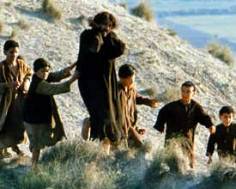
© 2003 Icon Distribution, Inc.. All Rights Reserved
Judas being harassed by what were apparently demons in the movie
As for the hooked nose part,
well, I can only think of two persons in the film that had what might be
considered as large noses. One was
a leading Pharisee, and the other was the Apostle Peter.
Are we to believe that Mr. Gibson had prosthetic noses placed on these
actors to mock the stereotypical appearance of some Jews?
I think this really stretches credulity.
I do not believe that the film
negatively depicted or tried to intentionally mock the physical appearance of
the Jews in the movie. The
characters in the movie looked like real people, plain and simple.
Now for the primary example of
anti-Semitism cited, i.e., that Jews were portrayed as the villains in the movie
who had Jesus crucified. Is the
film anti-Semitic in its portrayal of the role that the Jews played in the
crucifixion of Jesus? Does it purposefully
misrepresent the facts, or denigrate and malign the Jews? Again, I
disagree with the charge of anti-Semitism.
In terms of the trials and subsequent crucifixion of Jesus, the
historical record is clear: the
religious leaders of the Jews, driven by intense envy and jealousy (Matt 27:18),
sought to have Jesus of Nazareth killed. They
had Jesus arrested, and charged Him with blasphemy.
Since they were under Roman occupation, they could not administer capital
punishment (John 18:31). So, they
handed Him over to the Romans in hopes that they would administer capital
punishment on Jesus, charging that Jesus was basically the leader of an
insurrection against Roman rule (if Jesus claimed to be a King, then that would
mean He would be usurping the authority of Rome).
These religious leaders knew that
they really didn’t have a case. So
corrupt were these leaders that they even allowed false witnesses to testify
against Jesus (Matthew 26:59,60; Mark 14:55-59). Finally, the High Priest just asked Jesus directly if He were
indeed the Son of the Holy One. Jesus’
reply was “Yes, it is as you say…” (Matt 26:62-64).
The religious leaders then had all they needed to charge Jesus with
blasphemy, but they still could not put Him to death.
They turned Jesus over to Pilate, who had no idea of what to do with
Jesus. It is clear that Pilate wasn’t buying the story of the
religious leaders, but he didn’t know how to handle the situation.
We read that Pilate brought Jesus out before the crowd to inquire of them
what should be done with Jesus.
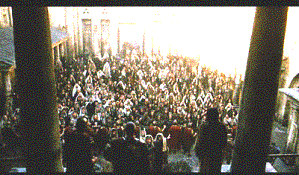
© 2003 Icon Distribution, Inc.. All
Rights Reserved.
Now, there is a very
important thing to understand about this crowd that is often completely
forgotten. In Matthew 27:20 we read something very interesting: “But the chief priests and the elders persuaded
the crowd to ask for Barabbas and to have Jesus crucified.”
Those three little words are crucial:
persuaded the crowd.
The religious leaders of the Jews had succeeded in poisoning the crowd
against Jesus. One might ask how that could be possible in so short of a
time. Well, again we must
understand that the plot to have Jesus killed wasn’t hatched overnight.
Throughout Jesus’ ministry we read of the intention of the religious
leaders to have Jesus killed (Matthew 21:46; Mark 11:18; Luke 4:28-30; John
8:59), and the religious leaders had even threatened excommunication to anyone
that followed Jesus (John 9:13-34). Then
in Matthew 26:3-5 we read, “3 Then the chief priests and the elders of the
people assembled in the palace of the high priest, whose name was Caiaphas, 4
and they plotted to arrest Jesus in some sly way and kill him. 5 "But not
during the Feast," they said, "or there may be a riot among the
people." (NIV) This took place during the final
week of Jesus’ ministry, just after His triumphal entry into Jerusalem (ref
Matthew chapter 21). Jesus incurred
the ire of the religious leaders by condemning their practices, and in one
sermon pronounced woes (curses) upon the religious leaders (Matthew chapter 23).
Thus, the plot to have Jesus killed had been put into motion for quite
some time.
After the religious leaders had
Jesus arrested and charged with blasphemy, and then turned over to the Romans,
the time was perfect for them to strong-arm the people and turn them against
Jesus, and to reinforce their power. As
noted above, the Pharisee’s had already threatened excommunication to anyone
who followed the teaching of Jesus. This
more than anything highlights the enormous power these leaders had over the
people. For a person to be put out
of the synagogue would be for that person to be cut off from the very fabric of
Jewish society. In commenting on
John 9:22, Matthew Henry, the Puritan Bible commentator of the eighteenth
century, writes:
“[put
out of the synagogue]…[was] the penalty to be inflicted for this crime (of
confessing Jesus as the Christ). If any should own himself a disciple of Jesus,
he should be deemed and taken as an apostate from the faith of the Jewish
church, and a rebel and traitor against the government of it, and should
therefore be put out of the synagogue, as one that had rendered himself unworthy
of the honors, and incapable of the privileges, of their church; he should be
excommunicated, and expelled from the commonwealth of Israel. Nor was this merely an
ecclesiastical censure, which a man that made no conscience of their authority
might slight, but it was, in effect, an outlawry, which excluded a man from
civil commerce and deprived him of his liberty and property.”
With these things in mind, we can
now see how difficult a situation that the people were in, and the
difficulties that were presented to Pontius Pilate. Anyone familiar
with the volatile history of Israel will understand the dilemma put before him.
Pilate was not a man of principle, and he, against all right judgment,
nevertheless had Jesus sentenced to crucifixion.
How did Pilate reach his decision? Did
he reach it based on the evidence, as any good judge would do? No.
Did he act on principle? No.
He basically pawned the decision off on what amounted to be a rent-a-crowd
mobilized and energized by religious leaders in opposition to Jesus, and caved
in to their cries of “Crucify
Him!”
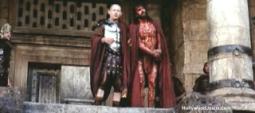
http://www.hollywoodjesus.com/passion_photo.htm
Thus, Pontius Pilate, after "finding
no fault in Him," nevertheless does the unthinkable: he decides
to put an innocent man to death, and then tries to pawn that off on the people
too by washing his hands of it! Did the Jews
have Jesus crucified? Yes. Did the Romans? Yes. Those are the historical facts,
and merely reporting historical facts does not make a person, or this film,
“anti” anything. When one
points out the atrocities committed by Nazi Germans against the Jews, do we then
say that the person is anti-German because he or she is just reporting the
facts? When one points out the
atrocities of the slavery of Black people in this country at the hands of White
slave owners, do we then say that the person is “anti-White” because he or
she merely reports the facts? No.
The Passion of The Christ is no more anti-Semitic than Schindler’s List is
anti-German, or Roots is anti-White.
Not only that, but consider that the “hero” of the movie was in fact
a Jew (Jesus), the actress who played Mary the mother of Jesus is herself a Jew,
and the movie was faithful to the historical record in that it showed that Jesus
had supporters even among the Jewish religious leaders, who spoke up in defense of
Jesus during His trial.
As objectively as I can, and with
all due respect to those wonderful Jews who voiced those concerns, I have to say
that I didn’t see anything that could rightly be said to rise to the level of
anti-Semitism. The film is
not anti-Semitic.
So why would some Jews feel that
way? I believe that what is driving
the charge of anti-Semitism isn’t that the movie is in fact anti-Semitic.
Rather, many of our Jewish friends who make this charge are concerned that the modern day non-Jew will be so deeply impacted by what they
see depicted on the screen that they will assign all of the blame for the death
of Christ to Jews, and
the movie then, though not anti-Semitic, will in fact be a tool that could fan
into flame anti-Semitic feelings. Is
this just paranoia? Not at all! Blaming
the Jews for the death of Jesus has been used many times in the past to ignite
anti-Semitism, and unfortunately, there are some today who continue to
assign all of the blame for the death of Jesus
to the Jews--and some of those who do have even used this movie as a point of
reference for their anti-Semitism. Thus, we need to be sensitive to
those concerns!
We who are Christians should be
especially proactive in voicing our disgust for anti-Semitism, and we should
proclaim loud and clear for all the world to hear that we do not hold the Jews
(or the Romans) ultimately or solely responsible for the death Jesus. So, who is ultimately
responsible for the death of Jesus then? Here we are presented with a
dynamic that we who are believers will be exploring for eternity. On the
one hand, we hold ourselves
responsible, because it was due to our sin that Jesus died.
In a very real sense it wasn’t merely Jews or the Romans who had Jesus crucified;
it was me who did!
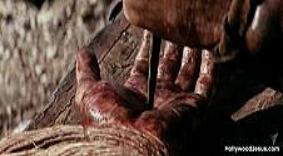
http://www.hollywoodjesus.com/passion_photo.htm
In this picture, the hand shown driving the nail is
actually the hand of Mel Gibson himself, who is making the statement who it is that he thinks crucified Jesus.
Some years ago I wrote a poem that
speaks to this fact. Here is an
excerpt that I pray will help put into perspective of who is to blame for the
passion (sufferings) of Christ:
Yes, Lord,
you've forgiven me of all; I know it's true.
You have not even a memory of my past wrongs--as far as
The east is from the west, there is not one thing you've left up to me to do.
Still, dear Jesus, if I may, in my hindsight and disgrace just say..........
Forgive me, Lord Jesus, for betraying you with a kiss.
Forgive me Lord for drawing my sword, when all the time
I knew you were meek.
Forgive me for denying you not once, but three times,
Forgive me for falsely accusing you of blasphemous crimes,
Forgive me, Lord for hating you--how could you turn the other cheek.
O, dear God, forgive me for beating you
And punching and spitting in your face,
And kicking you like a wretched dog
While
holding you down in place.
O, my sweet Savior, forgive me for tying you to the flogging post
And arrogantly drawing back my whip;
It cracked down across your back
Tearing
the flesh from Your bones away strip by strip.
O, Christ Jesus,
forgive me for mockingly selecting
A jagged crown of thorns and ripping it down over your head!
Forgive me, Father for watching the blood of your Son
Flow down His face and wishing He were dead!
O, sweet, precious,
only begotten Son of God, forgive me for crying out,
"Crucify Him, Crucify Him, Crucify Him!!!"
Forgive me, Lord, for washing my hands of you.
Forgive me Lord for condemning you to die
When
all you ever said or did was loving and true.
O, how you struggled to walk with the beam upon your saving
Shoulders through the stony, Jerusalem street,
Blisters and sores tearing and burning through the flesh of your feet.
Forgive me.....
O, Jesus, my God, forgive me for laying you down
Upon that rugged, splintered, piece of tree…
Forgive me Lord for driving the nails through your
Hands and feet, and hoisting you up beaten, afflicted,
Disgraced, and naked for all the world to see.
Forgive me, O Master and Savior, for my cowardliness…
As you hung there I ran off to hide.
Forgive me Christ Jesus for taking my spear
And plunging it deep into your side.
However, that is only one side of the story: the human side, and from the human side the point of the Christ's sufferings was clear to me when I wrote that poem in 1996, and the movie only brought to mind what every Christian already knows: it wasn't because of the corrupt religious leaders of the Jews, or the brutal Roman soldiers that Jesus died, it was because of me and my sin.
While this does capture a bit of the truth of why Jesus died, it by no means captures the whole of it. The other, and most significant side, is the Divine side. We must understand that all that unfolded in the life of Jesus (and all of human history for the matter) was all conceived in the mind of God before time even began. God, from all eternity, determined to infallibly save a multitude of sinners from every nation, tribe and tongue who deserved nothing except the just condemnation and wrath of God. Yet God, out of His sheer grace and mercy and alone, chose those whom He was going to save in Christ before the foundation of the world, then came to the world in the person of Christ, bore the full penalty for sins, rose from the dead, and guarantees the free gift of eternal life to every person who believes. A.W. Pink, in his book The Sovereignty of God wrote:
"From all eternity God designed that our world should be the stage on which He would display His
manifold grace and wisdom in the redemption of lost sinners: "To the intent that now unto the principalities
and powers in heavenly places might be known by the church the manifold wisdom of God, according to the
eternal purpose which he purposed in Christ Jesus our Lord" (Eph 3:11). For the accomplishment of this
glorious design God has governed the world from the beginning, and will continue it to the end."
(Pink, p.111-112).
This is critical to understand. Salvation, and thus the "passion" of Christ, all unfolded according to "the determined purpose and foreknowledge of God" (Acts 2:23), and Christ is the Lamb of God slain from the foundation of the earth (Rev 13:8).
John Piper, in his book The Passion of Jesus Christ, states:
"The most important question of the twenty-first century is: Why did Jesus Christ suffer so much?
But we will never see the importance if we fail to go beyond the human cause. The ultimate answer to
the question, Who crucified Jesus? is: God did. It is a staggering thought. Jesus was His Son. And the
suffering was unsurpassed. But the whole message of the Bible leads to this conclusion." (Piper, p. 11)
Piper then quotes Isaiah 53:10, Romans 8:32, Romans 3:25, and Acts 4:27-28, "There were gathered together against your holy servant Jesus...both Herod and Pontius Pilate, along with the Gentiles and the peoples of Israel, to do whatever your hand and your plan had predestined to take place." Piper comments:
"The depth and scope of this divine sovereignty takes our breath away. But it is also the key to our
salvation. God planned it, and by the means of wicked men, great good has come to the world...we must
move beyond the question of human cause to divine purpose. The central issue of Jesus' death is not the
cause, but the purpose--the meaning." (Piper, pp. 11-12)
Piper's book eloquently, concisely, and powerfully sets forth that purpose by touching on 50 reasons why Christ suffered and died. The book is a treasure trove of insight packed into just 118 pages of very easy reading, and is must reading for all, especially for those who view the movie The Passion of The Christ. I encourage the reader to visit his website at www.desiringgod.org.
For my Jewish friends, all I can do is assure them of how I, and I believe all true Christians, view the death of Christ, and that I stand with them against anyone who uses the movie The Passion of The Christ as a tool to fuel their hatred for Jews.
To view comments from Jews who support the movie, see: http://www.jewsforjesus.org/special/passion/jewishComments.htm
The second line of critics who
were even more vociferous in their protests was the liberal media, Hollywood,
and those aligned on the political left. They
have a long track record of opposing religion in general, and Christianity in
particular, in the marketplace of ideas.
As a side note to my fellow
Christians, I have often been discouraged at how some Christians seem completely
oblivious to this fact, and continue to vote for politicians that not only
oppose their Christian views, but are actually hostile toward
them. Yet, because they have been
allured by the lie that is perpetuated that the political left is “for the
little guy,” or is “pro-minority,” they continue to cast votes
for people who will work tirelessly to advance a moral agenda that these very
Christians find offensive and even perverted.
For at least the past 30 years,
the verdict is clear. Of the two
major political parties, one has advanced a moral agenda that has been
consistently antithetical to Christian values, and the other has advanced one
that has been, more often than not, sympathetic to Christian values. That is not to say that any political Party has it all
together. It doesn’t.
And Christians shouldn’t hang their hats on one political Party, as if
that Party were the “Christian Party.”
It’s not. What
it does say is that more times than not, Christians are presented with only one
truly viable candidate that they could vote for without violating their
Christian conscience. Sometimes
that means that there aren’t any viable candidates, because all the candidates
are just as liberal when it comes to the moral and social issues.
If this is the situation, and one still feels compelled to vote, then one
can always vote for a write-in candidate.
In any event, when we come to the
movie of The Passion of The Christ, it is not surprising to see who it is
that is attacking the movie. The
liberal media has been relentless in its attacks, even going so far as to mock
both Mr. Gibson and Christianity as a whole.
Three prominent examples immediately come to mind: Andy Rooney’s
comments on 60 Minutes, New York Times writer Frank Rich, and Entertainment
Weekly.
Andy Rooney, mocking as if God
were speaking to him, made these comments on 60 Minutes:
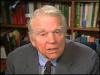
"Andrew,
you have the eyes and ears of a lot of people. I wish you'd tell your viewers
that both Pat Robertson and Mel Gibson strike me as wackos. I believe that's one
of your current words. They're crazy as bedbugs, another earthly expression. I
created bedbugs. I'll tell you, they're no crazier than people,” said God.
“As
far as Mel Gibson goes, I (God) haven't seen his movie, 'The Passion of the Christ,'
because it hasn't opened up here (Heaven) yet. But I did catch Gibson being interviewed
by Diane Sawyer. I did something right when I came up with her, didn't I,”
added God. “Anyway, as I was saying, Mel is a real nut case. What in the world
was I thinking when I created him? Listen, we all make mistakes."
Rooney
wasn’t finished though. Saying he
had no intention of seeing The Passion of The Christ, Rooney
told radio host Don Imus, "I mean, I don't want to pay $9 just for a few laughs."
Rooney went on to bash religion in general, saying those who believe in
God are "absurd." Rooney continued, "I mean, it's
absurd to invent God to unburden our problems on him…And, on the other hand,
there are so many questions that are unanswered that, you know, we're looking
for some solution to it. And we have invented God."
Frank Rich, a writer for the New York Times (which is really just a propaganda machine for the political left/Democratic Party) had this to say in his review of the movie for the New York Times:

"With
its laborious build-up to its orgasmic spurtings of blood and other bodily
fluids, Mr. Gibson's film is constructed like nothing so much as a porn movie,
replete with slo-mo climaxes and pounding music for the money shots…"
Since the historical record is quite clear that Christ was indeed beaten to a bloody pulp (I touch on this a bit later), Mr. Rich's comments are exceedingly offensive in that he mocks what actually occurred to Christ, and then he couches his maniacal comments in many explicit and implicit sexual terms, and likens The Passion of The Christ to a porn movie. Can you imagine if Mr. Rich had made comments like this, using the pornographic language he does, in reference to a movie about Mohammed, the founder of Islam?
As for Entertainment Weekly (EW),
they had this
picture on its cover, mocking Jesus and Gibson:
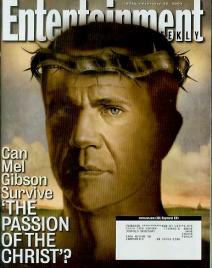
EW was “kind” of enough
to have two different critics provide reviews of the film, which really just
turned out to be two opportunities for them to malign Mr. Gibson and
Christianity.
Here is some of what Owen Gleiberman had to say:
“Tempting
as it may be to dismiss Mel Gibson as a glorified pain freak, dressing up a
martyrdom fantasy in Aramaic and Latin, it would be more accurate, I think, to
say that the filmmaker, a Catholic fundamentalist, presents his torture-racked
vision of Jesus' last 12 hours on earth as a sacred form of shock
therapy…''The Passion of the Christ'' comes close to being a splatter film in
which the victim embraces his own dismemberment.”
Mr. Gleiberman then goes on to praise
the blasphemous movie The Last Temptation of Christ, and says that
Gibson’s movie is, “blood-soaked pop theology for a doom-laden time…”
He gave the movie a final grade of “B”.
Mr. Gleiberman finds it quite
difficult to hide his obvious anti-Christian bias and distaste, as he seeks to
marginalize the film with his pejorative descriptions of Mr. Gibson.
Though he stops short of actually calling Mr. Gibson a “glorified pain
freak,” it is rather clear that is precisely Gleiberman’s view.
So, he instead calls Mr. Gibson a “Catholic fundamentalist.” I must
confess, that is a new term for me (and I’m sure it is for many others as
well, particularly Roman Catholic apologists, who spend much of their time
answering the theological critiques of “Fundamentalists”). Being
a fundamentalist of any kind in and of itself is not a problem.
Anyone who holds to the fundamental tenets of a belief system is in fact
a fundamentalist (could it be that Mr. Gleiberman is a Liberal
fundamentalist?!). However, the word has come to be used in recent years as a
derogatory term to identify individuals thought to be on the lunatic fringe of a
particular group or sect. When Mr. Gleiberman uses the term, there is no question he is using it as a slur against
Mr. Gibson, and he is trying to draw a parallel in the minds of his readers
between the term he used earlier of “glorified pain freak” with the idea of
Mr. Gibson’s supposed Catholic fundamentalism. In other words, Mr. Gleiberman
won’t call Mr. Gibson a glorified pain freak; he’ll just invent a new term
that means the same thing to him, and then assign that to Mr. Gibson.
By the way, the victim here (Christ) did embrace His own dismemberment!
That was the whole point! It
wasn’t a sacred form of shock therapy; rather, it was a sacred form of sin
“therapy,” where an absolutely Holy God revealed His wrath against sin, and
in love provided the only “cure” for it:
the atoning death of His one and only Son, Jesus Christ, who willing laid
down His life for His sheep. And
what Mr. Gleiberman calls “blood-soaked pop theology” is in fact the very heart
of the Gospel itself. Here is just
a sampling of that “blood-soaked” pop theology that Mr. Gleiberman has chosen to
cast his pebbles:
Mark 14:24
– “And [Jesus] said to them, "This is My blood of the new
covenant, which is shed for many.”
Acts 20:28
– “Therefore take heed to yourselves and to all the flock, among which the
Holy Spirit has made you overseers, to shepherd the church of God which He
purchased with His own blood.”
Rom 3:24-25
– “being justified freely by His grace through the redemption that is in
Christ Jesus, whom God set forth as a propitiation by His blood,
through faith…”
Ephesians
1:7 - “in whom we have redemption
through His blood, the forgiveness of sins, according to the
riches of His grace.”
Eph 2:13 –
“But now in Christ Jesus you who once were far off have been brought near by the
blood of Christ.”
Heb 9:11-12
– “But Christ came as High Priest of the good things to come, with the
greater and more perfect tabernacle not made with hands, that is, not of this
creation. Not with the blood of goats and calves, but with His own blood
He entered the Most Holy Place once for all, having obtained eternal
redemption.”
1 Peter 1:2
– “elect according to the foreknowledge of God the Father, in sanctification
of the Spirit, for obedience and sprinkling of the blood of Jesus
Christ…”
1 John 1:7
– “But if we walk in the light as He is in the light, we have fellowship
with one another, and the blood of Jesus Christ His Son cleanses
us from all sin.”
Rev 5:9 -
And they sang a new song, saying: "You are worthy to take the scroll, and
to open its seals; For You were slain, and have redeemed us to God by Your
blood out of every tribe and tongue and people and nation…”
What Mr. Gleiberman calls
blood-soaked pop theology, is in fact a blood-soaked Divine redeeming of a sin
corrupted, and as a result, doom-laden creation (see Romans chapter 8).
The next EW
critic wasn’t quite as, uh, “generous.”
Lisa Schwarzbaum spared no venom in voicing her overall disgust for the
film, at one point saying in mocking fashion:
“But
verily, ''The Passion of the Christ'' is Gibson's obsessive meditation on his
own cross of fame. It's a weave of Gospel versions, narrative add-ons … and
the age-old Gibsonian homoerotic fascination with the sight of a handsome male
body undergoing torture…the physical suffering of Jesus is made more riveting
and ''lifelike'' than the exemplary, loving character and holy aura of Jesus
himself. It's a baroque lesson in Christ-like patience that demands we watch
lingering scenes of skin splitting and blood coursing as Jesus is lashed with
canes, then flayed with barbaric weapons of torture, then turned over and
flogged some more. (The Gospels give the activity a few sentences; ''The
Passion'' makes the punishment its own fetish plotline.)”
She then
speaks of how enthralled Gibson was with the sight of Jesus’ blood, and
basically impugns the collective intelligence of all Christians (or at the least
tries to dissuade Christians from seeing the film) who would dare bring their
children to the “meeting tent” (another little dig) as she calls it, where
they will be “traumatized” by what they see.
Ultimately, what these people fail to realize
is that the movie wasn’t about, as Ms. Scwarzbaum says, “the exemplary, loving character and holy aura” of Christ!
The movie was about His last hours and the suffering that He endured to
secure the salvation of a multitude of people scattered throughout the entire
world. Remember, the movie is
called “The Passion of The Christ,” not “The Wonderful Teachings
of the Christ” (note: the
word passion is derived from the Latin word "passio" which means to
suffer). The
punishment that Jesus endured was the plotline!
I will address this further a bit later.
On the political side, one only
had to view the FOX News channels Hannity & Colmes to see where the political
parties stood. Hannity, a
conservative Republican, stood in strident defense of the movie and consistently
made reference to Christian values, while Colmes, a liberal Democrat, was
largely unsupportive of the film (thought I got the feeling this was more out of
what had to be tremendous pressure on him to try to defend and put some sort of
civilized perspective to the ridiculous tirades of his fellow liberals than what
he actually thought).

http://www.foxnews.com/hannityandcolmes/
Hannity is pictured on the left and Colmes on the right.
They brought in guests that
were both for and against the movie, and I will leave it to the reader to take a
wild guess as to the political leanings of the guests that were against movie,
and the political leanings of those who were supportive of it.
Now, this is not to say that there
aren’t those who are politically conservative who did not voice some concern
over the movie, as we will see when I address the concerns of some Evangelicals.
But their concerns are based more on theological grounds, and they do not
call into question the historical record in terms of the brutality of the
flogging and the crucifixion, and they obviously do not denigrate Mr. Gibson or
Christianity. The problem with the
liberal media and some (not all) of those on the political left who oppose the
film is that their critique is often vicious, unfair, grossly misinformed, and
calls into question the historical nature of Christianity itself.
As for the exact nature of their
objections, they more or less jumped on the anti-Semitism bandwagon (the
political left is famous for using race to divide Americans to further their
own causes). However, the primary
objection that inflamed these critics was, rather ironically, the sheer
brutality of what they saw. What
they fail to understand is that Mel Gibson didn’t “make” the passion (the
sufferings) of Christ brutal. He
merely attempted to show us what the historical record clearly demonstrates, and the truth
of the matter is that the film still could not capture the full scope of the
brutality!
Now, before I go on, I want us to
stop and think about this objection for a moment, and who is making the
objection. As noted, these
objections are coming from those on the political left, Hollywood, and the
liberal media. This is the same
crowd that has consistently objected to and/or mocked moral conservatives’
concerns over unwarranted violence in film.
This is the same crowd that supports abortion on demand, where a baby
inside the mother’s womb is either ripped to shreds by a vacuum device or
disintegrated by an acidic solution. (http://www.nrlc.org/abortion/ASMF/asmf.html)


18 week old unborn child Unborn child at 5 months
Both pics drawn from http://www.w-cpc.org/fetal2.html
This is the same crowd that
supports partial birth abortion, where a baby is carried to full term, labor is
induced, the baby is turned in such a manner that it comes out of the womb feet
first, and when the baby’s head appears, a “doctor” crams scissors in the
back of that baby’s skull, and takes a vacuum device, sucks it brains out,
collapses the skull, and then discards the child. You can go to this link to see
a diagram of this barbaric procedure: http://www.nrlc.org/abortion/pba/diagram.html.
By the way, for you Christians that voted for Bill Clinton, and were
going to vote for Al Gore in the 2000 elections, forgive me for my rebuke here,
but that is what you voted for, because Bill Clinton is the one
who twice vetoed the bill that would have ended that barbaric practice, and Al
Gore is the one who vowed to keep that practice as a legal procedure in the land
if he were elected.
This is the same crowd that never raises a peep of protest at
the tons of grotesque images that adorn much of what is pumped out by the
Hollywood Studios (need I mention such artistic gems such as the Friday the 13th
movies, and other such marvels of cinematic genius?). This is the same crowd that now
has the unmitigated gall, the sheer audacity, to say that they
think that the Passion of The Christ is too violent!! The very ones crying foul about the violence in this
movie are the very ones who support the most monstrous and despicable practices
in real life, and then turn a deaf ear to those who say movies in
general are too violent! Give
me a break!
So, does this mean that moral
conservatives who have concerns over violence in film are being inconsistent?
No. The objection is against
those movies that are violent just for the sake of being violent so that it
might stand a better chance of making more money at the box office.
Violence is advanced as the primary means to overcome any obstacle in
life, and there is no regard for the sanctity of human life.
People are pointlessly shot up, cut up, sawed up, and chewed up over and
over again in the movies. Most
people I know do not object to a film’s accurate portrayal of violence in such
things as war movies, westerns, police dramas, etc.
It’s with the over-saturation of unwarranted violence in films that
concerns people.
Poster for the Freddie vs. Jason movie
Further, it is interesting to note
that no one questioned the brutality of what they saw in such was movies as Saving Private Ryan or any number of other such movies.
Why? Because they understood
that what they saw being represented on the screen was historical, or at least
had a historical basis. I seem to
remember many even praising Saving Private Ryan for its accurate depiction
of the brutality of war. Director Steven Spielberg masterfully put us
there: you felt like you were right
there on the beaches of Normandy with those troops.

Saving
Private Ryan
So, what’s different about The
Passion of The Christ? Those who understand
history know how brutal, bloody, and horrible floggings and crucifixions were.
It seems it’s ok for filmmakers to accurately portray the violence of war, but
the crucifixion is off limits.
I believe this is what lay’s at
the root of the objections. This is
what they truly hate. And in the final
analysis, we really shouldn't be surprised. What we
Christians need to understand is that the world hates Jesus. Jesus even said as much.
Listen for a moment to the words of our Savior, “If the world hates
you, you know that it hated Me before it hated you…” (John 15:8).
We need not wonder at why these ones are offended, because the Scripture
is clear that the cross of Christ is an offense (see Galatians 5:11). Not only
that, but, as the Apostle Paul said, “The message of the cross is
foolishness to those who are perishing…we preach Christ crucified, to the Jews
a stumbling block and to the Greeks [i.e., non-Jews] foolishness…” (1
Cor 1:18, 23). By the way, the
Greek word use in that passage for “stumbling block” is “skandalon.”
It is the word from which we get the word “scandalous.” As noted
above with regard to the way the critics have reacted, this is precisely what
the crucifixion has been to them.
Thus, the real thing that
antagonizes these critics isn’t anti-Semitism, and it isn’t the violence of
the film. The real thing that
antagonizes them is the cross of Christ itself.
If these things really happened, then that means we have a choice to
make. If we decide to reject Jesus,
then we have to come up with a way of explaining away the death of Christ.
The argument kind of goes like this:
1. This Jesus went to great lengths to die for sinners, and He offers people the free gift of eternal life on the basis of what He did.
2. The way I receive that gift is by turning from my sins and embracing Christ as my Lord and Savior,
and trusting in Him alone to save me.
3. If I don’t, then what am I saying about the sufferings of Christ? If God were willing to go to such
lengths to save sinners, and I reject that, then I guess I’m in pretty deep water with God!
4.
But if all of this didn’t really happen; if this isn’t the
“historical” Jesus, then I am ok, and your ok, you have your truth, and I
have my truth, and I can continue to live my life my own way.
So, leave me alone, and while you're at it, quit showing us such horrible
pictures about the "Jesus" you have concocted in your own mind.
In the movies, we root for the
heroes. We love the good guys, and
we want to be on the good guy’s side. But
in this movie, the hero is a Jewish Carpenter from Nazareth who wasn’t merely
a Jewish Carpenter, but was in fact God incarnate who came to earth for the
specific purpose of dieing for and saving sinners. And that is what Mr. Gibson showed us.
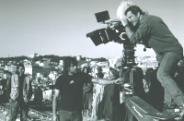
© 2004 Icon Distribution, Inc. Photo credit: Philippe Antonello, All
Rights Reserved.
And the ultimate rub is that this
isn’t just a movie of make believe events.
Rather, it is about the real Christ of history who suffered and died a
real death, and was really raised from the dead.
With all of that said, we must now deal with the objection in terms of
what is presented on the screen. Did
Mr. Gibson overdue it? Is it too
graphic? As one who has done a fair
amount of study on the topic of the sufferings of Christ, and preached a number
of sermons that referenced the crucifixion, one
of my hopes was that someone would make a movie that might capture the brutality
of what Jesus actually went through. In
my estimation, with reference to the physical trauma inflicted on Jesus, the
movie provides us the most accurate description that has ever been put to film.
Here are some facts about flogging and crucifixion for you to ponder
drawn from some of the best scholarship on the topic:
The New Bible Dictionary of the Bible (Second
Edition, Inter-Varsity Press, 1982):
“After a criminals condemnation, it was the custom for a victim to be scourged with the flagellum, a whip with leather thongs, which in the Lord’s case doubtless greatly weakened Him and hastened eventual death. He was then made to carry the cross-beam like a slave to the scene of His torture and death…the condemned man was stripped naked, laid on the ground with the cross beam under his shoulders, and his arms or his hands tied or nailed to it…There the condemned man was left to die of hunger and exhaustion…”

http://www.hollywoodjesus.com/passion_photo.htm
The NIV Study Bible (Zondervan, 1985) Commentary note on Mark 15:15:
“flogged…The Jews limited the number of stripes
to a maximum of 40…but no such limitation was recognized by the Romans, and
victims of Roman floggings often did not survive.”
The Believers Study Bible (Nelson, 1991) Commentary note on Mark 15:15:
“Scourging was a cruel and barbaric punishment.
The victim was stripped to the waist, and his hands were bound to a pole,
and he was whipped. The whip or scourge itself was an inhumane instrument
consisting of a handle with several leather thongs attached, which were weighted
on the ends with jagged pieces of bone, metal, and rock. Frequently, the agony of the scourging resulted in death.
Victims lost eyes and teeth, were occasionally disemboweled and were
almost always horribly disfigured. The
scourging combined with the crucifixion makes the sufferings of the Lord as
extensive as any imaginable.”


http://www.hollywoodjesus.com/passion_photo.htm
A Ready Defense (Thomas Nelson Publishers,
1993). In one chapter of this book, Josh McDowell breaks down aspects of the suffering of Christ:
“Death by crucifixion developed into one of the
world’s most disgraceful and cruel methods of torture.
Cicero called it “the most cruel and hideous of tortures.”
Will Durant wrote that, “even the Romans…pitied the victims.”
Flavius Josephus…observed many crucifixions and called them, “the most
wretched deaths.”
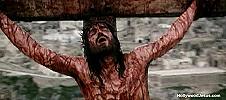
http://www.hollywoodjesus.com/passion_photo.htm
“After
the verdict of crucifixion was pronounced by the court…the criminal
was…severely whipped…the Pharisees…would limit their lashes…the Romans
recognized no such limitations. Out
of disgust or anger, the Romans could totally ignore the Jewish limitation, and
probably did so in the case of Jesus.”

http://www.hollywoodjesus.com/passion_photo.htm
“Dr. C. Truman Davis, a medical doctor who has meticulously studied crucifixion from a medical perspective, describes the effects of the Roman flagrum used in whipping:
‘“The heavy whip is brought down with full force again and again across [a person’s] shoulders, back, and legs. At first the heavy thongs cut through the skin only. Then, as the blows continue, they cut deeper into the subcutaneous tissues, producing first an oozing of blood from the capillaries and veins of the skin, and finally spurting arterial bleeding from vessels in the underlying muscles. The small balls of lead first produce large, deep bruises which are broken open by subsequent blows. Finally the skin of the back is hanging in long ribbons and the entire area is an unrecognizable mass of torn, bleeding tissue. When it is determined by the centurion in charge that the prisoner is near death, the beating is finally stopped.”’ “Eusebius, a third-century historian, confirms Dr. Davis’ description when he writes, “the sufferers veins were laid bare, and the very muscles and sinews, and bowels of the victim were open to exposure.”
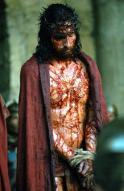
http://www.hollywoodjesus.com/passion_photo.htm
Josh McDowell then quotes Dr.
Davis again as to what occurred to a person when on the cross:
“As
the arms fatigue, great waves of cramps sweep over the muscles, knotting them in
deep, relentless, throbbing pain. With
these cramps comes the inability to push Himself upward.
Hanging by His arms, the pectoral muscles are paralyzed and the
intercostal muscles are unable to act. Air
can be drawn into the lungs, but cannot be exhaled.
Jesus fights to raise Himself in order to get even one short breath.
Finally carbon dioxide builds up in the lungs and in the bloodstream and
the cramps partially subside. Spasmodically,
He is able to push Himself upward to exhale and bring in the life-giving
oxygen.” McDowell then notes,
“After a while, orthostatic collapse through insufficient blood circulating to
the brain and heart would follow…”

http://www.hollywoodjesus.com/passion_photo.htm
For the above reference, see A
Ready Defense, Thomas Nelson Publishers, 1993, pages 221-224.
The Scriptures also provide more fascinating
details that are often overlooked. The prophet Isaiah for
example, writing some 800 years before Jesus is even born, speaks of what the
Messiah, the Suffering Servant, would endure.
You can read Isaiah 53. However,
other notable things mentioned by the prophet Isaiah are the fact that the Suffering Servant would be
disfigured beyond recognition (Isaiah 52:14), and He would have the hairs of His
beard pulled out (Isaiah 50:6). Psalm
22, penned by King David hundreds of years before the birth of Christ, is known as a
Messianic Psalm, i.e., it is a Psalm that deals with who the Messiah is and/or
what He would do. Psalm 22 gives a
vivid portrayal of what Jesus endured on the cross, and of particular interest
is the very first verse: “My
God, My God, why have you forsaken Me?”
The Psalm goes on to describe in shocking detail events associated with
the crucifixion of Christ--events that would not occur for hundreds of years:
Ps
22:7-18 - All who see me mock me; they hurl insults, shaking their heads:
"He trusts in the LORD; let the LORD rescue him. Let him deliver him, since
he delights in him." ... Do not be far from me, for trouble is near
and there is no one to help. Many bulls surround me; strong bulls of Bashan
encircle me. Roaring lions tearing their prey open their mouths wide against me.
I am poured out like water, and all my bones are out of joint. My heart has
turned to wax; it has melted away within me. My strength is dried up like a
potsherd, and my tongue sticks to the roof of my mouth; you lay me in the dust
of death. Dogs have surrounded me; a band of evil men has encircled me, they
have pierced my hands and my feet. I can count all my bones; people stare and
gloat over me. They divide my garments among them and cast lots for my clothing.
(New International Version)
So, let us review the charge. Did
Mr. Gibson overdue it? Was the
portrayal of what happened to Jesus too violent?
Hardly. I stand by the
conclusion that the film is the most accurate portrayal of the physical
suffering of Jesus ever put to film. Instead
of criticizing the film for the violence, these critics should learn their
history, and then congratulate and thank Mr. Gibson for his brilliance in being
able to transport us back in time that we might be able to get a sense for what
the historical Christ actually endured.
Concerns From
Bible-Believing Evangelicals
Now for the third, and probably the most surprising in the minds of some, group of people that have voiced concern over the film: conservative, Bible-believing Evangelicals.
The primary objection raised by my some of my fellow Evangelicals is theological in nature. Some Evangelicals believe that the film is, more or less, filled with Roman Catholic dogma, and some have gone so far as to not recommend the viewing of the movie at all. What of these charges?
It must be understood that Mel
Gibson is a devout Roman Catholic and by his own admission he drew his material
from the New Testament and the visions
of a Catholic mystic named Anne Emmerich as his primary sources for the film. This is a significant point that cannot be lost.
The
Catholic Exchange states:
“Mel Gibson has based his upcoming movie, "The Passion" on this book (The Dolorous Passion of Our Lord Jesus Christ by Anne Emmerich). Sister Emmerich's account of the Passion and Death of Our Lord Jesus Christ, while faithful to the Bible, is heart-rending, edifying and surprising because of its intimate detail. Based on the visions of this great mystic, The Dolorous Passion recounts in incredible detail the horrendous sufferings undergone by our Saviour in His (it would seem) superhumanly heroic act of Redemption. Illuminating in its description of Mary's participation in the sufferings of her Son, this book gives the reader a poignant understanding of why Our Lady is sometimes called our "Co-Redemptrix." (emphasis mine) Above quote drawn from: http://www.aquinasandmore.com/index.cfm/FuseAction/store.ItemDetails/SKU/1524/affiliate/catholicexch4132
Granted, the Catholic Exchange is commenting on the book The Dolorous
Passion. However, they draw a direct parallel between that work and Mr.
Gibson’s movie the Passion (and actually overstate the case making it appear
that the movie was based solely on that book. By Mr. Gibson’s own account, it wasn’t. He used the New Testament and the book).
It is also clear that Mr. Gibson
drew heavily upon Roman Catholic tradition as well, much of which is not found
in the New Testament and as such would not be considered as part of the
infallible historical record of what actually occurred.
Thus,
while the movie is definitely faithful in many places to the historical account
provided in the New Testament, it also has in my view an excessive amount of extra-biblical
elements, and the only document that infallibly provides us with what actually
occurred is the New Testament. Anything that goes beyond that should be
considered suspect at best, and fiction at worst (to say the least).
Of
considerable concern for some Evangelicals is the prominence of Mary the mother
of Jesus in the film. Anyone
familiar with the New Testament and Rome’s teaching concerning Mary the mother
of Jesus will immediately recognize the many scenes in the film that are
directly influenced by Roman Catholic teaching about her.
In the never-ending progression
of anti-biblical dogma that defines modern Roman Catholicism, Mary has been
exalted to such a position as to be called a Mediator and a Co-Redeemer, and for
them Emmerich’s book, and Mr. Gibson’s film by extension, are landmark works
that demonstrate the truth as they see it.
Also, one cannot miss the fact
that the events related to the crucifixion and burial of Christ follows the
Roman Catholic devotional (for lack of a better word) known as the “Stations
of the Cross.” Each station is
just one event or scene that occurred from the time Jesus was condemned to be
crucified to His burial in the tomb. There
are 14 stations listed. A person is encouraged to read a brief summary of
what happened at each station, and then visualize the scene and pray at each
station. Those stations, while accurate in many places, do contain non-historical
events, such as a woman named Veronica who wipes Jesus’ face, and Mary
encountering Jesus while He was carrying His cross, etc.

http://www.hollywoodjesus.com/passion_photo.htm
With all of this in mind, The Catholic Passion Outreach makes this statement that will help us understand even further why some Evangelicals are concerned:
The
Passion of The Christ offers an unprecedented
cultural opportunity for you to spread, strengthen, and share the Catholic
faith with your family and friends. Unlike any other,
this
movie will inspire hearts and change minds. And it will evoke
questions.
You can play
a role in bringing home this film’s inspiring message. Catholic Passion Outreach
has prepared some great resources to help you in your evangelization efforts.
http://passion.catholicexchange.com/
(emphasis mine)
Notice
the statement there. They believe
that the movie presents an unprecedented opportunity to share the Catholic faith.
When they say Catholic faith, they mean the Roman Church in particular
with all of its dogma’s, many of which have no biblical basis, and in point of
fact are directly contradictory to Scripture and completely undermine the Gospel
of Jesus Christ. In other words, they view it as opportunity to evangelize
the masses with their false gospel because they see their false gospel
being clearly depicted in the movie, and the only way one can understand all
that is going on in the movie is to have and understanding of their false
gospel. Thus, once people begin asking the questions that the movie is sure to
provoke, the door is wide-open for them to provide the answers, enlighten people
on the “truth,” and turn them back to the “Mother Church.”
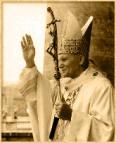
Pope John Paul II
This
is what many Protestants fail to realize about Roman Catholicism.
In their never-ending quest to compromise with just about anything
(usually in the name of being “seeker-sensitive,” or “unity”), and to
move according to whichever way the wind is blowing, many so-called Evangelicals simply
refuse to acknowledge the clear fact that Rome has a false Gospel, and it is,
without question, an apostate church. That
doesn’t mean that there aren’t some well-intentioned, even saved, individual
Roman Catholics. I for one believe that the walls of Roman churches contain
individuals who rest their hope of eternal life solely upon the basis of the
finished work of Jesus Christ alone. But they do so despite the teaching of that
church, not because of it. And I hope that those who
read my comments do not misunderstand me. I
am greatly appreciative of many devout individual Roman Catholics (Mr. Gibson
for one, who by an incredible act of courage and faith has given us a cinematic
masterpiece that has profoundly touched me), and I respect them.
I was a Roman Catholic myself until I was 29 years old (though not
devoted in any sense of the word), and have fond and cherished memories of the
Nuns that taught me in school. My
criticism isn’t of them, but of the unbiblical teachings of the ecclesiastical
organization known as the Roman “Catholic” Church, and I stand by
the assertion that the Roman Catholic Church, by its denial of the Gospel, while
it may contain some persons who would rightly be called my Christian brothers
and sisters, is nevertheless a false church, plain and simple.
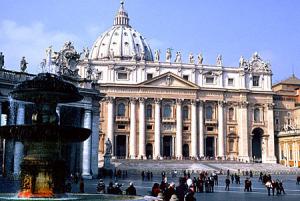
http://www.planetware.com/photos/SCV/I749.HTM
Picture of Vatican City, Facade of St Peters Basilica
For those Protestants who disagree with my assessment of the
Roman Catholic Church, or think it is too strong, let me ask:
why in the world do you think there was a Protestant Reformation in the
first place? How and why in the
world did you came to be called a “Protestant”?
This brings to mind maybe the greatest irony of all: the Roman Church is
far worse today in terms of its doctrine than it was at the time of the
Reformation, yet those who claim the banner of “Protestant” are far more
accepting of Rome today, and if truth be known, have far more in common with
her!
How can I make such a comments? Because it wasn’t until years after the Reformation that the Roman Church had its Counter-Reformation, and the Council of Trent was convened from 1546-1564 AD. It is the decisions that came out of that council that many believe marks the official point in time when Rome actually declared itself to be an apostate church by virtue of its having officially denied the doctrine of justification by faith alone, which Martin Luther referred to as the chief article upon which the church either stands or falls. Not only did Rome deny this crucial doctrine which lays at the heart of the Gospel, but they then condemned anyone who taught it.

So many Protestants today simply don’t understand that, and they don’t understand all that is at stake. None of this should be surprising I suppose, since most of those who call themselves Protestant do not hold to the key doctrines that the Protestant Reformers taught which in fact served as the impetus for the Reformation in the first place, and ironically enough for them, as I mentioned above, they have more in common with Rome theologically than they do with their Protestant forerunners. The modern-day theologian J.I. Packer, in co-writing an introduction to Martin Luther’s classic Bondage of the Will, comments:
![[author photo]](passio27.jpg)
J.I. Packer
“Much modern Protestantism would be neither owned
nor even recognized by the pioneer Reformers. The Bondage of the Will fairly
sets before us what they believed about the salvation of lost mankind. In light
of it, we are forced to ask whether Protestant Christendom has not tragically
sold its birthright between Luther's day and our own.”
Given all of
this, some Evangelicals leaders are very concerned, and they want desperately to
guard their sheep from error, and to make other Protestants aware of the
theological pitfalls in the movie that could be used by Rome in a powerful way
to ravage even more sheep.
Dr. James White, Director of Alpha and Omega Ministries (www.aomin.org), considered by many as one of the foremost defenders of Biblical Christianity today, has done significant work in confronting the errors of Rome (as well as Mormonism, Jehovah Witnesses, Arminianism, etc.).

On Dr. White’s website, he has a blog, and in one installment he provides a quote from a new book written by The Catholic Exchange. Below are portions of what Dr. White has posted, and I encourage the reader to go to his website and read it in its entirety:
3/1/04: Shepherds, Be Alert
Well, the book arrived. I refer to A Guide to the Passion: 100
Questions About The Passion of the Christ, a book designed especially to be
given out by Catholics to folks who have seen The Passion of the Christ from
Ascension Press, written by the Catholic Exchange. The URL given for the
book is: www.evangelization.com.
Notice that there are downloadable "devotional prayers" from the
Rosary on the site, suggestions for how to evangelize for the "true
faith," etc. I told you RC (Roman Catholic) apologists were
rejoicing. And here is a section from the Introduction of the book that
pretty much says it all:
As someone involved in the distribution and marketing
of the film, I noticed early on the fervor with which many Protestant
communities were preparing to use the film for evangelistic purposes...
Yet, for all the sophisticated evangelization strategies, the irony is that our
Protestant brothers and sisters cannot adequately speak to many of the issues
and questions the film evokes because the film is so distinctly Marian, so -
obviously Eucharistic, so quintessentially Catholic — as is the New
Testament itself….can their [Evangelicals] theology adequately or honestly
mine such cinematic gems as the Last Supper flashbacks?...
And without an understanding of Mary as our model
in true Christian faith, one cannot begin to understand her significant role in
the film. Only a solid understanding of the Catholic Faith can help us grasp
these essential elements that figure so prominently in both in the
Scriptural record and the apostolic Tradition.
The film quite accurately links the sacrifice of the cross with the sacrifice
of the Mass. In doing so, it faithfully depicts biblical and Catholic
teaching. Yet the Eucharistic connections between the Passion and the Mass
are not obvious to many Catholics today. Indeed, speaking out of my own
experience as a clueless Catholic ten years ago, I can only say that it’s
highly unlikely that such connections are obvious even to those who have been
born and raised in the Church. This is not because the connections are not
there, but because so many people have not received an education in the Faith
that equips them to see those connections, which are quite real and are, in
fact, delineated for us in the teaching of the Church. Therefore, we at
CatholicExchange.com see a need for this book to provide answers to some of the
many questions critical to a full understanding of authentic Christianity -
questions The Passion of The Christ will most certainly raise. (emphasis
mine).
Dr White
then concludes his comments by saying, “…For those of you who thought I
was being reactionary a few weeks ago in saying this movie is a Roman Catholic
apologists' dream, well, tell me: will most of the evangelicals you know be
ready with an answer to this kind of stuff?”
Based on all that is stated above, it is clear that those who defend Roman Catholicism are extremely excited about the film. Evangelical leaders who are voicing concern over the movie are not being paranoid, and they are not just trying to be difficult simply because the film was produced by a devout Roman Catholic. The issues are real and they are serious. These Roman Catholic organizations see this as one of the greatest opportunities that they have had in years, maybe ever, for them to share their false gospel (which has Mary and the Mass front and center) with the multiplied millions who will see the movie, and they are standing ready, in their words, “to provide answers to some of the many questions critical to a full understanding of authentic Christianity.”
When they say “authentic Christianity” they mean that the Roman Catholic Church is the only true church on earth, and while their view of Protestants since Vatican II (1965) may be a bit more palatable in terms of referring to us as “separated brethren” it should not be lost on us that the verdicts of the Council of Trent are still binding. In other words, unless one holds to their view of salvation and their view of the sacrifice of Christ, among other things, that person is still under the anathemas (curses) of that council. And just because the Roman Church is willing to call us “separated brethren” does not in any way diminish their view of the Council of Trent and how that relates to us, nor does it dull their evangelistic fervor to bring in as many of those separated brethren into the “Mother Church,” where they might have a chance somehow to experience salvation (which, ironically, the Roman Catholic view actually negates because they deny the sufficiency of the atonement of Christ!).
At the heart of salvation is of course the Passion (sufferings) of Christ. Suffice it to say that the Roman Catholic view is extremely problematic at this point. Why precisely did Jesus suffer, and what precisely did He accomplish by His death on the cross? It should not go unnoticed that in the movie, the last words Jesus says on the cross are, “It is accomplished.” However, in the Biblical text, Jesus says, “it is finished.” Now, some may say what’s the big deal, don’t those two words mean precisely the same thing? No, they don’t. They are very similar, but there is an important difference. The primary meaning of accomplish is to succeed in doing, and the primary meaning of finish is to bring to and end, to terminate. One can accomplish something without finish something.
For example, a person can accomplish (i.e., succeed in doing) all of the course work necessary for a particular degree; however, in order to be awarded the degree, he must have the course work graded, etc. Once approved and he is awarded his degree by the school, and it is only then that he can rightly say that he is “finished” with his degree. Or, take military wars. One side may accomplish all that is necessary to win a war, but in order to bring the war to a close (i.e., to finish it), treaties must signed, all military actions must cease, etc. As a side note, and another example at the time of this writing is that we have accomplished, or succeeded in toppling Saddam Hussein from power, but our work is still far from finished in Iraq.
In Roman Catholic theology (and, unfortunately, in the theology of many Protestants since the years shortly following the Reformation), the only thing that Jesus accomplished by His sacrifice on the cross was that He made people savable. There is still something that must be done that is added to Christ’s work that results in salvation. In other words, something was “accomplished,” but it was not “finished,” and the only thing that is said to be accomplished is that Christ succeeded in merely making salvation a possibility.
William Webster, whose ministry has done considerable work in exposing the errors of the Rome Catholic Church, wrote an article entitled “The Roman Catholic Teaching on Salvation and Justification.” (http://www.christiantruth.com/RCJustification.html). In it, he quotes directly from Roman Catholic sources, and comments:
“According
to the Church of Rome, Christ did not accomplish a full, finished and
completed salvation in his work of atonement. His death on the cross did not
deal with the full penalty of man's sin. It merited grace for man which is then
channeled to the individual through the Roman Catholic Church and its
sacraments. This grace then enables man to do works of righteousness in order to
merit justification and eternal life.”
Notice the words “finished” and “completed” that Mr. Webster
uses. Rome also adds the sacraments
of baptism, penance, and the Lord’s Supper as necessary causes for salvation
(note: Rome actually holds that there are seven sacraments, while most
Protestants believe there are only two: baptism
and the Lord’s Supper). In other words, Christ’s atonement is not the
sole efficient cause of redemption.
At the heart of the Roman Catholic view is the Lord’s Supper (commonly referred to as the Eucharist). For Rome, the Mass is a re-presentation of the sacrifice of Christ on the cross. During the priest’s prayer of consecration, the Eucharistic elements of bread and wine actually become the literal Body and Blood of Jesus (a process that is called “transubstantiation”), and Christ is thought to be sacrificed over and over again because He didn’t finish, i.e., terminate, His work of redemption on the cross 2,000 years ago. The Mass is thus termed as an “un-bloody” sacrifice.
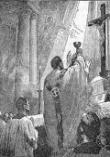
http://www.saint-gregory.org/anniv.html
Mr. Webster notes, “The mass is the re–sacrifice of Jesus Christ
as a propitiation for sin. It is declared by Trent to be a propitiatory
sacrifice and necessary for salvation…” Mr. Webster then quotes directly
form the Council of Trent (1564 AD),
“In
this divine sacrifice...that same Christ is contained and immolated in an
unbloody manner who once offered himself in a bloody manner on the altar of the
cross...This sacrifice is truly propitiatory...If any one saith, that the
sacrifice of the mass is only a sacrifice of praise and thanksgiving; or that it
is a bare commemoration of the sacrifice consummated on the cross, but not a
propitiatory sacrifice...and that it ought not to be offered for the living and
dead for sins, pains, satisfactions and other necessities: let him be anathema (The
Canons and Decrees of the Council of Trent. Found in Philip Schaff, The Creeds
of Christendom (Grand Rapids: Baker, 1910), Doctrine on the Sacrifice of the
Mass, Chp. II, p. 180, Canon III).
Mr. Webster then adds the commentary of John Hardon, a deceased Catholic priest and author of The Question and Answer Catholic Catechism (which carries the official authorization of the Vatican), who says:
“The
Sacrifice of the altar... is no mere empty commemoration of the Passion and
death of Jesus Christ, but a true and proper act of sacrifice. Christ, the
eternal High Priest, in an unbloody way offers himself a most acceptable Victim
to the eternal Father as He did upon the Cross...In the Mass, no less than on
Calvary, Jesus really offers His life to His heavenly Father...The Mass,
therefore, no less than the Cross, is expiatory for sins.” (emphasis mine) (John
Hardon, The Question and Answer Catholic Catechism (Garden City: Image, 1981),
Questions #1265, 1269, 1277).
Mr. Webster aptly comments on
these things saying, “According to
Rome, then, the offering of Christ in sacrifice is not finished but continues
and is perpetuated through time. But such teaching contradicts Scripture. The
word of God teaches that Christ has made a complete propitiation for sin through
his once–for–all sacrifice of atonement. It is finished.”
(emphasis mine).
Add to this the concepts of purgatory, where individuals must go after they die to be purged of remaining sin (which is what the cross was supposed to take care of!), and a number of other concepts that I don’t have time to deal with, such as Indulgences, the Treasury of Merit, etc., and it becomes clear that in Roman Catholic theology, it would be preferable to see Jesus saying the words, “It is accomplished” instead of “It is finished.”
For many Protestants since the years shortly following the Reformation, they are essentially in the same boat as Rome. By His work on the cross, all that Jesus accomplished was that He made people savable. In this view, Jesus has done all He could. He lived, and He died; now it’s up to the individual. The thing that is needed now is the decision of the individual to make the atonement of Christ effectual. There is no essential difference between this view and the Roman Catholic view. Something must be added to the cross in order to make the cross effective, because the cross, in and of itself, did not actually finish the job of saving, it only made it possible. Where Rome adds the sacraments, the Mass, etc., these “non-Reformation” Protestants add the act of “accepting” Christ, and there is a real sense in which this view is just a modified version of the Roman Catholic sacrament of penance. To put it plainly, according to this view, the cross of Christ alone does not save because it lacks the power to save in and of itself. Instead of “Jesus saves,” it is “Jesus tries to save.” To get even more to the point, it is “Jesus tries to help us save ourselves.”
Both of these views are quite deficient. In classical Protestant Reformation thought, and I might add Biblical thought, Jesus both accomplished and finished His work of redemption on the cross. Jesus accomplished (succeeded in doing all) that the Father sent Him to do, and that was far more than just making salvation a mere possibility. He lived a life of perfect obedience, and then laid down His life on the cross where He became sin and bore the full penalty for sin. He succeeded in actually, not potentially, redeeming all those that the Father had given Him by His substitutionary atonement on their behalf. Jesus said, “I lay down my life for the sheep…” and “I give them eternal life, and they shall never perish…” (John 10:15; 28), and by virtue of that, He fulfilled the prophesy spoken concerning Him at His birth when the Angel told Joseph to name Him Jesus because, “He will save His people from their sins.”
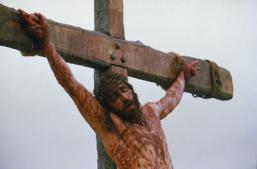
© 2004 Icon Distribution, Inc. Photo credit: Philippe Antonello, All
Rights Reserved
Not only did He perfectly accomplish His work of atonement, He also finished it. He brought it to an end. He terminated it. What that means is that Jesus’ work of atonement was a once for all event never to repeated or added to. There is nothing left to be done to secure the salvation of people. The work of Jesus Christ on the cross is effectual in and of its self. It doesn’t need anything to be added to it to make it effective: it doesn’t need sacraments (baptism, the Lord’s Supper, or any other thing), it doesn’t need a Mass, and it doesn’t need the "free will" decision of a person to fill up what is lacking in its saving power. Jesus actually saved people at the cross. Presbyterian Theologian John Murray (deceased), in his book Redemption Accomplished and Applied, observed:
“Christ
procured redemption and therefore secured it.
He met in Himself and swallowed up the full toll of divine condemnation
and judgment against sin. He
wrought righteousness which is the proper ground of complete justification and
the title to everlasting life. Grace
thus reigns through righteousness unto eternal life through Jesus Christ our
Lord (cf. Romans 5:19, 21). He
expiated guilt and “by one offering He hath perfected forever them that are
sanctified…” (Hebrews 10:14). “Being
made perfect He became the author (the cause) of eternal salvation to all them
that obey Him.” (Hebrews 5:9)….
“What
does redemption mean? It does not
mean redeem-ability; that we are placed in a redeemable position.
It means that Christ purchased and procured redemption.
This is the triumphant note of the New Testament whenever it plays on the
redemptive chord. Christ redeemed us to God by His blood (Rev 5:9).
He obtained eternal redemption (Heb 9:12).
“He gave Himself for us that He might redeem us from all iniquity and
purify to Himself a people of His own possession, zealous of good works.” (Titus
2:14). It is to beggar (impoverish)
the concept of redemption…to construe it as anything less than the effectual
accomplishment which secures the salvation of those who are its objects.
Christ did not come to put men in a redeemable position, but to redeem to
Himself a people…Christ did not come to make sins expiable.
He came to expiate sins (Heb 1:3). Christ
did not come to make God reconciliable. He
reconciled us to God by His own blood.” (Wm B. Eerdmans Publishing Co., Grand
Rapids MI, copyright 1955, p. 58, 63)
The cross was not a Divine afterthought, where God sent His Son to die, crossed His fingers, and hoped that someone might “accept” Him. It was the place where Christ made a full, complete, all-sufficient, completely satisfactory, all-powerful and perfect sacrifice, and finished the work of atonement whereby He fully satisfied the wrath of God and expiated the sins of His people. Jesus doesn’t just try to save; Jesus saves! Creation and history itself is nothing more than the outworking of God’s sovereign plan of redemption that He initiated before time even began—a plan that makes Christ an actual Savior instead of merely a potential Savior; a plan that makes God the perfect Architect of a perfect plan that will come about precisely as He has determined; a plan that ascribes all of the glory to God, and to Him alone; a plan that makes Christ the only Savior, not a co-savior.
True enough, the benefits of that work must be appropriated through saving faith, and the benefits do not come to the person unless he or she embraces Christ in personal faith and repentance. The historic Protestant Reformation view acknowledges the need for individuals to exercise personal saving faith in Christ; however, the very faith that we possess was itself purchased by Christ on the cross (cf. Jeremiah 31:31-34 with Mark 14:24; Ephesians 2:8,9; 1 Pet 1:19-21). Faith is not the cause of our salvation; rather, it is the instrument, given to us by Christ, through which we are enabled to take hold of Him who had taken hold of us from before the foundation of the world (Romans 8:28-33; Eph 1:4-11; Revelation 13:8).
It isn’t me who makes the objective work of the cross effective. It is effective in and of itself. All I do is receive what Christ has already done, and the reason I receive isn’t due to something good inherent in me, rather, it is due to Christ Himself, and it is because of this that we can say we are saved by grace alone.. Only in classical Reformation Protestant theology is the Biblical truth proclaimed that Jesus Christ Himself is the sole sufficient and efficient cause of our salvation. The late Dr. Greg Bahnsen comments,
“It
isn’t the cross plus my
converted heart that equals salvation; rather, it is the cross that gives
me a converted heart and therefore
salvation.”
Jesus didn’t die to help us save ourselves. By His death He actually, not possibly, saved sinners. (Revelation 5:9). C.H. Spurgeon, the 19th century Baptist preacher stated, “We say Christ so died that He infallibly secured the salvation of a multitude that no man can number, who through Christ’s death not only may be saved, but are saved, must be saved, and cannot by any possibility run the hazard of being anything but saved.” To examine in more detail the Biblical position on the atonement, please see my webpage www.geocities.com/johnandursula/limitedatonement; and for extensive research see http://www.the-highway.com/atonement.html, and http://www.monergism.com/thethreshold/articles/topic/redemption.html.
Now, after reading all of what I just said, one might get the impression that I do not recommend the movie. That is not my view. While I am in complete agreement with my Evangelical brothers and sisters who have concerns about the Roman Catholic content of the film, and how it could be used by Roman Catholic organizations to try and draw people to the Roman Church, I still recommend the movie. Why? Because I believe that this movie is masterpiece of film, and while having many allusions to Roman doctrine, it nevertheless remains the most historically accurate representation of what Christ actually endured in His sufferings. In other words, I am not willing to throw the baby out with the bathwater. The movie is too good, too powerful, and too accurate in terms of the sufferings of Christ to do that. And I agree with the Catholic Exchange that the movie will most certainly raise questions. However, I for one find it interesting that even the Roman Catholic apologists in the excerpt provided by Dr. White acknowledge that most people don’t draw the conclusions that they necessarily think they should draw, thus they, “… see a need for this book to provide answers to some of the many questions critical to a full understanding of authentic Christianity…” In other words, even though the film does have those elements in it, they are lost on most people. Isn’t it a bit strange how on the one hand they say that the movie clearly portrays the link between the Mass and the cross, and Mary’s roles as Co-Redeemer, yet they then say that no one will make those connections (not even most Catholics!) unless they help people make them with their book!
I’ll tell
you the connections that I, a former Roman Catholic made, and what I believe
most people who view the film will make. It
is quite true that we see quite a bit of Mary in the movie. But
what is Mary doing? She
is doing what any mother would be expected to do:
grieving, reminiscing, and finding anyway she can to get to her Son
during the most important moment of His life.
I personally do not have a problem with those scenes. Those scenes, for me, do not draw me to the conclusions drawn
by Rome about Mary. How could
they?! And this is precisely why the Catholic Exchange sees the need to fill in
the blanks.
This is not to say that I didn’t
think there were too many scenes of Mary in the movie.
There were, particularly given the fact that the Gospels have just one
reference to her at the foot of the cross--99.9% of what we see of Mary in the
movie (and in Roman Catholic theology) is not in the Gospels.
But what we did see I don’t think even comes close to evoking such
ideas as the immaculate conception of Mary, her title as Queen of Heaven, her
elevation as Mediatrix and Co-Redemptrix, or even that prayers are to be offered
to and/or through her. For one to
see those things, one would have to bring those ideas, and extra-biblical and
non-historical traditions, to the film.
Does that mean that we must
never imagine what Mary must have felt as she witnessed her eldest Son being
viciously brutalized? I don’t
think so. Why should we allow Rome to co-opt Mary?
As the movie would show scenes of Mary, the verse that kept coming to my
mind was Luke 2:35, “and a sword shall pierce your heart.”
Even now, as I think about that verse and ponder what Mary might have
felt as she witnessed her Son being slaughtered, I feel tears well up in my
eyes. Roman apologists would say, “aha! So you see Marian doctrine too, and you even use a key verse
for it!” Dear sirs, while I
admire your zeal, I don’t draw from that one verse what can only be said to be
the blasphemous notion that Mary is somehow a Mediator and Co-Redeemer.
I draw from the verse precisely what I saw in the movie:
a mother deeply grieved and anguished over what she witnessed happening
to her Son. That was the
“sword” that pierced her heart. She would experience deep anguish of soul
over what she would have to witness her Son endure.
My dear Catholic friends, it wasn’t Mary who was flogged; it was Jesus.
It wasn’t Mary who had a crown of thorns ripped over her head; it was
Jesus. It wasn’t Mary who had
nails driven through her hands and feet on a Roman cross; it was Jesus.
It wasn’t Mary who had a Roman spear thrust into her side; it was
Jesus. It wasn’t Mary who rose from the grave; it was Jesus.
It wasn’t Mary who bore the full brunt of the wrath of God for sin, and
became a ransom for many; it was Jesus. There
is only one Mediator between God and men, the Man Christ Jesus; and there is
only One Redeemer; and His name is Jesus.
For me, the scenes of Mary in
the movie merely added to the humanity of what we saw.
It made Jesus’ human nature that much more tangible. Jesus had a
mother, just like me. He had a mom
who loved Him dearly, just like me. He
loved His mother very much and had fond memories of her, just like me. If we keep this perspective, which is really the only
perspective that we can conclude unless we already have a preconceived idea that
impose onto the story, then I really don’t have a problem with it.
When it comes to the Bible, there is nothing wrong with us wondering what
a person must have been feeling, and trying to empathize in some small way with
the character and the situation. I
for one, as a preacher, can think of many times in my sermons I have taken the
journey down the road of “sanctified speculation.” What preacher has never
said, “what must Peter have been feeling when…” Or, let’s just
take the text, “and a sword shall pierce your heart.”
Is it a stretch to hear a preacher say, “what did the person mean by
that statement to Mary? Well beloved, imagine the agony of soul you would feel
if you witnessed one of your children being crucified!
Think of Mary, and the love she had for her Son.
What emotion! What pain!
Surely she would have reflected on when her Son was a child…you see,
these are real people who experienced real pain.”
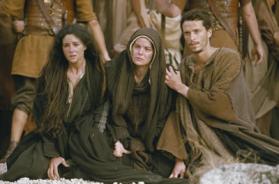
©
2004 Icon Distribution, Inc. Photo credit: Philippe Antonello, All Rights
Reserved
Mary
mother of Jesus grieving over Jesus (middle) with Mary Magdalene and John the
Apostle.
If one were given the liberty
to speculate as to what Mary may have been feeling, I believe that the movie’s
“speculation” (even though influenced by Roman dogma) was what one might
expect any grieving mother to do. For
we Protestants, I fear that so often our “protest” over Roman doctrine,
particularly as it relates to Mary, while justified, can sometimes blind us to
the fact the Mary was the mother of Jesus.
She was called “blessed among women.”
She was a chosen instrument of God to be the mom of His One and Only Son, and all
of us can call her blessed because of that.
She is someone whose example we can emulate, though of course not
venerate, and I simply refuse to let Rome not only co-opt Mary, but then
attribute to Mary things that she herself would have been horrified at.
If Mary knew what people were teaching as a matter of doctrine and
practice regarding her, I’m sure it would be like another sword piercing her
heart, as she would witness people attribute to her what could only be
attributed to her Son, and thereby trample underfoot the precious Blood of her
Son.
Much more could be said with
regard to the theological issues involved.
I refer the reader to the ministries of Dr. James White and William
Webster for more information. Dr.
White has had numerous debates with leading Roman Catholic apologists that you
can listen to on-line, and you can purchase a book he wrote called The Roman
Catholic Controversy. His
website again is www.aomin.org.
William Webster’s website is at www.christiantruth.com.
He also has audio files you can listen to at http://www.straitgate.com/webster/index.htm
This movie was one of the greatest movies I have ever seen.
I spent a large portion of the movie deeply affected, and was brought to
tears (actually, near sobbing) at many points during the movie.
Everything about the way the movie was produced is nothing short of
genius. From the insistence on
using the languages of the time (I was initially
disappointed that the movie would be subtitled in English, but soon came to see
the Mr. Gibson’s wisdom in doing it as he did it.
I’m thankful he finally agreed on the subtitles as well!), down to the
authentic appearance of the characters and the set, the movie is just
unparalleled in its ability to transport you back in time.
This movie like no other I have ever seen puts you there.
It puts us in the Garden of Gethsemane with Jesus, where Jesus’ deep
torment of soul almost becomes palpable to us as He contemplates bearing the
full brunt of the wrath of God for the sin of the world, which He knows means
being utterly forsaken by God (all of this is to say that Jesus realized He
would be experiencing hell on the cross. It
wasn’t the nails and the thorns that had Him in distress, it was realizing
He’d be cut-off from the Father until He had finished paying the full penalty
for the sins of His people). It puts us in the trial room where Jesus was being
judged by the religious leaders. It
puts you in the flogging area, where the Son of God was whipped mercilessly till
the flesh all but hung from His bones. It
puts us in the courtyard where Pilate presents a bloodied and mutilated Jesus
before a hostile crowd that cries out “Crucify Him!
Give us Barabbas!” Most
importantly, it puts you right there, at the cross of the crucified Savior, and
forces us to contemplate ourselves and the only true and living Holy God who
loved the world so much that He sent His Son to die that whoever believes in Him
should not perish, but have everlasting life.
Every performance was powerful.
Cavaziel was simply brilliant as Jesus.
I was also extremely intrigued with Mr. Gibson’s rendering of Satan. Satan, played by a woman, was a sort of a unisex character
who perfectly captured the subtleties and beguiling nature of Satan.

http://www.hollywoodjesus.com/passion_photo.htm
Though I do not agree with many
of Mr. Gibson’s theological convictions, I nevertheless thank him for having
the courage to produce the movie that he did, and for producing the most
historically accurate portrayal of the sufferings of Christ that has ever been
put to film. I had a respect
for Mr. Gibson prior to this movie as a filmmaker and an actor, and that has
only increased ten-fold with the making of this film, as I have watched him
handle some of the most vicious attacks with a grace that we can all
learn from. Obviously, we do not possess the ability to know all of the things that
motivate people to do the things they do. However,
it seems clear that Mr. Gibson’s primary motivation for
making this masterpiece was his desire to use all of his God-given talent and
skill to produce something that would honor the King of kings and Lord of lords,
Jesus Christ, and cause us all to ponder the depths of what Christ actually
endured during His passion.
Photo by Holly McClure http://www.sbcbaptistpress.org/bpnews.asp?ID=15304
I pray that the movie does elicit questions, and that people do seek answers,
not in any church tradition (whether Roman Catholic or Protestant), but from the
text of the Bible itself. As for
the impact of the movie, I can’t help but be reminded of the
words of the timeless hymn When I Survey The Wondrous Cross written by
Isaac Watts some three hundred years ago:
When I survey the wondrous cross on which the Prince
of Glory died,
My richest gain I count but loss and pour contempt on
all my pride.
Forbid it Lord that I should boast, save in the death
of Christ my God,
All the vain things that charm me most, I sacrifice
them to His blood.
See, from His head, His hands, His feet, sorrow and
love flow mingled Down;
Did ever such love and sorrow meet, or thorns compose
so rich a crown.
Were the whole realm of nature mine, that were a
present far too small;
Love so amazing, so divine, demands my soul, my life,
my all.
If you
would like to receive the free gift of eternal life that Jesus Christ purchased
with His blood, please see this link: http://www.eeinternational.org/dykfs/[email protected]
Soli Deo Gloria,
JCO