


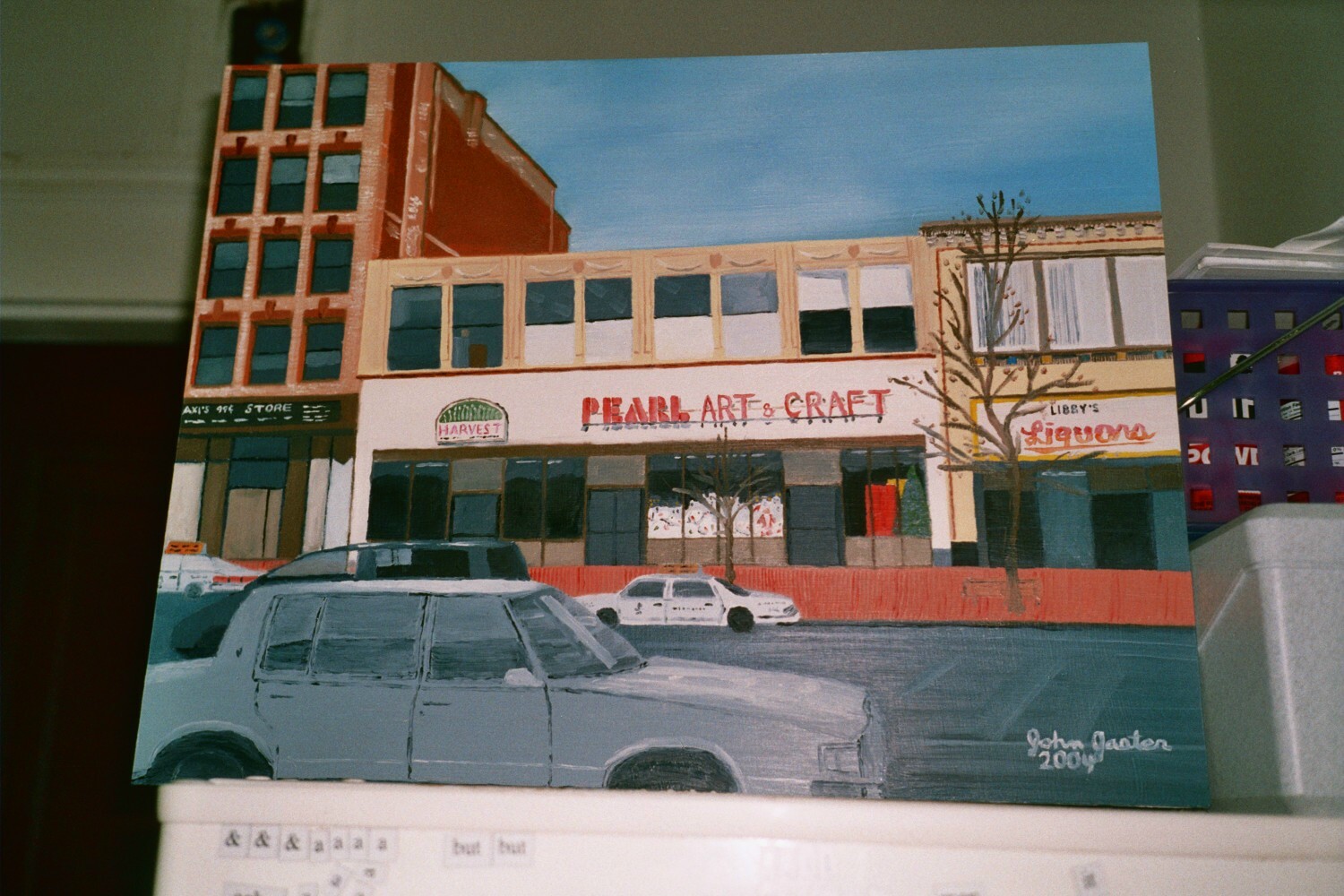
If you're just starting out as a painter you don't need fancy supplies. You probably don't have room at home for a full fledged art studio anyway. May I recommend 1) an aluminum table top easel, 2) No more than 10 tubes of paint (small magenta, yellow, blue, an umber, a sienna, violet, orange, two different greens, and a big tube of white), 3) Plastic plates instead of palettes, 4) A mutltipack of brushes in the $10 range, 5) A plastic knife for a palette knife, 6) A pack of canvas boards, and 7) A chrome paper sorter from an office store (to leave your paintings to dry in).
PERMANENCE:
Not all paint is permanent. Hobby paints, like 99 cent tubes of acrylic, usually don't tell you the pigment inside and they use the cheapest binder. They're meant for whimsy not for permanence. The next step up is student grade paints (like Winsor and Newton Winton or Dahler Rowney Georgian). These are fine to start though they are clearly inferior to artist grade. Most artists are incensed at the idea of ever using student grade. I fully agree it's inferior but everything in life has its time and place. When I work in oil i often put a coat of paint on the backside of the board to equalize the tension from the front. There's no reason that unseen backside can't be student grade. Likewise for an undercoat. Likewise if a piece is so experimental I expect before I start I'll likely end up throwing it away. Student grade is what it is. But then there's the good stuff - artist grade. The top of the line stuff. They run $7 to $30 a tube (or beyond)! Yet, even in artist grade you need to read the tube for the pigments enclosed. There are many fugitive pigments from the past which artists still buy for nostalgic reasons even though they probably shouldn't. Genuine madder for example. Personally, I don't use anything of moderate to low permanence. It might as well be a sand painting.
TOXICITY:
Also for nostalgic reasons artists still have demand for toxic pigments from the past. They don't have to because there are many modern alternatives in every color. Always read the back of a tube. Look for either an "AP Nontoxic" or "No Health Label Required" indication. Also it's wise to study pigments and their code numbers because sometimes that's all the tube will tell you. And the biggest warning sign of all is if they tell you nothing about the tube contents. Personally I avoid lead, tin, cadmium, cobalt, mercury, and nickel paints.
PAINT BRANDS:
They all have something great, something terrible, and a lot imbetween. They all claim to have the highest pigment load and the most permanence. They all charge you the most they can get away with. Read the tubes, experiment, and build your own collection of favorites. My choices have fluctuated alot over the years. In oils I prefer Williamsburg and Old Holland, but I use just about everything and I'll give strong mentions to Winsor and Newton, Maimeri, Gamblin, Blockx, Rembrandt, DaVinci, and M. Graham. I'll sometimes use the next tier down - Lefranc & Bourgeois, Blick, Van Gogh, Art Spectrum, Rowney, Chroma Archival, Grumbacher, Daler-Rowney Georgian, Winsor and Newton Winton (but always read the backs for toxicity and permanence). I never liked Weber, Shiva (their oils - but I do like their casein), or Yarka. In acrylics, which are newer to me, my favorites are Lascaux, Golden, Liquitex, Daler Rowney Cryla, and M. Graham.
UNDER GLASS OR VARNISHED?
Most paintings need some sort of protection to survive long term. I'd say put all water based paints under glass: watercolor, gouache, casein, egg tempura. Acrylic can go either way - glass or varnish. I'd advise against putting oil paint under glass because it needs to breathe. Instead wait 6 months and varnish an oil painting with a reversible art varnish (never with a hardware store varnish, which are all permanent). That way dust will stick to the varnish instead of the paint and decades later a conservator could restore the painting by replacing the varnish. In extreme cases you could put oil under glass as long as it's well dried. A painting hung in a public place where many fingers may touch it, for example, is where the benefits of glass outway the risks.
CANVAS VERSUS BOARD: There are pros and cons to both. You'll see from my portfolio I use board more than anything else (although lately I've focused on paper and polyester because they're so easy to store away and I have little space at home). I chose board as my most common support because a) I started as a woodcarver so board was a natural progression, b) A 1/8" hardboard is super thin. I can fit 6 board paintings in the same closet space where I fit 1 stretched canvas painting. 3) I believe it's more archival if prepared properly (sealed, gessoed, balanced on both sides). Canvas painters can list many virtues of canvas, but they'll need a lot more space to work in volume, the works are fragile to the touch with cracking and tears possible, and the generally pay more for their supports.
OIL VERSUS OTHER MEDIA: I used to have a big write-up on this website promoting oil over acrylic. But I've experimented with so many media at this point that I don't know anymore. Everything has it's strengths and weaknesses. I love the workability of oil, yet I love the versatility and quick drying of acrylic. Casein smells delicious (like a bowl of cereal - it's milk based). Watercolor and gouache are unique and cool. Really I don't have a favorite anymore. Use them all!