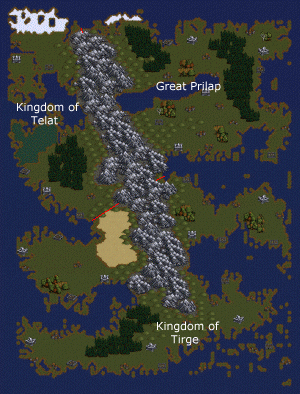
The current year is 529 c.y. (Common Year). Almost
three hundred years ago the known lands were under the control of three
kingdoms. The Kingdom of Telat in the west, Great Prilap in the east, and the
Kingdom of Tirge in the south. This had been the political situation for
hundreds of years, throughout written history these three nations had existed.
After centuries of rule, the monarchs in all three kingdoms had become less and
less worried about the concerns of the common folk. Grand palaces and monuments
were built in the kingdoms, and the nobles lived in the lap of luxury.
Merchants charged bloated prices for everything from spices to gems, and the
nobles would eagerly buy the latest and greatest to impress their peers at the
balls and formals that were common at that time. All the while, the commoners
suffered more and more. It seemed that the more that the nobles had, the less
that was left for the commoners. In 230 c.y. unrest had reached a boiling
point. People who lived close to the Kingdoms' center of power were generally
passive and simply lived with their hardships. But in the more remote regions,
talk of a better life was rampant.
The kings of Telat and Prilap dealt harshly with anyone caught spreading words
of treason. The two kings quickly sent soldiers to all corners of the Kingdoms
to round of trouble-makers and put them to death for treason. Tirge tried to
take a different approach, and instead of sending troops to kill treason
instigators, the King chose to ignore talk of rogue provinces.
By the year 255 c.y. open rebellion was spreading
through the lands like wild fire. The three kingdoms had been battling rogue
territories for 25 years, and they were all losing ground. Each kingdom had
taken a different approach to their dealings with the separatists.
Telat was by far the most severe. Already having the largest standing army, and
having the least compassion for those that the crown viewed as traitors, Telat
responded with absolute brutality. A small territory to the north, calling its
self Asoit (from the old tongue, meaning "Remote" or "Far off"), slowly carved
out an existence. Largely with the help of several nomadic tribes of
barbarians, the Asoit wanted to live in peace and independence from the
Telatian Crown.
Prilap tried to bribe the commoners to turn in those who talked of treason.
After several years of hunting the traitors, the King thought that if he could
turn the commoners against themselves that they would forget the talk of
independence. At first the plan seemed to be working, as several people were
turned in as traitors and put to death as examples. And then the baron from the
south east province of Great Prilap was killed and his head was delivered to
the Prilap King with a message. "The province of Sorethland no longer
recognizes the rule of the Prilap Crown, and thus declares its independence!"
For 8 years the king sent waves of troops to Sorethland, but they were all
driven back by small armies of commoners who were supported by two clans of
Elves.
The approach of Tirge was much more subtle. The king wanted to avoid war at all
costs. He was under a great deal of pressure from nobles who desperately wanted
to maintain their pampered lifestyle, and were not willing to make the
sacrifices that come during a time of war. So the Tirge king he refused to send
troops to his north east province when word came that they had declared
independence from Tirge. Instead he sent an ambassador to plead with the
province to return to the kingdom, even offering it a generous financial
reward. The gold was melted down and the word Ulas (from the old tongue meaning
"freedom") was stamped on it. The golden chunk was sent back to the king in
answer.
As word spread that Ulas was allowed independence without even a fight it
emboldened a large but sparsely populated section in the north west of Tirge to
follow the example of Ulas. The leaders of the independence movement in this
area promised the people absolute freedom from any sort of government. No
taxation, no rulers. Thus named Elulas from the old tongue, Ell meant
"Absolute" or "Complete" and Ulas meant "Freedom". Elulas, which was usually
written El'ulas was a another word for "Anarchy" in the old tongue. By 255 c.y.
a large swath of NW Tirge was largely accepted as the free land of Elulas.
The warring went on for another 25 years, and things
got worse and worse for the three kingdoms. Unrest at home, and growing
opposition in the more remote regions, encouraged even more peoples to declare
their independence from the kings.
Things in Telat grew more brutal and the king became paranoid that all of his
vassals were going to turn against him. Any of the dukes and barons that ruled
the provinces of Telat who acted even slightly unloyal were put to death
without question. In 278 c.y. a city in south Telat (called Zirand) was rumored to be unloyal
so the king of Telat sent his troops to the town with very specific orders:
kill every single person, from the mayor to the priests, and then burn the town
to the ground. The troops followed their orders, and from that point forward
Telat did not have any further problems with traitors. The horrible situation
was known as The Burning of Zirand, and
word of the brutal actions spread throughout Ne'khol like wildfire.
In the North, the battle for the rogue
land calling its self Asoit was basically at a stand still. The king had grown
tired of the constant fighting in the north so he largely ignored the mostly
barren land. He still sent troops north every month or so to pillage and
plunder any farms or villages that they encountered, until they met resistance
and then they returned.
In Great Prilap the financial situation was turning dire. Unlike Telat, Prilap did not have many stockpiles of armor
and weapons, so when the wars started the king found himself in desperate need of
metal to make the tools of war. But, the Dwarves of the Goril Mountains controlled
almost all metal mining and (being the industrious folk that they are) as the demand
for metal skyrocketed, so did the prices. The Prilap crown spent a huge portion of
its wealth to arm an army enough to battle in Sorethland. nobles complained mightily
as their pampered lifestyle suffered becauseof the war. The king's eldest son, Crown Prince
Gwel, was one of the most vocal against his father. He insisted that his father stop
the battle against Sorethland and grant them independence like the Tirge had. With the
backing of many of the nobles, the king feared that his son would usurp power of the
whole kingdom, so he offered his son an alternative. Gwel was offered his own section
of land in the NE section of Prilap, and he and his loyal nobles could go there and
live in peace under Gwel's rule. His son, and several Prilapian nobles, took the
king up on his offer and in 277 c.y. the land of Gwela was born.
Many of the people in Elulas were learning that absolute freedom wasn't as great
as it had sounded. Bands of brigands and ruffians roamed the lands, pillaging at will.
In the towns, the thieves guild ran most aspects of business life. Some cities lived
a fairly normal existence (other than rampant crime rate and near-impossible control
over the thieves), but most lands were in chaos. By 258, the north west section of Elulas
had experienced enough and declared their independence from the newly formed land. The
people called their land Koiharland, after Sir Robart Koihar the leader of the independence
movement.
In the south, a bold Duke declared that his province of Alimur was free of the control
of the Tirgean Crown. The duke was not content with having his own country, he longed to
control the southern peninsula and he sent his troops east to conquer as much of Tirge
as he could. By 274 c.y. his troops had captured the cities of Rheodoc and Darcyn, and
were poised to attack the town of Leobryn. The Tirge king, Dunn Arumma the 4th, had been battling the new Alimur
soldiers for months, and was mustering new troops daily, but the Alimur kept making progress.
King Dunn's Talon has been in Sorethland secretly helping the Sorethlanders in their
battle against Prilap, but as the Alimur army pushed east, the king called them back
to defend their homeland. Dunn's Talon consisted of 7 people: three soldiers, a priest,
two wizards, and a knight. They worked behind Alimurian lines for 14 months. They
ambushed Alimur messengers, set fire to the Alimur army food stores, impersonated messengers to
give incorrect orders to forward commanders, gave mild poisons to cavalry horses to prevent
them from being able to fight, and assassinated over 40 Alimur army leaders. The actions
of Dunn's Talon turned the tide of the war. By 276 c.y. the Tirge pushed the Alimur
back west of the town of Bliryn, back to the land that was originally the province
of Alimur.
In 279 c.y. several leaders were calling for peace in the wake of several bloody
battles, primarily the Burning of Zirand. Lead by Tirge, Prilap, Gwela, Sorethland,
Ulas, and Koiharland, a council was formed. It was decided that representatives from
every country would meet in the Simir Isles, since that was a remote and neutral land.
Alimur and Asoit eventually agreed to send delegates and even Telat participated (after
originally claiming that they would not send a delegate if Asoit was represented. The
council decided to call its self the Zirand Council, in honor of the memory of the 7,000
people who were killed in Zirand by the Telat army.
The first goal of the Zirand Council was to bring peace. Gwela and Sorethland both
complained that Great Prilap was too big and powerful for peace to exist in the North
East. Ulas and Alimur made the same complaints about the Kingdom of Tirge. Surprisingly,
Asoit did not raise any objections to the size or power of Telat, asking only that the
attacks stop. The Kingdom of Telat, delighted at the though to limiting the power of its
former rivals, was quick to jump on the bandwagon to limit the power of the two
original kingdoms. After 8 months of verbal warfare, the council finally decided that
the only way to deal with the problem was to further divide both Prilap and Tirge.
The Frigod province in Great Prilap was declared an independent Duchy, and was ordered
to send a representative to the Zirand Council. In the Kingdom of Tirge, the provinces of
Jeand and Lyju were made self-governing lands to limit the power and size of Tirge. The
Jeand Barony and Duchy of Lyju sent representatives to the Zirand Council in 280 c.y.
The leaders of Prilap and Tirge were not happy with the outcome of the Zirand Council, but
both leaders were ready for peace. They were both afraid that the endless war would
be the end of their own family's rule and didn't want to risk losing power. In Tirge, King
Dunn's son was infuriated that he had just lost another huge chunk of his future kingdom.
He resented the fact that his father would negotiate away control of a huge section of his
land. When he took the crown in 313 c.y. he vowed that the Kingdom of Tirge would
be whole again some day.
By 293 c.y., under pressure of the Zirand Council, the country of Elulas adopted a
federated government and appointed leaders over each town and township to bring the
problem of the brigands under some sort of control. In 295 c.y. Elulas sent its first
representative to the Zirand Council, making it the final country to join the group.
For almost 200 years the lands of Ne'khol have known peace, thanks to the actions of
the Zirand Council. Each member country agrees to follow the will of the council, and
has pledged to provide troops to enforce the collective will of the Council if one
of the nations fails to follow the directions of the Council.
The Zirand Council is now comprised of representatives of all 13 human nations, as well
as 3 clans of Dwarves, 4 clans of Elves, and 1 clan of Halflings. The 21 representatives
all have a vote in all issues that come before the council. There is no leader, all
members have an equal vote, and simple majority decides all votes.

 The current year is 529 c.y. (Common Year). Almost
three hundred years ago the known lands were under the control of three
kingdoms. The Kingdom of Telat in the west, Great Prilap in the east, and the
Kingdom of Tirge in the south. This had been the political situation for
hundreds of years, throughout written history these three nations had existed.
The current year is 529 c.y. (Common Year). Almost
three hundred years ago the known lands were under the control of three
kingdoms. The Kingdom of Telat in the west, Great Prilap in the east, and the
Kingdom of Tirge in the south. This had been the political situation for
hundreds of years, throughout written history these three nations had existed.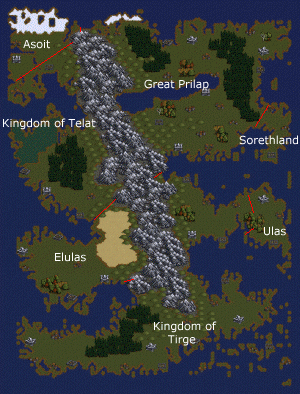 By the year 255 c.y. open rebellion was spreading
through the lands like wild fire. The three kingdoms had been battling rogue
territories for 25 years, and they were all losing ground. Each kingdom had
taken a different approach to their dealings with the separatists.
By the year 255 c.y. open rebellion was spreading
through the lands like wild fire. The three kingdoms had been battling rogue
territories for 25 years, and they were all losing ground. Each kingdom had
taken a different approach to their dealings with the separatists.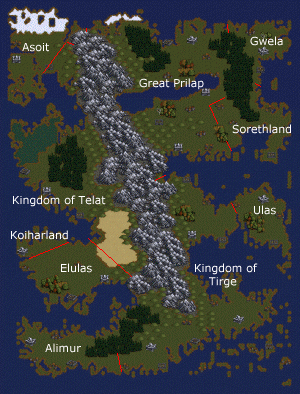 The warring went on for another 25 years, and things
got worse and worse for the three kingdoms. Unrest at home, and growing
opposition in the more remote regions, encouraged even more peoples to declare
their independence from the kings.
The warring went on for another 25 years, and things
got worse and worse for the three kingdoms. Unrest at home, and growing
opposition in the more remote regions, encouraged even more peoples to declare
their independence from the kings.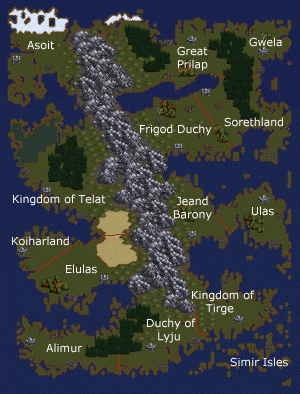 In 279 c.y. several leaders were calling for peace in the wake of several bloody
battles, primarily the Burning of Zirand. Lead by Tirge, Prilap, Gwela, Sorethland,
Ulas, and Koiharland, a council was formed. It was decided that representatives from
every country would meet in the Simir Isles, since that was a remote and neutral land.
Alimur and Asoit eventually agreed to send delegates and even Telat participated (after
originally claiming that they would not send a delegate if Asoit was represented. The
council decided to call its self the Zirand Council, in honor of the memory of the 7,000
people who were killed in Zirand by the Telat army.
In 279 c.y. several leaders were calling for peace in the wake of several bloody
battles, primarily the Burning of Zirand. Lead by Tirge, Prilap, Gwela, Sorethland,
Ulas, and Koiharland, a council was formed. It was decided that representatives from
every country would meet in the Simir Isles, since that was a remote and neutral land.
Alimur and Asoit eventually agreed to send delegates and even Telat participated (after
originally claiming that they would not send a delegate if Asoit was represented. The
council decided to call its self the Zirand Council, in honor of the memory of the 7,000
people who were killed in Zirand by the Telat army.