
|
| JoeNiv's Reloading & Load Development Page |
|
|
 |
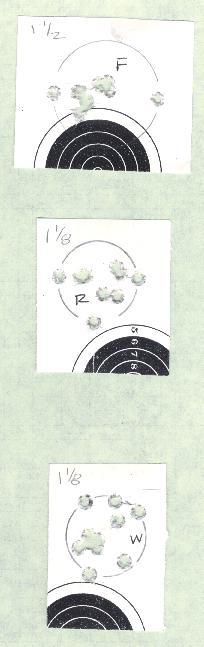 |
| During our bowling pin league, we use .22LR pistols and try to knock 5 bowling pins off a flat board at 25 feet as quickly as we can. I mounted an Aimpoint on my 22/45 and took three types of ammo to the range to see if the gun preferred one brand over another. As you can see, not really. I like the Winchester because it is cheaper and I have a bunch on hand, but my gun jams with it. The Federal works better, but I still get a stove pipe every so often. I will use the Remington for the rest of the year. I don't remember the last time I had a problem with Remington 22 LR hollowpoints. They just seem to work well in my guns. |
| Back to JoeNiv Home |
 |
 |
 |
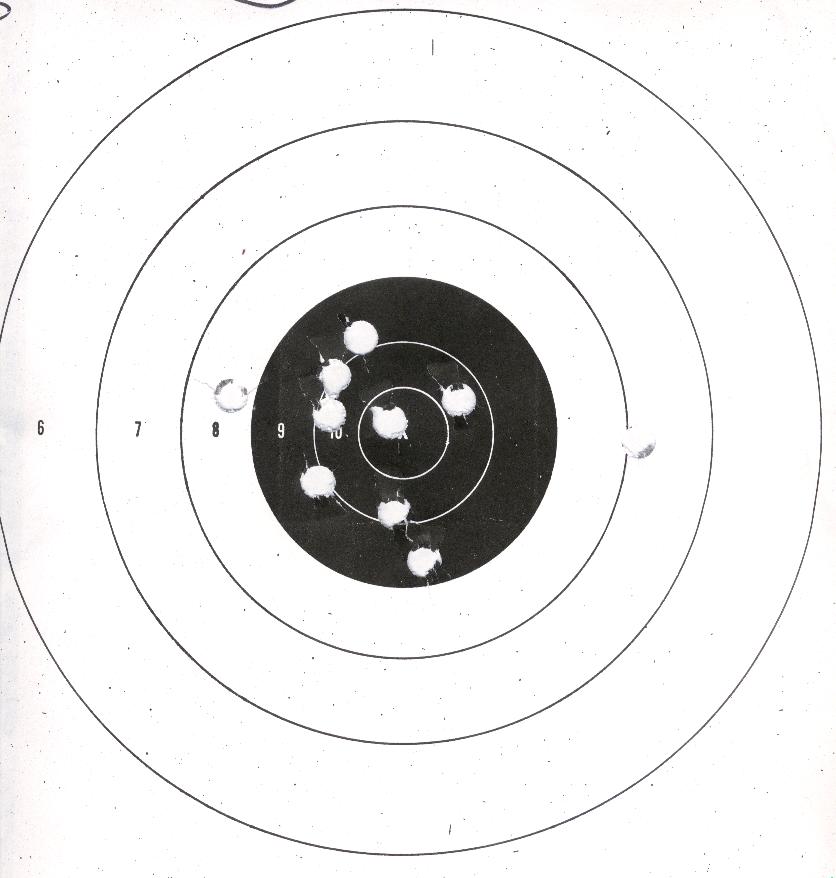
| I belong to a rifle and pistol club that conducts league shoots during the winter months. One of the leagues is a "300" league. You shoot at 50', at a paper target and score based on your bullet placement within the scoring rings. My best target of the winter is below. It was scored a 95. |
 |
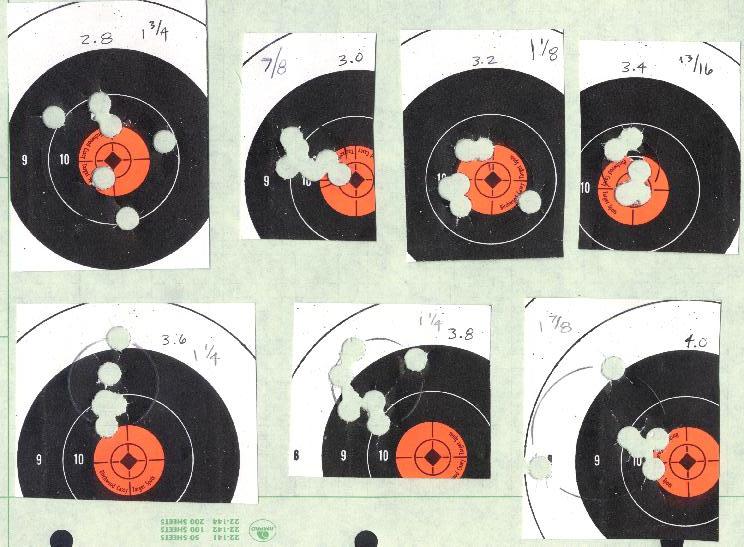
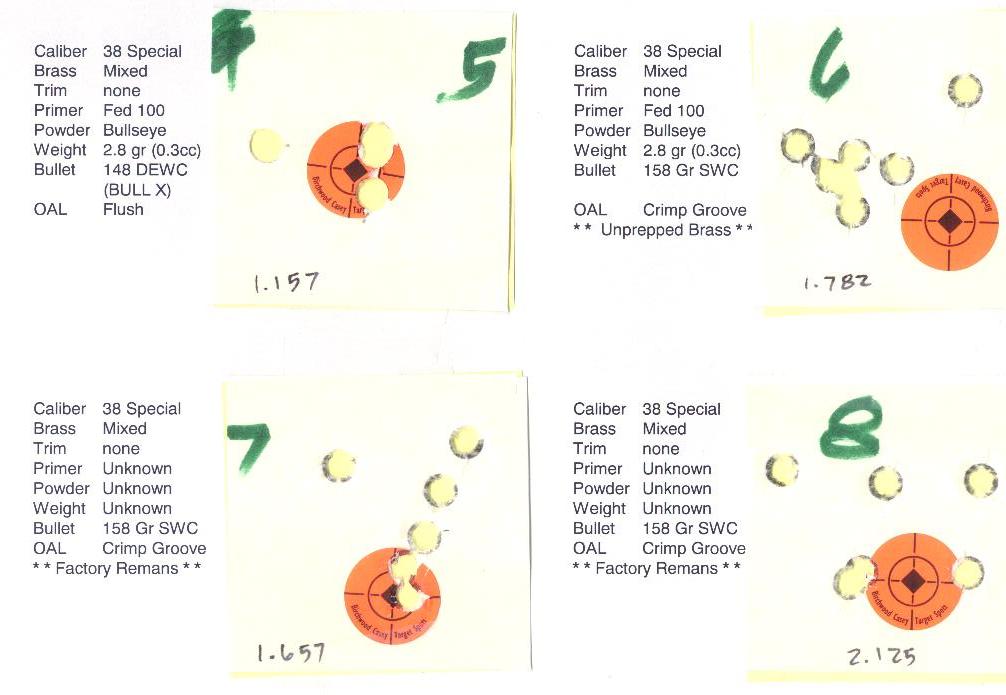
| Up until now, I've been shooting Georgia Arms "Canned Heat" reloads at $120/1000 rounds of 158 gr SWC .38 Specials. The ammo can ran dry about the same time the league ended, so I know next time I will need to get some reloads worked up. I just started reloading 6 months ago and have reloaded for rifles only thus far. This next set of targets shows the groups I was getting out of my Python, shooting off a rest with a 2X scope. I sought the advice of a handgun reloading message board, compared what they were saying with what my reloading manual said and took it from there. These first reloads were shot with all Winchester brass, all Fed 100 primers, 148 gr DEWC bullets, seated to the crimp groove. I thought I was getting fair accuracy at between 3.0 and 3.4 grains of Bullseye. |
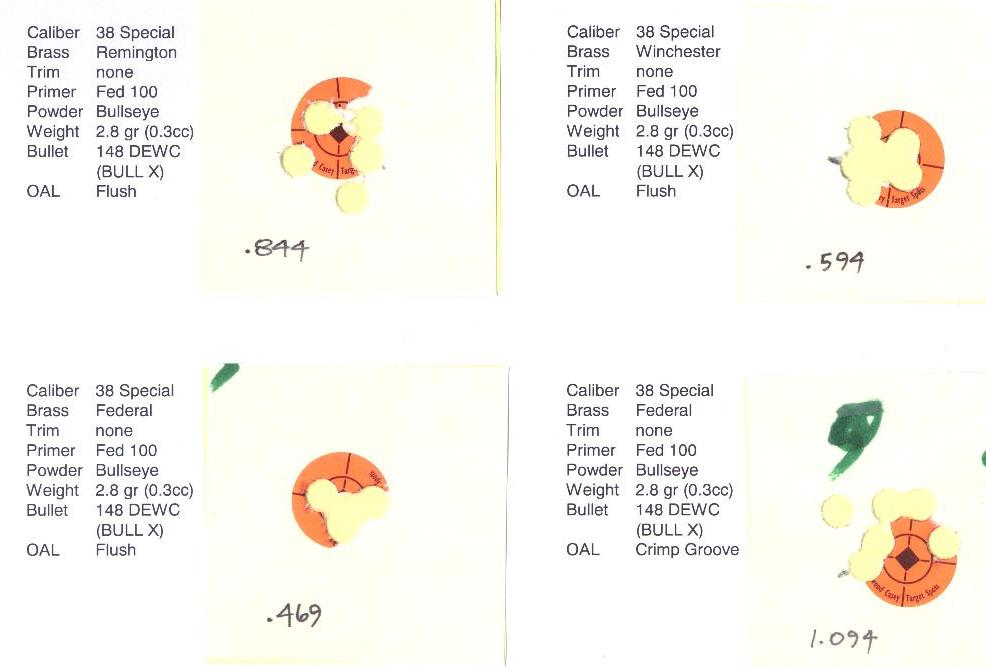
| TThe only problem I had was the fact that it was real hard to throw a 3 grain powder charge using my RCBS powder measure. Back to the message board again, and they told me to find a Lee powder dipper. This is a set of measuring spoons, calibrated in cubic centimeters. Lee provides the weight of each powder charge for each size dipper for a variety of popular powders. I double checked the .3 and .5 measures with Bullseye and found the charts and the dippers to be right on. I was not about to hand weigh each powder charge. So, my next trip to the range, I had an idea. The Speer reloading manual I was using recommended loading the DEWC bullets to the crimp groove. That left about 0.100" of the bullet sticking out of the brass. I decided that I should try to seat them basically flush with the brass. I also loaded each powder charge using the Lee dipper. No more weighing charges. The other variable I thru in was brass. As you can see, I got real good groups with Winch, Fed and Rem brass, so so results with mixed brass. I also think I got better groups with the bullet seated flush than I did when the bullet was seated to the crimp groove. |
| I had loaded up 8 sets of samples. I wanted to double check and see what happened with mixed brass - I got some bad crimps and the ammo wouldn't go into the cylinder. Trimming and setting my dies right would solve that. I also tried to shoot a group with some 158 gr SWC bullets... that group looks kinda ragged as well. The real eye opener to me was the final two groups. I had saved a few of the 'canned heat' ammo and shot it for accuracy as well. They are groups 7 and 8 below. Group sizes go from the 3/4" range to the 1 3/4" range! Its no wonder I shot so poorly in league... |
| The other side benefit of reloading is the reduced cost of ammunition. I did not shop for cheap components at all. I paid $1.99 per hundred primers, $19.99 for 500 bullets, $15.49 per pound of Bullseye. That cyphers out to about 6.6 cents per round. Basically half price of the factory remans that I was buying. I don't think I'm done yet. I still need to go back and verify accuracy on the next set of reloads. In addition, I want to trim the brass and get a nice uniform crimp on all rounds. Overall though, I'm quite pleased. A special thanks to all those who answered my questions posted on the various message boards I frequent. Without your help, this would have been a much longer and more frustrating journey. |
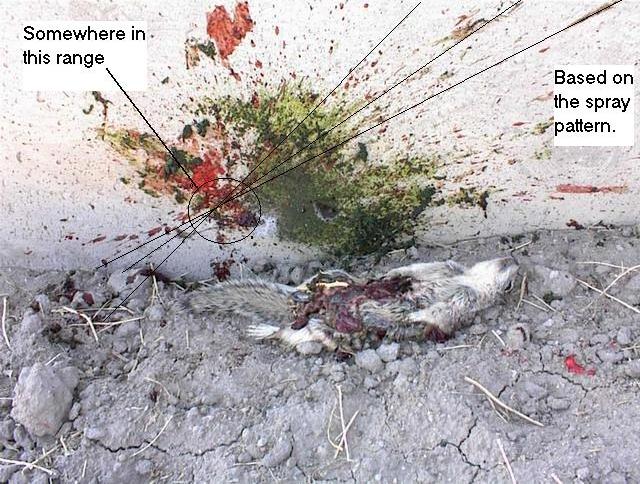
| Please stop here if you are squeemish. Below is a snapshot of a ground squirrel blown to bits. It isn't pretty. We were trying to find evidence of where the bullet hit on the wall that the critter was standing in front of. There appears to be a skuff mark on the wall as well, down and to the right of the circle I drew. |
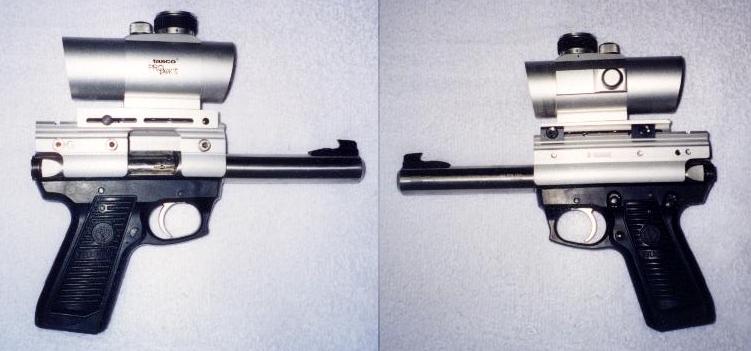 |
| This is my bowling pin gun. It is a stock Ruger 22/45 with a Tasco PDP4 mounted with a B Square no smith weaver style mount. It looks kinda spacey, but it works well. The one thing I don't like about it is how high the sight is over the bore. I do like the fact that I didn't have to remove the iron sights from the pistol. I can knock 5 bowling pins off a 2 X 6 from 25' in around 3.5 seconds with it. |
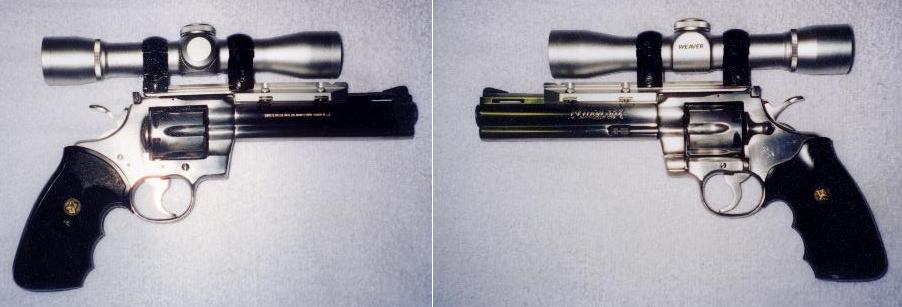 |
| This is my bullseye gun. 6" Colt Python, stainless, with a Weaver 2X scope. I used a Weigand no smith mount and a set of weaver rings I had on my shelf. This is the first gun I bought when I got back into shooting several years ago. |
 |
 |
 |
 |
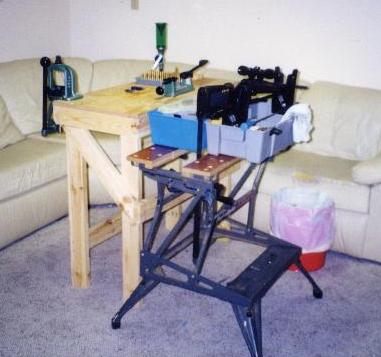
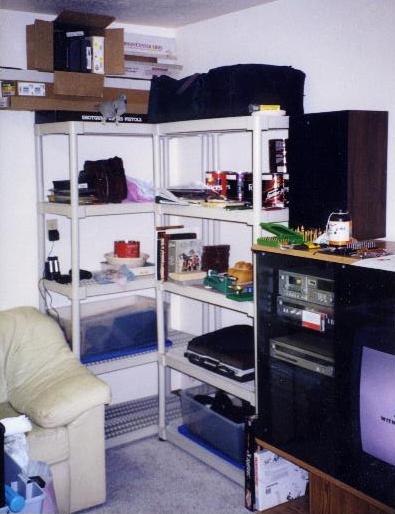
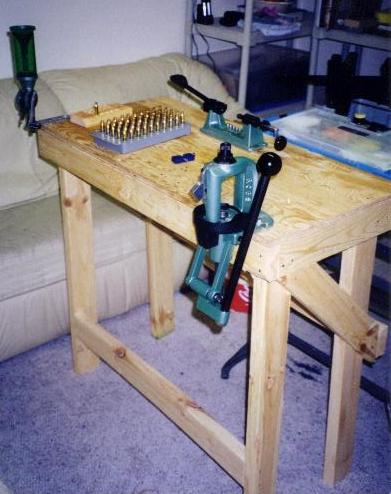
| My reloading room is my downstairs living room. One of the advantages of being single. My bench is not built in and can be moved around when needed. I use my range box as my cleaning station on a workmate. I've got a couple of cheap plastic shelves in the corner to stack stuff on. The top of the entertainment center works also. |
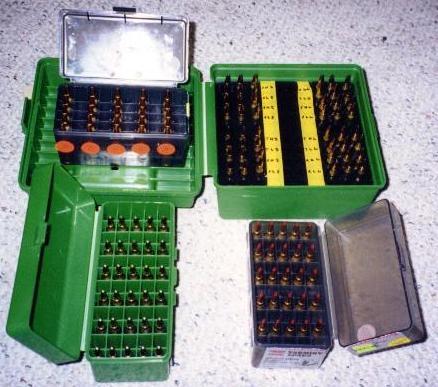
| I must have been neck turning for my new rifle. The powder measure, trimmer and press are all screwed to the deck of the table. It is standing height. The other picture is of the reloads I've worked on but haven't shot yet. It's been too cold and wintery here to get out and shoot much. |