| "You Can't Do That": The Great Stereo vs. Mono vs. Re-mixing Debate. |
 |
| Just thought i'd chip my two cents worth in to the eternal quibble over whether the Beatles albums are better in stereo or monoural. To start off, a few things to keep in mind. Heres the thing with mono and stereo mixes. One is not inherently better than the other. I'm not saying they are. Its simply that the individual mixes themselves are better done, NOT that they are in mono or stereo. Theoretically, you could re-mix a stereo track to sound more like the balance, etc. achieved on the mono. Anyway... What is the difference between stereo and mono?: One track and two tracks. Sound can be moved back and forth in the stereo spectrum, giving the illusion of movement. But theres not a real big difference. Very little is really recorded in stereo anyway, i.e., one amp, one mike, etc. There have been a few noteable experiments in true stereo (Brian Wilson), but it's never quite caught on. Why are the first four Beatles CD's in mono?: Who really knows? No one, it seems, will take ultimate responsibility for this. But a rumour has surfaced that the reason EMI and George Martin vetoed the stereo mixes was that they heard a defective tape of them. |
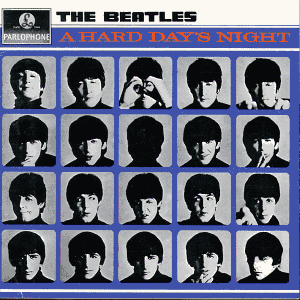 |
| It's fairly universally agreed that the first two albums are indeed better off in mono, at least on CD. But have you heard the "Hard Day's Night" CD lately? Ugh! Well, it's pretty obvious that EMI knows we'll buy this stuff any way they release it. Do the Beatles deserve better? Sure. Are they even aware the CD's are like this? |
| It appears not. The biggest problem with the folks in charge of the Beatles master tapes is that they are far too literal minded. Part of EMI's argument is that most folks in the early 60's only had mono-capable sound systems. Thats why the early Beatles albums are in mono and therefore why the CD's should be in mono! What kind of logic is this? |
 |
| Okay, so what's the problem? Well, beyond the poor packaging, EMI has basically put on CD the album masters, making everything sound horribly flat on compact disc. George Martin knows this. So why did they do it? When the Beatles re-signed with EMI in 1967, they stipulated that their master tapes were not to be tampered with by anyone. So this is part of the problem today. |
| Compact discs are capable of handling much more bass frequencies than vinyl, so we get a bass-less White album CD. Do the tapes just sound that way? NO!! The actual session tapes sound as if they were recorded yesterday. The vocal sound on them is beautiful; the drums sound great. So yes, they could be re-mixed to sound very up to date. You heard the "Yellow Submarine" songtrack. So should the first two albums be released in stereo? Well, with the current CD masters, no. But if someone sitting on the cash cow would pull out that cash and re-mix the tapes, it could be done. Listen to take 9 of "I Saw Her Standing There" on the "Free as a Bird" single, and it sounds wonderful! And while we're at it, not all the CD's sound bad. |
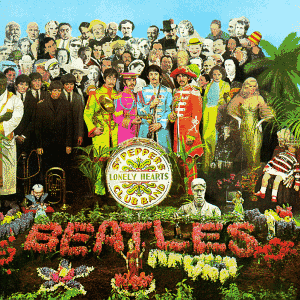 |
| "Let It Be" is quite good, while "Sgt. Pepper" isn't bad. So it's not complaints all around; it only appears that EMI are too lazy to go back and re-mix the first four CD's! Please don't get me wrong, folks. I'm not blaming the Fabs. As I said above, I have my doubts that they even are aware of the shoddy quality of the early discs. But there is some light at the end of the article. |
| You may have seen the 30th anniversary release of the 'White Album'. That was more like it, right? But it seems that until the Beatles archive falls into less conservative hands at EMI, we will never get official stereo CD's for the first four. Is that bad? Well, would you rather not have them at all? The Final Debate: Did the Beatles mix for Mono? To say that "Sgt. Pepper" was meant to be a mono album is as misleading as saynig the 'White Album' was meant for stereo. As with all Beatles albums, both mono and stereo mixing would be done thru out the recording sessions. Yes, engineer Richard Lush says that the mono Pepper is the real mix, that "there are all sorts of things on the mono... which the stereo doesn't have". Well, the exact opposite can just as easily be said. And just because early copies of Pepper say 'this is a monoural recording' on the back means about as much as early White Albums saying 'STEREO' on the back does. Simply put, mono was indeed the standard for English record producers in the 1960's, even if other countries had already abandoned it. |
 |
 |
 |
| But to say the mono mixes are superior because they were done first is foolish. Although "Hey Jude" was originally released as a mono single, it was first mixed for stereo. Matter of fact, the original mono mix was going to simply be a reduction of the stereo! So whats the big bleedin' difference? Why do so many folks covet mono copies of "Pepper" and "The Beatles"? Folks, mono and stereo is apples and oranges. |
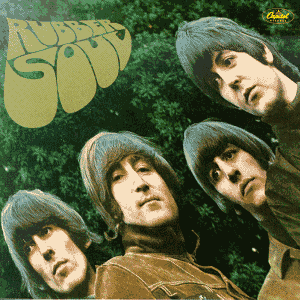
| The main point is different mixes of the same song! Just, one happens to be mono, etc. This is really the whole point in many cases. Of course, there is still the problem of the first 4 CD's. If you can get bootlegs, there are a few excellent ones with perfect stereo mixes reported out there. My main gripe about the first four is the shoddy packaging and flat sound quality, which has nothing to do with mono and mostly to do with the bizzare logic employed by EMI. So in closing: mono good. Stereo better. But even if it's a Quad 8-track, let's continue to enjoy the incredible music of the Beatles, and simply hope that good sense will someday prevail over in the Abbey Road archives. Hey, for lack of anything else, pull out those great old American LP's! WHICH LEADS US TO... A (long) Footnote: There seems to be some slight misunderstandings surrounding this article, so let me clarify and/or boil down a few points. When the Beatles were involved in the mono mixing process, it seems to me that the mono was intended as something of a template, or blueprint, to be followed in production of a stereo mix. As though the band said, "OK, we've got the mono down, we trust you to follow that for the stereo." Unfortunately, it seems certain that The Beatles themselves had no inkling of the differences between stereo and mono mixing (I can't imagine anyone even attempting to explain it to Lennon!). It's simply a total different set of considerations; thinking here of echo, reverb,double tracking, even the placement of the vocals. For one thing, simply reducing stereo to mono would result in a 4 db jump in the vocals! Also, if you read your bible (Recording Sessions), you'll notice that, while a mono mix might be done on one night, the stereo mix might not be completed till a month or more later! I find it highly unlikely that, given the bands' and EMI's hectic schedule, someone took the time to A-B the mono and stereo mixes to make sure they matched! Basically, it seems what might have been a keen idea one night, might have been forgotten the next. Remember too, the instances where Capitol requested a song from EMI early (Yesterday and Today). Recall that the Capitol mixes and the UK mixes here differ greatly. The main point, I think? Well, one can be sure no one realized folks would be digitally scrutinizing these things in the 21st century! Furthermore... The argument that one does not re-paint a masterpiece simply does not hold up. Eventually Michelangelos work in the Sistine Chapel must be touched up, losing luster and colour over time. Some type of reconstruction must be done to ensure that future generations may continue to enjoy the art. Now, however, comes the argument of the method of reconstruction. Is remixing reinterpreting? Most of us are familiar with the colorization of black and white movies and cartoons. This will be a very interesting analogy for us, because the issue of B&W vs. digital color is very akin to the mono vs. stereo debate. When one colorizes a film, it may appear more 'contemporary' to some, but much of the filmmakers originally intended nuances in b&w are lost in the transfer. This should remind you of the differences between mixing for mono and stereo. Certain nuances of the mono/b&w are lost in the mix to color/stereo. But to me, talking of Beatles recordings,the real analogy is in the restoration of film. After many years, a film must be restored, cleaned and maybe re -edited to return it to it's former glory. So, what is the 'former ,original glory' of Beatles songs? Is it the original session tapes? The original LP master tapes? Vinyl? You see the quandry; I mean, what is keeping EMI from giving us improved CD's? What defines 'improved'? Another problem that must be dealt with is the quality of compact discs themselves. CD's today generally feature 16-bit mastering. DVD's, however, with their superior audio, use 24-bit mastering. 16- bit is simply not very accurate, and one could actually get better sound from a mint vinyl album! CD's seem better due to lack of surface noise, but they are not. This problem must be addressed by the recording industry. The whole thing lies in the difference between analog and digital recordings. A vinyl record is an analog recording, and CDs and DVDs are digital recordings. Original sound is analog by definition. A digital recording takes snapshots of the analog signal at a certain rate (for CDs it is 44,100 times per second) and measures each snapshot with a certain accuracy (for CDs it is 16-bit, which means the value must be one of 65,536 possible values).This means that, by definition, a digital recording is not capturing the complete sound wave. It is approximating it with a series of steps. Some sounds that have very quick transitions, such as a drum beat or a trumpet's tone, will be distorted because they change too quickly for the sample rate. In your home stereo the CD or DVD player takes this digital recording and converts it to an analog signal, which is fed to your amplifier. The amplifier then raises the voltage of the signal to a level powerful enough to drive your speaker. A vinyl record has a groove carved into it that mirrors the original sound's waveform. This means that no information is lost. The output of a record player is analog. It can be fed directly to your amplifier with no conversion. This means that the waveforms from a vinyl recording can be much more accurate, and that can be heard in the richness of the sound. But there is a downside, any specks of dust or damage to the disc can be heard as noise or static. During quiet spots in songs this noise may be heard over the music. Digital recordings don't degrade over time, and if the digital recording contains silence, then there will be no noise. CD quality audio does not do a very good job of replicating the original signal. The main ways to improve the quality of a digital recording are to increase the sampling rate and to increase the accuracy of the sampling. The recording industry has a new standard for DVD audio discs that will greatly improve the sound quality. . DVDs can hold 80 (or more?) minutes of music at their highest quality level. CDs can also hold 80 minutes of music. By lowering either the sampling rate or the accuracy, DVDs can hold more music. For instance a DVD can hold almost 7 hours of CD quality audio. So basically it comes to this:a CD uses 2 bytes, or 16 bits, per sample. For a more accurate sample, you would use more byts, or bits, leading to 20 and 24 bit sampling.Most CD burners on computers, as well as basic home digiatl editors, use 16 bits, basically as a space saving measure. But whomever did these 24 bit remasters, what I think they did, is use different digital filters on what they had, different EQs, and then for a more accurate representation of the basic WAV, transferred it to 24 bit. And all this is not even considering the issue of DVD-A and Super Audio discs! So there, everythings clearer now... Well, is remixing the answer? Keep this in mind right away: The "Yellow Submarine" remixes were done in concern to the film and DVD releases, in order to supply an excellent theatrical experience. The CD was simply a by-product; an extra. Yes, the sound was relevatory, especially in regard to the Pepper cuts; theres a real depth here not present in earlier releases. Also, current Dolby and digital mixing technology would also now allow for recreations of otherwise non-existant stereo mixes. Such songs as "She Loves You" and "Love Me Do" could finally get the stereo treatment. Okay, so the albums are remixed and rejigged. How do you market them? Delete the originals? Some folks are gonna be mad, having to buy all those CDs again. And where does the remixing end? I don't think anyone wants "Abbey Road" or "Let It Be'', or even the White Album redone (which is so erratic and individual in its sound that any remix would be ill-advised indeed). And just how much good would come from reconstructing the early two track recordings, for which their raw, live sound (and live was quite the case) would have to be sacrificed? So what is the best answer? This is my reccomendation, that I think would please everyone and leave the music in the best possible shape for the future. |
 |
| Reconstruction of the Beatles CD catalog: (keeping in mind this was written long before the 2009 remasters..) |
| #1) Remaster the original master tapes for CD. No remixing. Look folks, I like the Yellow Sub songtrack too, but it's not what the Beatles want for their whole catalog. It would be wrong for the first 2 or 3 albums altogether, and furthermore, as stated previous, where would it end? One of my favorite things to listen to right now are tapes of my Beatles vinyl. Know what? It sounds great! Sure, I could do without the pops and clicks, but apart from that, tracks like "Paperback Writer" and "I Call Your Name" sound superior to their CD counterparts. |
| And yes, the stereo on the early tracks, like "Please Please Me" sounds great. Stereo or not for the first 4? I feel the first 2 may indeed be better served in mono, if these are going to be done without the original masters. "AHDN" and "Beatles For Sale" must be in pristine stereo though, with 24-bit mastering a must. Could a compromise be reached, where the tracks that work well in mono or stereo stay that way on each album? A good rule of thumb here for EMI is: does this CD sound better than a mint vinyl copy? If not, scrap it and get back to work. #2) Packaging: The packaging on all Beatles CD's is so sorry it's embarrasing. Yes, "Pepper" is okay, but it's been so bloody long ago that the liner notes refer you to the cardboard box that CD's used to come with for the cutouts!! Has NO ONE at EMI noticed this? I would strongly advise the format utilized so nicely for Pauls 25th anniversary version of "Band on the Run",or the 30th anniversary "White Album". No jewel boxes, just the mini LP cover, all gatefolds, with bound in booklets filled with recording details and photos. They could also include an extra disc (at no extra price) with alternate mixes, interviews, or even better, the singles contemporary to the album (i.e., "Long Tall Sally" with the "AHDN" cd). This would make a 'singles collection' CD unneccesary. Look, it's been done before, so why not even a 'limited deluxe edition'? Will this happen? I don't think so. Frankly, I'm ashamed to steer kids today to these sorry looking things. What worked in 1965 will not fly today, simple as that. The Beatles music must be protected for the future, but it appears we must first overcome EMI/Capitols apathy and ignorance.The bottom line is this: the greatest popular music in history deserves better. |
| Copyright 2009, The Walrus Was Crow Productions! |
|
| Notes: Remastering is a diferent animal than remixing. Remastering is partly done due to the increased dynamic demands of compact disc. Yes, George Martin did remix "Help!" and "Rubber Soul" for CD. But this was done to make these sound as close as possible to the original LP mixes, even IF it still wasn't done right (i.e., digital reverb). Please keep the cassette market in mind as well if it still exists..), as the Beatles tapes are done so bizzarely its unspeakable. One thing done to the CD's that we all should protest is the actual changing of things in the songs. Like repairing duff guitar notes (Day Tripper) or screwy harmonies (If I Fell). This is the real tampering, and should be stopped. Part of the charm of Beatles songs is the mistakes Should EMI wipe them all out? It's not true that George Martin remixed the 1976 "Rock and Roll Music" album. He simply filtered out dirt and hiss, and brought out the bass a bit. He did not have access to the master tapes, just copies. I think what he did there (Apart from switching the stereo cables) is a good idea. "Got To Get You Into My Life" sounded really good there. For further info on this, read Martins book, "All You Need Is Ears". |
