

|
Lakin Vault |
|
You cant choose your friends... but you can choose your family. |
|
|
|
|
S and R Nomenclature |
Enantiomers come in pairs and are molecules that have the same structural
arrangement and are mirror images of one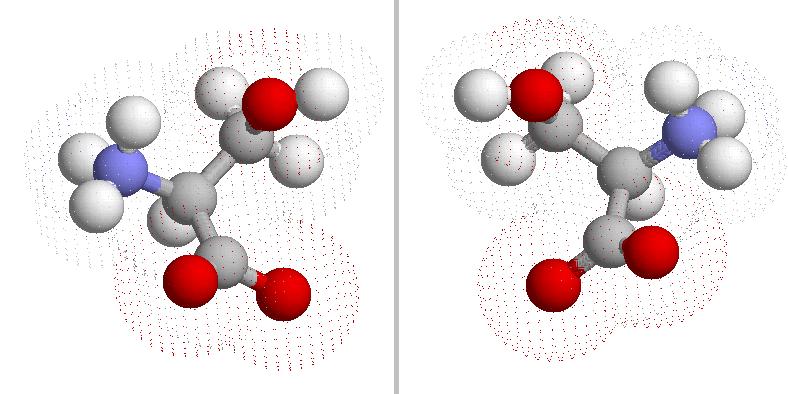 another, but they can't be superimposed upon each other-they have a different 3D
arrangement in space. The molecule on the far right is called R-serine and that
on the left is called S-serine. Even if R-serine were rotated it wouldn't be
possible to superimpose it on S-serine.
another, but they can't be superimposed upon each other-they have a different 3D
arrangement in space. The molecule on the far right is called R-serine and that
on the left is called S-serine. Even if R-serine were rotated it wouldn't be
possible to superimpose it on S-serine.
Any molecule (A) which has a mirror image that can't be superimposed upon(B) it is called chiral, and the molecule(A) and its mirror image which isn't superimposable(B) are called enantiomers or optical isomers.
R-serine has 4 different groups attached to one central centre-the chiral centre, a carbon atom. S-serine has all the same groups as R-serine, but the four groups are arranged differently in space.
R and S nomenclature is a way to distinguish between the two types of enantiomer and specify its exact arrangement. The chiral centre of the molecule is firstly found. Usually the chiral centre in an organic molecule is found by looking for an asymmetric carbon-a carbon which has four different groups attached to it. The groups are then prioritized using the Cahn-Ingold-Prelog rules.
 The first step involves comparing the atomic number of the first atom in a group
that's bonded to the asymmetric carbon. This gives a priority list of:
The first step involves comparing the atomic number of the first atom in a group
that's bonded to the asymmetric carbon. This gives a priority list of:
Amino group (atomic number =7)> Carboxylic group (6), CH2OH group (6) > Hydrogen (1).
Further steps are required in order to prioritize the two equal groups (carboxylic group and the CH2OH group) until a difference is found between these two. The two groups which were prioritized (the amino group and the hydrogen) keep their order and aren’t affected by further steps to prioritize the carboxylic acid and the CH2OH group.
The second step involves finding a difference in the second atom along in the group (the 2nd atom used in the group is the one with the highest atomic number), then third atom and so on until a difference is found. If there is any double bonding then the atomic number for that atom is counted as being double. The carboxylic group has double bonding with oxygen so gets priority. This then gives our priority as:
Amino group>
Carboxylic group> CH2OH Group> Hydrogen.
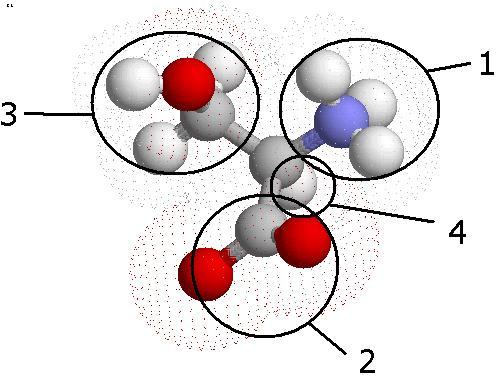
Next draw the 3D molecule with the lowest priority group on the molecule facing away from you, and then labeling the groups in terms of their order. The image on the left shows this, the order goes clockwise from one to two to three. This clockwise arrangement is dubbed R, if it were anticlockwise it would be S.
Diastereomers are chiral molecules with 2 chiral centers, and give rise to 4 different isomers, R R-where both chiral centers have their groups arranged in the R configuration, R S-where one chiral centre is in the R configuration and the other is in the S configuration, S R, and RR.
Word count 499 -ignoring Title, footer, bibliography and aannotations in diagrams.
Bibliography:
Images 1-3 created using ramsol And Microsoft paint.
Chemistry second edition- Cathrine.E. Housecroft and Edwin C. Constable (2002)
Published by Pearson Education Limited
Biology Internation Edition 6th Edition- Campbell and Reece (2002)
Published by Pearson Education Limited.