

|
Lakin Vault |
|
You cant choose your friends... but you can choose your family. |
|
|
|
|
Chemistry of peptide synthesis |
Introduction-Structure of amino acids.
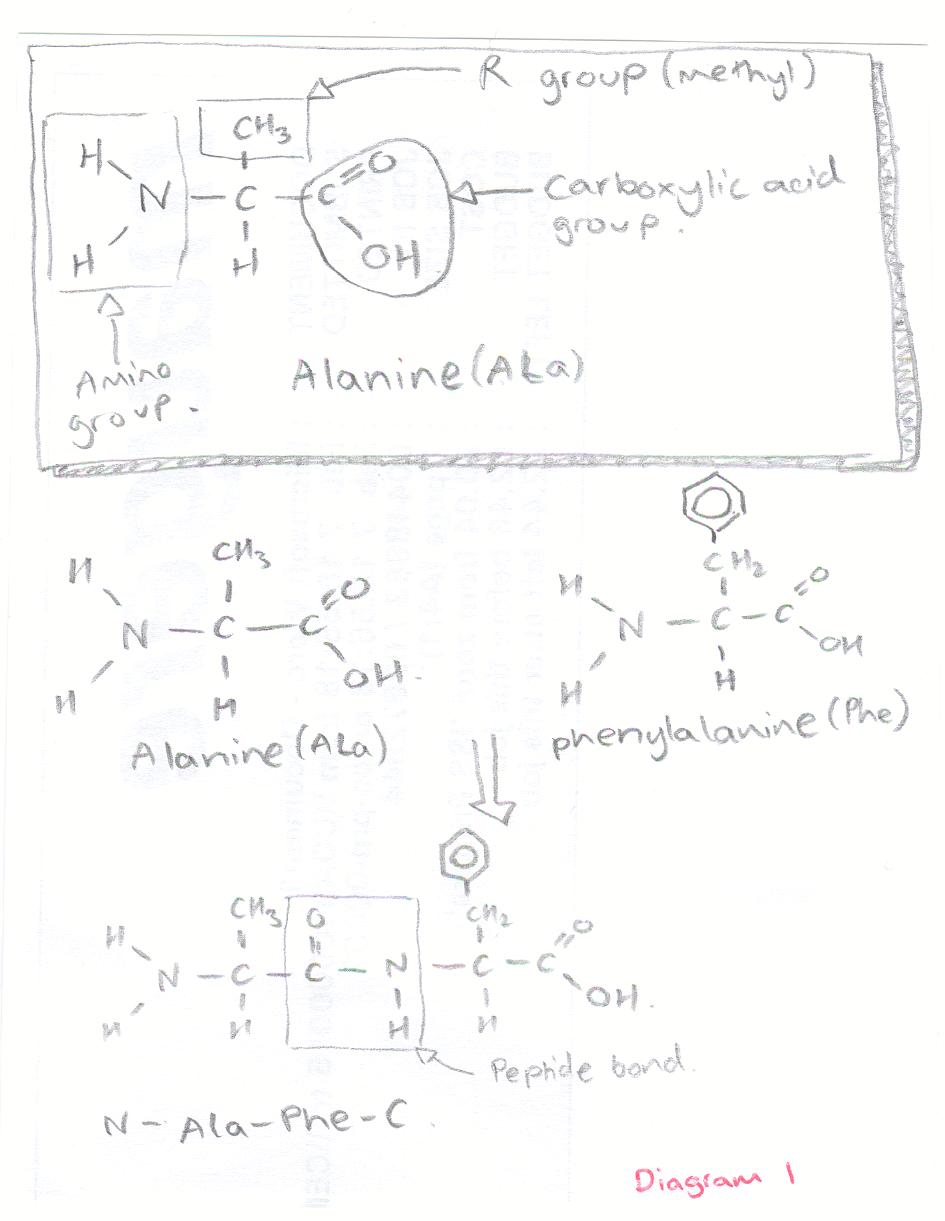
Amino acids share a common structure-a carboxylic acid group, amino group, hydrogen atom, carbon atom and its “R” group (diagram 1 shows alanine). The difference between amino acids is their “R” groups.
Peptides.
 Two
amino acids can be joined together to make a dipeptide- the
carboxylic acid group from one of the amino acid molecule reacts with
the amino group of another amino acid molecule, the bond between the
two is called a peptide bond(diagram 1).
Two
amino acids can be joined together to make a dipeptide- the
carboxylic acid group from one of the amino acid molecule reacts with
the amino group of another amino acid molecule, the bond between the
two is called a peptide bond(diagram 1).
Order is important in peptides.
In diagram 1 alanine's carboxylic acid group reacts with phenylalanine's amino group-but phenyalanine's carboxylic acid group could have reacted with alanine's amino group and had that occurred the dipeptide produced would be different isomerically. The order of a peptide with respect to its N and C terminus (The free amino group in a peptide is called its N-terminus, and the free carboxylic acid group in a peptide is called a C-terminus) can create different isomers. Diagram 1 shows the peptide
“N terminus-Ala-Phe-C terminus”
It’s called this because its order is the free N terminus, then alanine, then phenyalanine’s then the free C-terminus (Amino acids are often abbreviated to a 3 letter code). The N terminus and C terminus can be omitted from the name of the peptide, and it's assumed the N Terminal is on the amino acid named first.
Traditional peptide synthesis.
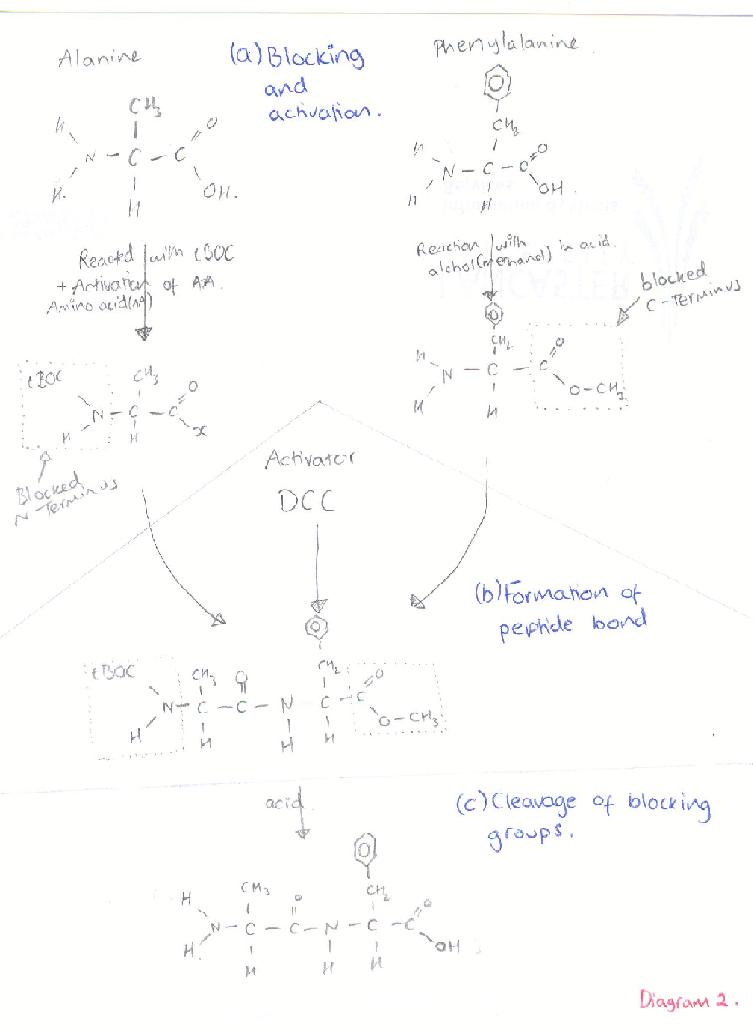
The peptide “Ala-Phe-Leu” will be used as our example of the peptide synthesized. An important thing to remember is that there's 27 ways these 3 amino acids can be arranged (33=27). A special mechanism has been devised to get only one specific peptide (diagram 2)
 Blocking
and activation. If we react alanine with phenyalanine’s
there are four possible dipeptides that could be produced Ala-Ala,
Ala-Phe, Phe-Phe and Phe-Ala. If the N terminus of alanine and the C
terminus of phenylalanine are blocked to prevent these groups
forming a peptide bond, then when the two amino acids react, only
the C terminus on alanine and the N terminus on phenylalanine will
be able to form a peptide bond making Ala-Phe. Blocking of the N
terminus can be achieved by reacting the amino group with tBOC or
CBZ, and the blocking of the C terminus can be achieved by reacting
the carboxylic acid group with an alcohol in acidic conditions to
form an ester. The C terminus on Alanine needs to be activated ready
for the next stage.
Blocking
and activation. If we react alanine with phenyalanine’s
there are four possible dipeptides that could be produced Ala-Ala,
Ala-Phe, Phe-Phe and Phe-Ala. If the N terminus of alanine and the C
terminus of phenylalanine are blocked to prevent these groups
forming a peptide bond, then when the two amino acids react, only
the C terminus on alanine and the N terminus on phenylalanine will
be able to form a peptide bond making Ala-Phe. Blocking of the N
terminus can be achieved by reacting the amino group with tBOC or
CBZ, and the blocking of the C terminus can be achieved by reacting
the carboxylic acid group with an alcohol in acidic conditions to
form an ester. The C terminus on Alanine needs to be activated ready
for the next stage.
The two amino acids with their respectively unblocked sites react (with the aid of DCC) to form a dipeptide with blocked sites on either end of the dipeptide.
The blocked ends are removed. An acid removes tBOC from the N terminus and catalyses the ester hydrolysis to produce the carboxylic acid.
Continuing on from this it gets more time consuming. In our solution we have our dipeptide “Ala-Phe”. The dipeptide has to be purified to remove impurities (for example by ion exchange chromatography).
Once our purified dipeptide is produced the same reaction route is used, its N terminus is blocked and reacted with leucine with its C terminus blocked to produce the tripeptide with a blocked N terminus and blocked C terminus. The blocking groups are removed and the tripeptide purified.
This traditional method works, but it gives a tiny yield as lots of the product is lost in purification and it takes ages due to the purification step.
The Merrifield teqnique.
1. An N terminal blocked amino acid is reacted with the insoluble resin chloromethyl-polystyrene; this creates a covalent bond between the C terminus end of the amino acid and the resin.
2. The Blocking agent on the n terminus is removed.
3. Excess unreacted amino acids and other compounds are simply washed off the resin. This leaves the amino acid joined onto the insoluble resin behind.
Further amino acids are added in the same manner to create a specific peptide.
The peptide can be released from the insoluble resin by reacting it with sodium hydroxide. Then the peptide can be purified.
This technique is easier because the wastefull purification step between adding amino acids is eliminated-it’s easy to remove excess unwanted amino acids and other unwanted products by simply washing them off. The peptide stays behind and higher yields are obtained.
Word count=712 excluding title, words in drawings and the word count
Summary
There are many different amino acids (a monomer), which can be reacted together to produce a peptide (a polymer). The variety that is present in peptides is because a peptide can be made up of different amino acids and there are different orders the amino acids can be arranged in (many isomers are possible). Techniques in chemistry have been developed to synthesize a specific peptide that is pure which involve controlling how amino acids react together. This is done by blocking one amino acids amino group and blocking another amino acids carboxylic acid group.
Word count of summary= 95
Bibliography;
Catherine E.Housecroft and Edwin C. Constable (2002). Chemistry 2nd edition. Pearson Education limited. P1069-1071
Michael Freemantle (1987). Chemistry in action. Macmillian education Ltd. P805-812
Dr Bob Lauder (2004). Lecture notes on peptide synthesis. Chem 103
Website-Peptides on demand. Chemical and engineering news (2003)
[site home adress http://pubs.acs.org/cen.index.html] Acessed on 20th feb 05.
Website-Biopeptide (1999-2005)
[Site adress http://www.biopeptide.com/index.html] Site acessed on 20th Feb 05
Images hand dawn and scanned in by author.