

| Lakin Vault |
| You cant choose your friends... but you can choose your family. |
|
|
|
| Cloning-(2003-16years old) |
Cloning is now a hot and highly controversial issue, which is often blown out of proportion. What is cloning and how does it work?
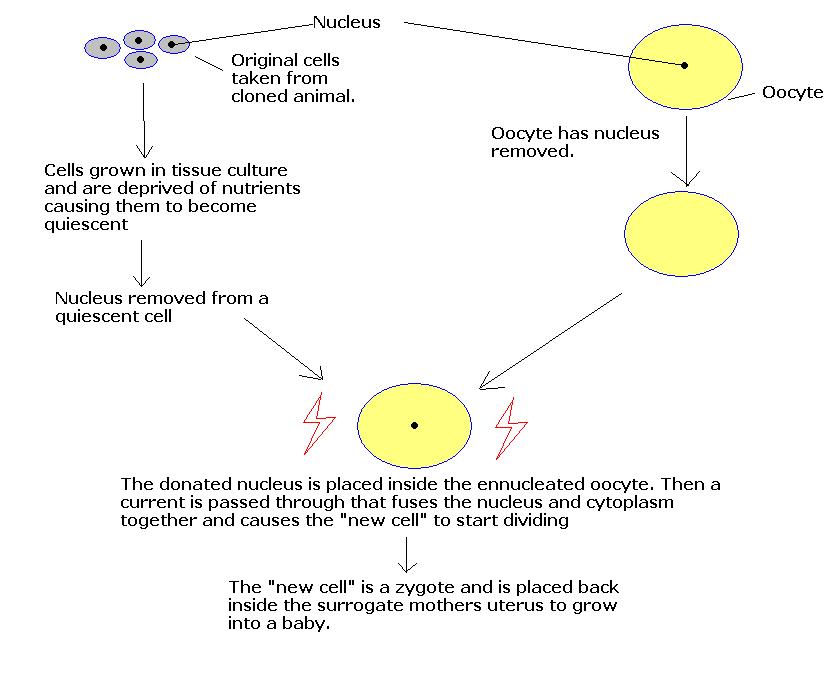
The aim of cloning is to produce a being that is genetically identical to another organism. At the moment it involves inserting the genetic material (DNA) from a cell (the donor cell), into an oocyte (ovum) that’s had it’s genetic material removed. This should then lead to the “new cell” having the genetic material of the DNA donor, and as the cell divides inside the uterus of the surrogate mother it produces a baby that is genetically identical to the donor (a clone).
An oocyte is an ovum, which only contains a haploid number of chromosomes (chromosomes are made up of DNA). It can’t grow into an organism, since it can’t form a zygote by itself with only half the number of required chromosomes. Normally this oocyte would become fertilised by a sperm cell, and the genetic material of the two gametes would fuse to produce a zygote that has half of its genetic material from either parent. The two sets of genetic information give the cell a full set of chromosomes to form a zygote.
The genetic material in an oocyte is found in its nucleus, so removing its nucleus removes the genetic material from the oocyte. If you take an organism’s nucleus (that would contain a full set of chromosomes), and insert it into the ennucleated (has no nucleus) oocyte, the “new cell” has a full set of genetic material (from the donated nucleus). This zygote can grow inside the surrogate mother’s uterus to become a cloned baby. This process is called nuclear transfer, and the way it’s performed varies.
The process made by Dr Campbell involves many stages. Firstly cells taken from the animal to be cloned was grown in a tissue culture. These cells were then starved of nutrients; this made the cells quiescent, which is where the cells would be in this long stage of not going through the cycle of mitosis. Some quiescent cells can stay in this stage all their life, however some of these quiescent cells do get out of this stage and divide (For example, when a young girl starts to develop breasts). It was thought that for cloning to work, the DNA might need time to rest and get its DNA in order, as the DNA is in a quiescent cell.
Once the cells had become quiescent a cell was taken, it had its nucleus removed using very delicate needles and a microscope. This nucleus was then injected into an oocyte that had had its nucleus removed (using the same process). The “new cell” then had an electric current passed through it (electrophoresis), this done two things. Firstly it bonded the cytoplasm of oocyte with the nucleus. Secondly it made the cell active and caused it to re-enter the cell cycle (mitosis). This “new cell” was then inserted into an ovary from the cloned animal’s species. This process had to be repeated 276 before it became a success and dolly was made (www.synapses.com 2003).
There a many arguable possible benefits that cloning could bring. Firstly using clones in an experiment would allow you to rule out some extraneous variables, allowing you to investigate the role of genetics with more reliable results (http://cloning.tripod.com/ 2003)
Secondly cloning could be used to enhance a species. An example is that some animals are worth tens of thousands of pounds, making clones of that animal could make a lot of money. Although cloning an animal currently costs about £30 000, it will probably become cheaper in time.
Thirdly cloning could be used to increase the population of an endangered species. Rare animals don’t reproduce much when in captivity; using cloning could be an alternate way for this species to reproduce more often (www.bbc.co.uk/science 2003+ Sylvia pagan Westphal 2002)
While cloning has some advantages to it, it also has many disadvantages. I personally believe that cloning is always wrong, and that the disadvantages of cloning, always outweigh the advantages of cloning. One of the current largest disadvantages of cloning is that it has a 97% failure rate, and many of the animals produced by it have defects (like disabilities)(www.bbc.co.uk/science 2003). While an abortion may be right, this isn’t. Although I believe this technology shouldn’t be used, I certainly know it shouldn’t currently be used if it leads to many defects and deaths. Only when it has a tiny failure rate and the risk of disability is minute can this technology possibly be used.
Although cloning could be used to rule out many extraneous variables in research, identical twins could be used instead. Although only animals are being used, being raised just for research has ethical problems.
While cloning may produce a genetically identical animal, it doesn’t produce an animal that has had the same nurture. So using cloning doesn’t make a clone that’s identical to the original. Using cloning to produce good animals, may turn out to be pointless therefore, if the factor which caused the animals greatness was caused by it’s nurture.
Also if a cloning was used in farming to produce a good livestock, it’s very likely there will be a public fear of a clone’s produce, such as milk. There may be no evidence to show that the food made is dangerous, but people may still boycott all produce made by clones. This has happened with genetically engineered crops, so it will probably happen here too.
Using Cloning as a means to increase the population of animal will lead to failure for two reasons. Firstly cloning would reduce the genetic diversity, and with out that, the animal would do poorly at adapting to a new environment or microbe. Secondly as it would lead to little (if any) genetic diversity, the animals wouldn’t be able to reproduce naturally since they would all be brothers and sisters, and their genes would be too similar to mate (http://cloning.tripod.com/ 2003).