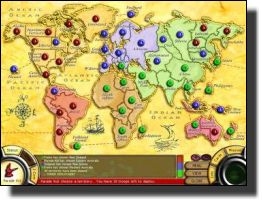
| Nagoya Vision from 2 Chronicles 14 (received, summer 2003) King Asa was a good king. It says he "did right in the sight of the Lord his God," which means that he was a man of integrity, he lived knowing God's presence. Because he had personal integrity, he was able to do the difficult things, like tear down idols. Now to a western mind, this may not seem like such a big deal, but let me tell you, living in Japan, you try kicking over your neighbor's little idol in his yard and you're going to be in BIG trouble. Now try to do that for your whole kingdom! Definitely not as easy as it seems. Once the idolatry was cleaned up, Asa helped his people to have the same kind of reverence for God. He wanted them to do two things, 1) Seek after God and 2) Obey His commandments. It�s only after doing an inner heart check that he started to take care of the outside. In verse 6 it says, "He built fortified cities in Judah..." He believed that God was blessing him with peace because he cleansed the area of idols and was setting people's hearts straight. So he began a building program. 14:7 So Asa told Judah, "Let's build these cities and make walls around them with towers and doors that can be barred. The country is still ours because we have dedicated our lives to serving the LORD our God. We have dedicated our lives to him, and he has surrounded us with peace." So they built the cities, and everything went well. He also built an army of 300,000 from Judah and from Benjamin 280,000 archers. Asa seemed to do everything well: - Modeled genuine faith - Cleaned house spiritually - Aligned people with God and His commandments - Built and fortified - Armed and was ready to defend This is how the Lord has led the Nagoya ministry. From the beginning, we had the vision to create a movement of multiplying disciples in a local area. That area become Nanzan, Meidai, and Chukyo universities. But at first, it was very tough going. Well, no one can remember exactly when it happened, but it did. By the end of the '90's we were seeing students receiving Christ at a dramatically higher rate, we were training them to do what we staff were doing and they began to do it! Leading their friends to Christ, following up, even discipling. We challenged them to lead and they did. They led teams in country and for international missions. Some joined staff; others church staff. Those who did not go into full-time work kept their faith and many have become church leaders. Like king Asa, we used the time of peace that God gave us to build. We built and we gained strength. While in prayer in Colorado this summer though, God said something that was very surprising to me. He said, "You are complacent." He said that I was satisfied and proud of our fortified Nagoya ministry and I was not acting with faith. He said that I was complacent?! To which I argued, "I don't have enough manpower to go anywhere else!" But then God won the argument very simply with, "This is MY vision, not yours. Go in faith." It took me a few weeks to work through that. My paradigm has been, 'Look at your resources and then make decisions.' But God turned that on its head. As I wrested with this concept (definitely not a new one, but one I obviously hadn't fully learned) God helped me and encouraged me until I was willing to say, "Yes, I will follow your vision." Verse 9-10 speaks of this similarly. Here comes the bad guy Zerah from Ethiopia with a 1 million man army and 300 chariots. The chariots would be today's equivalent of M1 tanks. And Asa had none of those; Asa's strategy was defensive so he did not need chariots. Thus Asa was trumped technologically and was outnumbered 2:1. Now here's the question. What would you do in this situation? For me the answer was simple: "A million man army plus chariots? No biggie. We have God and God gave us all the provisions we needed to build this fort. What are chariots to barricaded gates and stone walls? We lock the gates, barricade ourselves inside, and put our big hairy soldiers on the wall. They shoot arrows and chuck spears at the bad guys down below and while they are doing that, I chose someone to plan and prepare the big victory feast after we win." End of story. That is, until we read the next verse: 14:10 Asa went to confront him, and the two armies set up their battle lines in the Zephathah Valley at Mareshah. Huh?! What kind of idiot would do that?! He just threw away his entire strategy and military advantage! They walked out of their walled fort and went into a valley where the army would eat them for lunch and the chariots would finish them off for dessert. Why?!!! As I thought about it, there was only one reasonable reason. God must have told Asa to go out. I think we can discern this in his prayer which follows: 14:11 Asa called on the LORD his God. He said, "LORD, there is no one except you who can help those who are not strong so that they can fight against a large army. Help us, LORD our God, because we are depending on you. In your name we go against this large crowd. You are the LORD our God. Don't let anyone successfully oppose you." Asa pleads for help. He knows that he has no chance what so ever. It is a suicide mission unless the Lord intervenes. Asa knows this, so all he can do is plead to his God and obey in faith. In human terms this was indeed a suicide mission, but verse 12 tells how God dealt with the situation, "So the Lord routed the Ethiopians before Asa and before Judah, and the Ethiopians fled." Our Zephathah Valley Reach 47 universities in Aichi prefecture and effectively help reach an area of over 2 million people with just a handful of staff. Some Broad Strokes of God's Vision - Jody and his staff need to get more serious about sacrificing their best time to the Lord in order to have strength to carry out God's commands (2 Chronicles 16:9). It starts with the heart. - Nagoya is a city of 2.2 million. In the Aichi prefecture (which Nagoya is part of), there are 44 four-year universities with about 170,000 students. God is calling us to go out and reach them with the gospel. A few of my staff have gotten the same vision individually, so we seem to be on the right track. We have shared excitement to go out. - The Osaka ministry of Japan CCC has been doing well in gathering non-Christians, but it was only this year that they saw decisions--an unprecedented 9 decisions! But these don't have Japanese student models to help them. The Osaka team is made up of all foreign staff and Japanese falsely believe that "foreigners are Christian." God has given the idea for us to partner with Osaka CCC in order to bring our Nagoya Christian students (not foreigners, but peers) to mix with their new believers and seekers for encouragement and as real models of faith. As we help Osaka, God said, this will help our people move out with more faith. (The Nagoya ministry has grown weak in evangelism). The ball is rolling on this one. The Osaka staff are fully behind this and we are in the implementation phase. - God is calling us to pray for area high school students. Specifically, to be able to reach the ones who will enter our main campuses. No plans yet, just prayer. - God is telling me to enter into the Nagoya Christian businessmen�s fellowship to encourage and support them. He says that something will happen if I do. He hasn't told me what that something is yet. Just praying. - He asked me to pray for the local government to seek a way to influence it. That's all I know. This one is totally out of my league. - God has made it clear that we cannot do this on our own. We need outside help, inside help, and partnerships through networking. 2 Chronicles 14 expresses our situation quite well. Although what we have built in Nagoya is good, it is not enough to just build and hold. We need to move out by faith. We are low on resources, but this makes us rely on God the Provider. We need to be directed by faith in His vision and not by our tangible resources. But as we seek to move out, we must never forget that the reason we CAN move out is because God allowed us to build. So we cannot allow our present movement to grow weak. We need to keep building and move out simultaneously. Each is important. It's like the board game, RISK. In RISK, the goal is always world conquest, but at first you attack only neighboring countries in order to build your armies. This initial building process is very important because without a well-built army, you cannot hope to conquer in a big way. Three RISK Strategies: 1) Immediately attack everything in sight--without building. Lots of excitement at first, but this player will get so spread thin as to become an easy target for everyone else on the board. 2) Focus only on building in order to withstand all attacks. This player may last long, but he will eventually die from being attacked in battles of attrition. 3) First attack in order to build. Then build in order to attack. Attack strategically and not haphazardly. Build well, but take the risk at crucial times because the chance may not come again. God is right. We have been content to just build. And as a result, we have lost momentum and our movement has grown lax and inward focused. Our students are not as sharp as they once were. It's a crucial time that requires us to roll the dice of faith and take a risk. This is not my plan or my way (my way would be to re-build without going out), but God's way. In reality, God holds our dice, so as long as we follow with faith, we will see Him route the enemy. Another thing God taught me this summer is that my need to see closure hinders me from starting things that I don't think I can finish. But God told me that I may not be around to see this vision's end. In other words, Don't worry about finishing it, just go with faith and let God finish it, because He is the author of it in the first place. Pray for us as we move out in faith. Written, December 2003 Home |
 |