 |
| Finally, we arrive at the highlight of our trip-the much awaited Panama Canal!! The Canal was opened in 1914, as an engineering wonder. And I can see why-it was absolutely amazing and fascinating that the locks still work for the huge ships of today. |
| Our ship sailed into the Panama waters about 6:00 am. The Panama pilot, who helps guide the ship into the locks, boarded the ship soon after. A Panama ranger also boarded, who narrated the process the whole day as we completed our crossing. We went up to the front of the 12th deck about 5:15 am to get a good view. Us and everyone else on the ship! The people were about 12 deep from all the edges. We sailed under the Bridge of the Americas, which officially separates North America from South America. At this point, it was so crowded Terry suggested we go to the back of the ship to see if it was less crowded. There was nobody there, so we ended up on the 7th floor at the back.We were about 2 floors above water level, so we had the best view in the house! |
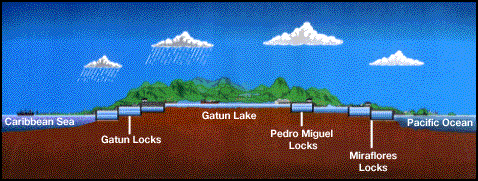
| For those of you who are unfamiliar with how the canal works, here it is in a nut shell. The Canal connects the Pacific Ocean with the Caribbean Sea at the narrowest points of land in Panama. The 3 sets of locks, with 2 lanes each, serve as water lifts elevating the ships 85 feet above sea level, to Gatun Lake. Here the ships are able to cross the Continental Divide, and then enter the last set of 3 locks to lower the ships backdown to sea level at the other side. During lockages, the huge steel gates seal the chambers allowing gravity to drain the water from the higher body of water to the lower. Each ship crossing uses 55 million gallons of fresh lake water that ultimately flushes into the sea!! |
|
 |
 |
 |
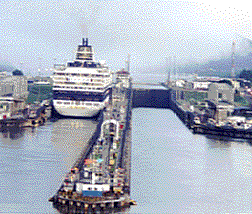 |
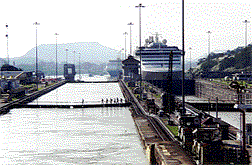
| We enter the right lane, the Celebrity Ship is on the left, just ahead of us. |
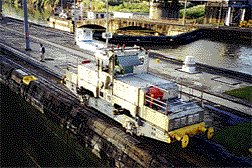
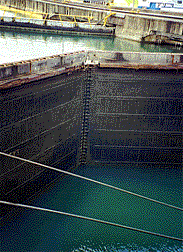
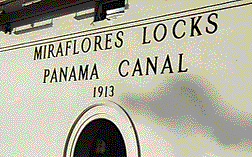
| We entered the first set of locks, the Miraflores Locks that consisted of 3 lock chambers. The ship barely fit in the locks with only about a foot of space on each side. As we entered the first chamber, locomotives, or mules, ran along each side of the ship and attached their cables on the back. There were also two attached to the front of the ship. The mules stabilized the ship, keeping it from moving side to side and from scraping the lock walls. After completely entering the first chamber, the doors closed behind us and we started rising. When the water became level with the water in front of us, the front doors opened, we entered that chamber, the back doors closed behind us and we lifted again. We repeated this one more time through the third lock, and then entered Gatun Lake, in the center of Panama. The locks lasted about 11/2 hours. There was a Celebrity cruise ship in front of us in the next lane. And there were 3 other cruise ships behind us-one being the Sea Princess, the ship we sailed to Alaska last year. |
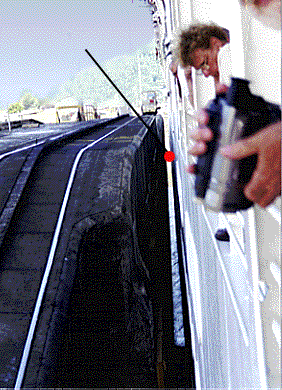
| The ranger explained that cruise ships have first priority crossings in the mornings, so they can keep their schedules. The fare for our ship to cross was $177,000. The smallest fairs ever paid for crossing were 36 cents for a man who swam the canal and 75 cents for a toy sized remote control boat! The picture at the right shows how close we came to the wall at one point. The red dot indicates the amount of space between the wall and the side of the ship. Right after this was taken we did scrape, taking out a huge area of paint. In our next port, the painters we out there fixing the eyesore!! |
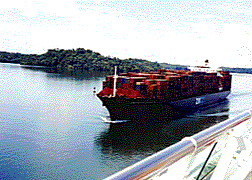
| We sailed 3 1/2 hours across Gatun Lake passing other cargo container ships going the other direction. As we approached to the final set of Gatun Locks, all the cargo ships were anchored in the lake, waiting for the cruise ships to finish their crossings first. |
| Then we entered the 3 chambers that lowered us 85 feet back down to sea level again. Our total crossing time was about 6 hours. Then, we were on our way again-out into the Caribbean! |
 |
 |
| Mule train |
| The Sea Princess behind us. |
| The gates close and lock the chamber behind us. |
 |
 |
 |
 |
| Really close!! |
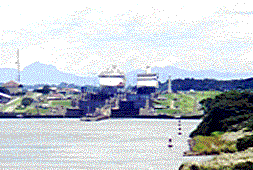
| This is the view looking back after we left the canal. This is an excellent photo showing the two cruise ships behind us as they make their descent back to sea level. |
| Next stop, Cartegena Columbia |
 |