 |
 |
 |
 |
3 Zone
refining techniques for growing single crystals of refractory materials.
In recent years, much interest has been shown in transition metal compounds as they represent a potentially important class of materials for high temperature structural applications .The cubic transition metal carbides, in particular, have the highest melting points (2600-4000 degree Celsius), high temperature strength and good thermal and electrical conductivities. However, they are inherently brittle at room temperatures and susceptible to thermal shock. Much of the earlier work on mechanical properties of these carbides was unreliable due to the use of sintered material of poor quality. Thus, in order to obtain both meaningful and reproducible experimental data
On the mechanical properties and deformation mechanism of these materials, there was a need for well characterized, both in terms of purity and stoichiometry, single crystals. Now, crystals of a reasonable size (>5mm) are not readily available commercially. Moreover even though a few workers have prepared single crystals, Hollox (1968) has pointed out that little information on the deformation characteristics and strengths of single crystals of most cubic carbides is available. The exception is tantalum carbide, crystals of, which have not been grown over a range of compositions within a single-phase field.
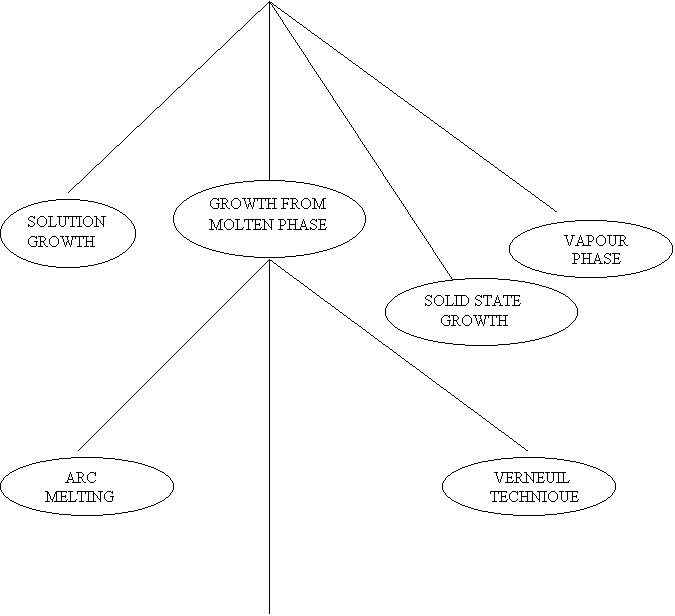
A number of techniques have been used to produce transition metal carbide crystals and they can be sub-divided into four general classes described by the method of growth-i.e. from solution , vapour phase, solid state and by solidification from a molten state. All these methods have both advantages and disadvantages when applied to growth of carbides.
Schematic
diagram of different techniques for production of transition metal carbides
3.2 Solution growth
This
is the growth of crystals from a solution either by normal nucleation or by the
use of a seed crystal. The main problem is in finding a suitable solvent
Ø
In which
the carbide is soluble
Ø
Where the
solubility varies with temperature
Ø
Of
reasonably low melting point
Ø
Which
does not react with either carbide or crucible to form compounds.
Ø
Has a
favourable partition co efficient.
The
advantage of such a technique is that crystal growth occurs at temperatures well
below the melting point of the crystal. Crystallisation is brought about by
either allowing the solvent to evaporate or on cooling the solution. However,
volatilisation of the solvent must be slow, otherwise spurious nucleation will
occur. Crystal quality, in terms of substructure and dislocation density is
usually good.
Bartlett
and Halden (1967) produced crystals of tantalum carbide by this method
but the crystal size did not exceed 0.2 mm. This was due to the low solubility
of TaC in the liquid metal solutions used (i.e. iron, nickel, aluminium,
platinum) and an inability to control spontaneous nucleation of the fine
crystals. These disperse with the convection current set up in the solvent and
prevent large crystal growth. Recently Rowcliffe
& Warren (1970) have also extracted small crystals of TaC from the iron
matrix. However, the maximum crystal size was found to be 02.mm.
3.3
Vapour phase growth
The
vapour phase growth of carbides by theVan
Arkel (1923) and similar processes has been used for many years to produce
high purity materials. The technique consists of the decomposition of a metal
halide by its reaction with hydrogen and a hydrocarbon. The resultant carbide is
then allowed to deposit on a hot surface. Again, the advantage of this technique
is crystal growth at temperature well below the melting points of the carbides.
Crystals produced in this manner are dense and of high purity. However, the
method has the disadvantages of low growth rates, small material yields and
difficulties in preventing random crystal nucleation. Thus, this method too is
not suitable for growth of large crystals of the transition metal carbides.
3.4 Solid-state growth
Two
methods exist for growing large grains or single crystal in the solid state from
polycrystalline material. Prolonged heat treatment causes normal or continuous
grain growth by grain coalescence. However, the method is slow and grain growth
only occurs to a limited extent. Nevertheless, the growth of one or two grains
at the expense of other grains can be produced under particular conditions. The
use of a controlled amount of plastic strain followed by heat treatment
encourages the growth of a few large grains. However, the amount of plastic
strain required is critical. If the strain is less that the critical value, then
no recrystallisation occurs on subsequent annealing. If the strain is too large
several grains will result. This strain anneal method was first used by
Carpenter & Elam (1921) to produce large single crystals of aluminium. The
starting material must be strain free uniform and of fine grain size in order to
obtain uniform deformation during straining. This reduces the chance nucleation
of several crystals. Growth of large grains is also encouraged by dispersed
second phase particles (Gilman 1966). Gilman
(1966) also suggested that if the original grains of the polycrystalline
materials, prior to the critical strain were randomly oriented then the
orientation of the resulting crystal would also be random. However the resultant
crystals may have more restricted orientations if a strong preferred orientation
is present.
Fleischer
and Tobin (1968,1971) have used the strain annealing method to produce
relatively large grains of transition metal carbides. They first prepared fully
dense specimens by direct reaction of the elements at high temperatures. The
resultant carbon composition gradient was removed by extended annealing at even
higher temperatures. (2500-3000 degree Celsius) The polycrystalline rods were
then axially compressed to a critical strain (2-5 %) at high temperatures
(2100-2500 degree Celsius) which refined the grain size of the material.
Subsequent isothermal annealing at higher temperatures caused growth of very
large grains. This recrystallisation occurs by means of grain boundary movements
under the influence of strain energy absorbed.
Crystals
grown by this method are usually homogeneous, strain free and of high quality,
with little internal substructure. However the method has not lent itself yet to
the growth of crystals of particular orientation.
To
produce large crystals by the strain annealing technique the materials has to be
prepared in a fully dense condition. Major disadvantage of this method are the
complexity of the process and therefore associated problems of control and the
long annealing time at very high temperatures.
3.5 Growth from the molten phase
Crystalline
specimens of the carbides are more usually produced by solidification from the
melt. This technique offers the greatest potential for producing large single
crystals at reasonable growth rates. Ideally, in all modifications of this
general technique, the melt is maintained slightly above the melting point,
while the crystallising solid is held just below the melting temperature. Once
growth is completed the crystals is cooled to room temperature minimising
thermal gradients through the crystal in order to minimise residual stress. The
main obstacle to growth from the melt carbides is attainment of the high
temperatures required and their instability at the melting point.
A
number of methods are available for crystal growth, which are dependent on the
different methods of heating. These include arc melting, a modified arc Verncuil
flame fusion technique, electron beam and radio frequency induction zone
melting. Each method has advantages for certain materials but each also has
certain operating restrictions.
3.5.1
ARC MELTING
Since
are discharge are capable of generating very high temperatures, the arc melting
method has been used to produce carbide crystals. Arc melting by direct
discharge of an electric arc to the growing crystal boule is possible as the
carbides have metallic conductivities. A variety of controlled atmospheres can
be used as the specimen environment in this method in order to suppress
vaporisation of the component from the sample. However it is difficult to
maintain the specimen temperature and crystal refinement is not possible. The
latter facility is important as dissolved impurities can markedly affect the
physical properties.
Crystals
grown by the arc melting contain high defect concentrations and large crystal
growth is hindered by spontaneous nucleation.
3.5.2 Verneuil technique
In
Verneuil’s crystal growth technique
powdered material is fed from the hopper through a heat source and falls on to a
growing crystal surface in the molten state. As growth proceeds, the crystal is
slowly withdrawn .An Oxy-Hydrogen gas flame is normally used to heat the powder
but is not capable to produce the temperature required for melting carbides.
However other heat sources have been developed to provide higher temperatures
and improve crystal quality. A major virtue of this process is that no crucible
is required which eliminates contamination from the source. This method has been
used industrially to prepare a wide variety of high melting point compounds.
Bartlett
& Halden
(1967) used induction-coupled plasma to achieve high temperature crystal growth
of TaC under closely controlled conditions. The substitution of a plasma torch
for the conventional burner also avoids the possible contamination problems that
might arise from combustion products. Temperatures in excess of 3500 degree
Celsius, in gaseous environment from 10mm.Hg. to 1 atmosphere, were obtained
with this apparatus. This method suffers from poor temperature control, high
temperature gradients and lack of crystal refinement. The crystals produced are
highly strained have variations in chemical stoichiometry and high
concentrations of defects.
3.5.3 Zone refining
Zone melting was developed in the early 1950”s (Pfann 1952). It has been extensively used to produce high quality crystals of semiconductors and high melting point metals and alloys .The method involves the formation of a molten zone in a solid and its subsequent slow movement through the solid by either moving the specimen itself or the heater. Successive zone passes leads to purification of the material (Pfann 1966), which should decrease the tendency for nucleation of a number of crystals. The eventual result of such a process should be a single crystal.
However, single crystal growth is not always concomitant with zone refining. A number of heating methods are available but most frequently either radio frequency (r.f) induction or electron beam heating is used. The transition metal carbides, which have metallic conductivities, readily lend them selves to these techniques, and heat can be generated directly in the material.
In electron beam melting (Calverly et al.1957, Mellors and Senderoff 1966)
A high voltage electron beam bombards the specimen. The electrons are focussed on a narrow zone of the specimen and dissipate their kinetic energy by heating this zone. Temperature of over 3000 degree Celsius can be attained in vacuums as high as 10-6 mm. Hg by this method. Some advantages of the method includes
§ Crystals of required orientation can be obtained by seeding.
However the method is restricted to pressure of 10-3 mm. Hg. and less, which prevents its use for growing crystals of compounds that have appreciable vapour pressure at their melting points. Unfortunately, a number of carbides (Halden and Eding 1965) have high vapour pressures at their melting temperatures and considerable material can be lost by evaporation. This usually occurs with preferential loss of one component and composition changes may result. Several carbides, such as TiC are homogenous over a wide range of composition and single-phase specimen is obtained. Others have narrower composition ranges and two-phase specimens are produced. Thus conditions such as vacuum, and also local overheating, aggravate material loss. The difficulties associated with the method centre on its lack of flexibility. The vacuum environment is a necessary feature of the method and so vaporisation cannot be suppressed or prevented.
Zone melting can be carried out either horizontally or vertically. Brookes and Packer (1968) used the cold crucible technique, developed by Sterling and Warren (1963), to prepare fully dense but polycrystalline samples of the refractory carbides and borides. In this technique, the specimen is melted within a shallow depression in a horizontal, water-cooled tube or boat by r.f induction. Opposing eddy currents are induced in the boat and the specimen, so that the melt is slightly levitated above boat surface. Provided the cooling is adequate, this prevents melting of the boat and contamination of the specimen. Specimens were produced with grain size up to 5 mm. Production of larger crystals by this technique seems improbable because containment within the water cooled boat gives rise to thermal gradient.But, this problem can be overcomed by vertical or float zone melting. The concept of this process involves the establishment and movement of a narrow molten zone up or down a vertical specimen rod. The melt is supported by the surface tension of the liquid between the upper and lower parts of the rod. The density, melting point and thermal conductivity of the material, as well as its surface tension, all influence the stability of the zone, as does both the zone length and the radius of the specimen.
An advantage of the method that the major source of contamination i.e. crucible is eliminated, as the molten zone is passed along the rod without contact with such a container. The method can be used either under vacuum or at high pressure in an inert atmosphere. Other attractive features of the technique are that the specimen can be refined and also heated and cooled at accurately controlled rates, either slowly or rapidly.
Precht and Hollox (1968) and Haggerty et al. (1968) have described radio frequency float zone melting of the carbides. Non-stoichiometry is common to the carbides and their phase diagrams are characterised by single-phase fields with wide homogeneity ranges, e.g. VC0.72 to VC0.90 (Adelsberg and Cadoff 1968). The degree of non-stoichiometry profoundly affects many of the properties of these materials (Hollox 1968). For this reason, Precht and Hollox (1968) prepared vanadium carbide crystals of varying carbon to metal ratio. When the initial composition of the carbide was close to the melting point maximum of the phase, congruent melting with little variation in composition was observed. However, when the initial composition was higher or lower than this value, longitudinal variations in the carbon to metal ratio ensue.
Such variations in composition are expected from considerations of the phase diagrams and the principles of zone refining. Precht and Hollox (1968) found that a zone levelling technique could remove these composition gradients. Subsequently large crystals were produced with a low density of dislocations, which were mainly confined to subgrain boundaries. Precht and Hollox (1968) also applied this technique to the growth of alloyed carbides.
Haggerty et al. (1968) grew crystals of both the transition metal carbides and borides. During their work, they investigated the effect of gas pressure on the volatilisation rate of a component from the molten zone. They found that the vaporisation rate of boron from zirconium diboride decreases linearly with 1/ P1/2, where P is the gas pressure thus; they grew all new crystals under an argon atmosphere at a pressure of 20 atmospheres. Large crystals were produced, free of cracks and secondary phases. The crystals contained few sub-grain boundaries although porosity, in the region of 1 volume percent, was evident.
More recently, Billingham et al (1972) and Packer and Murray (1972) have also used the floating zone technique to prepare large, high purity crystals under positive pressure of inert gas. Packer and Murray (1972) made use of an eddy current concentration to restrict the length of the molten zone.
Ø Vaporisation losses can be overcomed by pressurisation with an inert gas.
Ø Stiochiometry variations can be removed by zone levelling or used to provide more data on the effects of stoichiometry on mechanical properties.
Ø Impurities can be removed by zone refining.
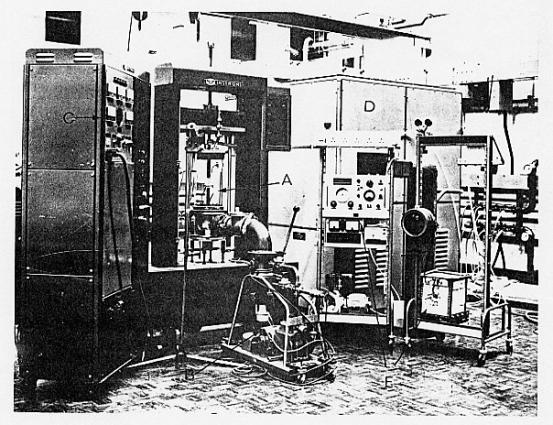 |
Fig 5
(Original
crystal growth apparatus showing pyrex chamber (A) mounted in a Instron frame,
vacuum system (B), Instron crosshead drive and r.f console(C), r.f generator (D)
and inert gas purification system (E))