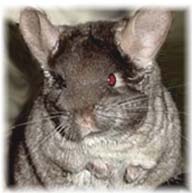
Giardiasis: Symptoms can be different for each chin and can appear slowly or in rapid succession. The following symptoms were seen by me in the order listed. I have them listed by the day, but keep in mind that the 5 day time-frame can be compacted into a much smaller time-frame as little as 36 to 72 hours.
These are the symptoms:
Day 1 ~ slight cut back on amount of food eaten and slightly back on water consumption (about 25% each) ~ mild diarrhea, with the feces being rounder, softer, more moist than normal and covered with a rather shiny mucous. This is a situation sometimes seen with chinchillas, without alarm to us because the mucous disappears quickly.
Day 2 ~ eats only about 1/2 of it's food and 1/2 to 2/3 normal amount of water ~ mild diarrhea, again the same as before. We may think he/she is only being picky and will do better tomorrow. If 2 or more chins are housed together it is hard to know which one is not eating or drinking.
Day 3 ~ will only eat oats or soft food, no regular hard pellets and 1/2 normal amount of water or less ~ mild diarrhea as before, but less of it. You may think it is getting better and not to worry because the diarrhea is almost gone and surely he/she will perk up tomorrow.
Day 4 ~ Chins will not eat food, not even treats and is down to 1/4 normal amount of water consumption. The chins seem to be more irritable than normal. The diarrhea is replaced by feces that appear to have some partially undigested food in them (usually green or brown, not the normal black), is firmer, smaller,little moisture and less than the normal amount in number. Eyes not wide open as they usually are and are dull in appearance. By now it is obvious that she is not feeling well. She appears listless, quiet, showing signs of dehydration (spine is more obvious)and loss of weight, withdrawn to a corner or a hut and not come to the front of the cage to meet you as they normally would. Finally you realize there is really something wrong, but it is almost to late now, or it may already be to late.
Day 5 ~Chin will not eat or drink ~ no feces seen (or very few small hard ones) ~ completely listless ~ very weak can not, or barely can, stand on it's own ~ as it progresses ~ loss of control of head ~ chin found laying at the front of the cage underneath water bottle, as if to draw your attention to it ~ slight twitching or tremors can be seen ~ almost completely dehydrated ~ labored breathing ~ gulping for air, followed by death within minutes, but sometimes up to several hours.
Please note: These are listed by the days, but the full five days can be compacted into 36 to 72 hours in some instances, but the symptoms with my little ones seemed pretty much the same and came in the same order, but faster in some than in others. I have read where there can be an increase in appetite in the beginning, but I did not see this in my little ones.
The giardia parasite can be transmitted by a chin walking on the feces of an ill chin, or the ill chin dropping it's feces in the food bowl or the dust bath, then the next chin(s) to use or eat the same will pick up the parasite (please use separate containers for each chin's dust baths) ~ giardia is very contagious! The eggs, called cysts, travel from the mouth to the stomach and into the intestines of the soon to be sick chinchilla. Although, it is thought by some, that all chinchillas carry this parasite in it's dormant stage, at all times, as do many other mammals both wild and domestic. Caution: Make it a habit to wash your hands and face with an anti bacterial cleaner before and after handling each of your chins. If you have any that are sick ~ even have a change of clothes or a different smock or bib apron should be used when handling the sick chins. Many of the germs and parasites that can cause a chin to be sick can stay on your clothing and be transferred to a well animal.
Stress is this parasites' 'best friend', because stress causes other physical problems that lead to illness in chinchillas. Then, the chinchilla becomes the unhappy host to the giardia parasite as it multiplies in number. Stress for a chinchilla can have many causes. A chinchilla can become stressed due to the loss of a mate, other family member or cage mate, by feeling threatened, or being chased on a regular basis by humans (please do not chase your chins ~ be patient, they will come to you), other animals or cage mates that are domineering and threaten or harass your chin can also causes stress. Stress caused by another illness such as pneumonia, diarrhea, inflamed lungs or stomach inflammation. Believe it or not, a chin can be stressed by a change something as simple as a change in routine, a move to a new place in the home (even a change in the height of the placement of the cage), being shipped from one location to another. Other stresses for chins that we have more control over are: unclean surroundings, lack of fresh outside air, contaminated water, food or hay, a dog barking loudly or other loud noises the chin is not use to, becoming overheated, or to many chins in a confined area. These are all things that can stress-out a chinchilla. They respond to many of the same things the same way we do and are affected by many of the same things, but some chinchillas may not handle it as well as we can. Each chinchilla is different, like humans, they can each handle different stress levels and different types of stress and each will react to each differently.
Why did I loose my chins to giardia? I had pneumonia for six weeks and was not able to care for them as good as I normally did. I always cleaned the cages at least once or twice a week and aired out the room nightly. We had high heat for about two weeks during this, even at night it was to hot to open the windows for them. We have air-conditioning and I thought they would be OK, but they needed that fresh air they were use to also. I could not spend the time with them I wanted to and normally did. This was a major change in the routine. They must have thought I had abandoned them. All these things I blame on the deaths of Gladys and Abby.
Be sure to take your chin to the vet for testing of the feces for giardia if you think it is ill ~ not just the feces it self. The feces must be fresh! The dropping must be under the microscope in less than two minutes to see this nasty little parasite. The vet can take a dropping, place it on a slide, mash it and add 1 or 2 drops of saline and look through the microscope. It is almost impossible to find in a post mortem ~ when the chin dies, so does the giardia parasite. The body must still be warm and flexible at the time of the post mortem to find the parasite.
We were lucky to save 4 more by getting them on medication as soon as the first and second signs showed up. We used 0.06cc of metronidazole per 100 grams weight of the chins, twice daily for two weeks. We also gave them lactobacillus acidophilus and vitamin C mixed in yogurt twice daily (half way in-between the doses of the metronidazole). Yogurt is a milk product and will inhibit the good the antibiotic is doing, so the yogurt mix is given 4 to 6 hours before or after the medication. The lactobacillus acidophilus and the live culture yogurt helps to keep the flora in the intestines the medication destroys. It is important to keep the chin's systems flowing properly or they can dehydrate and block the intestines. There are other medications that are acceptable for this treatment and work well. My vet also had to give them injections of fluids to replenish the fluids lost by the chins. Once I got them home, I had to continue to get fluids in them by mouth (about 2 or 3cc every 2 to 4 hours).
My 'learning experience' from the sneaky little parasite began 3 weeks before this was written. All 66 of my little chinchillas seemed very happy and healthy at that time, then, I noticed Rose and Gladys fussing, which was unusual for them. The next day I made my normal feeding rounds in the morning, I noticed my little Gladys seemed listless and not herself, she was in stage 4 and 5. I noticed she and Rose had left about 1/2 of their food and water in the containers. I could see Gladys was sick, so we rushed her to the vet. Rose seemed perfectly alright. Four hours later Gladys was gone and we did not know why. I consented to a post mortem on her.
I began to rack my brain for anything that should have or could have warned me of her illness. Before we could get the results back from the post mortem, Abby fell ill with the same symptoms from above. She died as we were taking her to see the vet, only 2 days after Gladys. I was beside myself, worried, confused not knowing what to do. Gladys and Abby were not cage mates, but were fairly close to each other. Abby had two cage-mates Sandy and Betsy we took them to the vet the same time we took Abby. They were showing the first and second signs of giardia. At this time we were not positive it was giardia, but as quickly as it was spreading we had to do something. We started them on metronidazole 0.06cc per 100 grams of weight twice daily and fluids at the vets for 24 hours. The next day they were doing great and we were able to take them home. The very next day at home, I had two more start showing signs, Kathy and Wabbit. I started them on the metronidazole, within 36 hours they seemed almost normal again. Things were looking up. A week went by and no more chins became ill, I thought it was over. I was breathing easier.
The next morning I found Mocha hovering over the cold body of Teeny. She was trying in vain to keep her warm. For as long as I have had chinchillas, none had broken the skin on me until that day. Mocha loved little Teeny and did not want me to take her away, so she bit me and took it to the bone on my finger. I could not get angry, she was trying to protect and keep Teeny with her. She began spraying me as I took Teeny out and continued to do so every time I passed her cage for the next two days. She would not allow me to touch or comfort her ~ I had taken her baby away. For these two days she would not eat, drink or even rest. On the third day she fell ill. That night she died. Giardia had seized the opportunity to multiply and take over.
It took a week to get the post mortems back and for that week I agonized, how many more of my babies would die before it was over? Teeny had a birth defect ... the lining of the vagina was thin in one place and had broken, her uterus and part of her intestines had prolapsed into the vagina. Mocha's death was due to gastritis (inflamed stomach lining) , severe dehydration, pneumonia and giardia ~ all due, we believe, to the stress of Teeny's death.
This has been the hardest articles I have ever written, yet if it will make you pay closer attention to your little ones and save even one of them, it was worth writing and having to recall the nightmare of those two weeks. There has been no more signs of illness and all seems well and good. I do not know that I will ever be as at ease again. The vet gave me the consolation of knowing the strongest of the herd survived or did not even get sick. This is good, but I will always keep the four that are gone in a very special place in my heart.
Please, weigh your animals weekly, pay attention to the normal amount of food and water intake ... if it varies ... keep an eye on your little one. If in question, be safe, not sorry, take your little one to see your vet.