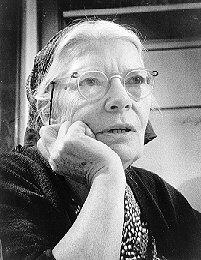
Dorothy Day- A Model of Faith
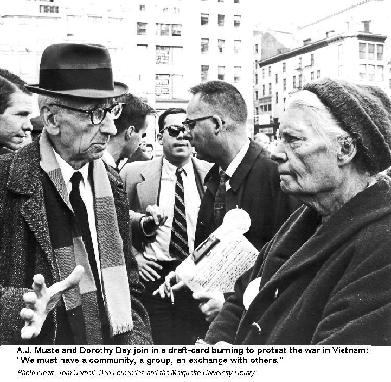
~Catholic historian David O'Brien
Dorothy Day was born in Brooklyn, New York, on November 8th, 1897. Her father was a sports writer, and he frequently moved among big cities to find jobs, so Dorothy found herself in Oakland, California at the time of the 1906 San Francisco earthquakes. Witnessing the acts of good will by her neighbors and family toward the survivors had an effect on Day that lasted for the rest of her life: the need to help the less fortunate.
Later the family moved to Chicago, where Day was first exposed to Roman Catholicism (her family was nominal Protestant). With Chicago came increased wealth for her family, so Day spent much of her time reading. The Jungle by Upton Sinclair grew in her an attraction to the unwanted, and she explored the rundown areas of Chicago�s South Side.
In 1914 Dorothy began to attend University of Illinois- Urbana, but she tired of conventional education and dropped out two years later. Moving to New York, she took various reporting jobs with leftist publications. In 1917 she was arrested for protesting in favor of women�s voting rights and then participated in a hunger strike while imprisoned.
Day later considered the 1920s a period in which she was a �wild Bohemian,� joining in the sexual revolution spreading across Europe at the time. Little is known in detail about this period, although she did have a brief love affair with another reporter. She became pregnant and ended up having an illegal abortion, a decision she regretted for the rest of her life.
In 1924, Day began a four-year common-law marriage with Forster Batterham, an anarchist and positive atheist. Three years later, against Forster�s wishes, she became pregnant and this time had a daughter, Tamar Theresa Day. This experience was a moment of metanoia in the new mother�s life, and she decided to have Tamar baptized in the Catholic Church. She had fostered an increasing respect for and interest in the Church over the years, seeing it in New York City as the church of the immigrants and the poor. Batterham, having no intention of joining a religion, left her, and later in the year Day herself was baptized.
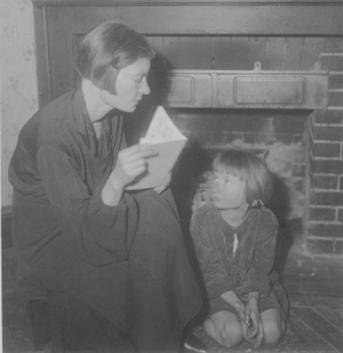
Day and her daughter
Having left the world of the secular left, Day put her talents to use working as a reporter for both Commonweal and America. An editor from Commonweal introduced her to Peter Maurin, a French immigrant who believed in creating a simpler society based on a communal Catholic lifestyle �in which it would be easier for men to be good.� By taking personal responsibility for our neighbors, they reasoned, the poor would no longer be considered by the middle and upper classes to be the problem of faceless government organizations.
This stance put Day in a position where her leftist allies, who advocated state-run agencies, at odds with her and brought her closer to more �conservative� supporters. The Distributists, Southerners (especially Catholics) who believed that industrialism and urbanization were counterproductive to human development, shared with Day a respect for a decentralized community model where each person is responsible for his/her neighbor, all the people own means of production instead of the state or a select few (socialism and capitalism, respectfully), and agriculture is the center of the economy. Through these methods, Day hoped to �emphasize the holiness of work, and� emphasize the sacramental quality of property, too.� The Catholic Worker continued to uphold her libertarian and anti-centralization sentiments even as both the left and the right built up presidential power in the face of the Cold War. In the words of editor Robert Ludlow:
�The American State, like every other State, is governed by those who have a compulsion to power, to centralization, to the preservation of their gains. And it is the liberals � The New Leader, New Republic, Commonweal variety � who have delivered the opiate necessary for the acceptance of this tyranny among �progressive� people. It is the fallacy of attempting social reform through the State, which builds up the power of the State to where it controls all avenues of life.�
In order to spread their vision, Maurin suggested that Day create her own newspaper. Selling The Catholic Worker for just a penny, Day worked to spread her relentless countercultural views among the common people � it was �so cheap that anyone could afford to buy it.� First published in May 1933, the number of readers grew to 100,000 in seven months.
Keeping with his vision of simplicity and community, Maurin wrote essays encouraging the rebirth of the ancient Christian practice of providing hospitality to the homeless. That winter, people began to show up at Day�s apartment looking for a place to stay.
�We were just sitting there talking when Peter Maurin came in.
We were just sitting there talking when lines of people began to form, saying, �We need bread.� We could not say, �Go, be thou filled.� If there were six small loaves and a few fishes, we had to divide them. There was always bread.
We were just sitting there talking and people moved in on us. Let those who can take it, take it. Some moved out and that made room for more. And somehow the walls expanded.
We were just sitting there talking and someone said, �Let�s all go live on a farm.� It was as casual as all that, I often think. It just came out. It just happened.�
The idea quickly spread. In the next three years, 36 Catholic Worker houses sprang up around the country, housing the multitudes of victims of the Depression. Today more than 185 exist in nine countries
As Europe moved toward World War II, Day took a �neutral, pacifist position� toward any conflict. She maintained this position even after Japan�s attack on Pearl Harbor, contrary to the vast majority of Catholics and Catholic publications. In a statement made in January 1942, she made the following proclamation:
�We are still pacifists. Our manifesto is the Sermon on the Mount, which means that we will try to be peacemakers. Speaking for many of our conscientious objectors, we will not participate in armed warfare or in making munitions, or by buying government bonds to prosecute the war, or in urging others to these efforts.�
Even though her readership declined and several Catholic Worker houses closed, Day held firm to this manifesto for the rest of her life, even refusing to participate in New York City air raid drills that occurred during the 1950s. This continued until 1961, when the city stopped their drills. In 1965, she participated in a fast in Rome to convince the Second Vatican Council to outlaw all war in their writing of the Constitution on the Church in the Modern World. They did outlaw nuclear war, condemning attacks �directed to the indiscriminate destruction of whole cities or vast areas with their inhabitants.�
During the 1960s, Catholic Workers actively resisted participation in the Vietnam War. Most joined protests and many were arrested for avoiding conscription. Day herself was last arrested at the age of 75 in 1973 while picketing with Cesar Chavez�s United Farm Workers in California.
Dorothy Day died on November 29th, 1980. She left in her wake a large network of Catholic Worker communities present on every continent (except Antarctica) and a newspaper with a circulation of over 80,000. True to her values, there is no central power in the Catholic Worker federation � they operate completely autonomously yet under the plans laid out by Maurin and Day. Their faith in each other, Maurin in Day�s �fierceness� of spirit and Day in Maurin�s vision, created a lasting reminder that countercultural plans can and do work.
Day�s personal Faith was largely overshadowed by her radical actions even as they were driven by that Faith. For a woman who lived in the company of Anarchists, Communists and other Atheists, a conversion to a strongly organized religion like Roman Catholicism reveals great faith in the strength of its message. Her dedication to Jesus� teachings drove her to the radical lengths to which most Catholics were not willing to go. Attempting to be the peacemaker Jesus refers to in the Sermon on the Mount, she inadvertently also became the one �persecuted for holiness� sake.� As with all people, she most likely had moments of disbelief, but these moments became �a continual testing ground for [her] religious convictions.� She must have succeeded, for as she tells us, she was never �embarrassed to talk about God.�
Speaking of Faith
FindArticles.com
Marquette University
Paulist Fathers
Catholic Worker