OUR SAEMANN FAMILY
|
|
Click on the pictures to view larger versions.
|

JOHANN GEORG SAEMANN
Generation 1
BACKGROUND
JOHANN GEORG SAEMANN was born Lomersheim, Württemberg, Germany, in 1708. The name “Saemann” means “sower.”
Johann married Brigitta Götz, who was born 24 January 1706. They had four children. Maria Brigitta Saemann died in 1760.
On 28 April 1761, Johann remarried, ANNA MARIA KOCH.
Anna Maria was born on 15 May 1716 at Sondelfingen, Württemberg, Germany.
|
Anna was the daughter of JOHANN GEORG KOCH. In the German records, Koch was listed as a “Bürger” (townsman, freeman) and “Taglöhner” (day-laborer).
|
Johann Saemann died 13 Mar 1772. Anna died on 4 Feb 1793.

CHILDREN BY MARIA BRIGITTA GÖTZ
Beata Regina Saemann was born 26 January 1733; she died in 1762.
- Johann Georg Saemann was born 12 July 1738; he settled and died away from home [“in der Fremde gestorben”].
- Stillborn son, 1745.
- Stillborn daughter, 1747.
CHILD BY ANNA MARIA KOCH
JOHANNES SAEMANN was born 13 September 1762. He married Christina Grimm.
JOHANNES SAEMANN
Generation 2
Emigrant
JOHANNES SAEMANN was born on 13 September 1762.
MARRIAGES
Johannes married on 25 November 1783, CHRISTINA GRIMM of Hohenhaslach, Württemberg, Germany. She was born the 28th of November 1760, the daughter of Judge Melchoir and Margareta (Best) Grimm.
Christina died on 30 January 1807.
A year later, on 14 January 1808, Johannes remarried, Ida Dorothea Gärtner. She was born at Ochsenbach, Württemberg, Germany, on 21 October 1773, the daughter of Georg and Anna Catharina Gärtner. Ida and Johannes had no children together.
EMIGRATION TO AMERICA
1843
In 1843, Johannes and Ida emigrated to the United States of America – three years after son John Michael, wife Elisabetha, and their children had left. The German church pastor notes that Johannes and Ida left, perhaps to go to his son (“vielleicht zu seinem Sohn”). Another son, Christoph Friedrich, also emigrated to Ohio, but we’re not sure when and with whom.
CHILDREN OF JOHANNES & CHRISTINA (GRIMM) SAEMANN
- Johann Michael Saemann, born 19 Feb 1785; died 1790.
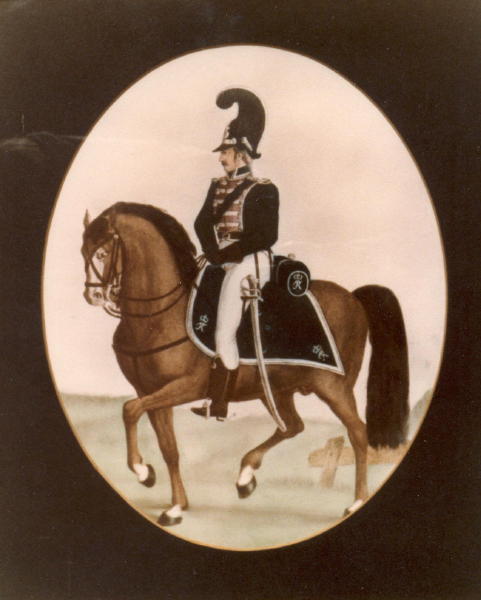
- Johannes Saemann was born on 4 February 1787. He entered military service under the Elector of Württemberg* and went, with Württemberger troops turned over to Napoleon by the Elector, to the Russian campaign of Napoleon’s Grande Armée.** In the retreat in September through December of 1812, Johannes died from drinking water of wells poisoned by Russian peasants.
Johannes was probably one of the Wirtembergian 1st, 2nd, or 3rd Horse Jager Regiments.
Each of the six Saemann children in Generation 5 were given a copy of the picture him, seen below.
|
* Read here about the Frederick I of Württemberg, the first King of Württemberg. [Note: The code I have for the link is absolutely correct, but it more often than not doesn't work I think due to the umlaut. You can reach the right page if you will type into the Wikipedia search box at the left of the page you reach, "King of Wuerttemberg", and hit "go".]
According to the Reichsdeputationshauptschluss, which reorganized the Empire as a result of the French annexation of the Left Bank of the Rhine, the Duke of Württemberg was raised to the dignity of Imperial Elector. Friedrich assumed the title Prince-Elector (Kurfürst) on 25 February 1803, and was thereafter known as the Elector of Württemberg. The reorganization of the Empire also secured the new Elector control of various ecclesiastical territories and former free cities, thus greatly increasing the size of his domains.
In exchange for providing France with a large auxiliary force (this is where Johannes Saemann served his monarch), Napoleon recognized the Elector as King of Württemberg on 26 December 1805. Friedrich became King Friedrich I when he formally ascended the throne on 1 January 1806 and was crowned as such on the same day at Stuttgart. Soon after, Württemberg seceded from the Holy Roman Empire and joined Napoleon’s Confederation of the Rhine.
Sidenote:
** Read now about the Russian campaign, the last of the Napoleonic Wars, in which Johannes died.
|
- Jakob Friedrich Saemann was born on 7 October 1789; died in 1790.
- Jakob Friedrich Saemann, b. 22 Dec 1791; died 1795.
- Stillborn child.
- Christoph Friedrich Saemann was born on 16 July 1796. He married on 9 November 1819, at Maulbronn, Württemberg, Germany, and removed from there (“und dahin abgegangen”). It is uncertain if he left Germany alone, or with one of the other family groups (his brother and family in 1840, or his parents in 1843), but presumably to be near his brother and nephew. The later published Sheboygan County history notes that “he settled in Ohio, where he lost his life by accident many years ago”. To date I know of no documentation of the death or location of his death.
- Stillborn child, 1799.
- Stillborn child, 1800.
- Regina Saemann was born on 8 May 1801; died in 1807.
- JOHANN MICHAEL SAEMANN, a farmer, was born on 6 October 1804 at Gündelbach, Oberamt Maulbronn, Württemberg, Germany. He married on 16 June 1830, at Gündelbach, Elisabetha Baumann. They emigrated to America, settling first in Ohio.
GERMAN EMIGRATIONS TO WISCONSIN
The settlement of German emigrants in Wisconsin began as early as 1839. From that time on to 1848, those who left the fatherland did so primarily to escape persecution for their opposition to the union of the Lutheran and Reformed Churches, and to establish communities where their religion would be tolerated. The North Germans began the movement. In 1839, about a thousand of them, coming chiefly from Pomerania, departed for America and settled almost wholly in Milwaukee and Ozaukee counties. Cedarburg and Freistadt were founded by them. Between 1850 and 1860 a large number of the settlers of these villages sold out and moved to the town of Herman in Sheboygan County.
In 1843 another emigration was made from Brandenburg and Pomerania. This was the last emigration from those parts for some time, for by 1845 the religious strife had abated to some extent. Germans from other provinces of Germany, however, continued arriving in great streams.
Wisconsin Past and Present: History of Sheboygan County, edited by Carl Ziller (Chicago: The S. J. Clarke Publishing Co., 1912) vol. 1, pg. 76.
|

PRIMARY REFERENCES
Ohio Historical Society, 1985 Velma Ave., Columbus, OH 43211. Library is open 9A-5P Tuesday through Saturday.
Birth, Death, and Marriage Indexes and Records are filed in the Sheboygan County Register of Deeds Office.
Zillier, Carl, ed. History of Sheboygan County Wisconsin (1912) pp. 382-86.
WORK STILL TO DO
Check for naturalization-citizenship documents (1840-1848)
Johannes & Ida (Gärtner) Saemann
Christoph Friedrich Saemann
Johann Michael Saemann
Find ship manifest (1840-43):
Johannes & Ida (Gärtner) Saemann
Christoph Friedrich Saemann
Check census: Ohio 1840.
Search Ohio death-probate-burial records:
Pleasant Twp, Marion Co; Columbus, Franklin Co OH:
Johannes Saemann (b. 1762); Ida G. Saemann (b. 1773); Christoph Friedrich Saemann (b. 1796)
Also check Erie and Warren Counties.
Check Ohio land records, 1840-1848:
Pleasant Twp, Marion Co (15 June 1840)
Columbus, Franklin Co, for purchase and disposition of land
Also check Erie and Warren Counties.
Check Wisconsin land records, 1842-1848:
Cedar Lake, Washington Co WI
Look in Ohio tax lists, directories, biographical sketch in county histories:
Christoph Friedrich Saemann.
WEB RESOURCES
Marion Ohio Public Library
445 E. Church St., Marion OH 43302.
Heritage Pursuit – site owner Allen L. Potts. Marion County, Ohio Home Page.
Germans to Marion County
Ohio Historical Society
1985 Velma Avenue, Columbus, OH 43211.
Some items in their collection are: Entry books for some Ohio federal land offices are available, but not indexed. Other records are at the Auditor of State’s Office. Quadrennial Census Enumerations for the 19th century. Local government vital statistic records. Ohio newspapers including 3,000 titles, 20,000 volumes, and 40,000 rolls of microfilm. Those newspapers which have been microfilmed may be borrowed through interlibrary loan. A guide entitled Guide to Ohio Newspapers, 1793-1973. The Archives-Library also maintains a number of full and partial newspaper indices; a listing of these is available upon request. And much more.
Sheboygan County Historical Research Center and Genealogical Society
518 Water Street, Sheboygan Falls, WI 53085. Phone: 920-467-4667. Open Tues-Sat 9AM-4PM.
The County of Sheboygan, Wisconsin Genealogy & History – Rootsweb site, by Debie Blindauer.
Map of Scott Township, Sheboygan County, Wisconsin – From Historic Map Works.
Provides address-searchable maps of 19th and early 20th century America.
Wisconsin Ancestors.
This website lists genealogy research available from John Von Haden, a native of Hartford, Wisconsin.
His research covers all of Washington and Ozaukee counties, Wisconsin and portions of Milwaukee, Waukesha, Dodge, Sheboygan, Fond du Lac counties. His specialty is researching church records and civil records from Germany, France and Luxemburg.
The Genealogy Home Page – site owner Stephen A. Wood.
A variety of resources are available on this site. For new submissions made daily, check the: "What’s New in Genealogy" page. Our website was submitted on 20 July 2006.
Official Website of the
Burch, Nickel, Sheldon, Griffin,
Saemann and Brazelton Family
This is the Saemann Family Page
Joann Saemann
West Jordan, Utah
Design and presentation © 2007 Joann Saemann
Some material may be paraphrased
Last Updated – 1 November 2008