


We don´t do fakes.
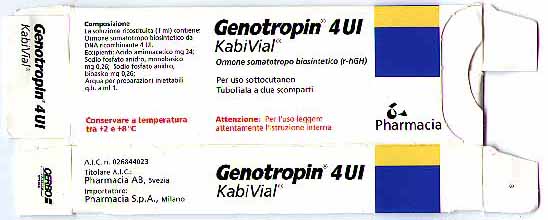
GROWTH HORMONE:
The use of exogenous sources of Growth Hormone has been popular
in the United States for almost 8 years now. Originally,athletes
used biologically active forms that were the actual extract of
the pituitary glands of cadavers. Ascellacrin and Crescormon were
the two most popular brand names on this original GH. While
production was under way on the synthetic,recombinant DNA
versions of this drug,it was discovered that the biologically
active form was associated with the formation of a rare brain
virus called Creutzveldt Jacob Disease. This was a fatal virus
that afflicted a very small number of GH users,none of whom were
athletes. In light of this discovery,the FDA removed all of
these natural GH versions from the market in the United States.
Luckily,the synthetic recombinant versions were approved by the
FDA a short time afterwards. These versions were developed after
years of experiments with amino acid chains. The first of these
versions was patented and produced by Genentech Labs with the
brand name Protropin. A short time later,another form of
synthetic Growth Hormone gained FDA approval. It was produced by
Eli Lilly Labs and brand named Humatrope. This product was
allowed to be patented because it was shown to be unique in that
it contained a slightly different amino acid chain than the
Protropin. The difference was that Humatrope had 191 amino acid
chains in sequence and Protropin had 192. For some very
complicated reasons,the 191 amino acid configuration has been
shown to be more effective. It had been speculated that these
synthetic versions of GH would greatly improve the cost
effectiveness of using GH,yet that has not been the case. An
athlete who wants to do a cycle of GH can still expect to be out
as much as $4000 a month. There are numerous versions of Growth
Hormone available in Europe,the majority of which are made up of
the 191 amino acid sequence. There is even a form of the original
human extract Growth Hormone,called Grorm which is available in
a few countries. Although this drug is indicated for the
treatment of pituitary deficient dwarfism,it has been used
extensively by athletes who are attempting to alter their body
composition. Growth Hormone itself,is an endogenous hormone
produced by the pituitary gland. It exists at especially high
levels during the teen years when it promotes growth of almost
all tissues. It also contributes to the deposition of protein and
promotes the breakdown of fat for use as energy. As the body
reaches full maturation,the endogenous levels of GH are
substantially diminished. After this,GH is still present in the
body but at a substantially lower level where it continues to aid
in protein synthesis,RNA and DNA reactions and the conversion of
body fat to energy. By introducing an exogenous source of this
hormone,athletes are hoping to promote these effects,causing
the body to deposit more muscle tissue while at the same time
reducing body fat stores. On paper,GH should work exceptionally
well; however,it does not seem to be delivering up to its
potential. Most athletes who have experimented with this product
end up being disappointed. There is some evidence that exogenous
sources of GH are being destroyed by antibodies which appear
after the introduction of the synthetic compound. Although the
191 amino acid sequence versions have been shown to produce less
of an antibody reaction,they are still not yielding consistent
results. I have speculated as to whether the introduction of
exogenous GH would yield an appreciable degree of efficacy simply
due to the fact that the body does not have sufficient receptor
affinity to GH in the post-teen years. A number of athletes claim
that GH is not that effective on its own,but in a stack with
steroids it can do remarkable things. Perhaps there is some type
of actual synergism created by the concomitant use of these two
agents. Empirical data suggests that the efficacy of GH is dose
related and that the majority of users may not have been taking
enough of it to get positive results. Despite speculation
concerning its efficacy,synthetic GH is being used by thousands
of elite athletes. These include men and women bodybuilders,
strength athletes,as well as a multitude of Olympic competitors.
Although Growth Hormone is banned by athletic committees,there
is no method for the detection of it which allows drug tested
competitors to use this product freely without any ramifications.
Adverse reactions to GH use are rare but technically could
involve acromegaly (elongation of the feet,forehead and hands).
Other possible side effects involve overgrowth of the elbows or
jaw,thickening of the skin and a type of diabetes. There are
numerous counterfeit versions of this product which are merely
cashing in on the drug's mystique and high price tag. The
legitimate versions must be refrigerated at all times,before and
after they are reconstituted. Effective dosages seem to be in the
area of 2 I.U.,2-4 times a week. Cycle length is usually
determined by how long the athlete can afford it. Some take the
product for 6 week cycles,others use it year round.