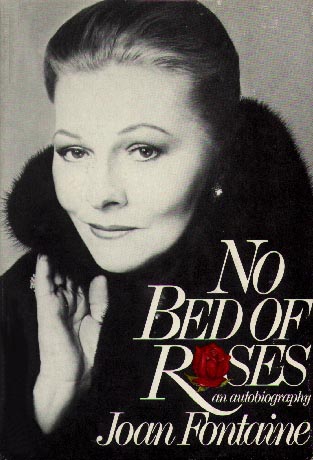
No Bed of Roses was published in August of 1978 by William Morrow and Co., Inc., NYC.
Click on the following links to buy the book used:
Half.com | amazon.com | Barnes and Noble | eBay

No Bed of Roses was published in August of 1978 by William Morrow and Co., Inc., NYC.
Click on the following links to buy the book used:
Half.com |
amazon.com |
Barnes and Noble |
eBay
A review of No Bed of Roses by Ronald Bowers, taken from Films in Review, November 1978:
Joan Fontaine has written the most literate Hollywood memoir in recent memory. Only The Gift Horse by Hildegarde Knef and Intermission by Anne Baxter approach what Fontaine does here: the depiction of the struggle by an intelligent, beautiful and talented woman to achieve independence, self-confidence and self sufficiency. In Fontaine's case she had to contend with the Draconian discipline enforced by a charming "Corporal" of an English mother who was a frustrated actress, as well as the will of her older sister, Olivia de Havilland, a "believer in the rule of primogeniture." Their strict upbringing is probably responsible in part for what Joan and Olivia have accomplished as actresses but the coeval lack of affection has left its emotional scar on both sisters.
However, No Bed of Roses is far more thoughtful than sad, for despite today's penchant for blatant and prurient confessions, Joan, while candid, opts for wit and perception rather than bitterness or revenge (except for an occasional well-aimed barb.)
Her metamorphosis from shy, sickly child, to elegant young actress and sophisticated maturity is a damned good story in which she discusses her four marriages and the other men in her life. Also revealed is a side which may be new to many of her readers, i.e. Joan Fontaine, the tomboy�a curious, spirited gal who will be one-upped by no man and who can hunt, fish, golf and pilot a plane with the best of them.
Joan's career was always secondary to her personal life (I always found her the more beautiful, talented and versatile sister) but her descriptions of a Paramount casting director and the contract system under David O. Selsnick provide a new insight into the exploitation of women by a motion picture industry dominated by men.
Fontaine's chapter headings are humorous and ironic�"Made in Japan" for the story of her birth in Tokyo and "Maid in Japan" for the years spent there with her father. Joan loves language and knows how to use it.
The actress says she wrote this book as a result of the "inexplicable" events perpetrated by Olivia regarding their mother's memorial service. That chapter and the "Epilogue," which crystalizes Joan's memories and impressions of her mother, should move even the most hardened reader.
A review by Barbara Kemp, University of Michigan Library, Ann Arbor. Taken from Library Journal, September 1, 1978:
The title accurately describes the author's life. A well-known film star and winner of an Academy Award for Suspicion Fontaine here recounts the story of broken homes, poor health, financial problems, and failed marriages. Overshadowing all her successes and failures are her relationships with her sister, Olivia de Havilland, and her mother. Well-publicized rivalries and misunderstandings have led to stories of bitter family feuds and hatred. Fontaine helps to correct what she considers a distorted picture. Rather than self-pity, she displays pride in her accomplishments and her ability to remain independent. Recommended.

