 |
In the morning of september 1st we took
the bus and train to Schiphol Amsterdam airport. At
eleven KLM flight 741 took off for a 14 hours flight
towards Bonaire and final destination Lima, Peru. In Lima
we were welcomed by Toon Meeuwsen, a Dutchman who runs a hostal
and a travel agency. When we arrived at his hostal, Toon
served us our first cup of coca tea. For the next
morning, Toon had booked a flight to Cusco for us. We
flew with Tans Peru, famous for it's frequent crashes
(check Accident Database). At first we
passed Cusco and flew further to Puerto Maldonado in the
Peruvian jungle. After a short stop (Is this Cusco??) we
took off back to Cusco. Thanks to wrong information in
our lonely planet, we payed 10 soles instead of the usual
2 soles for our taxi to the city center. In Cusco we
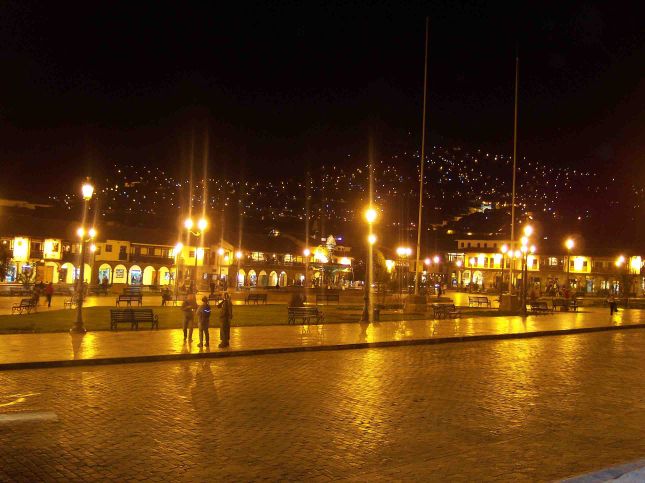
stayed in hostal Santa Maria, close to the Plaza the
Armas (photo). |
 |
In the afternoon, we already walked
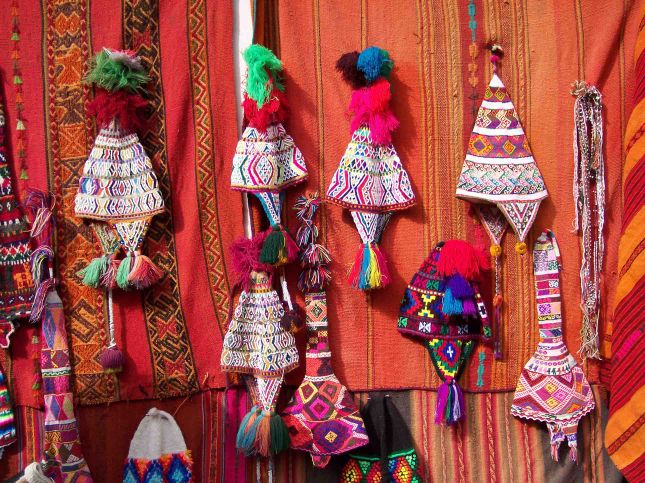
around a bit in Cusco. At a nice market we bought our
first Peruvian woollen cap. Because of the altitude (3200
m), we were not very fit yet. After a good night's sleep,
we were much better and ready to visit the Inca ruins of
Chinchero (3700 m). We traveled together with the
peruvians with the very cheap local bus (1 hour drive,
1,5 soles). |
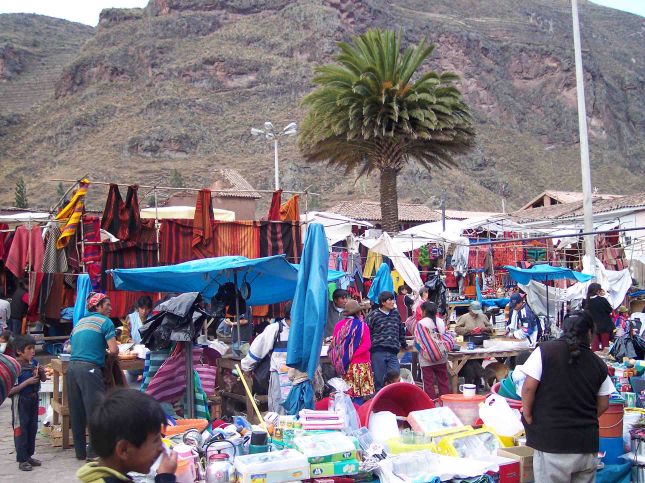 |
The next day, we took the bus to Pisac.
We first had a look at the market (photo). After that we
visited the Inca ruins of Pisac. This is the second most
beautiful Inca-site after Machu Picchu. The bus back to
Cusco was very crowded and I lost my good old Swiss army
knive to a pickpocket. The next day we visited the ruins
of Sacsayhuaman near Cusco. That afternoon we visited
some museums that were included in our 'tourist billet'.
We also booked our train trip to Machu Picchu for the
next day. |
 |
Very early in the next morning we took
the train to Aguas Calientes, a village with a hot spring
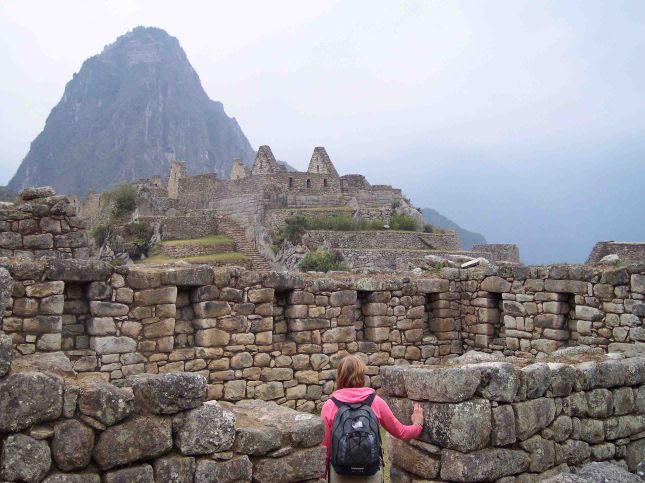
near the ruins of Machu Picchu. The next morning we took
the first bus (5:30 am) to Machu Picchu (photo). Although
were were not alone, the site was still quite empty and
we had plenty of time to explore the beatiful ancient
city. We also climbed the steep Huaynu Picchu (photo
background) for a magnificent view over Machu Picchu and
surroundings. In the afternoon we walked back to Aguas
Calientes and took the train to Ollantaytambo. The next
day we visited the Inca ruins of Ollantaytambo. After
lunch, we took the bus back to Cusco. |
 |
The next morning it was time to move on after an
whole week of visiting Inca ruins around Cusco. We took
the bus to Puno, at the Titicaca lake. The bus trip took
us gradually to our altitude record of 4335 m. The next
day we went on a two days boat trip on the itikaka lake.
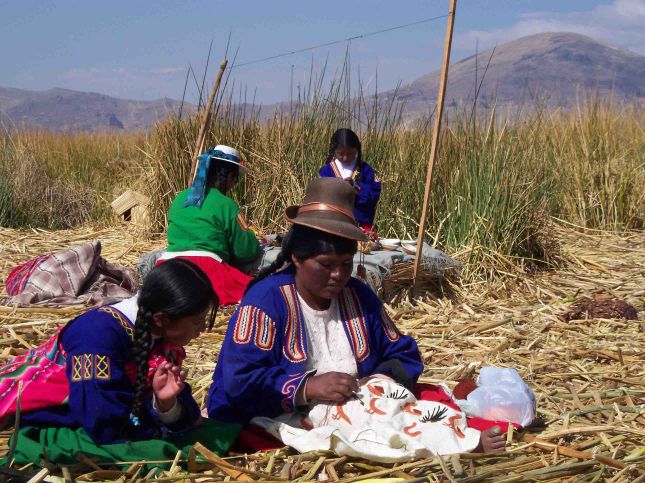
On the first day we visited two of the floating islands
of Uros (photo). The Uros people really create everything
out of reed; islands, houses, boats and even food. After
our visit we traveled further on to the (non-floating)
island of Amantani. We were welcomed by the local
families who would be our hosts for the night. We climbed
the highest point of the island and after the descend and
dinner we had to dance with our local family. The next
day we went to Taquile island. We walked across the
island and enjoyed the view over the Titikaka lake and
the nice caracteristic clothes of the locals. Their hats
revealed wether they were single or married. After a nice
lunch with trout from the lake we took our boat back to
Puno. |
 |
The next morning we travelled to Copacabana, on the
shores of the Bolivian part of the Titikaka lake. The
crossing of the boarder was an adventure on its own.
Copacabana is a very nice pilgrimage village. There's a
beautiful church with a Maria statue inside that is said
to change colors every now and then. That afternoon we
spent some time looking around and shopping (everything
is even cheaper than in Peru). The next morning we took
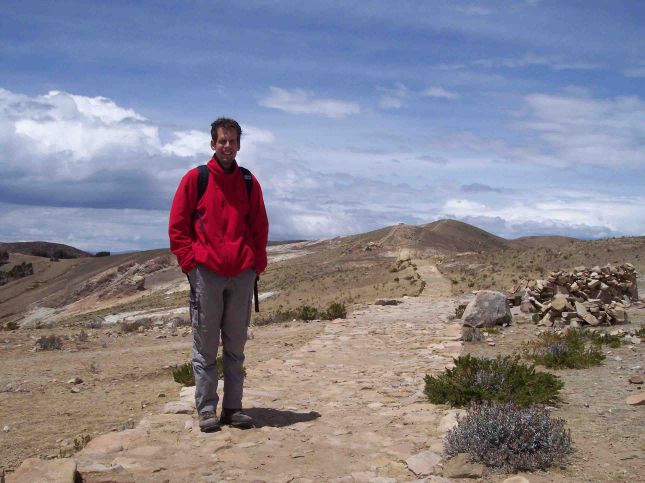
the boat to the island of the Sun. After a very nice walk
upon the highest ridge of the island (photo) we spent the
night in a brand new hostel. The hostal wasn't even
finished yet and the strong cold wind blew right through
it. It was even snowing a bit that night. Luckily we had
already bought us already some nice and warm Alpaca
woollen caps. The next day we travelled back to
Copacabana and further back to Puno. |
 |
After another night in Puno, we took a bus to
Arequipa. The seven hours bus trip was beautiful as we
drove through a spectacular snow covered moutainious
area. After arrival in the nice and friendly city
Arequipa, we took a taxi to the hostal La Reyna. From the
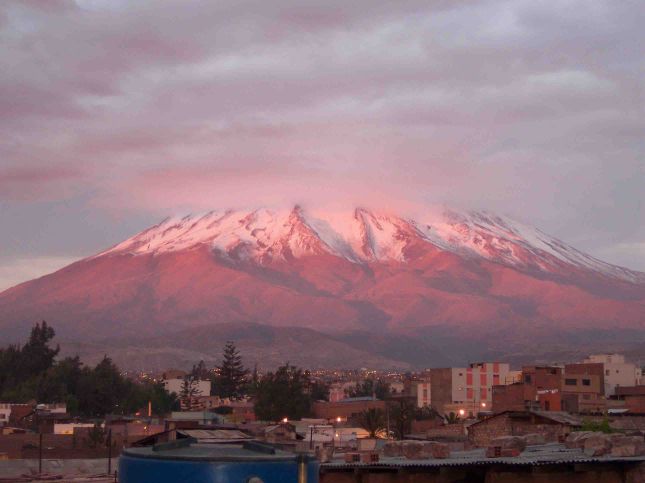
roof of this hostal we had a magnificent view over
Arequipa and the mighty El Misti volcano (photo). |
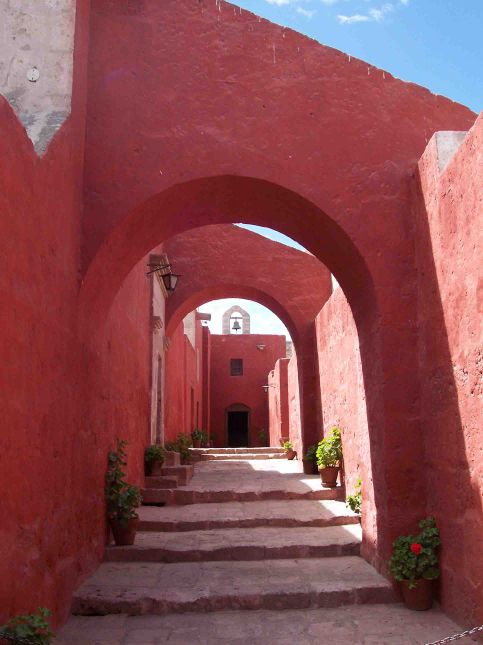 |
The next morning we visited the giant monastry Santa
Catalina (photo), which was situated next to our hostal.
We spent three hours in this impressive monastry with
red-brown and light blue painted walls. In the afternoon
we booked a three days tour to the Colca canyon for the
next days. Then we visited the museum where the famous
Juanita is exposed. Juanita was sacrificed by the Inca's
on Peru's highest vulcano, the Ampato (6380 m). She is
beautifully conservated by frost. After an eruption of a
nearby vulcano the black ashes fell on the Ampato and
caused Juanita's snowcover to melt. She fell into the
crater, but was found a few hours later by scientists.
That night we enjoyed a beautiful sunset from the roof of
our hostal. We met a Dutch couple who had coincidently
booked the same trip at the same office as we did. |
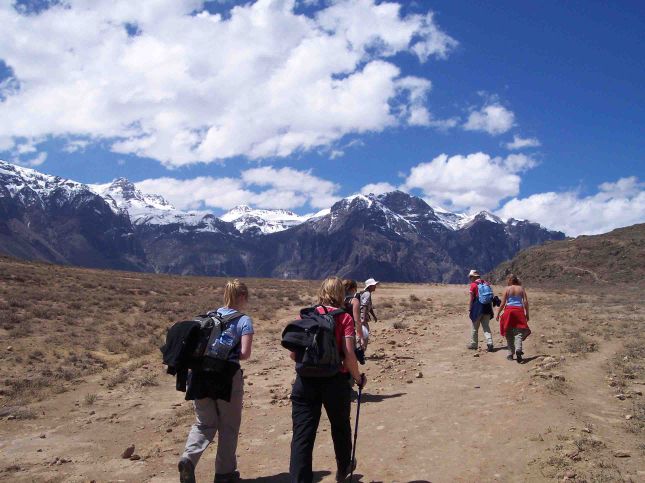 |
The four of us were picked up at the hostal by a
Peruvian guide the next morning. We picked up two English
girls and left for our three days trip to the Colca
canyon. First, we had to drive six hours to Cabanaconde.
Here we started to hike down into the 1000 m deep valley.
After crossing the river over a scary rotten bridge (the
new bridge was already in construction), we soon reached
the guides parents' house where we would spent the night.
We had fresh trout from the river for dinner. The next
day started with pancakes. After this nice breakfast we
started a three hours hike trough the valley to the
'oasis'. This was a very relaxed place with many palm
trees, flowers and swimming pools. |
 |
The next morning we were waked at 2:30 by our guide.
After breakfast we climbed 1000 m up back to Cabanconde.
The moon provided enough light and we did not need our
head lights. After a second breakfast in Cabanaconde, we
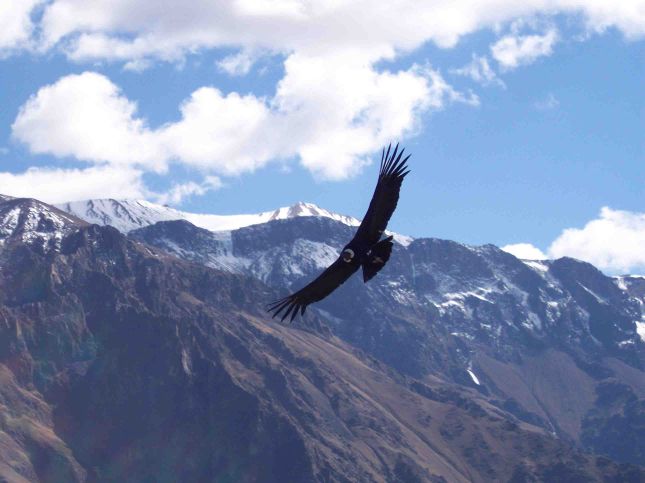
took the bus to 'El cruz del condor'. At this site,
condors are flighing around every morning from 7 till 9.
The condors came really close and were really spectacular
(photo). After this highlight we took the bus to Chivay
were we had a bath in a pool with nice hot water from a
hot spring. After this bath we slept all the way back to
Arequipa. |
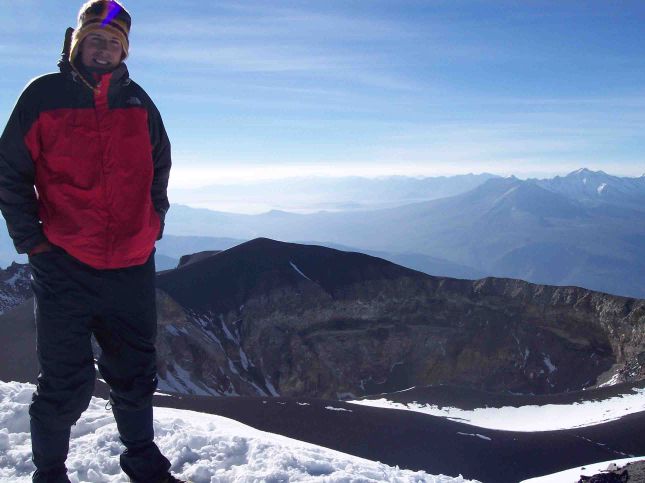 |
The next day I started climbing the El Misti Volcano
(5825 m). This would by far be the highest place I've
ever been. While Hanneke stayed in Arequipa and went
shopping and relaxing, I was picked up by a guide. On the
first day we climbed about 1000 meter to the base camp at
4600 m. While climbing we met the 86 years old El Misti
guide who is honorary mentioned in the lonely planet.
After arriving at basecamp we set up the tent that I
shared a tent with an Austrian guy. The view was
spectacular, especially during sunset. We could see the
many lights of Arequipa deep down below us. After a
freezing and windy night without any sleep we were
'waked' at 2 o'clock the next morning. After some bread
and of course a cup of coca tea we started climbing. Just
after sunset we arrived at the El Misti's summit (photo).
Again, the views were incredibly beautiful. The decend
went very fast as we could slide over a snowfield all the
way back to the base camp. After a break we walked
further down to the bus that took us back to Arequipa. |
 |
The next day we took a local bus and visited a
village called Yura. We walked from the new to the old
village through a green river valley in the desert. From
the old village we took a bus back to Arequipa. The next
day we spend some more time in Arequipa and at 5 pm we
took a bus to Nazca. The trip took about 12 hours and we
arrived in Nazca at 5 am. A peruvian trying to sell us a
flight trip above the famous Nazca lines helped us
finding the hostal that we had chosen from our guidebook.
After some more sleep, we were fit enough again to go and
explore the city. We found some travel agencies and
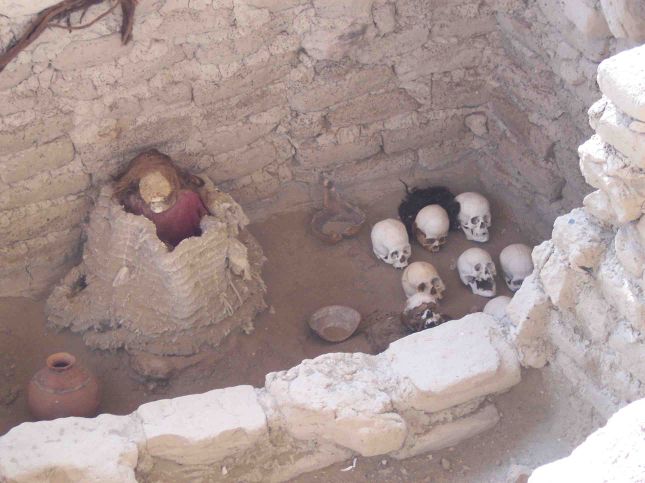
booked a trip to the Chauchilla cemetry (photo) for the
same afternoon and to the Nazca lines for the next
morning. First we went to a museum about the Nazca lines
and the different cultures that had inhabited the area.
We had lunch in the nice garden that was part of the
museum. That afternoon we went to the meeting point for
our trip to the Chauchilla cemetrie. There we met our
private taxi driver and tour guide Leo, who first took us
to a pottery and a place where they separated gold from
rocks. Then he took us Chauchilla, where a sand storm was
going on. Leo stayed in his taxi while we rushed from
grave to grave. The skeletons were al looking eastwards,
worshipping the holy sun for eternity. Quite impressive,
although the graves were looted before archeologist found
them. When we got back in the taxi the sand was
everywhere in our clothes, hair and ears. |
 |
The next morning we had our second tour to the Maria
Reiche museum and a tower from which to Nazca figures can
be seen. This time we had our private taxi driver and a
tour guide. First we went to the museum that is located
in Maria Reiches old house and research centre. Maria
spent a big part of her live studying the Nazca lines and
trying to figure out what their purpose was. She
concluded that they had to be some sort of giant
astronomical calender. Others still believe that aliens
used them as air strips. After a tour through the museum
we went to the tower. From there we could see the 'Hands'
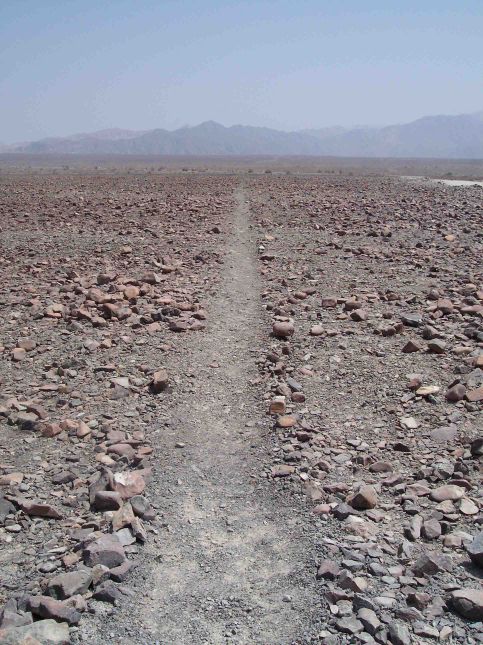
and the 'Tree'. Several other features and some endless
straight Nazca lines (photo) could also be seen from the
tower. After returning to Nazca, we took a bus to Ica.
Two wounded people were sitting next to us. When we
passed two crashed and totally destroyed buses, they told
us that they were in one of those busses when they
collided that night. |
 |
In Ica we found a hostel and had dinner in a fast
food chicken restaurant. No good choiche we would find
out later. The next day we walked to a famous museum with
a lot of nice mummies, clothes and pottery made by
different ancient cultures. I already started to feel a
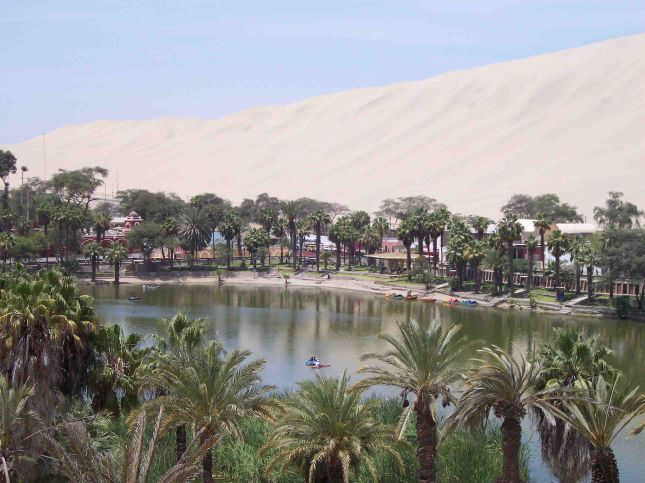
little bit sick. After lunch we took a taxi to the nearby
oasis (photo). This is a nice tourist resort between the
highest dunes of Latin America. That afternoon I really
got sick. While I was threwing up several times and
trying to get some sleep in between, Hanneke made a
desert crossing trip with fast buggies. |
 |
The next morning we had the best breakfast of our
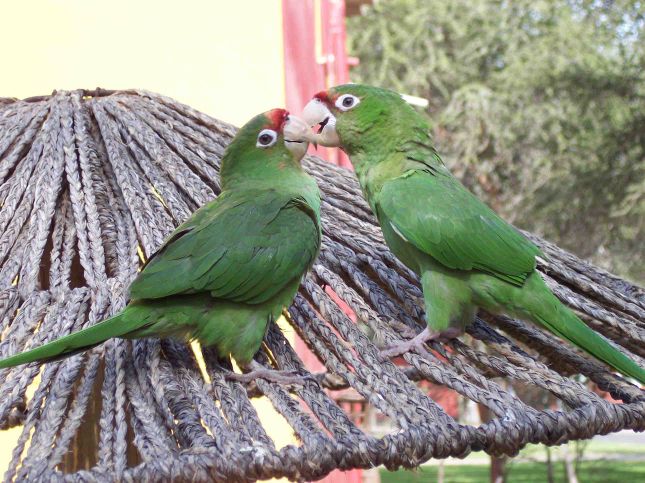
stay in Peru. In the garden of our hostal, accompanied by
two parrots (photo), we had bread, marmelade, banana
juice, eggs, tea and mixed fruits. As I managed to keep
everything inside, we decided to climb the highest dune
next to the oasis. After the descend on the other side
and an ice cream at a terrace, we took a taxi back to
Ica. There we took a bus to Pisac. The next day we
visited the Islas Ballestras. There we spotted pelicans,
dolphins, penguins, sea lions and a lot of birds. In the
afternoon we visited the Paracas peninsula. Next day we
took a bus back to Lima and went back to Toon's hostal.
We spent our last day sightseeing and souvenir shopping
in Lima. The next day we left Peru with an extra bag full
of souvenirs and a lot of great memories. |